
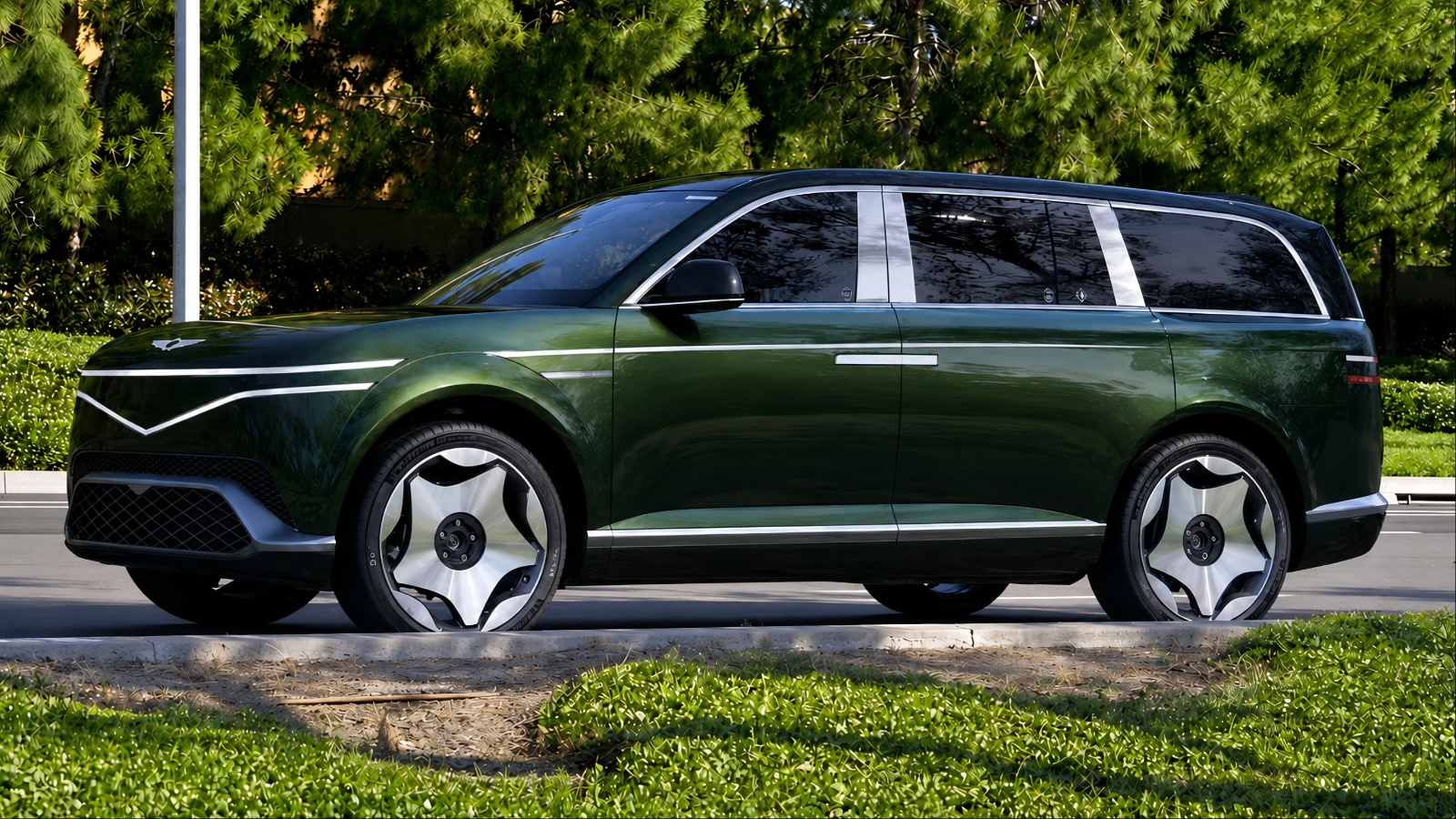
Genesis has officially entered the full-size luxury electric SUV segment with the new GV90, a flagship model designed to take the Korean luxury brand into direct competition with some of the industry’s most expensive electric SUVs.
Unveiled in San Francisco on August 19, the GV90 becomes the largest and most technologically ambitious Genesis model yet. It is built around a new electric platform developed specifically for the brand’s flagship vehicles and combines a 123.5 kWh battery, dual-motor all-wheel drive, and up to 657 horsepower, or 490 kW, according to Genesis.
The new SUV also introduces a long list of technology and luxury features, including multi-chamber air suspension, rear-wheel steering, a 23.6-inch pop-up OLED display, a 25-inch head-up display, and a 25-speaker Bang & Olufsen sound system.
According to Genesis, the seven-seat GV90 has an estimated range of approximately 310 miles based on internal testing, while a 350-kW DC fast charger can take the battery from 10% to 80% in about 22 minutes.
The GV90 is important for Genesis because it moves the company into a segment dominated by established luxury manufacturers while giving it a vehicle designed specifically around electric propulsion rather than adapting an existing gasoline-powered flagship.
A New Flagship Built Around Electric Power
Genesis developed the GV90 on a new eMP platform intended specifically for its flagship electric vehicles. The SUV measures 208.1 inches long with a 127.8-inch wheelbase, placing it firmly in the full-size luxury SUV category.
Its battery is the largest currently used by Hyundai Motor Group, with a total capacity of 123.5 kWh. Genesis says the battery uses high-density cells designed to improve energy density, output, and charging performance. The company also uses a wireless battery-management system to improve packaging efficiency.
The powertrain consists of electric motors on both axles. Genesis lists a 322-horsepower front motor and a 335-horsepower rear motor, producing a combined maximum output of 657 horsepower and 590 pound-feet of torque.
That output gives the GV90 considerable performance despite its size. Genesis has also equipped the SUV with its first Dual Electronic Limited Slip Differential system. Separate E-LSDs on the front and rear motors are designed to distribute power more effectively during cornering and help control wheel slip on wet, snowy, or uneven roads.
The suspension is equally sophisticated. A multi-chamber air-suspension system adjusts stiffness according to driving conditions, while electronically controlled dampers vary damping force to balance ride comfort and body control.
The GV90 also receives rear-wheel steering, allowing the rear wheels to turn by up to five degrees. Genesis says this can reduce the turning radius and make the large SUV easier to maneuver in tight spaces while improving stability at higher speeds.
Charging is another major part of the package. Genesis says the GV90 can charge from 10% to 80% in approximately 22 minutes using a 350-kW fast charger. Its estimated range of about 310 miles applies to the seven-seat configuration based on Genesis’ internal R&D testing.
Those figures put the GV90 in a competitive position against large luxury EVs while demonstrating that Genesis is not treating the vehicle simply as a spacious electric cruiser.
Genesis Pushes Luxury and Technology Further
The GV90’s most distinctive features are found inside and around the cabin. Genesis will offer two main versions. The standard GV90 uses conventional doors, while the GV90 Neolun features the company’s unusual “Neolun Arch Gate.” The system uses hidden B-pillars and independently opening rear coach doors to create a large opening for passengers.
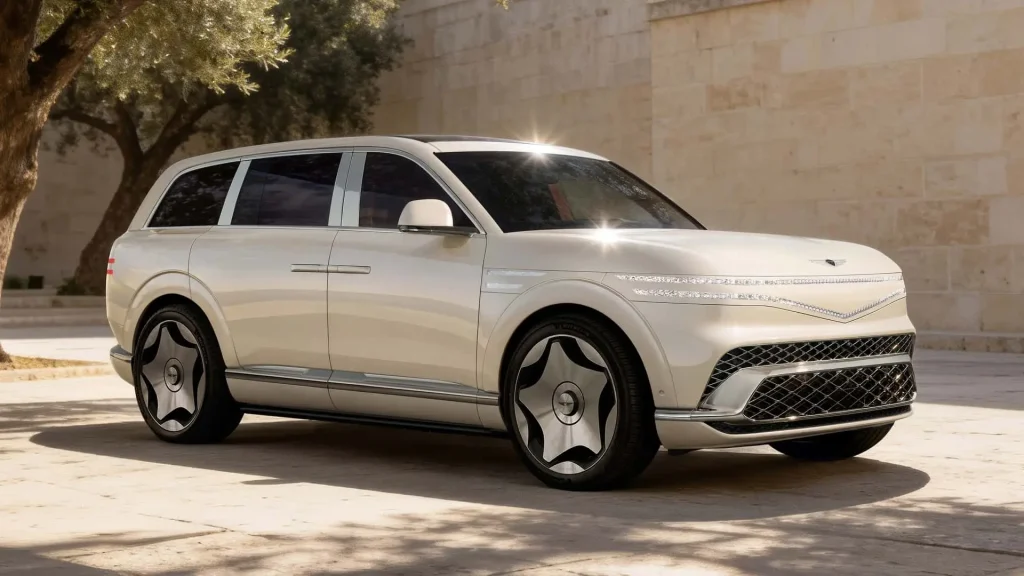
Removing the conventional B-pillar creates significant engineering challenges, so Genesis developed additional structural reinforcement to maintain rigidity and crash protection. The company says the vehicle uses high-strength steel beams and reinforced cabin structures to provide protection comparable to a conventional B-pillar design.
Genesis has also made safety a major focus. The GV90 has 12 airbags, including what Genesis calls the industry’s first roof airbag. The system is designed to deploy across the roof glass during a severe rollover to help protect occupants.
The SUV also has an in-cabin monitoring system that can identify occupant position and seating status, allowing the vehicle to optimize airbag and seatbelt operation.
Inside, Genesis has attempted to create more of a luxury lounge than a conventional SUV cabin.
The flagship receives a large 23.6-inch OLED Cinematic Display that combines the instrument cluster, navigation, and media functions. When the vehicle is parked, the display can extend upward and increase to 24.6 inches for entertainment.
A separate 25-inch head-up display projects driving information and navigation instructions into the driver’s field of view.
The GV90 is also one of the first Hyundai Motor Group vehicles to use the company’s new Power Control System. Genesis says the system eliminates the traditional start button. When the driver enters and closes the door, the vehicle prepares itself for operation, while the shifter and Crystal Sphere Controller move into position.
The SUV also introduces Pleos Connect, Hyundai Motor Group’s next-generation infotainment platform. It is based on Android Automotive and allows third-party applications to be downloaded through the Pleos App Market.
An onboard generative AI assistant called Gleo AI is designed to allow occupants to control functions and retrieve information using natural-language conversations.
Luxury extends to the audio system as well. Genesis offers a 25-speaker Bang & Olufsen Premier 3D system with Dolby Atmos, while ambient lighting and premium materials are used throughout the cabin.
The seats feature multiple air cells and pulse-vibration functions for massage, while heated surfaces are incorporated into areas of the cabin to improve comfort in cold weather.
For customers seeking the most exclusive configuration, the GV90 Neolun Executive Suite offers four seats, rear-seat-focused luxury features, a refrigerator, integrated tables, privacy blinds, and a heated floor inspired by Korea’s traditional ondol heating concept.
A Serious Challenge to Established Luxury EVs
The GV90 arrives at an important time for the luxury EV market. Genesis is no longer competing simply against other Korean or Japanese luxury products. The vehicle enters a segment populated by large electric SUVs from Mercedes-Benz, Cadillac, and other established premium manufacturers.
Its positioning also makes the GV90 important to Genesis’ broader ambitions. The brand has expanded significantly since its launch and has increasingly emphasized distinctive Korean design, premium materials, and technology rather than simply trying to imitate European luxury manufacturers.
The GV90 represents the clearest expression of that strategy. Its exterior draws inspiration from the traditional Korean moon jar, with Genesis emphasizing simple proportions, clean surfaces, and restrained detailing.
The SUV measures more than 17 feet long and can be equipped with 24-inch forged wheels, giving it a substantial road presence without relying on aggressive styling.
Genesis is also offering an extensive range of colors and interior combinations, reinforcing the vehicle’s bespoke positioning.
The GV90 Neolun First Edition takes that approach even further with exclusive two-tone exterior finishes, body-colored 24-inch wheels, and special interior materials.
The technical foundation is equally important. Certification information reported before the official unveiling had already pointed to the 123.5-kWh battery and 490-kW dual-motor system. Those figures were subsequently confirmed by Genesis, which lists the production SUV at 657 horsepower.
The combination gives Genesis a credible flagship powertrain rather than simply a luxury-focused EV with modest performance.
At the same time, the GV90 appears designed primarily around comfort. Air suspension, extensive sound insulation, rear-wheel steering, and advanced cabin technology all point toward a vehicle intended to provide a quiet and relaxed experience rather than chase extreme acceleration figures.
That could become one of its biggest advantages. Luxury SUV buyers do not necessarily need the quickest vehicle in the segment. They often prioritize refinement, space, technology, and passenger comfort. Genesis appears to understand that distinction and has engineered the GV90 around those priorities.
The vehicle’s size also gives Genesis something it has not previously offered: a genuine full-size electric flagship SUV.
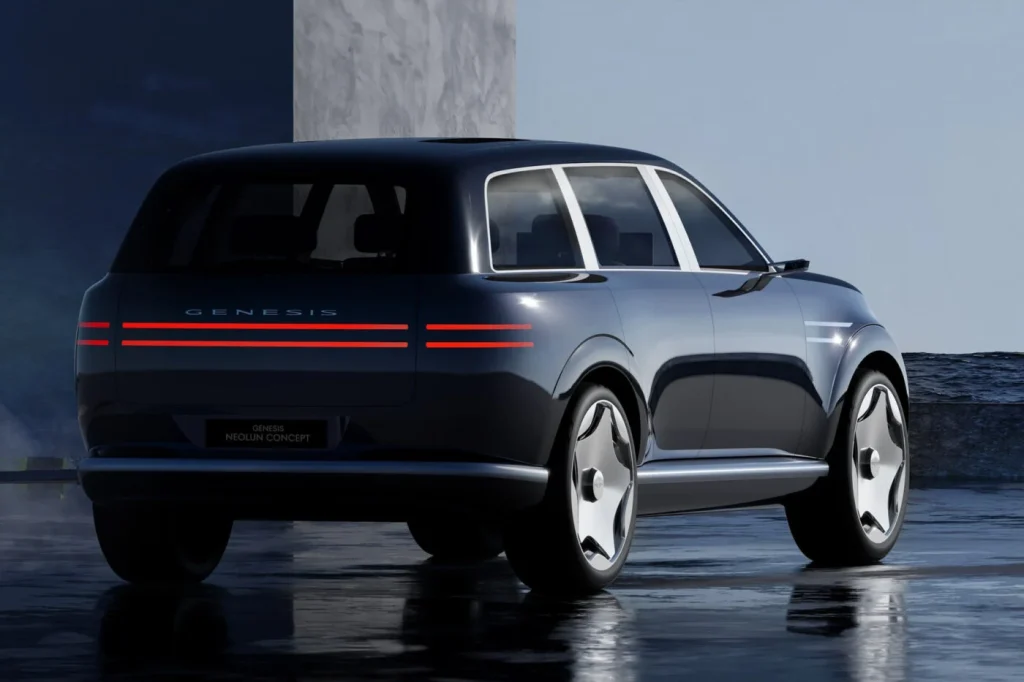
The GV90 measures 208.1 inches long and offers six- or seven-seat configurations, depending on specification. That gives it the dimensions and flexibility required to compete for customers who would otherwise consider a Cadillac Escalade IQ, Mercedes-Benz EQS SUV, or similarly positioned premium EV.
For the U.S. market, that could be particularly important. American luxury buyers have a strong preference for large SUVs, and an electric flagship allows Genesis to move beyond its existing GV60, Electrified GV70, and other smaller EV offerings.
Pricing and final U.S. availability details will determine how aggressively Genesis can challenge established competitors, but the product itself gives the brand a much stronger presence at the top of the luxury-EV market.
The GV90 also demonstrates how quickly Genesis’ product strategy is evolving. What began as a relatively small luxury brand now has a full range of sedans and SUVs, electric models, performance products, and a dedicated flagship.
The new SUV brings those efforts together. With its 123.5-kWh battery, 657-horsepower dual-motor system, estimated 310-mile range, and rapid charging capability, the GV90 has the fundamental EV specifications expected of a modern luxury flagship.
Its unusual doors, advanced suspension, AI-powered infotainment, and highly customizable interior provide additional differentiation. For Genesis, however, the biggest challenge begins after the unveiling.
The company must convince luxury buyers that Genesis belongs alongside the world’s most established premium brands. The GV90 is clearly designed to make that argument through technology, craftsmanship, and performance rather than relying solely on price.
If Genesis can deliver the refinement promised by the vehicle while maintaining competitive charging, range, and ownership support, the GV90 could become an important turning point for the brand.
The new flagship does not merely expand Genesis’ electric lineup. It gives the company a vehicle capable of competing at the highest end of the luxury SUV market while showing how far the brand has progressed in less than a decade.
