
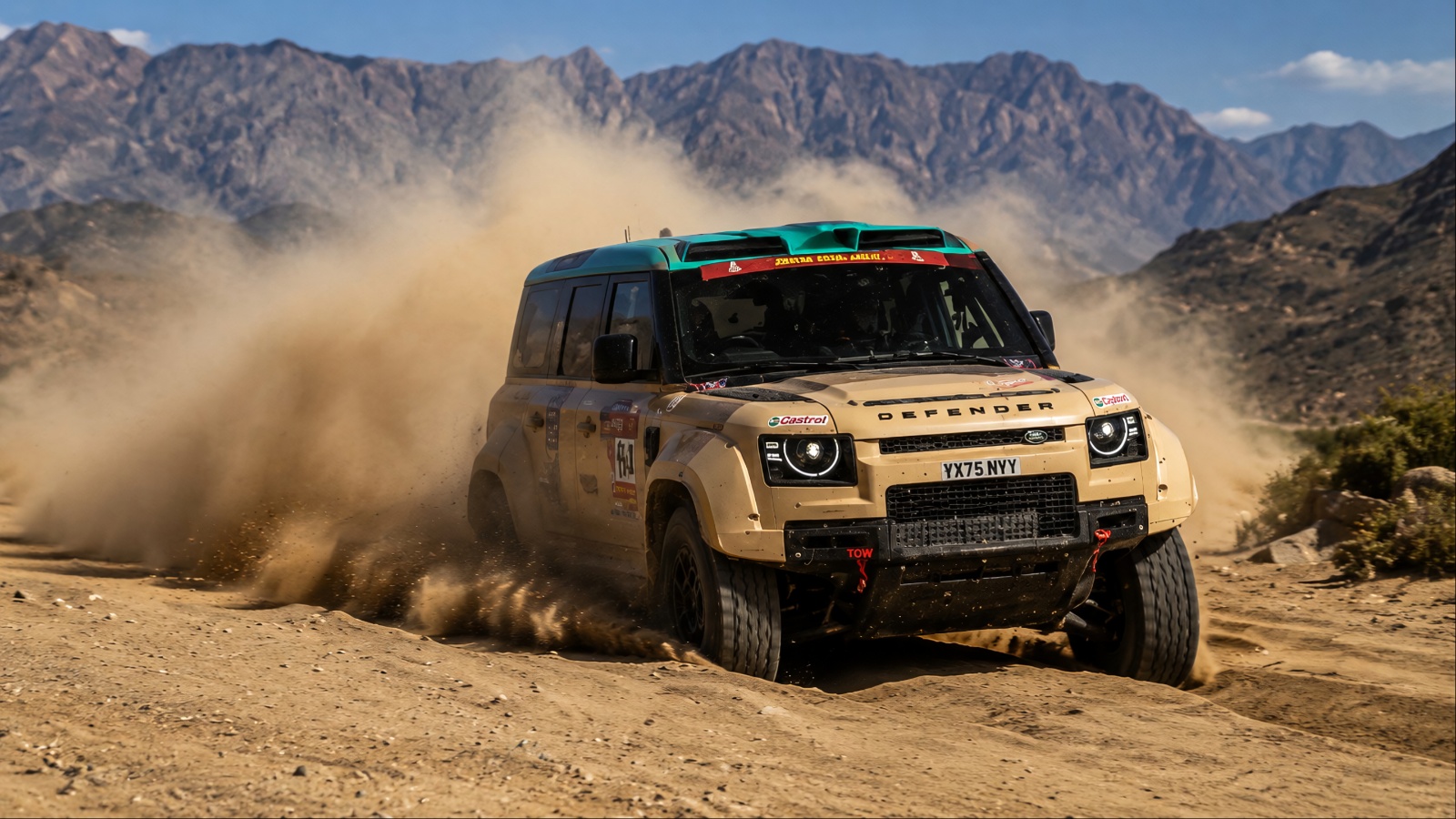
Land Rover is turning its success in one of the world’s toughest motorsport events into an unusually extreme production vehicle. The company has confirmed that a limited-run Defender Dakar will bring technology and hardware developed for its Dakar Rally-winning D7X-R competition vehicle to a road-legal SUV.
Revealed as a design preview at The Quail during Monterey Car Week, the Defender Dakar is based heavily on the competition vehicle that made its Dakar debut in 2026.
According to WardsAuto, the production model is scheduled to arrive in 2027 and will use a 4.4-liter twin-turbocharged V8 with more power than the race car was permitted to produce under competition regulations.
Land Rover is positioning the vehicle as the most extreme expression yet of its Defender brand. Rather than simply adding cosmetic rally-inspired features to a standard SUV, engineers have carried over substantial elements of the Dakar racer’s chassis, suspension, driveline, and body architecture.
The result is a road-going Defender designed to deliver genuine high-speed off-road capability while retaining the equipment necessary to operate on public roads.
From Dakar Winner to Road-Legal Defender
The story begins with the Defender D7X-R, which competed in the 2026 Dakar Rally in the new Stock class. The competition program could hardly have produced a stronger debut.
According to Land Rover, three D7X-R vehicles finished first, second, and fourth in their class after 14 days of competition. The team also achieved a first-second-third result on 10 of the 13 stages. Together, the three vehicles covered approximately 24,000 kilometers, or 14,913 miles, during the event.
That success provided Land Rover with a ready-made foundation for the road-going model. The Defender Dakar retains the D7X-R’s D7X body architecture, transmission, and driveline, all of which are derived from the Defender OCTA.
This is important because it means the production vehicle is not simply inspired by the rally car. Much of its fundamental mechanical architecture comes directly from the same engineering program. The biggest mechanical headline is the engine.
The Defender Dakar will use the 4.4-liter twin-turbo V8 from the Defender OCTA, but the production model will not be restricted by Dakar competition regulations. Land Rover says it will produce 635 PS, equivalent to approximately 626 horsepower, and 750 Nm, or 553 lb-ft, of torque. The engine also receives additional cooling capability.
That makes the road car more powerful than the competition version, a rare situation for a vehicle derived from a race program.
Land Rover has also dramatically altered the SUV’s geometry. The Defender Dakar receives a wider track and increased ride height, helping create the additional ground clearance and stability needed for serious off-road driving.
The suspension is equally important. The vehicle uses coil springs combined with motorsport-proven Bilstein Advanced Dampers, giving engineers greater control over the suspension during high-speed driving across rough terrain.
It also gets 35-inch all-terrain tires mounted on forged 20-inch wheels. That enormous tire package is one of the clearest indications that the Defender Dakar has been designed for more than occasional trail driving.
Land Rover has added two specific driving modes called Dunes and Gravel, while another feature called Flight Mode has been adapted from the competition vehicle.
Flight mode is particularly unusual for a production SUV. The system was developed for the D7X-R to help control the vehicle when it becomes airborne over severe terrain and to provide smoother landings. Bringing that technology to a road-legal Defender demonstrates how closely the production model follows the Dakar program.
The vehicle’s braking and underbody protection have also been adapted for extreme conditions, while the exterior includes a metal front undershield and additional underbody protection.
Rally Hardware Becomes Part of the Defender’s Identity
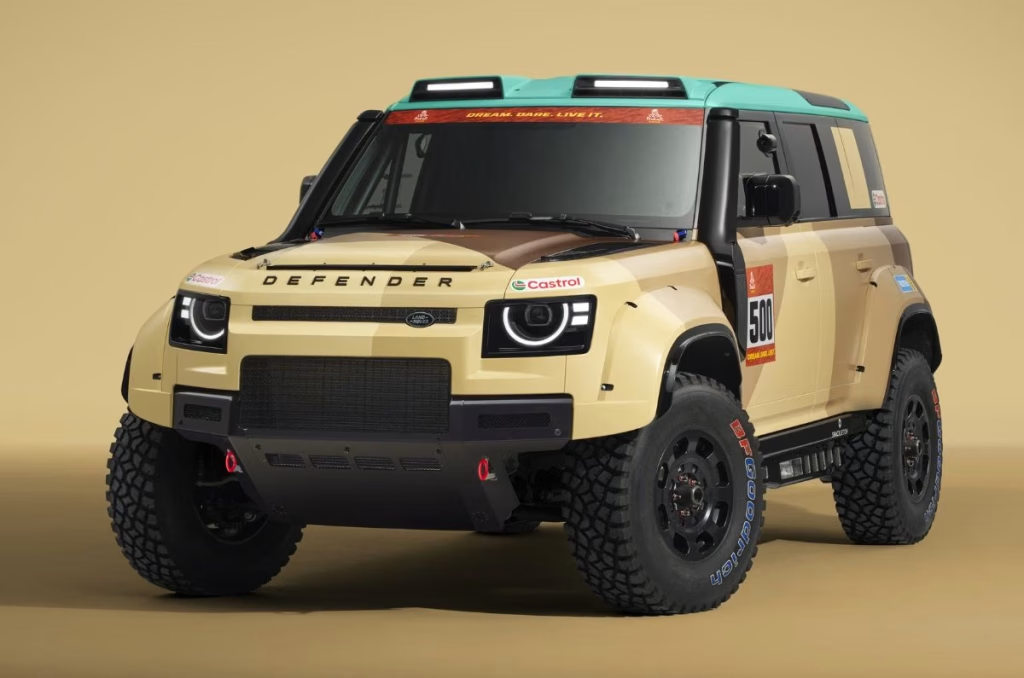
The Defender Dakar’s appearance is deliberately connected to its competition origins. The exterior features roof-mounted light pods, a fixed metal roof, carbon-fiber raised air intakes, a carbon-fiber hood, and extended wheel arches with exposed rivets. Mud flaps and a tailgate blanking plate further reinforce the connection with the D7X-R.
The design preview shown at Monterey Car Week was finished in a combination of Dakar Sand and Yanbu Turquoise, colors inspired by the rally-winning competition vehicle. Buyers will also have other exterior options, including Narvik Black and Alaska White, with a matte protective film available as an option.
Inside, Land Rover has taken a similar approach. The Defender Dakar will use a 2+2 seating arrangement with specially developed front race seats.
Optional four-point racing harnesses will be available, while rear storage has been designed to accommodate racing helmets. There is also a dedicated mounting system for the spare wheel and air compressor in the load area.
Those features make the Defender Dakar substantially different from a conventional luxury SUV.
The standard Defender has increasingly moved into the premium lifestyle market, where customers can use it as a daily vehicle while retaining strong off-road ability. The Dakar model takes that formula much further toward motorsport.
Land Rover’s decision also comes at an important moment for the Defender brand. The company says more than 130,000 Defenders have been sold in the United States since the model returned to the market five years ago, demonstrating the strength of demand for the nameplate.
The Defender OCTA has already pushed the production Defender toward higher performance, and the Dakar model takes that progression to another level.
The connection with motorsport is particularly valuable because it gives Land Rover a way to demonstrate the Defender’s capabilities under conditions that are considerably more demanding than conventional vehicle testing.
Dakar is not simply a marketing exercise. Vehicles must survive long-distance stages across extremely difficult terrain, including sand, rocks, high-speed sections, and severe temperature changes. The D7X-R’s class victory gives Land Rover an unusually strong foundation for claiming that its road-going derivative contains genuine competition-developed technology.
That does not mean the Defender Dakar will be identical to the race car. The competition vehicle was built around specific Dakar regulations and requirements, while the production model must meet road-use requirements and offer a usable cabin.
Land Rover has therefore adapted the race technology rather than simply transferring the entire competition vehicle to public roads.
The limited production run will also make the Defender Dakar an enthusiast-focused model rather than a high-volume variant.
Land Rover says reservations will open in early 2027, while additional technical details and specifications will be revealed at the 2027 Dakar Rally in Saudi Arabia.
That strategy allows the company to maintain interest in the vehicle through another Dakar event before customer deliveries begin.
A New Kind of High-Performance Defender
The Defender Dakar represents an increasingly unusual approach to performance SUVs. Most high-performance SUVs are designed primarily around road performance, with their off-road capabilities remaining secondary. The Dakar model reverses that priority.
Its large tires, raised geometry, rally-derived suspension, Flight Mode, and extensive underbody protection are all intended to make it exceptionally capable away from paved roads.
At the same time, the 635-PS V8 gives it the kind of power normally associated with high-performance road cars.
That combination makes the Defender Dakar more than another special-edition Defender with a distinctive appearance. Land Rover has used its Dakar program as an engineering laboratory and then transferred many of the resulting ideas into a limited-production road vehicle.
The timing is also significant because Defender will continue competing in the FIA World Rally-Raid Championship from 2026 as part of a planned three-year program. The competition program gives engineers additional opportunities to develop and validate technology that could influence future Defender products.
For buyers, the Defender Dakar will offer something few production SUVs can claim: a direct mechanical connection to a vehicle that has already won one of the world’s most demanding off-road races.
Its 626-horsepower V8, 35-inch tires, rally-developed suspension, and Flight Mode make its specifications extraordinary, but the most interesting aspect may be how much of the competition vehicle’s underlying engineering has survived the transition to the road.
Land Rover has effectively taken its Dakar winner, removed the restrictions imposed by racing regulations, added the equipment required for road use, and created an exclusive production SUV from the result.
With reservations opening in early 2027 and more details expected at the next Dakar Rally, the Defender Dakar is shaping up to be one of the most extreme factory-built off-road vehicles in Land Rover’s modern history.
