
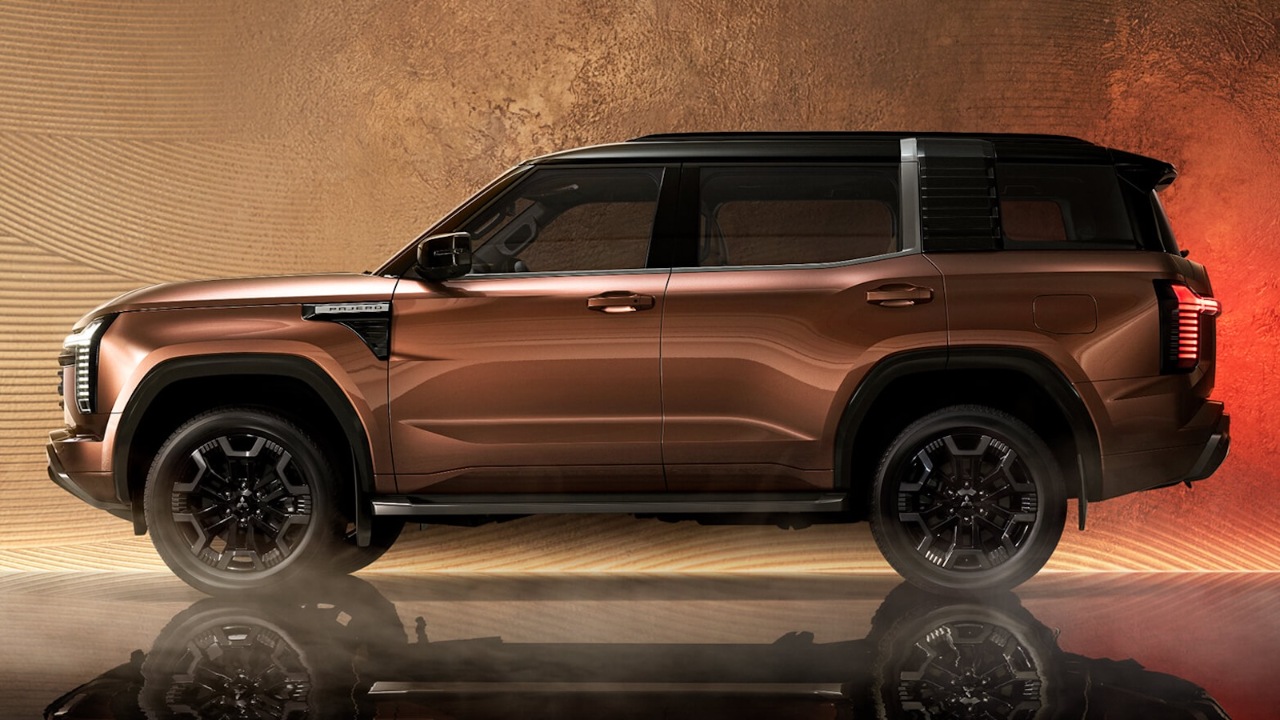
Mitsubishi has brought one of its most recognizable nameplates back to the global automotive market, reviving the Pajero after a five-year absence with a new-generation SUV designed to compete directly with rugged models such as the Toyota Land Cruiser.
In the UK, the Pajero was historically marketed as the Shogun, while other markets used names such as Montero. The new model returns to the rugged formula that helped its predecessors succeed, combining a body-on-frame platform with four-wheel drive, generous ground clearance, and a diesel engine built to provide strong torque in challenging conditions.
According to Autocar, the new Pajero is intended to prioritize genuine all-terrain capability while improving refinement on paved roads. Mitsubishi has positioned it as the company’s new flagship SUV, rather than as a soft-roading family crossover.
Mitsubishi’s own announcement confirms that the new Pajero was developed as a cross-country SUV and will initially be produced in Thailand. It will launch first in Thailand, followed by Japan and Australia during fiscal 2026, with expansion to approximately 100 countries planned from fiscal 2027.
That makes the comeback particularly significant. Mitsubishi is attempting to rebuild the Pajero as a modern global off-roader while retaining the characteristics that made the original famous.
A Proper Body-on-Frame Off-Roader
The biggest difference between the new Pajero and many modern SUVs is underneath. Mitsubishi has retained a high-strength ladder-frame construction, giving the vehicle the type of foundation traditionally associated with serious off-road vehicles.
According to Mitsubishi, the rigid ladder frame works with specially developed suspension to maintain tire contact over difficult terrain while also improving ride quality and handling on paved roads. The company specifically says it wanted to balance off-road performance with greater comfort and refinement.
That approach puts the Pajero firmly into the same broad category as the Toyota Land Cruiser rather than positioning it against car-based crossovers.
The numbers reinforce that ambition. Autocar reports that the Pajero has 230mm of ground clearance, with a maximum approach angle of 30.4 degrees and a departure angle of 25.8 degrees. Those figures give it the geometry needed to negotiate steep approaches, uneven surfaces, and obstacles without relying purely on electronic driving aids.
The design also deliberately references the Pajero’s heritage. Its upright, boxy proportions recall the short-wheelbase Pajeros that competed successfully in the Paris-Dakar Rally during the 1980s, 1990s, and 2000s.
Mitsubishi has modernized that shape considerably, but the new SUV still looks more purposeful than fashionable. It has a high stance, chunky tires, and a squared-off body intended to communicate its off-road purpose.
One familiar feature has been left behind. The externally mounted spare wheel, which became a defining visual element of earlier Pajero models, is no longer attached to the tailgate.
The new model also receives Mitsubishi’s Super All-Wheel Control (S-AWC) system. This technology manages torque distribution and braking to improve traction and stability across different surfaces.
Mitsubishi says the new Pajero builds upon the company’s experience with its earlier Super Select four-wheel-drive systems while adding S-AWC to provide greater all-around control. The system is designed to help the SUV remain stable both on loose terrain and during everyday road driving.
Another interesting feature is the return of the Pajero’s distinctive off-road instrumentation in modern form. Mitsubishi has created a new multi-meter display that provides information including altitude, compass direction, temperature, and vehicle pitch and roll angles. It can also show information related to the vehicle’s Active Yaw Control system.
That is a small but meaningful connection to the original Pajero, whose dashboard featured dedicated gauges for monitoring conditions during off-road driving.
Diesel Power for a New Generation
While much of the industry is moving toward electrification, Mitsubishi has chosen a traditional diesel powertrain for the new Pajero, at least in the version revealed so far.
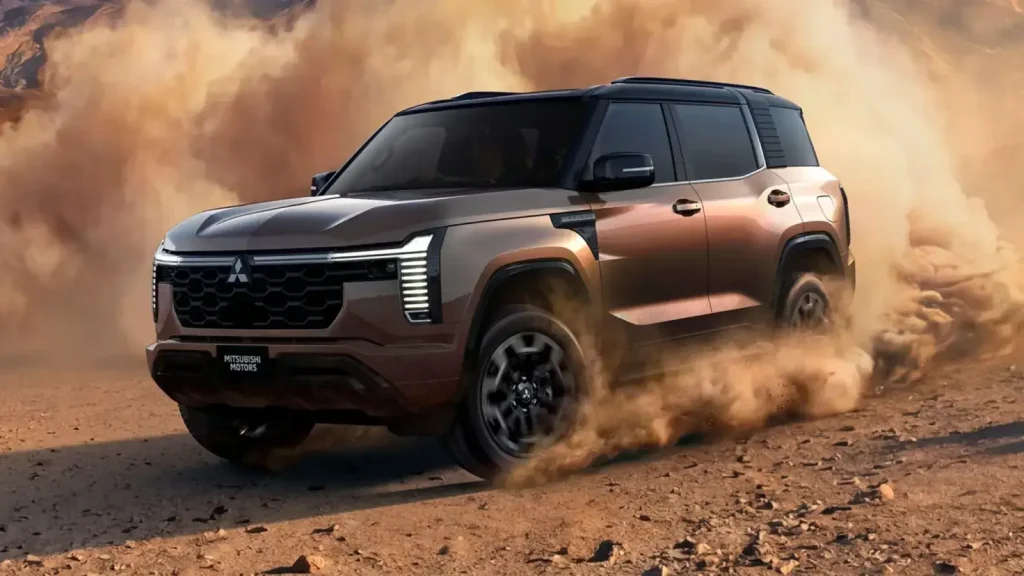
Power comes from a newly developed 2.4-liter clean-diesel engine producing 201bhp and 480Nm of torque. The engine is paired with a newly developed eight-speed automatic transmission.
Autocar reports that the diesel is derived from the engine used in the Mitsubishi L200 pickup, but it has been adapted for the Pajero’s requirements. Mitsubishi says its variable-geometry turbocharger provides strong torque across a broad operating range, while the eight-speed automatic is intended to deliver smoother acceleration and improved refinement.
The emphasis on torque makes sense for the Pajero’s intended role. A serious off-road vehicle needs predictable power delivery at low speeds, particularly when climbing steep surfaces or traveling over loose terrain.
The 480Nm figure also gives the Pajero a useful advantage when carrying passengers or equipment. Unlike performance-focused SUVs, this vehicle is designed to provide its capability without requiring a high-revving engine.
The diesel choice is nevertheless interesting because emissions regulations are making large diesel SUVs increasingly difficult to sell in some markets.
Mitsubishi has not yet confirmed every powertrain option for every market, but the initial vehicle demonstrates that the company believes there remains demand for a conventional diesel-powered 4×4 in regions where long-distance travel, towing, and off-road use are important.
Australia is an obvious example. The Pajero is scheduled to arrive there by March 2027, according to Autocar, putting it into a market where buyers have traditionally shown strong interest in rugged diesel SUVs.
The same applies to several Asian, Latin American, and Middle Eastern markets where diesel-powered four-wheel-drive vehicles remain popular.
A More Premium Pajero
Mitsubishi has also moved the Pajero noticeably upmarket. The new SUV can accommodate seven passengers across three rows, making it a practical family vehicle as well as an off-roader. Inside, the company has given the flagship model a considerably more luxurious character than previous generations.
Autocar reports that leather covers most of the cabin surfaces, while equipment includes three-zone climate control and ventilated seats. A Yamaha audio system is also available, with technology designed to counteract road noise entering the cabin.
That combination reflects the changing expectations of buyers in this segment. People purchasing a Land Cruiser-style SUV increasingly expect their vehicle to be capable in remote areas without sacrificing comfort during long highway journeys.
Mitsubishi is therefore attempting to make the Pajero equally convincing on an unpaved trail and a motorway. The SUV’s flagship positioning is important for Mitsubishi’s wider strategy, too.
The company has been rebuilding its lineup around models such as the Outlander and L200, and the Pajero gives it a much more recognizable halo vehicle. A distinctive flagship can attract attention to the brand even if its sales volumes are smaller than those of mainstream models.
Mitsubishi has confirmed that the Pajero will initially be built in Thailand before reaching Japan and Australia. From fiscal 2027, the company plans to introduce it in roughly 100 countries, including markets across ASEAN, Latin America, and the Middle East.
The UK remains uncertain. Autocar reports that the vehicle’s right-hand-drive configuration means a British launch is technically possible, but Mitsubishi has not confirmed that it will be sold there.
That would be particularly notable because the Shogun name has considerable history in Britain. The previous Shogun was discontinued in 2019 after a 37-year run, according to Auto Express, which reported that more than 114,000 examples had been sold in the UK during that period.
The return of the Pajero therefore represents more than the revival of an old badge. Mitsubishi is bringing back a model with a clear identity at a time when many manufacturers are moving toward softer, more road-focused SUVs.
The challenge will be balancing that traditional capability with modern emissions requirements, safety standards, and customer expectations.

For now, Mitsubishi appears to have stayed remarkably faithful to the Pajero’s original philosophy. The new SUV has a ladder frame, four-wheel drive, substantial ground clearance, seven seats, and a torque-rich diesel engine. It is not simply a crossover borrowing a historic name.
That makes the new Pajero an unusual proposition in today’s market. As manufacturers increasingly prioritize electrification and car-based SUVs, Mitsubishi has chosen to revive one of its most rugged nameplates with a mechanical package aimed squarely at traditional off-road buyers.
Whether the formula can succeed globally remains to be seen. But with 201 bhp, 480 Nm, 230 mm of ground clearance, and a dedicated four-wheel-drive system, the new Pajero has the hardware to challenge established competitors.
For Mitsubishi, the larger goal may be even more significant. Bringing back the Pajero as a recognizable flagship could strengthen the brand’s identity while allowing Mitsubishi to capitalize on the model’s long-standing off-road reputation.
After disappearing for five years, the Pajero is back, and this time, Mitsubishi is making it clear that the legendary nameplate has not forgotten what it was built to do.
