
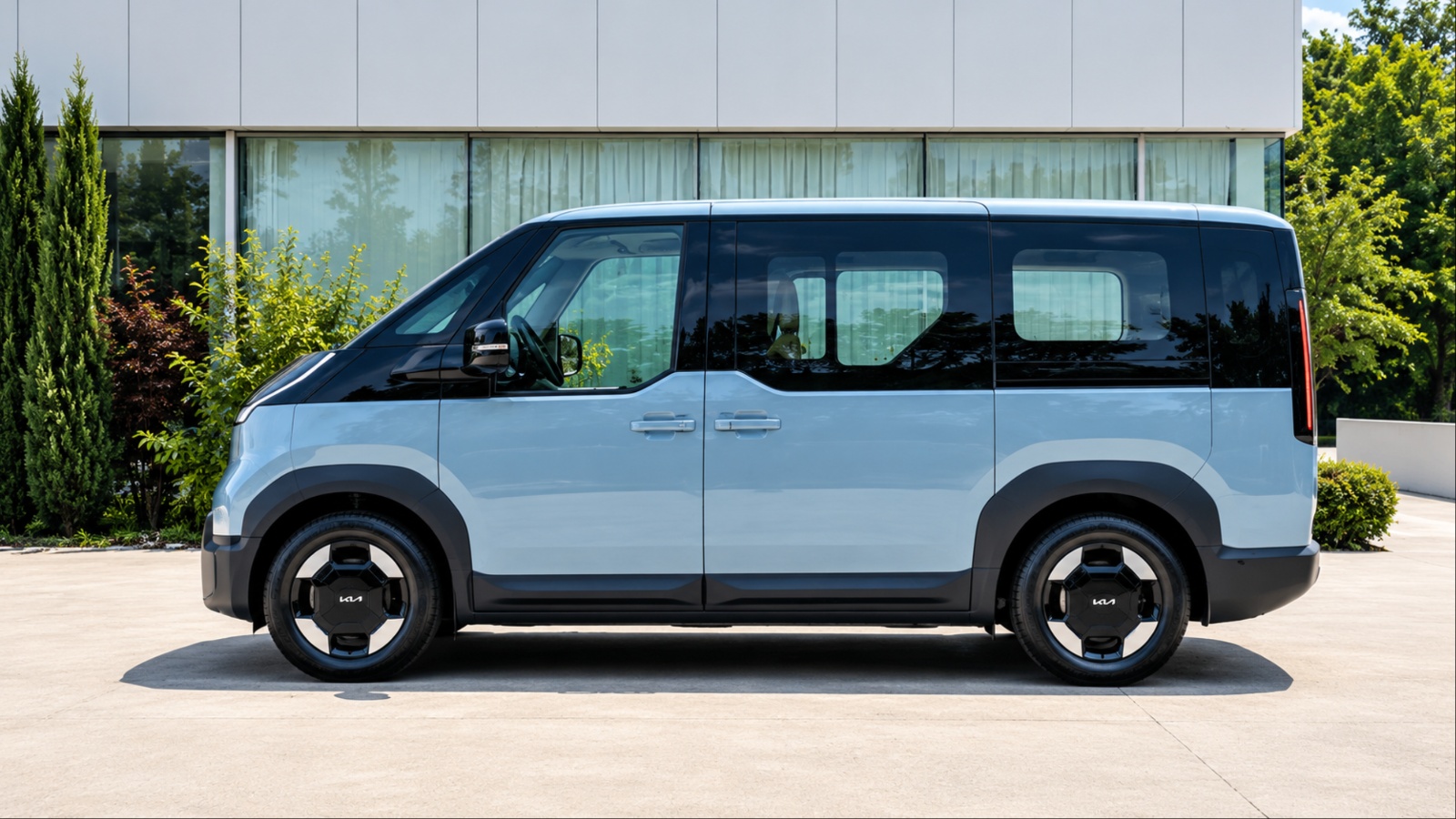
Kia has revealed the first details of the PV7, an all-electric van that will become the second model in the company’s Platform Beyond Vehicle strategy.
Designed for commercial fleets but also intended for leisure users, the PV7 expands Kia’s ambitions beyond conventional passenger vehicles and into a rapidly developing global electric commercial-vehicle market.
According to Motor1, Kia has released initial information and teaser images ahead of the PV7’s full reveal. The model follows the PV5, which established Kia’s new purpose-built electric-vehicle approach and became the first production vehicle developed under the Platform Beyond Vehicle, or PBV, strategy.
The PV7 is positioned above the PV5 and is intended to provide substantially more space for customers who need a larger electric van. Kia says its PBV strategy is designed to create flexible vehicles that can be adapted to different business and lifestyle requirements rather than being limited to a single body style or use case.
That distinction is important because Kia is not approaching the PV7 simply as another electric van. The company sees its PBV business as a new pillar of its global strategy, combining dedicated electric platforms with different bodies, interiors, and commercial applications.
The PV7 will therefore play an important role in determining whether Kia can establish itself as a serious competitor in the expanding electric van market.
A Larger Electric Van for Commercial and Leisure Use
The PV7 is being developed around the needs of commercial customers, but Kia is also targeting private users who want a spacious electric vehicle.
The van’s larger size should allow it to serve applications ranging from cargo transportation and fleet operations to passenger transportation, recreational travel, and other lifestyle uses.
Kia’s PBV approach is based on flexibility. Rather than designing one fixed interior configuration, the company intends to support multiple versions that can be adapted to particular applications.
For businesses, that could mean using the PV7 as a delivery vehicle, mobile workshop, or service vehicle. Passenger-oriented versions could potentially serve shuttle operations, while private customers could use the available space for camping, outdoor activities, or family travel.
The strategy gives Kia a way to address several markets with one underlying vehicle architecture.
Motor1 reports that the PV7 will be the second Kia model under the PBV strategy following the PV5. The company has previously described the PBV business as an important part of its future mobility plans, with electric vehicles designed from the beginning to support different purposes.
That differs from conventional vans that are often adapted from combustion-powered commercial vehicles. A purpose-built electric platform can provide greater freedom when engineers determine the position of the battery, electric motors, and cabin.
It can also make it easier to create different body lengths and roof heights while maintaining a common underlying architecture.
For commercial customers, flexibility is particularly valuable. Fleet operators can select vehicles based on cargo capacity, passenger requirements, and daily operating patterns without having to move to entirely different platforms.
The PV7’s larger dimensions should also allow Kia to compete with established electric vans from European manufacturers, including Mercedes-Benz, Ford, and Volkswagen.
Those companies already have extensive experience with commercial vehicles, meaning Kia will need more than an electric powertrain to gain fleet customers.
Reliability, charging convenience, operating costs, payload capacity, and after-sales support will all influence purchasing decisions.
Kia Is Moving Beyond Traditional Passenger Cars
The PV7 represents a broader transformation of Kia’s business. For decades, Kia’s identity was centered on passenger cars and SUVs. The company has since expanded aggressively into electric vehicles, and its PBV strategy represents another step toward becoming a broader mobility and commercial-vehicle company.
Kia believes purpose-built electric vehicles can create new opportunities because their design is not constrained by the traditional relationship between a car’s exterior shape and interior layout.
A van such as the PV7 can use its large cabin volume for many different purposes, while digital systems can make it easier to adapt the vehicle to fleet operations.
Commercial operators are increasingly interested in electrification because electric vans can have lower energy and maintenance costs in suitable applications. Delivery vehicles, for example, often follow predictable routes and return to a central depot, making scheduled charging easier than it is for private vehicles that travel unpredictable distances.
Electric vans can also provide a quieter working environment and produce no tailpipe emissions while operating.
However, commercial customers are generally less willing than private buyers to accept compromises. A delivery company cannot afford excessive charging downtime, while a service business needs predictable range and sufficient payload capacity. That makes the PV7’s eventual specifications particularly important.
Kia has not yet released the complete technical details of the PV7, including final battery capacities, range figures, charging performance, motor outputs, and payload ratings. Those figures will determine how competitive the vehicle is against established electric commercial vans.
The company has also not revealed the complete pricing structure. The lack of those details means the PV7 should currently be viewed as a product preview rather than a complete market launch.
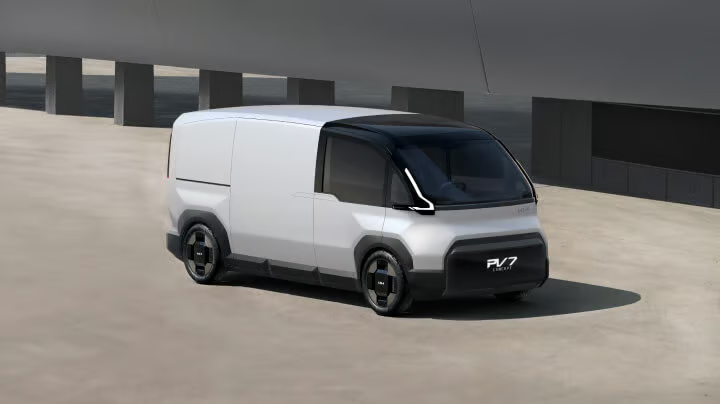
Kia’s teaser images nevertheless indicate the vehicle’s design direction. The PV7 follows the clean, upright appearance established by the PV5, with a focus on maximizing usable interior volume rather than creating a conventional passenger-car silhouette.
That approach is typical of purpose-built commercial EVs, where interior packaging is often more important than aerodynamic styling alone.
The PV7 Could Become a Key Global PBV Model
The most important aspect of the PV7 may be its potential global reach. Kia has made clear that its PBV strategy is intended for international markets rather than being limited to South Korea. That gives the PV7 a much larger potential customer base and could help Kia build economies of scale around its electric commercial-vehicle business.
The company is also developing a broader PBV ecosystem rather than simply selling vans. Fleet management, charging, software, and specialized conversions can all become part of the business opportunity.
For fleet operators, connected-vehicle technology can provide information about vehicle location, energy consumption, maintenance requirements, and operating efficiency. Those tools can be just as important as the van itself when businesses manage dozens or hundreds of vehicles.
Kia’s PBV strategy therefore allows the company to develop recurring commercial relationships rather than relying exclusively on individual vehicle sales.
The PV7 also arrives at a time when electric commercial vehicles are becoming more diverse. Automakers are moving beyond small electric delivery vans and introducing larger models capable of serving logistics, passenger transportation, and specialized applications.
Kia’s challenge will be establishing credibility in a sector where fleet customers typically prioritize proven durability and low operating costs over brand image.
The PV5’s performance in global markets will likely provide Kia with valuable experience before the larger PV7 reaches more customers. Lessons involving charging, fleet operations, and vehicle customization could influence how Kia positions the new van.
The company also has the advantage of being able to develop the PV7 after gaining experience with its first PBV model rather than entering the commercial EV market without an established product.
That could allow Kia to refine its software and vehicle architecture while expanding the PBV family.
For private customers, the PV7 could offer something different from conventional SUVs and MPVs. Its large interior and electric powertrain could make it attractive to families, campers, and outdoor enthusiasts who prioritize space and flexibility.
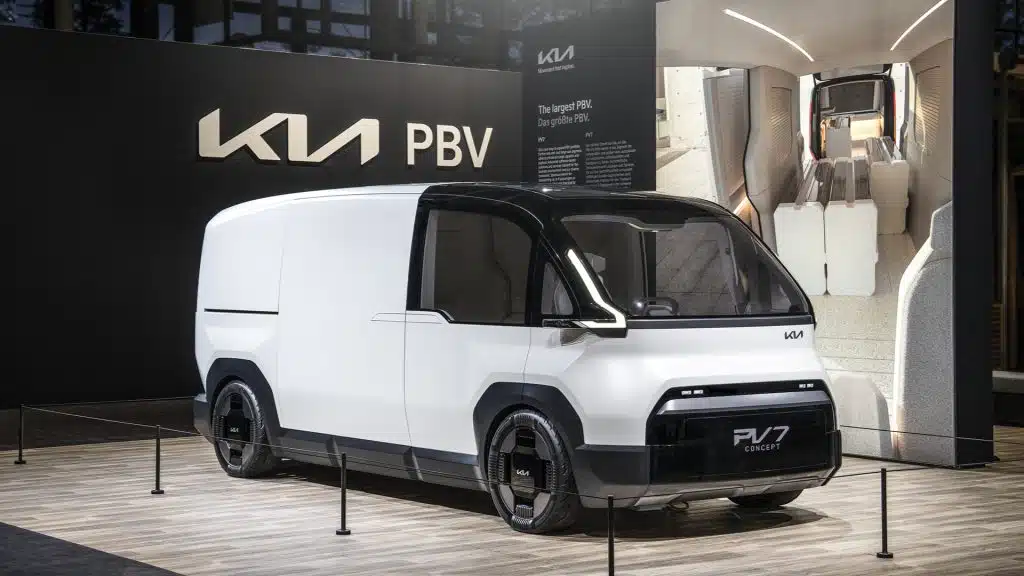
The same vehicle could appeal to two distinct audiences, serving as practical fleet transportation for businesses while also functioning as a versatile lifestyle vehicle for private buyers.
That dual-purpose strategy could help Kia spread development costs across a wider customer base.
Still, the PV7’s success will ultimately depend on details that Kia has yet to disclose. Range, charging speed, payload, interior configurations, pricing, and availability will determine whether it can compete effectively against established electric vans.
The company has already shown with the PV5 that it intends to build a dedicated business around purpose-built electric vehicles rather than treating commercial EVs as a minor extension of its passenger-car lineup. The PV7 takes that strategy into a larger and potentially more profitable segment.
If Kia can combine useful range, fast charging, flexible configurations, and competitive operating costs, the PV7 could become an important alternative for commercial fleets while also attracting private buyers who need more space than a conventional EV can provide.
For now, Kia is keeping the full technical picture under wraps, with additional information expected as the vehicle moves toward its full reveal.
The PV7 nevertheless sends a clear message about where Kia wants to go next. The company is no longer limiting its electric ambitions to cars and SUVs. Through its PBV strategy, Kia is attempting to create a broader family of purpose-built electric vehicles capable of serving businesses, families, and entirely new forms of mobility.
