
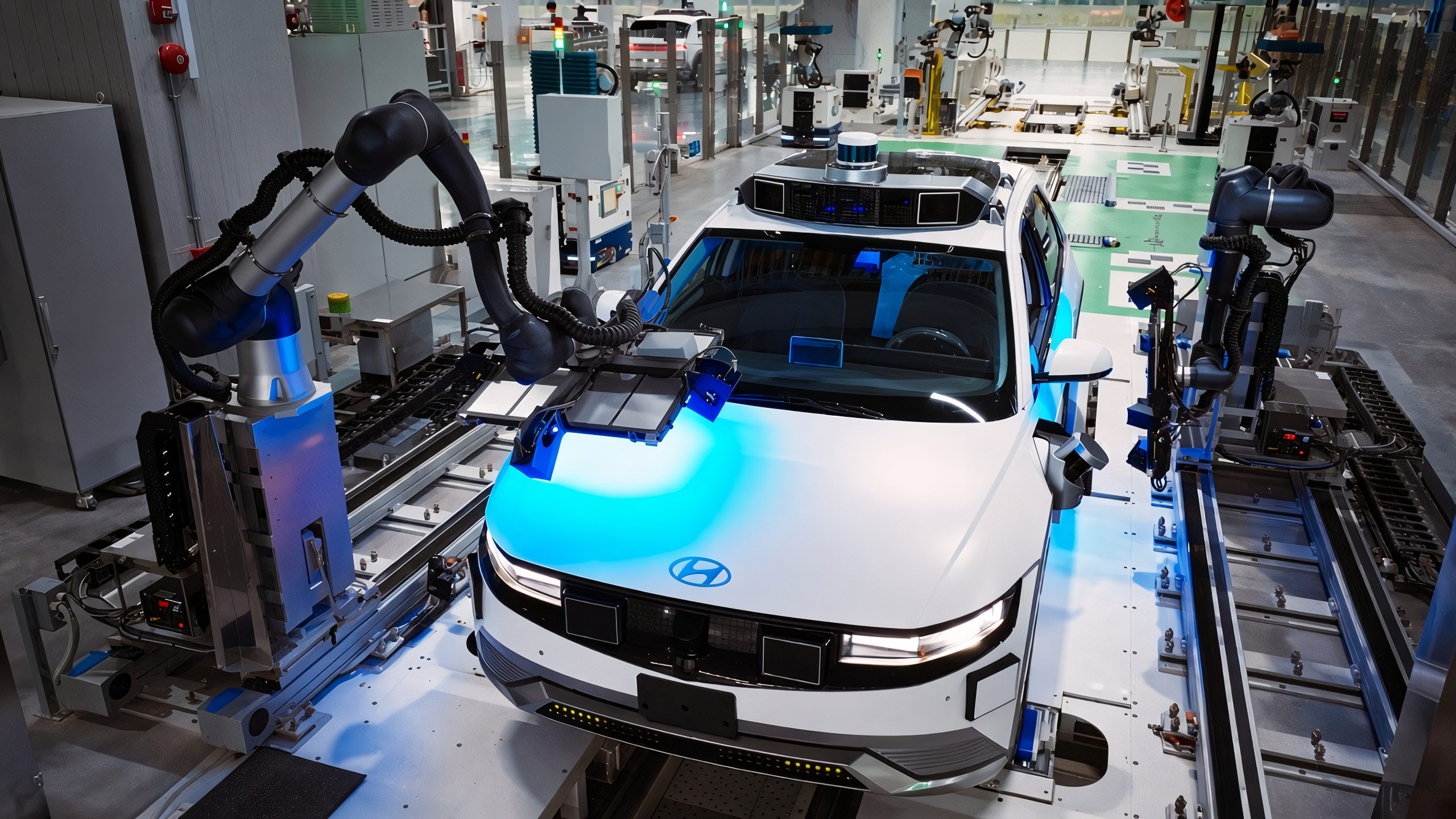
Hyundai Motor Group is accelerating its autonomous-driving ambitions with a new artificial-intelligence data strategy designed to continuously connect real-world driving data, AI training, validation, and deployment. The group says its Data Flywheel is now fully operational, creating a system in which every new driving experience can help improve the next generation of autonomous-driving technology.
Announced on September 13 at Hyundai Motor Group’s Autonomous Driving Media Day in South Korea, the system is intended to shorten development cycles while improving the ability of autonomous-driving models to deal with difficult and unexpected road situations.
Hyundai says the approach will support both its near-term driver-assistance products and its longer-term efforts to develop higher levels of autonomy.
The strategy is being built around Atria AI, Hyundai Motor Group’s proprietary autonomous-driving technology developed by its Advanced Vehicle Platform division and software company 42dot. The group is also developing vision-language-action technology that combines visual perception, language-based reasoning, and vehicle control.
The move represents a significant change in how Hyundai approaches autonomous driving. Instead of treating development as a sequence of testing, software updates, and new vehicle launches, the company wants to establish a continuous learning system in which vehicles generate data, AI models learn from it, updated systems are validated, and improvements are eventually returned to production vehicles.
How Hyundai’s Data Flywheel Works
The concept behind the Data Flywheel is straightforward. Vehicles gather real-world data that engineers can use to train AI models. After those models are tested and refined, improved versions can be deployed in vehicles, generating additional data that supports the next round of development.
The difficult part is building that process at sufficient scale. Hyundai Motor Group says Hyundai and Kia sell more than 7 million vehicles annually across approximately 190 countries and regions. That global footprint gives the group a potentially enormous source of real-world driving information.
The company also operates around 40 dedicated data-collection vehicles around the clock to gather additional information for autonomous-driving development. The data is not limited to ordinary driving.
Hyundai specifically wants to capture situations that autonomous systems find difficult to interpret, including construction zones, unusual road infrastructure, severe weather, sudden lane changes, emergency maneuvers, narrow roads, and complicated urban traffic.
That focus is important because simply collecting enormous quantities of normal driving data does not necessarily make an autonomous system significantly better. Developers need to identify the unusual situations that cause AI models to make mistakes and then expose those models to similar situations repeatedly.
Hyundai calls one part of this process hard example mining. The system identifies challenging driving scenarios and prioritizes them for additional AI training.
A continuous training pipeline then incorporates newly collected and validated data into the development process. Instead of waiting for a large development cycle to finish, engineers can repeatedly train and refine models as new information becomes available.
Hyundai is also using virtual validation. Real-world driving data can be reconstructed into three-dimensional environments, allowing engineers to recreate difficult scenarios without having to repeatedly expose test vehicles to potentially dangerous situations.
The company says it is using technologies such as 3D Gaussian Splatting to recreate real-world environments for simulation and validation. Engineers can then test updated AI models repeatedly and check whether improvements in one area unintentionally reduce performance elsewhere.
Another component is Hyundai’s Special Event Recorder, or SER. The system records important events and associated data during autonomous driving, allowing the information to be analyzed and fed back into AI development.
Hyundai is also developing a Data Union framework connecting Hyundai Motor, Kia, 42dot, and Motional. The goal is to standardize sensor architectures and data structures so information generated across different organizations and vehicles can be combined and used more efficiently for AI training.
Atria AI and Hyundai’s Autonomous-Driving Roadmap
The Data Flywheel is ultimately designed to support Hyundai’s proprietary Atria AI system. At the Autonomous Driving Media Day, Hyundai showed an Atria AI-equipped software-defined vehicle testbed navigating complex urban traffic without driver intervention at a Level 2++ capability.
The demonstration was intended to show how the Data Flywheel can connect real-world driving with continuous AI improvement. Hyundai is following a dual-track strategy rather than waiting for its fully proprietary system to mature before putting advanced technology into production.
The first track involves a collaboration with NVIDIA. Hyundai plans to introduce Level 2+ autonomous-driving technology based on NVIDIA solutions in mass-produced vehicles during the first half of 2028, followed by Level 2++ capability in the second half of 2028.
The second track is focused on Atria AI and Hyundai’s long-term technological independence. The group is targeting production vehicles equipped with Atria AI-powered Level 2++ technology in the second half of 2029.
That staged approach gives Hyundai a way to introduce increasingly sophisticated driver assistance while continuing to develop its own autonomous-driving architecture.
The group is also pursuing Level 4 validation in real-world conditions. Hyundai plans to launch an Atria AI-equipped vehicle in the Gwangju area of South Korea by the end of 2026 in cooperation with the country’s Ministry of Land, Infrastructure, and Transport.
The purpose is not simply to demonstrate autonomous driving to the public. Hyundai wants the vehicles to encounter real traffic, unpredictable road conditions, and unusual situations that can generate additional information for the Data Flywheel.
That information can then return to the development process, creating another cycle of learning and validation.
The distinction between Level 2++ and Level 4 is important. Level 2 systems still require the driver to remain responsible for the driving task, while Level 4 systems can perform the complete driving task within defined operating conditions. Hyundai’s roadmap therefore involves gradually increasing capability rather than claiming that current technology can immediately replace human drivers.
Why Data Could Become Hyundai’s Biggest Autonomous-Driving Advantage
Hyundai’s strategy reflects a broader shift in the autonomous-driving industry. The competition is increasingly moving away from individual sensors or isolated driving functions and toward the ability to collect, process, and learn from enormous quantities of real-world data.
An autonomous vehicle may have sophisticated cameras, radar, and computing hardware, but those components are only part of the equation. AI models must understand what those sensors are seeing and determine how the vehicle should respond. Rare road situations can be particularly difficult because there may be little training data available for them.
Hyundai’s Data Flywheel is designed to address that problem by making difficult situations valuable development inputs rather than isolated failures.
The company’s global scale gives it another potential advantage. Hyundai Motor Group has previously said it plans to standardize autonomous-driving sensor architectures around the NVIDIA ecosystem so data collected by Hyundai, Kia, 42dot, and Motional can be integrated more consistently.
The group is also planning a major computing expansion. From 2029, Hyundai expects its Saemangeum AI Data Center to become operational, with a planned capacity of 100 megawatts and more than 50,000 GPUs. The facility is intended to provide computing infrastructure for the growing quantities of data generated by Hyundai’s global vehicle fleet and autonomous-driving programs.
Hyundai is going even further with its research into Vision-Language-Action, or VLA, models. Traditional end-to-end autonomous-driving systems attempt to translate sensor inputs directly into driving actions. Hyundai’s VLA research adds language-based reasoning to help the system interpret complicated situations and determine appropriate responses.
42dot is currently validating its VLA models through simulation. Real-vehicle testing and a broader development process are scheduled to begin from late 2026 into early 2027. Hyundai believes the technology could be particularly useful for unusual situations where conventional driving data alone may not provide enough examples for an AI system to learn.
The company is also connecting development teams in South Korea and the United States through a “Follow-the-Sun” development model. Because the teams operate in different time zones, data analysis, issue identification, and model improvement can continue around the clock rather than stopping when one development center closes for the day.
Hyundai’s latest strategy therefore goes well beyond adding another autonomous-driving feature to its vehicles. The company is attempting to create an industrial-scale learning infrastructure around autonomous mobility.
The challenge will be turning that enormous volume of information into genuinely safer and more capable systems. More data alone does not guarantee better autonomous driving; the data must be accurately collected, labeled, interpreted, and used to train models without introducing new weaknesses.
Hyundai acknowledges that challenge by emphasizing validation alongside AI training. New models must be tested against real-world and simulated scenarios before their improvements are deployed.
If the system works as intended, Hyundai could create a continuous development cycle in which every generation of vehicles contributes information that helps improve the next one.
That could become particularly important as the group moves toward Level 2+, Level 2++, and eventually Level 4 autonomous-driving systems. Hyundai’s strategy is not to rely on one breakthrough but to combine its global vehicle fleet, dedicated test vehicles, AI computing, proprietary software, and real-world validation into a single development pipeline.
The Data Flywheel is now operational, but its real significance will be measured by what Hyundai can accomplish with it. The company’s goal is to make autonomous-driving development faster without compromising validation and safety, while gradually turning Atria AI into a production-ready technology.
For Hyundai Motor Group, the race toward autonomous driving is increasingly becoming a race to collect better data, learn from it faster, and deploy validated improvements more efficiently. The new Data Flywheel is the infrastructure Hyundai believes can give it that advantage.
