
Stellantis is expanding its commercial-vehicle strategy with a stronger focus on electrification, fleet software, and new-generation vans, giving the Ram brand a larger role in the company’s North American commercial EV plans.
The strategy was presented as part of Stellantis Pro One’s broader commercial-vehicle offensive around IAA Transportation 2026 in Hanover, Germany.
While the Ram ProMaster EV itself is not a brand-new vehicle for 2026, Stellantis is using the model as an important part of its North American electric-van portfolio while preparing a much larger generation of commercial vehicles for the years ahead.
Stellantis says Pro One will introduce 11 new commercial models globally by 2030, including two new multi-energy van platforms, new pickups, and additional battery-electric powertrains. The company sold approximately 1.65 million commercial vehicles in 2025 and is targeting 30% volume growth by 2030.
The strategy reflects a significant change in how Stellantis approaches commercial vehicles. Instead of focusing only on selling vans and trucks, the company wants to combine electrified vehicles with connected services, fleet management, financing, charging, and artificial intelligence.
For Ram customers in the United States, the ProMaster EV provides the current foundation of that strategy.
Ram ProMaster EV Anchors Stellantis’ Electric Van Push
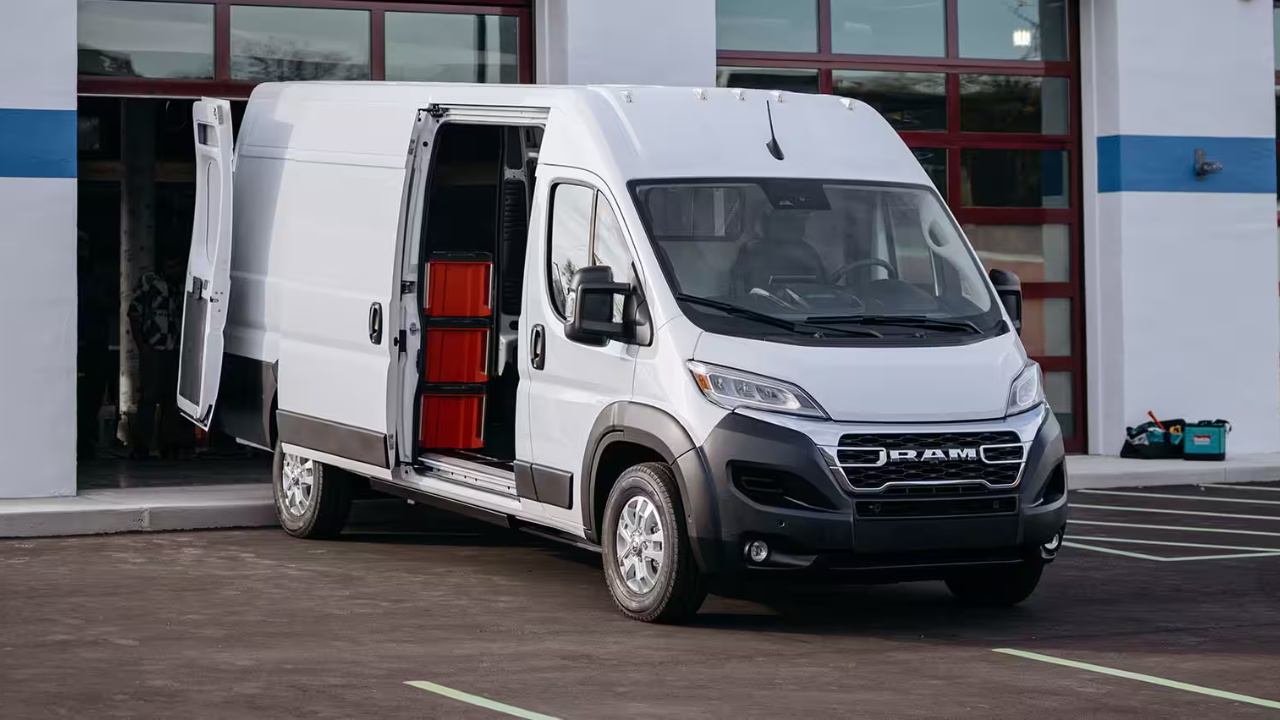
The Ram ProMaster EV was introduced for the U.S. market in 2024 and remains Stellantis’ main fully electric commercial van under the Ram brand.
The 2026 model uses a 110-kWh battery and a 200-kW electric drive module producing 268 horsepower and 302 pound-feet of torque. Ram lists a maximum payload of up to 3,170 pounds and a combined city/highway range of 164 miles for the current model.
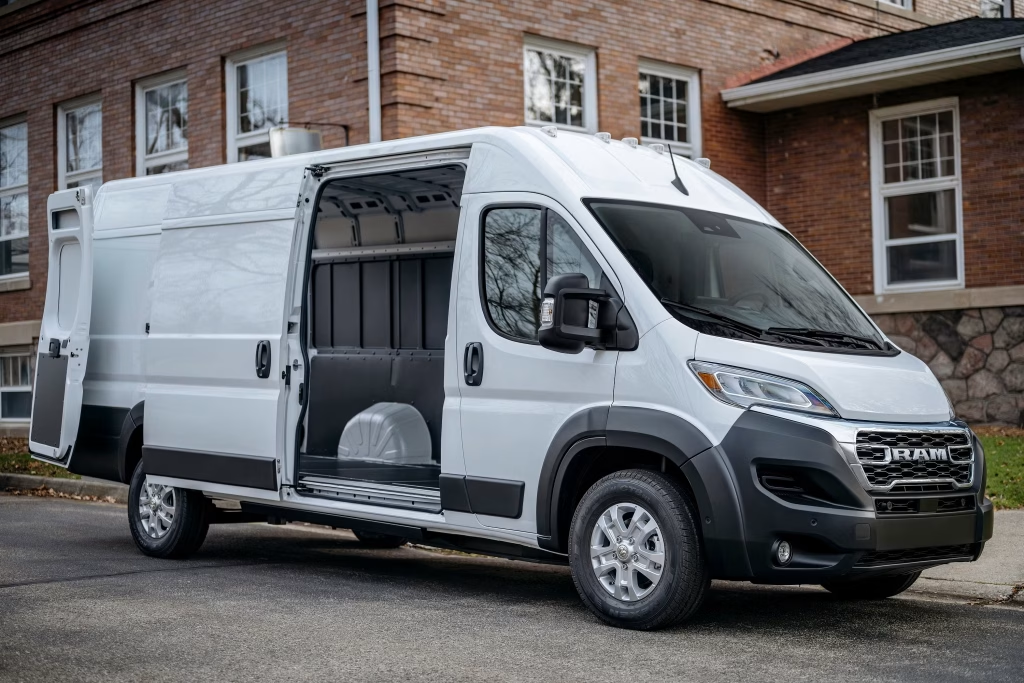
The van is offered in cargo configurations designed around commercial customers rather than private buyers. Its battery is positioned beneath the floor, allowing the electric version to retain the practical cargo area associated with the ProMaster platform.
Ram also offers the ProMaster EV in Tradesman, SLT, and SLT+ configurations, giving fleet customers different equipment levels depending on their operating requirements. Stellantis says the vehicle is designed for businesses ranging from delivery operators to contractors and other professional users.
The current ProMaster EV is built around front-wheel drive and uses a 400-volt electrical system. While its range is considerably lower than some passenger EVs, commercial vans operate under different requirements. Fleet operators often prioritize payload, cargo space, charging access, and operating costs rather than maximum highway range.
That distinction becomes important as Stellantis develops its next generation of commercial vehicles.
The company announced in May that its next-generation mid-size and large van platforms will use the STLA Brain architecture and support multiple powertrains, including battery-electric, hybrid, and internal-combustion systems.
Stellantis says the platforms are being designed around payload, cargo volume, and conversion readiness while maintaining flexibility as customer demand changes.
That approach is particularly relevant in North America, where commercial customers operate vehicles under very different conditions.
A delivery company running predictable urban routes may benefit significantly from a battery-electric van. A contractor traveling long distances or operating in areas with limited charging infrastructure may still prefer a combustion or hybrid vehicle.
Stellantis’ new strategy therefore does not assume that every commercial customer will immediately switch to a battery-electric vehicle.
Instead, the company is developing platforms capable of supporting several propulsion technologies.
That represents a major adjustment from the industry’s earlier assumption that commercial electrification would follow a single battery-electric path.
New Vans Will Combine EVs With Fleet Technology
The vehicle strategy is only one part of Stellantis Pro One’s plans. The company is also developing Pro One NEXT, a connected ecosystem designed around commercial fleet uptime. Stellantis describes it as an operating system and command center that can use vehicle data, connectivity, and artificial intelligence to help businesses manage their fleets.
The system is intended to support predictive maintenance, fleet monitoring, and other services designed to reduce downtime. Stellantis says its long-term objective is to move toward 100% vehicle uptime for commercial customers.
That target reflects a fundamental difference between consumer vehicles and commercial vehicles.
For a private owner, a vehicle being unavailable for a day can be inconvenient. For a delivery company, contractor, or logistics operator, an unavailable van can directly reduce revenue.
Stellantis therefore sees connected services as a way to make its commercial vehicles more valuable beyond their physical specifications.
The company is also developing a wider service ecosystem covering financing, renting, insurance, and charging. Its Free2move Charge business provides charging hardware, software, installation, and energy-management services, allowing Stellantis to offer more of the infrastructure required by electric fleets.
The strategy also includes CustomFit, the company’s conversion and personalization program. Stellantis says it has a global network of more than 550 certified partners capable of adapting commercial vehicles for specialized applications.
That matters because commercial vans are rarely purchased simply as standard cargo vehicles.
A van can become a refrigerated delivery vehicle, mobile workshop, emergency vehicle, passenger shuttle, or specialized service vehicle. Stellantis wants its next-generation platforms to make those conversions easier and faster. The company’s new architecture is being developed with this flexibility in mind.
At IAA Transportation, Stellantis also presented a new autonomous “Box on Wheels” concept designed for last-mile delivery. The driverless vehicle combines zero-emission operation with connected services and is intended to demonstrate how autonomous technology could eventually change commercial delivery operations.
The concept is not a production Ram model, but it illustrates the direction Stellantis wants its commercial business to take.
Instead of simply replacing a gasoline van with an electric van, the company is investigating a system in which the vehicle can communicate with fleet software, operate autonomously in specific applications, and continuously provide information to the business using it.
Ram Has a Larger Role in North America
The North American market is particularly important to Stellantis’ commercial strategy because Ram is one of the company’s core brands and already has a broad range of pickups and commercial vans.
Stellantis’ May strategy outlined plans for a complete renewal of its full-size pickup portfolio, including light-duty, heavy-duty, and chassis-cab models. It also plans to introduce a new mid-size Ram pickup for North America. The company is simultaneously moving toward multiple forms of electrification.
Stellantis’ revised strategy emphasizes battery-electric vehicles, hybrids, range-extended EVs, and combustion engines rather than relying exclusively on BEVs. That shift reflects the company’s assessment that adoption rates will vary between regions and vehicle categories.
The change is especially relevant to commercial vehicles, where operating requirements can make charging availability and downtime more important than they are for passenger cars.
The existing ProMaster EV therefore serves as a bridge between Stellantis’ current commercial lineup and its next generation of products.
Its 110-kWh battery, electric motor, and dedicated cargo configurations demonstrate that Ram is already offering a fully electric commercial van in the United States. The future platforms are expected to bring more flexibility, better integration with software, and additional powertrain choices.
Stellantis is also trying to improve the economics of electric commercial vehicles. The company has announced plans for new LFP and NMC battery technologies across its future commercial lineup, with the goal of improving affordability and range.
That could be particularly important for fleet buyers, who typically evaluate vehicles based on total operating cost rather than simply the purchase price.
Electric vans can offer lower energy and maintenance costs, but the initial vehicle price, charging infrastructure, and range requirements remain important considerations. Stellantis’ multi-energy strategy allows fleet operators to choose the technology that best matches their routes rather than forcing every customer into the same configuration.
The company is targeting 30% commercial-vehicle volume growth by 2030 and wants Pro One to become a more complete mobility provider for professional customers. Its current position gives it a substantial base from which to pursue that target, with approximately 1.65 million commercial vehicles sold globally in 2025.
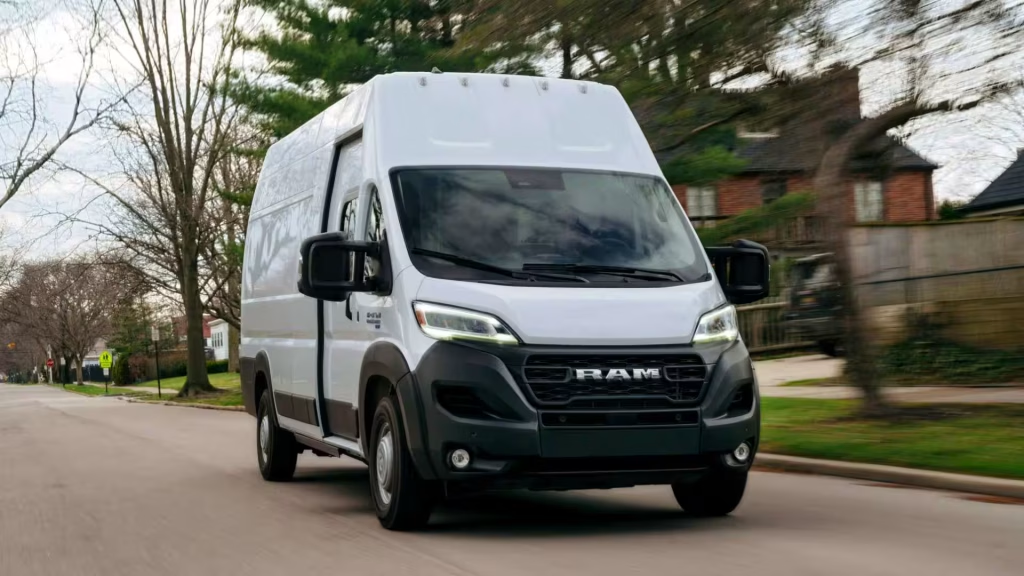
For Ram, the ProMaster EV is likely to remain an important part of that expansion in the United States. The van already provides an electric option for businesses, while Stellantis’ future platforms could eventually bring more capable and flexible commercial EVs to the market.
The bigger story is therefore not simply the ProMaster EV itself. Stellantis is rebuilding its commercial-vehicle business around electrification, software, fleet services, and multiple powertrain technologies.
The company is preparing 11 new commercial models through 2030, while its Pro One NEXT ecosystem aims to connect those vehicles more closely with the businesses that operate them.
For U.S. fleet operators, that could mean more choices between battery-electric, hybrid, range-extended, and gasoline-powered vans and trucks. It could also mean greater use of software to manage charging, maintenance, vehicle utilization, and operating costs.
The Ram ProMaster EV represents the current electric starting point. Stellantis’ next generation of commercial vehicles will determine how far the company can take that strategy as commercial fleets gradually adapt to electrification and connected vehicle technology.
