
Hyundai Motor CEO José Muñoz has warned that Chinese automakers could make a rapid push into the U.S. market if Washington weakens the trade barriers and market-access restrictions that currently limit their ability to sell vehicles directly to American consumers.
Speaking to Reuters on September 18, Muñoz pointed to China’s growing presence in Europe as an indication of what could happen in the United States if restrictions are relaxed. He said Chinese vehicles are selling for 30% to 40% less than competing models in some European markets, putting pressure on established manufacturers.
His comments come as the U.S. automotive industry continues to debate how it should respond to Chinese manufacturers. Companies including BYD, Geely, and other Chinese brands have expanded rapidly in overseas markets, particularly in electric vehicles and plug-in hybrids.
At the same time, the Trump administration has indicated that Chinese automakers could potentially build vehicles in the United States, creating a different route into the American market than simply importing cars from China.
For Hyundai, the issue extends beyond trade policy. Muñoz also discussed the company’s autonomous-driving strategy and confirmed that Hyundai has delayed its own proprietary Level 2++ driver-assistance technology from late 2027 to late 2029 while it gathers more real-world data and validates the system.
Hyundai Sees China’s European Expansion as a Warning
Chinese automakers have already established a significant presence in Europe. Reuters reported that Chinese-brand vehicles represented more than 9% of new-car sales in the European Union during the first half of 2026, while Chinese brands accounted for about 15% of new registrations in the United Kingdom.
The U.K. has not imposed the same additional tariffs on Chinese-built EVs that the European Union introduced.
Muñoz specifically cited the U.K. as an example of how quickly Chinese manufacturers can gain ground when market-access barriers are lower.
He said Chinese vehicles have become substantially cheaper than competing products in countries such as Italy, Spain, and France. That price advantage has allowed Chinese companies to gain market share despite European trade measures. The United States currently presents a very different environment.
Chinese-built electric vehicles face tariffs of approximately 100%, effectively preventing them from competing directly in the U.S. passenger-vehicle market at normal imported-vehicle prices. However, the situation could change if Chinese manufacturers establish production facilities inside the United States.
President Donald Trump has said he would welcome Chinese automakers building vehicles in the country. That possibility is important because producing vehicles domestically could potentially allow Chinese companies to avoid some of the restrictions associated with importing finished vehicles from China.
Muñoz argued that Washington would need to establish conditions for Chinese companies entering the U.S. market rather than simply removing existing barriers.
His comments were not presented as a prediction that Chinese automakers will definitely dominate the U.S. market. Instead, he was pointing to the experience of Europe and warning that the competitive effect could be substantial if market-access conditions change.
The Hyundai CEO also acknowledged the technological progress made by Chinese automakers. Having previously run Nissan’s operations in China, Muñoz said he has been impressed by the pace of innovation, technological development, and improvement in China’s automotive industry.
That development is particularly relevant to Hyundai because Chinese manufacturers increasingly compete in areas that were once dominated by established global automakers, including EV technology, batteries, software, and connected-car systems.
Hyundai Delays Its Own Level 2++ System.
While discussing the competitive environment, Muñoz also addressed Hyundai Motor Group’s autonomous-driving development.
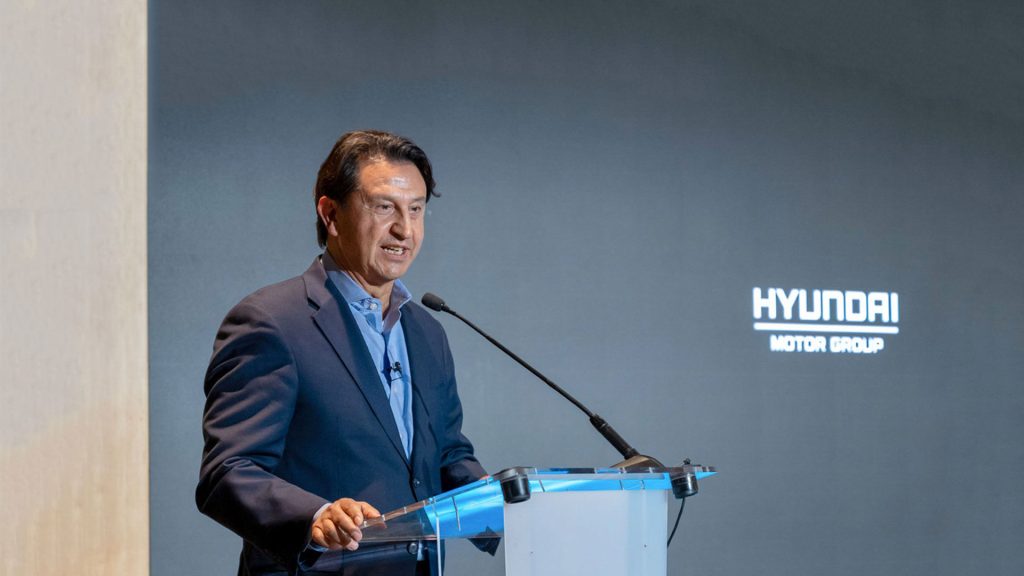
Hyundai had previously targeted the introduction of its own proprietary advanced driver-assistance software in vehicles beginning in late 2027. The company has now moved that target to the second half of 2029.
The delay does not mean Hyundai has abandoned the technology. Instead, the company says it needs additional time to collect data and validate safety performance before deploying its internally developed system at scale. In the meantime, Hyundai is taking a two-track approach.
The first involves a partnership with NVIDIA. Hyundai Motor Group plans to use NVIDIA’s vehicle AI computing platform and autonomous-driving software to bring Level 2+ vehicles to production in the first half of 2028, followed by Level 2++ vehicles in the second half of 2028.
The second track focuses on Hyundai’s own technology. The group’s proprietary Atria AI system is being developed by Hyundai Motor Group’s autonomous-driving organizations, including 42dot. Production vehicles using Atria AI-powered Level 2++ technology are targeted for the second half of 2029.
This strategy gives Hyundai a way to introduce more advanced driver assistance sooner while continuing development of its own software platform.
The company’s recent autonomous-driving strategy also relies heavily on data. Hyundai says its new Data Flywheel system links data collection, AI training, virtual validation, and deployment. The company is using production vehicles and dedicated data-collection vehicles to gather information that can be used to improve autonomous-driving models.
Hyundai is also using virtual environments to reproduce difficult real-world driving situations. Its system incorporates technologies such as 3D Gaussian Splatting to recreate driving environments and test autonomous-driving models against scenarios that can be difficult or unsafe to reproduce repeatedly on public roads.
Hyundai Wants More Control Over Key Technology
Muñoz’s comments also highlight a strategic tension inside Hyundai’s technology plans. The company is willing to work with NVIDIA to accelerate deployment, but the CEO said Hyundai ultimately wants to develop important technologies internally.
That includes autonomous-driving systems and batteries. Muñoz described vertical integration as an important long-term objective, while acknowledging that partnerships can provide useful technology during the development process.
Hyundai’s ownership of a U.S.-based autonomous-driving company, Motiona, also gives the group another technology resource as it develops its broader autonomy strategy.
The delayed Atria AI timeline shows how difficult it is for traditional automakers to develop advanced automated-driving systems while maintaining the testing and validation standards required for large-scale production.
The company is therefore using NVIDIA technology as an interim route while continuing to develop its own software.
The timing is significant because Chinese automakers are also investing heavily in autonomous-driving systems, software, and artificial intelligence. Hyundai is facing competition not only in vehicle prices but increasingly in the technologies that determine how vehicles operate.
That makes Muñoz’s two warnings closely connected. Chinese manufacturers are gaining ground through rapid product development and competitive pricing, while Hyundai is simultaneously trying to accelerate its own transition toward software-defined and increasingly automated vehicles.
For the U.S. market, the immediate situation remains heavily shaped by trade policy. Chinese EV imports face major tariff barriers, while the possibility of Chinese companies establishing American manufacturing could create a different competitive landscape.
For Hyundai, the response is likely to involve both manufacturing and technology. The company is expanding its U.S. production footprint while investing in batteries, software, artificial intelligence, and advanced driver assistance.
Muñoz’s comments do not establish that Chinese automakers will enter the United States at a particular scale or within a specific timeframe. They highlight a potential scenario based on the changes already visible in Europe.
Meanwhile, Hyundai’s revised autonomous-driving timetable shows that the company is taking additional time before putting its proprietary Level 2++ system into production. NVIDIA-backed Level 2+ and Level 2++ systems are now targeted for 2028, while Hyundai’s own Atria AI-powered Level 2++ vehicles are planned for late 2029.
These developments place Hyundai amid two major changes in the global automotive industry. Chinese automakers are becoming more competitive, while vehicle development is increasingly shifting from traditional engineering toward software, artificial intelligence, and automated driving technology.
