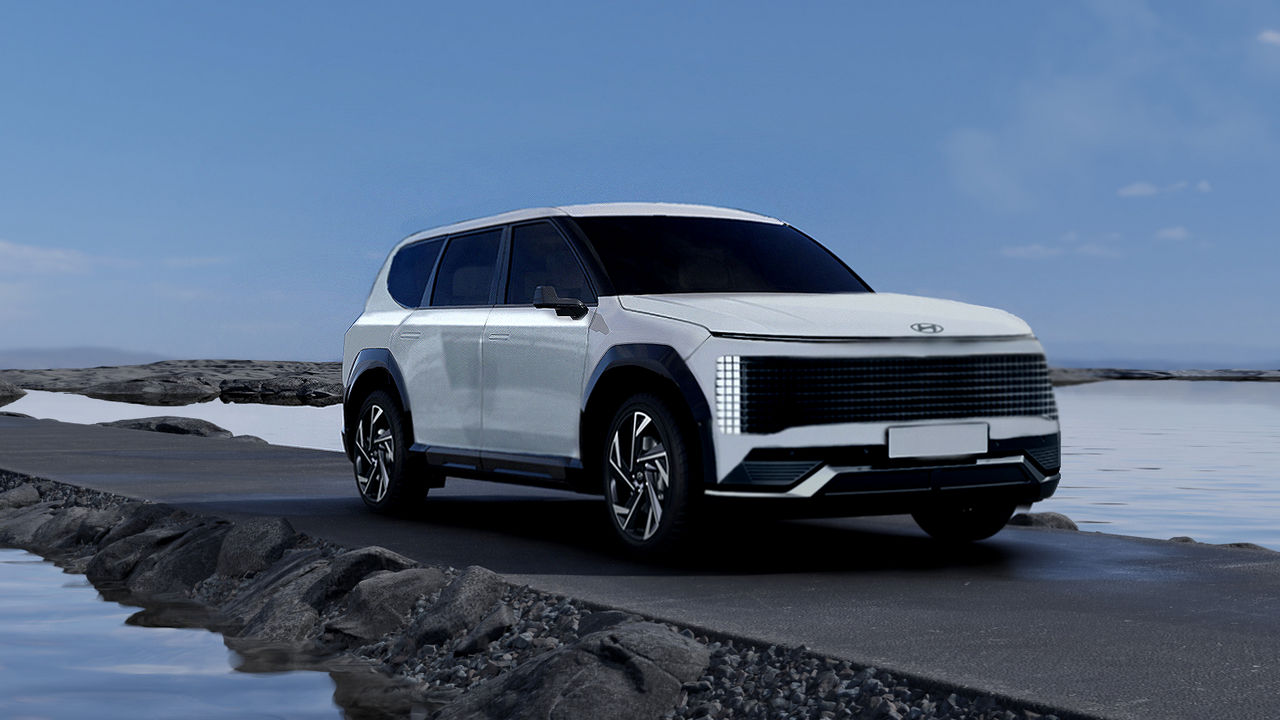
Hyundai is reportedly preparing two new electric SUVs for its Ioniq family as the automaker moves to fill important gaps in its battery-electric lineup. The reported Ioniq 4 and Ioniq 7 would sit in different segments, giving Hyundai additional options between the existing Ioniq 3, Ioniq 5, and Ioniq 9 as competition in the global EV market becomes increasingly crowded.
The models have not been officially confirmed by Hyundai under those names, so their reported specifications, launch timing, and market availability should be treated as provisional. Autoblog, citing Auto Express, reports that Hyundai is targeting the two crossover SUVs for launch within roughly the next 12 to 18 months.
The reported expansion comes shortly after Hyundai’s 2026 CEO Investor Day, where the company announced plans to launch or refresh more than 100 vehicles globally by 2030.
Hyundai said those products would include entries into new market segments and a broad mix of powertrain technologies, reflecting a strategy that does not depend exclusively on battery-electric vehicles.
That makes the potential Ioniq 4 and Ioniq 7 particularly interesting. Rather than simply adding larger or more expensive EVs, Hyundai appears to be targeting segments where relatively affordable electric crossovers can attract mainstream buyers.
Ioniq 7 Could Fill a Major Gap in the Lineup
The reported Ioniq 7 would occupy the space between the Ioniq 5 and the larger three-row Ioniq 9. That would give Hyundai an electric SUV positioned for customers who need more interior space than the Ioniq 5 provides but do not necessarily want the size and price of the Ioniq 9.
According to Autoblog’s report, the Ioniq 7 is expected to have a more conventional SUV shape than the Ioniq 5 and could be offered with either two or three rows of seating. That would make it particularly relevant to family buyers who prioritize passenger space and practicality.
The reported powertrain strategy is also ambitious. The Ioniq 7 is expected to offer single-motor and dual-motor configurations, while an 800-volt electrical architecture could provide the fast-charging capability that has become an important selling point for Hyundai’s dedicated EVs.
A reported WLTP range of at least 400 miles has also been mentioned, although Hyundai has not officially confirmed a range figure.
The potential use of 800-volt technology would place the vehicle within the technical philosophy already associated with Hyundai’s E-GMP-based EVs.
Fast charging has been one of the major strengths of Hyundai’s dedicated electric models, and extending that capability into another SUV could help the company compete against newer electric crossovers from both established automakers and Chinese manufacturers.
The Ioniq 7 could also receive Hyundai’s newer Pleos infotainment system and over-the-air software update capabilities, according to the report. These details remain unconfirmed, however, and should not be confused with official specifications.
One important correction to the naming story is also necessary. Hyundai originally announced an Ioniq 7 as one of its planned dedicated EVs when it established Ioniq as an electric-vehicle sub-brand.
The production three-row vehicle that eventually arrived was instead named the Ioniq 9, leaving the Ioniq 7 name available for a potential future model.
That makes the reported name plausible, but Hyundai has yet to formally confirm that the upcoming midsize SUV will carry it.
Ioniq 4 Targets the More Affordable End
The reported Ioniq 4 would approach the EV market from the opposite direction. Rather than filling a midsize family-SUV gap, it is expected to be a smaller crossover positioned between the Ioniq 3 and Ioniq 5.
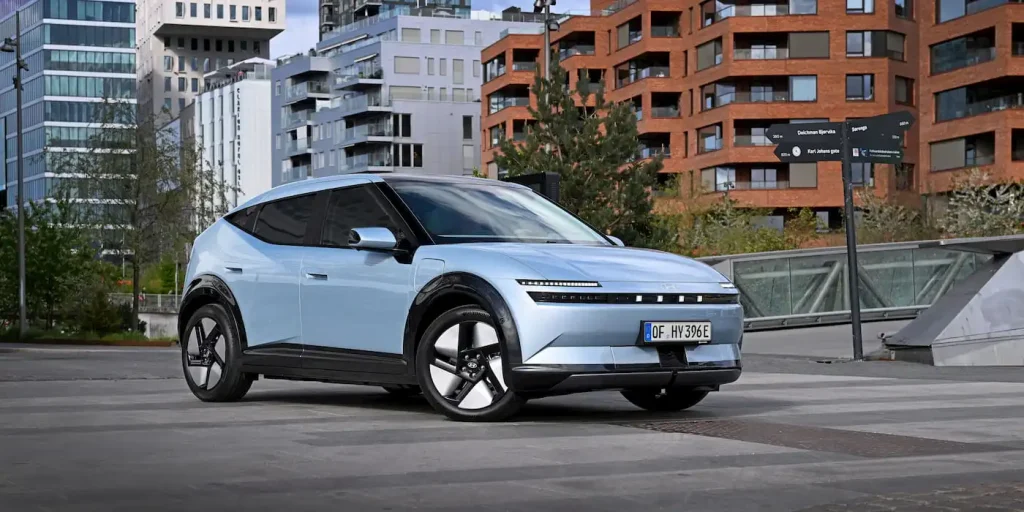
Autoblog reports that the Ioniq 4 would effectively take over the space currently occupied by the Kona Electric and compete against smaller electric crossovers such as the Renault 4 and Skoda Epiq in Europe.
This segment could become strategically important for Hyundai. Electric vehicles have expanded rapidly at the upper end of the market, but affordability remains one of the biggest barriers to broader adoption. A smaller and less expensive Ioniq could allow Hyundai to reach customers who cannot justify the price of a larger electric SUV.
Hyundai’s own strategy announcement supports the broader direction. The company said it plans an extensive series of new products through 2030, including an all-new global B-segment SUV and an all-new B-segment SUV for Europe. It also announced an A-segment electric SUV for India.
Hyundai Europe product chief Chris McKinnon has also acknowledged that the smaller electric SUV segment is important to the company, although he declined to confirm details about the reported Ioniq 4.
That means there is supporting evidence for a new small electric SUV program, even though the Ioniq 4 name and final specifications remain unconfirmed.
The reported technical package could include battery capacities of approximately 42 kWh and 61 kWh, paired with a front-mounted electric motor. Those details come from reporting around the vehicle and are not official Hyundai specifications.
The smaller vehicle could be particularly important in Europe, where compact electric crossovers are becoming a major battleground. Hyundai already has experience with the Kia EV3 through its wider Hyundai Motor Group portfolio, giving the group a technical and commercial reference point for a Hyundai-branded competitor.
The Ioniq 4 could therefore provide Hyundai with an opportunity to combine the distinctive Ioniq design language with a more accessible body style and price point.
Hyundai’s EV Strategy Is Expanding, Not Going All-Electric
The reported Ioniq expansion comes at an interesting point in Hyundai’s product strategy. The company remains committed to electric vehicles, but its latest roadmap shows a deliberate move toward multiple powertrain technologies.
At its August 2026 investor day, Hyundai said it expects to launch or refresh more than 100 models by 2030. The company is also developing extended-range electric vehicles, hybrids, and conventional powertrains alongside battery EVs.
Hyundai expects its first EREV to arrive in the first half of 2027. The company says that vehicle will combine electric driving characteristics with the convenience of an onboard engine-generator system and is expected to offer more than 600 miles of total range.
That approach reflects a broader change across the automotive industry. Automakers are increasingly trying to offer customers different electrification levels rather than assuming every market will move to battery-electric vehicles at the same pace.
Hyundai’s Ioniq family, however, remains central to its dedicated EV strategy. The Ioniq 5 established the sub-brand internationally, the Ioniq 6 added a sedan, and the Ioniq 9 expanded the range into the large three-row SUV category. The Ioniq 3 has also expanded the family into the European compact segment.
Adding an Ioniq 4 and a midsize Ioniq 7 would consequently give the brand a much broader SUV presence.
The timing could also prove important. Hyundai is competing against established EV manufacturers while facing increasingly strong products from Chinese automakers. Smaller electric SUVs are particularly competitive because they combine the practicality of a crossover with a lower entry price than larger battery-powered vehicles.
For Hyundai, filling those gaps could help prevent customers from leaving the brand simply because there is no appropriately sized electric model available.
The potential Ioniq 4 and Ioniq 7 also show why Hyundai’s future EV strategy is likely to focus heavily on segmentation. The company is not simply adding electric versions of existing vehicles. It is building a dedicated range intended to cover different sizes, prices, and customer requirements.
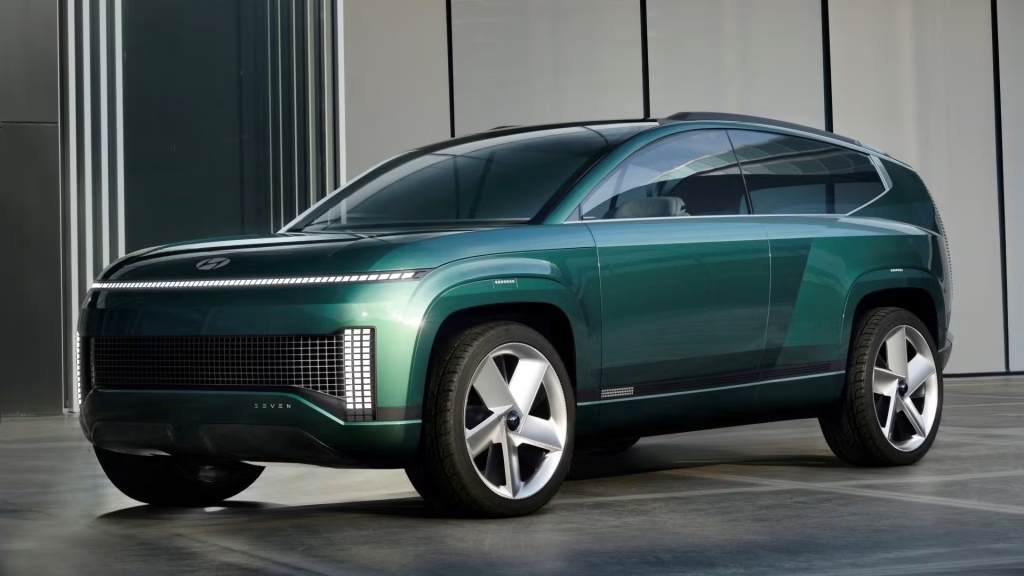
Still, there is a clear distinction between what Hyundai has officially announced and what has been reported. Hyundai has confirmed an aggressive product expansion and several new electric products, but it has not formally announced the Ioniq 4 or Ioniq 7 by name.
Their reported launch schedules, specifications, pricing, and availability therefore remain subject to change.
If the reports prove accurate, the two SUVs would significantly strengthen Hyundai’s dedicated EV portfolio. The Ioniq 4 could give the brand a stronger presence among affordable compact electric crossovers, while the Ioniq 7 could address customers looking for a family-oriented SUV between the Ioniq 5 and Ioniq 9.
That would leave Hyundai with a considerably broader Ioniq lineup at a time when electric-vehicle competition is becoming more intense across nearly every segment.
The biggest question is no longer whether Hyundai intends to expand its EV portfolio, which its latest corporate roadmap clearly demonstrates, but how quickly the company can bring those products to market at prices that mainstream buyers are willing to pay.