Toyota is taking its Woodland identity beyond a single model with five concepts planned for the 2026 Specialty Equipment Market Association (SEMA) Show in Las Vegas.
The RAV4 Plug-in Hybrid, Grand Highlander, Sienna, bZ, and Crown Signia have each received an outdoor-focused treatment developed with help from Toyota’s California-based CALTY Design Research team.
The concepts share lifted stances, all-terrain tires, protective-looking bodywork, and a distinctive blue finish, but their significance goes beyond appearance.
Toyota is showing how family vehicles and electrified models could be adapted for outdoor use without being replaced by traditional off-road trucks. These are design and accessory prototypes, not announced production packages.
Five Different Vehicles Share One Woodland Identity
Toyota’s five-vehicle showcase applies a common design language to vehicles with very different roles. The RAV4 Woodland Plug-in Hybrid Concept is the compact option, while the Grand Highlander Woodland Concept targets families needing three-row space.
The Sienna Woodland Concept brings the treatment to a minivan, the BZ Woodland Concept carries it into the battery-electric segment, and the Crown Signia Woodland Concept gives the premium-oriented crossover a more rugged appearance.
Toyota says the group is intended to connect everyday transportation with trips to trailheads and campsites.
The shared appearance is deliberate. CALTY Design Research created a consistent visual and functional identity built around lift kits, large over-fenders, satin-black wheels, and all-terrain tires. Roof racks and crossbars add carrying capacity for equipment, while contrasting two-tone paint gives the vehicles a more purposeful look.
Every concept wears Horizon Blue, a shade inspired by Toyota’s 1960s color palette and vehicles such as the Stout, Crown, and Corona. The blue finish links the otherwise unrelated models and gives the display a recognizable family resemblance.
The Sienna is perhaps the most unexpected member of the group. Minivans are designed around passenger access, interior space, and family convenience, rather than rugged terrain. Giving it a lifted stance, all-terrain tires, and roof-mounted equipment reframes it as a potential base for road trips and campsite travel.
It does not turn the Sienna into a dedicated off-roader, but it demonstrates how Toyota could appeal to buyers who want a practical family vehicle with a more outdoors-oriented character.
The bZ concept makes a similar point from the electric side. Rather than treating battery-electric vehicles as city-only transportation, Toyota is including an EV in a display focused on getting beyond paved roads.
The concept lineup therefore spans plug-in hybrid, hybrid, and battery-electric technology, showing that Toyota sees the Woodland theme as an equipment and lifestyle direction rather than a label tied to one type of powertrain.
CALTY’s Design Adds Adventure Styling, Not Confirmed Off-Road Hardware
The Woodland concepts look more capable because of their raised ride heights, chunkier tires, and expanded wheel-arch treatment. Those elements can improve the appearance of ground clearance and provide space for more rugged tire choices.
Roof racks and crossbars also make the vehicles look ready to carry camping equipment, bicycles, or other recreational gear. However, Toyota has not published lift heights, suspension specifications, approach or departure angles, underbody protection details, or changes to four-wheel-drive systems for these five concepts.
That distinction matters. A lift kit and all-terrain tires can be useful on gravel roads, uneven campsite access routes, and other moderate surfaces, but they do not automatically make a vehicle suitable for difficult trails.
Genuine off-road performance depends on factors such as ground clearance, suspension articulation, traction management, tire construction, underbody protection, and drivetrain capability. Without those specifications, it would be inaccurate to describe the Woodland concepts as serious off-road builds.
Toyota’s own disclaimer reinforces the prototype nature of the display. The company says the vehicles are special project prototypes modified with parts and accessories that may not be available from Toyota.
It also warns that the modifications could void the vehicle warranty, negatively affect performance or safety, and may not be street legal. In other words, the concepts are intended to communicate a design direction, not serve as a ready-to-order list of factory upgrades.
The use of CALTY is also worth noting. Toyota’s North American design studio has a role in shaping the visual direction of the concepts, bringing the vehicles together through a consistent treatment rather than making each one look like an independent aftermarket build.
The Horizon Blue paint connects the display to Toyota’s history, while the black accents, over-fenders, and wheel-and-tire combinations give the models a contemporary outdoor aesthetic.
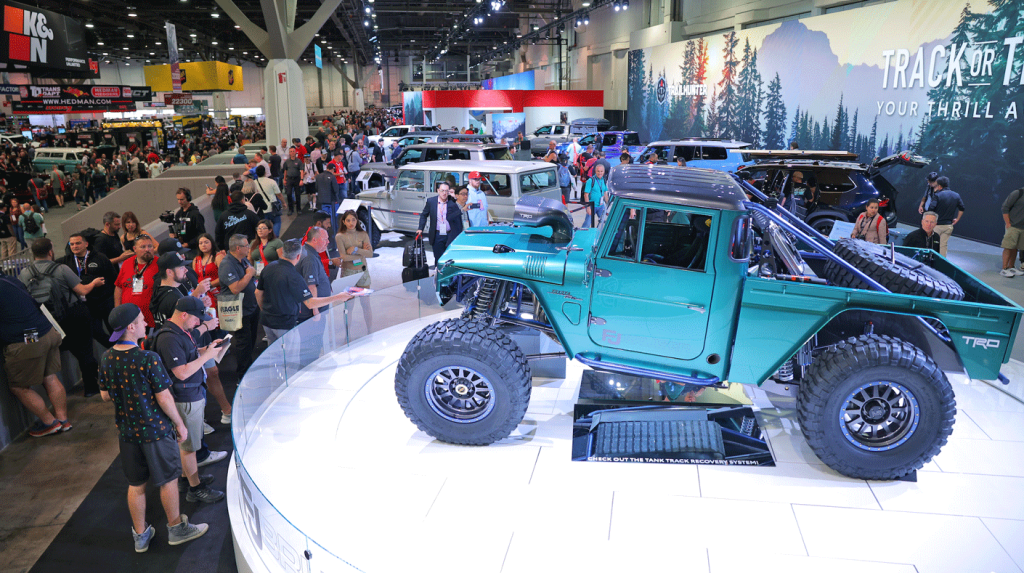
This is different from Toyota’s Snowhunter concepts, also planned for the 2026 SEMA event. That separate five-vehicle group uses tracked running gear and winter-specific equipment on the Tundra, Tacoma, 4Runner, Land Cruiser, and Sequoia.
The Woodland family takes a more moderate approach, prioritizing everyday practicality through passenger vehicles and electrified models. Together, the two concept families highlight Toyota’s different approaches to adventure, with one emphasizing snow-ready designs and specialized equipment, while the other focuses on versatility for a wider range of lifestyles.
Woodland Could Become a Wider Identity Across Toyota’s Lineup
The timing of the concepts is significant because Toyota has already used Woodland branding on production vehicles. The name is not entirely new, and the SEMA display should not be read as confirmation that five additional Woodland trims are entering showrooms.
Instead, Toyota is demonstrating how the theme could be extended across more of its range, including vehicles that are not normally associated with outdoor-focused styling.
That direction makes commercial sense. Many buyers want vehicles that can handle daily commuting, school runs, and long-distance travel but also look appropriate at a campsite or on a rough access road.
They may not need the extra cost, size, or fuel consumption of a specialized off-road SUV. A factory-developed appearance and accessory package could offer a middle ground, provided it preserves the comfort, efficiency, and practicality that attracted buyers to the original vehicle.
The five concepts also give Toyota a way to connect its electrification strategy with outdoor recreation. The RAV4 plug-in hybrid can combine electric driving with gasoline-powered flexibility, while the bZ represents a fully electric approach.
The Grand Highlander and Crown Signia bring hybrid capability to different sizes and price positions, and the Sienna emphasizes passenger and cargo utility.
Toyota has not disclosed whether the concept modifications affect range, fuel economy, towing ratings, or payload, so those figures should not be assumed to match the standard production models after modification.
The SEMA setting allows the company to gauge reactions from enthusiasts, owners, and the aftermarket industry. SEMA is a major venue for customized vehicles, accessories, and performance products, making it a useful place to present design ideas that may influence future parts or packages.
Still, Toyota has not announced production plans, pricing, availability, or a timetable for bringing these exact builds to dealerships. Any suggestion that the concepts will become factory options remains speculation.
For now, the Woodland family is best understood as a preview of how Toyota could broaden the appeal of its mainstream vehicles. The five concepts do not establish new off-road capabilities or confirm a new production sub-brand.
They show a consistent styling and equipment direction applied to several different vehicle types, including hybrids and an EV. If Toyota eventually offers selected components through its accessory channels, the concepts could provide a template for owners who want more outdoor character without moving to a dedicated truck or off-road SUV.
Until then, their main achievement is making the case that adventure-oriented design can extend well beyond traditional off-road vehicles.