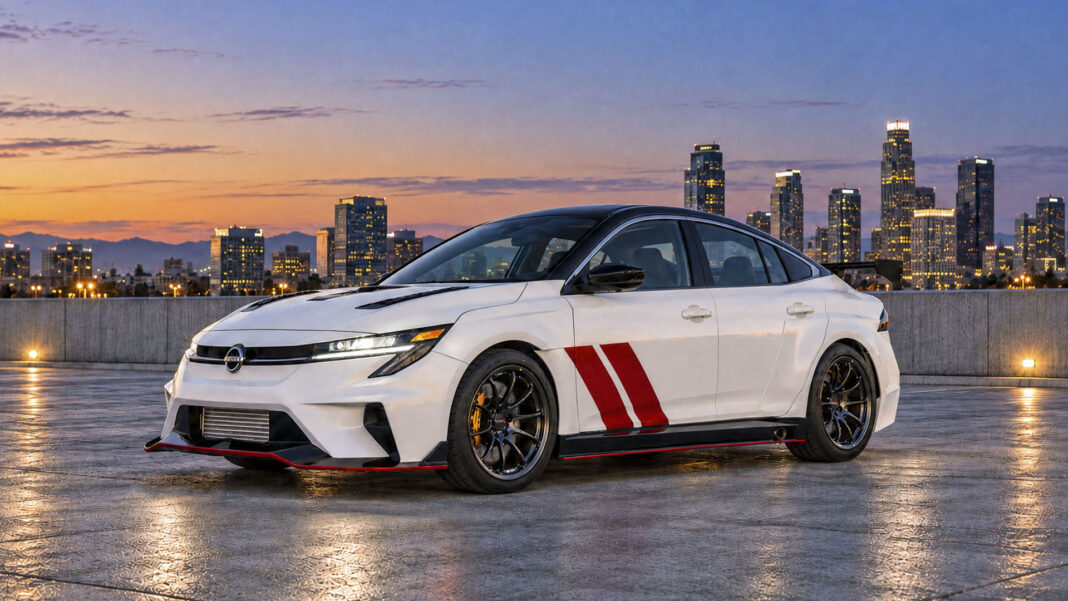
Nissan is using the 2026 SEMA Show to remind American enthusiasts that its performance identity extends well beyond the Z sports car. The company is bringing back the Sentra Spec-V name through an extensively modified compact sedan, while two additional Z-based projects highlight its motorsport and heritage connections.
The three builds celebrate different sides of Nissan’s enthusiast culture, from turbocharged front-wheel-drive performance to vintage sports-car restoration and track competition.
However, these are concept vehicles rather than previews of confirmed production models. Their real significance lies in the engineering ideas, parts, and customization possibilities Nissan wants owners to notice.
The Sentra Spec-V Returns With 300 Horsepower
Nissan’s choice of the Spec-V badge is deliberate. The company says the project marks 35 years since the Sentra SE-R first arrived in North America, connecting the new build to a period when compact Japanese sedans had a strong following among drivers who wanted practical cars with genuine performance potential.
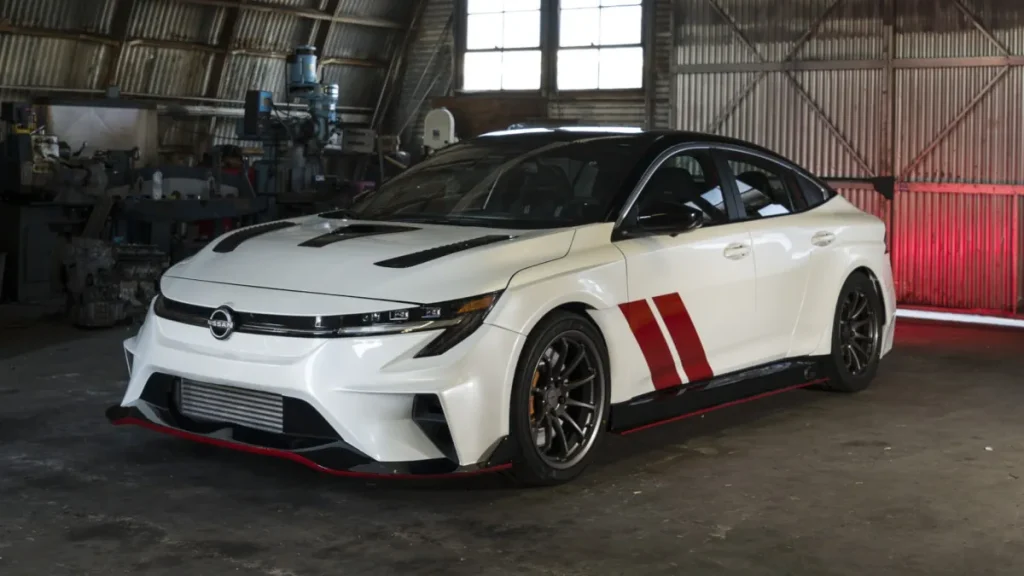
Rather than simply adding cosmetic parts, Nissan has reworked the powertrain, transmission, suspension, brakes, and interior.
The concept retains the Sentra’s 2.0-liter MR20DD four-cylinder engine, but the factory configuration has been transformed with a Garrett G25-550 turbocharger, a front-mounted intercooler, upgraded internal components, and supplementary port fuel injection.
Nissan’s detailed build sheet lists Carrillo connecting rods, JE pistons, ARP fasteners, and a custom fuel system. The result is a claimed 300 horsepower at the wheels, a substantial figure for a front-wheel-drive compact sedan.
Power reaches the front wheels through a modified six-speed manual transmission sourced from the Juke NISMO RS. The gearbox also receives a helical limited-slip differential, while a lightweight flywheel and upgraded clutch are intended to help manage the added output.
A key part of the concept’s appeal is Nissan’s decision to prioritize driver engagement by offering a manual transmission instead of focusing solely on acceleration and performance figures.
The chassis and braking upgrades are equally extensive. The car uses a track-focused version of the NISMO Sentra coilover setup, with revised damping and more aggressive spring rates, alongside NISMO anti-roll bars.
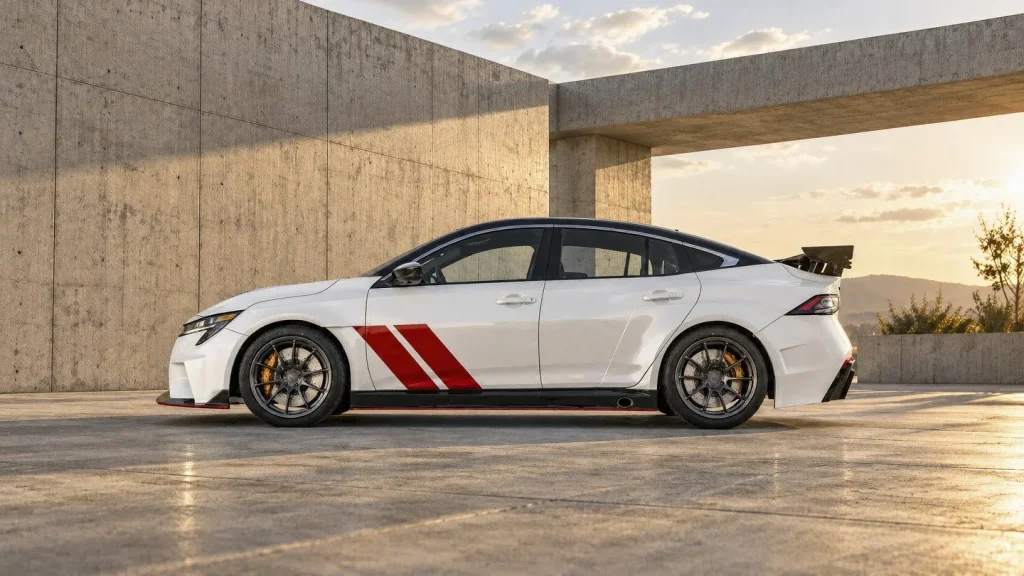
Its 19-inch NISMO LM-RS1 forged wheels wear 265-section Yokohama ADVAN NEOVA AD09 tires. Braking comes from an R35-generation GT-R NISMO conversion, including six-piston front and four-piston rear Brembo calipers.
The exterior makes the car’s intentions obvious. A BOMEX widebody kit, custom vented hood, side-exit exhaust, and large rear spoiler borrowed from the GT-R NISMO give the sedan a far more aggressive appearance than a standard commuter car.
Inside, GT-R-sourced Recaro front seats and a NISMO steering wheel reinforce the connection to Nissan’s performance catalogue.
There is an important distinction between this show car and a potential showroom model. Nissan has not announced plans to sell a production Sentra Spec-V, nor has it confirmed that the engine package will become a dealer-installed performance option.
The concept demonstrates what the platform and parts ecosystem can achieve when a manufacturer-backed build receives extensive engineering attention. It should not be mistaken for a new production sports sedan.
Project NAT2 Turns the Nissan Z Into an SCCA Race Car
Where the Sentra celebrates the sport-compact scene, Project NAT2 represents Nissan’s grassroots motorsport culture. The car was developed by the Nissan Acceleration Team, an all-volunteer group of Nissan employees who pursue racing projects outside their regular work responsibilities.
Their assignment was to take the Z beyond its road-going role and prepare it for competition under Sports Car Club of America Touring 2 specifications.
The project retains the Z’s twin-turbocharged 3.0-liter VR30DDTT V6, but its supporting hardware has been adapted for sustained track use. The engine features 38-millimeter turbo inlet restrictors to comply with class requirements, a NISMO cold-air intake, a GT4-style single-exit exhaust, and a custom calibration from Z1 Motorsports.
Nissan’s build sheet also lists upgraded cooling equipment, including an aluminum radiator, heat exchanger, and additional engine and differential oil cooling.
That cooling work matters because a car intended for repeated high-speed laps faces different demands from one driven on public roads. Temperatures rise during extended sessions, and engine oil, transmission fluid, and differential lubricant must cope with sustained loads.
The added cooling hardware is intended to help the car remain consistent during competition rather than deliver a short burst of performance.
Nissan has also made substantial changes to the cabin. Carpet, sound insulation, air-conditioning components, audio equipment, and other unnecessary trim have been removed. In their place are a competition-specification roll cage, a Sabelt racing seat, a six-point harness, window nets, and a fire-suppression system.
An AiM data logger and cockpit camera provide information that can help the team assess performance and driver inputs.
The suspension uses NISMO coilovers, adjustable anti-roll bar links, and revised control arms, supported by upgraded bushings and mounting hardware. The car sits on 18-by-11-inch forged wheels with 275-section Maxxis RC-1 competition tires.
Up front, a Z1 Motorsports big-brake kit uses six-piston calipers and 380-millimeter two-piece rotors. The rear retains its stock calipers and rotors to comply with Touring 2 class rules.
This is not simply a Z with racing stickers and a louder exhaust. Its stripped interior, safety equipment, cooling changes, and class-specific hardware show how much work is required to turn a road car into a serious competition machine.
The project also gives Nissan employees a way to develop practical motorsport experience and demonstrate how the company’s components can be used in a demanding environment.
The SCCA connection is particularly relevant to American enthusiasts because club racing offers a route into organized motorsport that does not require a factory-backed professional team. Project NAT2 is a manufacturer-supported showcase of that culture, although Nissan has not announced a customer race-car program based on this specific build.
The Datsun S30 Concept Connects Z Heritage With Modern Performance
The second Z-focused build takes a very different approach. Instead of preparing a modern car for a racing class, Nissan has worked with Formula Drift champion and longtime Z enthusiast Chris Forsberg to reinterpret the original Datsun S30.
The project combines the classic sports car’s shape with the powertrain and technology of a contemporary Nissan Z, creating a restomod that links two important chapters of the company’s sports car history.
Its most significant change is under the hood. The S30 receives the modern Z’s twin-turbocharged VR30DDTT V6, paired with a six-speed manual transmission.
Nissan’s build sheet lists Garrett PMAX turbochargers, NISMO cold-air intakes, a NISMO heat exchanger, and a twin-disc clutch and flywheel. A NISMO R200 limited-slip differential helps transfer power to the rear wheels.
The conversion goes well beyond an engine swap. The car receives a custom suspension package from Techno Toy Tuning, including billet components, front and rear coilovers, revised control arms, sway bars, and steering hardware.
Braking is upgraded with Wilwood components, using six-piston front calipers and four-piston rear calipers. The combination is designed to give the older chassis the control and stopping capability expected from a much more powerful modern performance car.
The exterior preserves the S30’s familiar silhouette while replacing several major panels with carbon fiber. The hood, front fenders, air dam, bumpers, hatch, and spoiler are among the lightweight components.
Nissan has finished the car in Seiran Blue and added a NISMO 40th anniversary decal set. Seventeen-inch NISMO forged wheels and modern tires complete the stance without abandoning the proportions that made the original Z recognizable.
The interior also mixes old-school character with modern equipment. OMP racing seats, a custom gauge package, a Grip Royal steering wheel, and a harness bar replace much of the original cabin’s feel.
The result is not intended to replicate a factory restoration. It is a performance-oriented reinterpretation that uses modern engineering to make a historic design more capable.
The Z Kaze concept will also have a place in Nissan’s SEMA display. This open-top custom Z made its debut at the 2026 ZCON gathering before being added to the show lineup. It is an independent project, however, and is not part of the two new Z builds introduced alongside the Sentra Spec-V.
That distinction matters because Nissan’s October 28 announcement focuses on three principal builds, while the Kaze adds another example of the brand’s ongoing enthusiast activity.
All of these vehicles are scheduled for display at Nissan’s booth, number 21521, in Central Hall at the Las Vegas Convention Center from November 3 to November 6. Nissan says the concepts are not for sale, although some Nissan and NISMO accessory parts used in the builds may be available through dealerships.
The company also says ideas developed for SEMA projects can influence future production vehicles, pointing to previous Rock Creek models as examples of concepts that eventually reached the lineup.
For Nissan, the three main concepts offer a useful way to speak to different enthusiast groups without announcing an entirely new production model. The Sentra brings back a performance badge with serious hardware, Project NAT2 highlights employee-led racing, and the S30 restomod celebrates the company’s sports-car history.
Whether any of these ideas influence future showroom vehicles remains uncertain, but the display gives Nissan a visible platform to reconnect with enthusiasts who want more than standard factory specifications.