
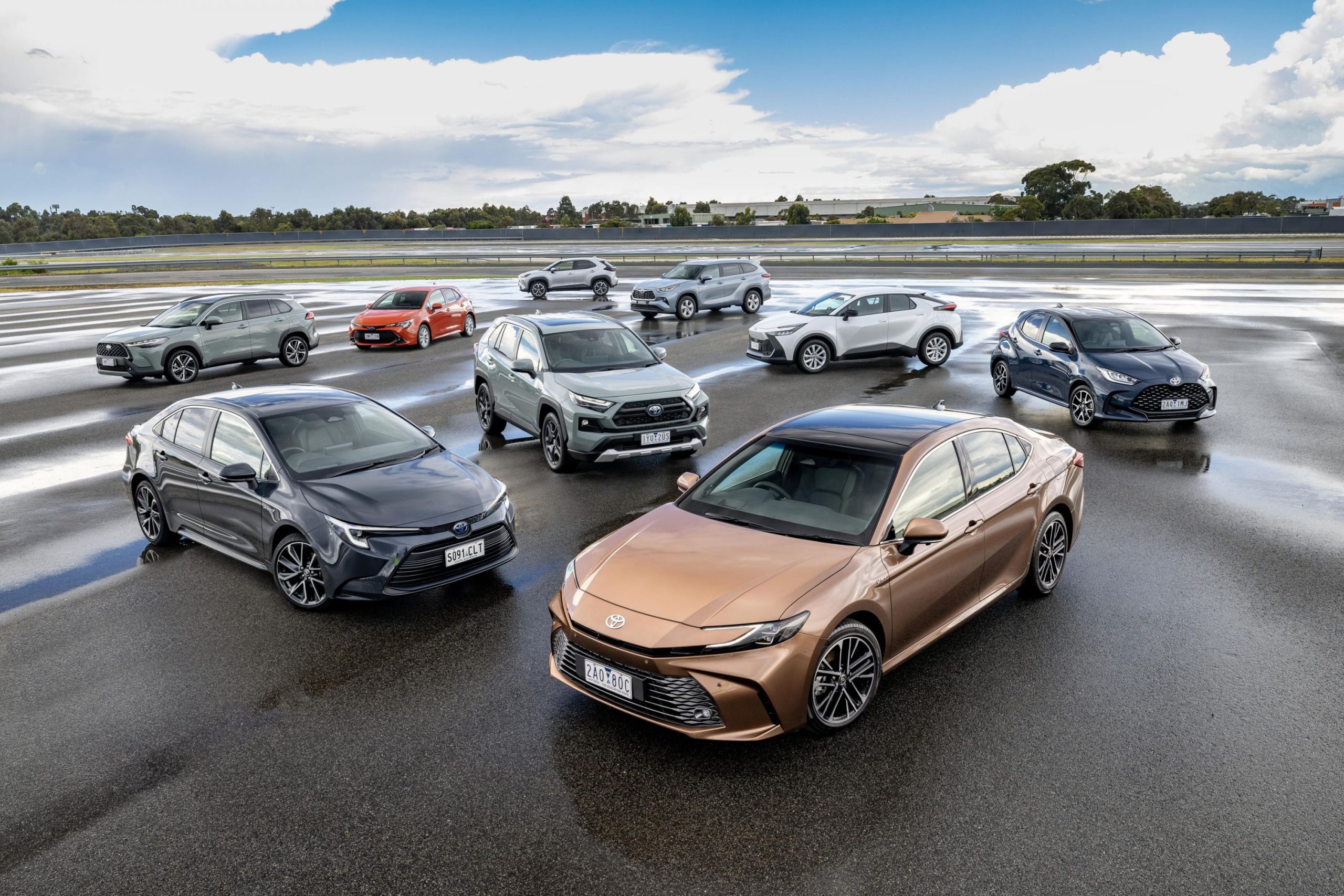
Toyota Motor Corporation has raised its full-year operating income forecast by 15% after stronger hybrid demand, a weaker Japanese yen, and lower tariff-related costs helped improve its financial outlook.
The automaker now expects operating income of ¥3.9 trillion (approximately $24.63 billion) for the fiscal year ending March 2027, compared with its previous projection of ¥3.4 trillion (approximately $21.48 billion). The revised outlook comes as Toyota also expands its shareholder-return plans and identifies robotics as a potential future business.
However, the results are not uniformly positive. Competition in China, changing trade conditions and rising material costs continue to challenge the company. Toyota’s latest announcement therefore combines stronger near-term financial expectations with a broader effort to prepare for growth beyond conventional vehicle manufacturing.
Strong Hybrid Demand Helps Toyota Raise Its Profit Forecast
Toyota announced its revised financial outlook on November 5, 2026, following the release of its second-quarter results for fiscal 2027.
The company increased its full-year operating income forecast from ¥3.4 trillion (approximately $21.48 billion) to ¥3.9 trillion (approximately $24.63 billion), a rise of approximately 15%. At the exchange rate used in Reuters’ reporting, the revised figure represents around $24.6 billion.
The improvement reflects several factors. Strong demand for hybrid electric vehicles has supported sales, particularly in the United States. A weaker yen has also increased the value of overseas earnings when converted into Japanese currency.
Toyota further said it had reduced the impact of U.S. tariffs and rising material costs through operational improvements, supply chain adjustments, and higher value chain earnings.
Hybrid vehicles remain an important part of Toyota’s product strategy. Unlike battery-electric vehicles, conventional hybrids combine a gasoline engine with an electric motor and a relatively small battery that is recharged through regenerative braking and the engine.
They do not generally require external charging, making them attractive to customers who want improved fuel efficiency without changing their refueling habits.
Toyota’s first-half sales figures reinforce the importance of this technology. Retail sales of Toyota and Lexus electrified vehicles reached approximately 2.81 million units during the six months ending September 2026, up 14.2% year over year.
Hybrid sales increased 8.3% to approximately 2.45 million units, while plug-in hybrid sales rose 33.2% to 130,000 units. Battery-electric vehicle sales more than doubled to 231,000 units, although they remained a much smaller part of the company’s electrified lineup.
The financial improvement also appeared in Toyota’s quarterly operating performance. Operating income for the July-September quarter rose 34% year over year to approximately ¥1.13 trillion (approximately $7.14 billion), exceeding the median analyst estimate of ¥992 billion (approximately $6.27 billion).
Reuters attributed the improvement to strong hybrid demand, currency movements, and lower tariff-related costs compared with the previous year.
However, Toyota’s revised forecast should not be interpreted as evidence that every part of its business is growing. Competition from Chinese manufacturers remains intense, particularly in battery-electric vehicles.
The company has also experienced weaker sales in China and the Middle East. Its ability to maintain profitability will depend on balancing regional demand, pricing, manufacturing costs, and investment in new technologies.
Toyota Expands Its Shareholder-Return Plans
Alongside the higher profit forecast, Toyota outlined a substantial increase in its planned shareholder returns. According to Reuters, the automaker intends to allocate up to ¥14 trillion (approximately $89 billion) to shareholder returns through March 2031. That is roughly double the amount returned during the preceding five years.
The plan reflects Toyota’s intention to improve capital efficiency while continuing to fund investments in manufacturing and technology.
The company has also increased its share-repurchase authorization for the current fiscal year. Toyota added ¥300 billion (approximately $1.90 billion) to the existing authorization, bringing the fiscal-year total to as much as ¥1.3 trillion (approximately $7.14 billion).
It also announced the cancellation of an additional 1 billion treasury shares, taking the planned fiscal-year total to 1.2 billion shares. These measures reduce the number of treasury shares held by the company and form part of its broader capital-management strategy.
Dividends are another part of the plan. Toyota forecasts a full-year dividend of ¥100 (approximately $0.63) per share for fiscal 2027, an increase of ¥5 (approximately $0.032) from the previous fiscal year.
The company also confirmed an interim dividend of ¥50 (approximately $0.32) per share, reflecting its stated policy of increasing dividends stably and continuously.
The scale of the shareholder-return announcement is notable because Toyota is also preparing substantial investments in its future operations. Its financial presentation identifies research and development, manufacturing improvements, electrification, advanced semiconductors, and robotics as important areas for long-term development.
The company must balance two key financial objectives, delivering value to shareholders while preserving sufficient funds to remain competitive in an evolving automotive market. Its expanded share repurchase program and long-term return targets suggest that management aims to meet investor expectations while making more effective use of its available capital.
However, the ¥14 trillion (approximately $88.42 billion) figure should not be confused with an immediate cash payment or a single share-buyback announcement. It represents a longer-term shareholder-return ambition extending through March 2031. The actual amount and timing will depend on future financial performance and capital-allocation decisions.
Robotics Emerges as Toyota’s Next Potential Growth Business
Perhaps the most interesting part of Toyota’s announcement is its intention to develop robotics into another major business. The company plans to establish a new organization called Toyota Robotics in January 2027 to accelerate commercialization.
Rather than treating robotics only as a supporting manufacturing technology, Toyota wants to develop it into a potential growth pillar alongside its vehicle and value-chain businesses.
Toyota has an existing advantage in industrial automation because it operates a large manufacturing network with extensive experience in production engineering. Its financial presentation highlights the potential to apply this knowledge to factory automation, logistics, human-robot collaboration, and eventually applications outside manufacturing.
The company describes three stages of factory automation. The first focuses on conventional rule-based robots performing specific tasks. The second involves coordinating machines and automating connected production and logistics processes. The third focuses on human-robot collaboration, where machines work alongside employees and support more complex tasks.
Toyota believes its manufacturing experience can help it develop robots that are reliable, productive, and suitable for real industrial environments. Its presentation points to data and expertise from approximately 60 plants and 18,000 skilled craftspeople as resources that could support development.
It also intends to use its automated-driving software expertise and production-management systems to improve robotic applications.
The initial commercialization strategy is focused on internal demand. Toyota and its group companies, along with suppliers, could become early customers for factory automation products.
Toyota estimates that replacement demand across these businesses could involve approximately 400,000 robots between 2028 and 2040. The company sees this internal market as a starting point before expanding into other industries and everyday applications.
The longer-term ambition extends beyond automotive factories. Toyota has identified delivery robots, household tasks, and lifestyle applications as possible areas of development. Its stated vision is to create robots that work alongside people and help expand human capabilities rather than simply replace human involvement.
However, these remain development and commercialization objectives, not evidence of an established large-scale robotics sales business.
The opportunity is significant because industrial automation is becoming increasingly important as manufacturers seek higher productivity, consistent quality, and more efficient use of labor.
Toyota’s experience with just-in-time production and manufacturing systems could provide a foundation for developing integrated automation solutions. The company will still need to compete with established robotics specialists and technology providers, particularly in hardware, software, and industrial integration.
Toyota’s wider investment strategy also includes artificial intelligence, advanced semiconductors, quantum technologies, and electrification. Its financial presentation identifies these areas as potential sources of future competitiveness, with investments intended to build technological capabilities and identify new commercial opportunities.
The company is therefore attempting to expand beyond traditional vehicle manufacturing without abandoning its core automotive business. Hybrids continue to generate substantial demand, while battery-electric vehicles and plug-in hybrids remain part of its broader electrification strategy.
Robotics offers another possible source of revenue over the longer term, particularly if Toyota can turn its internal manufacturing experience into products that other businesses are willing to purchase.
For now, the higher operating-income forecast reflects improvements in Toyota’s existing automotive operations, not earnings from a fully developed robotics business. The shareholder-return program and planned robotics organization represent separate parts of its longer-term strategy.
Toyota’s revised ¥3.9 trillion (approximately $24.63 billion) operating-income forecast highlights the strength of its hybrid business, while its shareholder-return and robotics plans show where management wants to take the company next.
The immediate financial improvement is measurable, but the success of its robotics ambitions will depend on turning manufacturing expertise into commercially viable products beyond its own factories.
