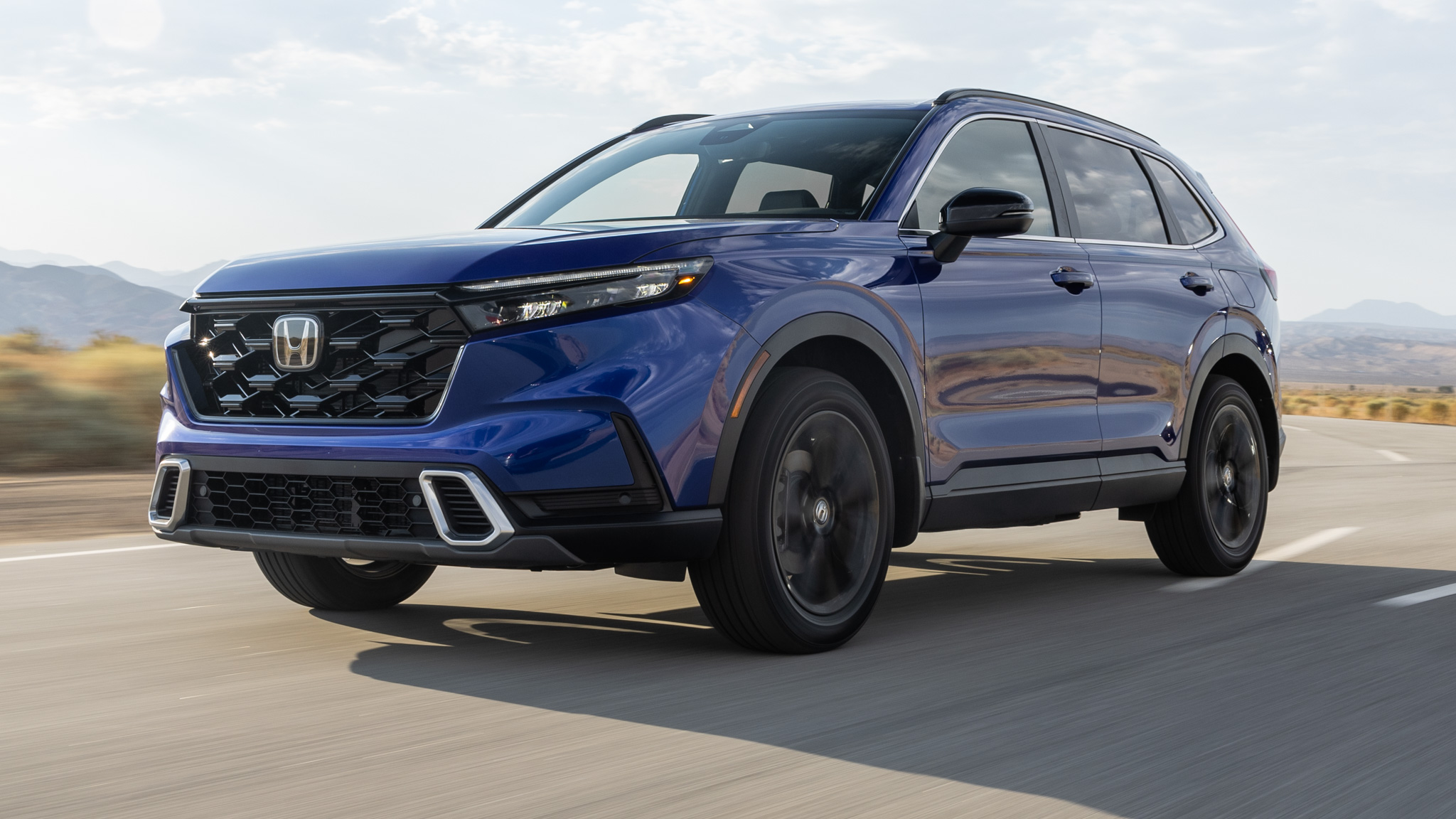
Honda has announced a major change for one of its key models, confirming that the next-generation CR-V will be offered exclusively with hybrid powertrains in North America. Announced on November 12, 2026, the seventh-generation SUV is expected to reach dealerships in 2027 as a 2028 model.
It will introduce a new vehicle platform, an updated two-motor hybrid system, and a redesigned exterior. The announcement marks a significant shift for the CR-V, which currently offers both gasoline and hybrid versions.
Honda is also preparing its North American factories to build the next-generation vehicle and its supporting hybrid components.
Honda Confirms a Hybrid-Only Seventh-Generation CR-V
Honda’s announcement confirms that the next CR-V will not follow the current model’s approach of offering separate gasoline and hybrid powertrains. Instead, every version of the seventh-generation SUV sold in North America is expected to use the company’s new two-motor hybrid system.
The vehicle will arrive next year as the 2028 Honda CR-V, even though its public debut and launch preparations take place during 2027.
The distinction between the announcement date and model year matters. Honda has not announced a 2027 model-year replacement. Its official release identifies the upcoming vehicle as the 2028 CR-V, with arrival planned for 2027. The new SUV will also mark the seventh generation of the nameplate, which first entered the market in 1995.
The decision reflects the growing importance of hybrid vehicles in Honda’s North American business. The company says hybrid versions already account for more than 50% of current CR-V sales.
Annual CR-V hybrid sales have increased nearly tenfold since the powertrain was introduced in 2020. That customer response gives Honda a commercial reason to make hybrid technology standard across the next generation.
The CR-V is particularly important to the company’s U.S. operations. Honda describes it as America’s best-selling SUV and says the model is on pace to exceed 400,000 sales for the third consecutive year.
Through October 2026, it was also the best-selling light-duty vehicle in the U.S. market, according to the automaker.
Honda reports that more than 7.5 million CR-Vs have been sold globally. The model has been its best-selling vehicle in the United States every year since 2017, making the next generation an important product launch for the brand.
A change to an all-hybrid lineup therefore affects a substantial part of Honda’s business, rather than a niche vehicle or limited trim.
The move also places the CR-V closer to the strategy used by some competitors. Toyota’s latest RAV4 lineup has moved to hybrid-only power in the United States, creating a direct comparison between two of the most prominent compact SUVs.
Honda’s decision suggests that it believes hybrid technology can serve a wider range of CR-V buyers without requiring a separate conventional gasoline model.
However, Honda has not yet released the complete seventh-generation lineup. Trim names, prices, final output figures, equipment levels, and detailed exterior dimensions remain unannounced. Those details will be important in understanding how the new CR-V will be positioned against the Toyota RAV4 and other compact SUVs.
New Platform and Fifth-Generation Hybrid System Bring Major Changes
The seventh-generation CR-V will introduce an entirely new platform developed to balance body rigidity with lower weight. Honda says the architecture will use a modular design that allows greater parts commonality across different vehicles.
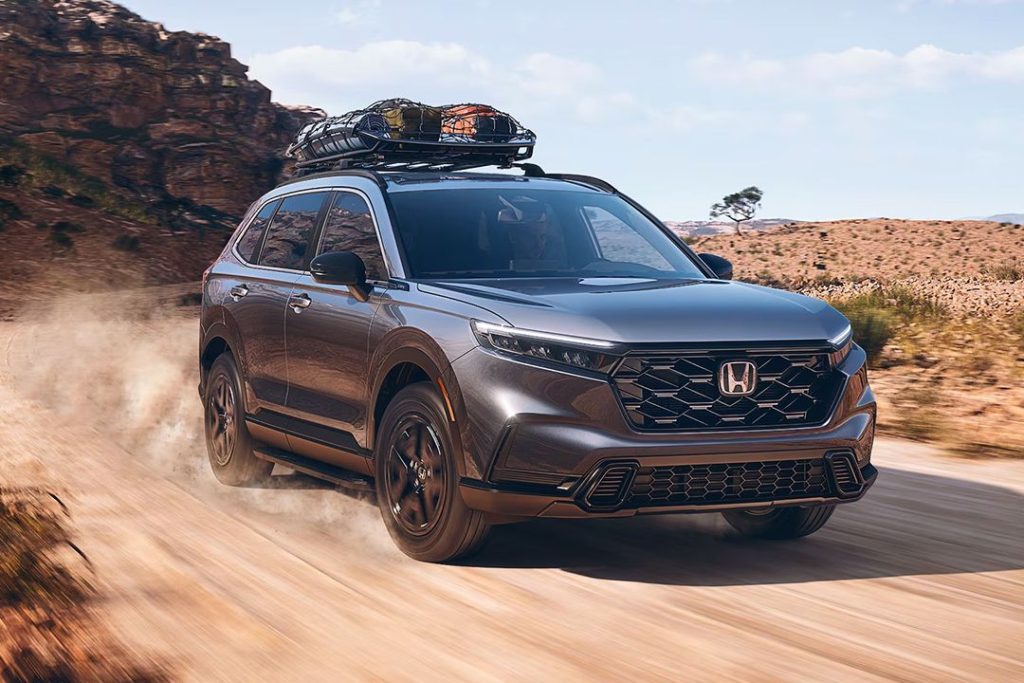
This approach can help the company use shared components and manufacturing processes across multiple models instead of developing every vehicle around a completely separate structure.
For customers, the platform’s development priorities could influence several areas of the driving experience. A stiffer body structure can help engineers tune suspension and steering responses, while reducing unnecessary weight can support efficiency and vehicle performance.
Honda says the new architecture is intended to deliver a more engaging driving experience while maintaining the versatility expected from a family-oriented SUV.
The new platform will debut alongside the next generation of Honda’s two-motor hybrid system. The automaker describes it as the fifth generation of its hybrid technology, with improvements intended to increase both performance and fuel efficiency.
Honda says the system has been developed to expand the operating range in which the gasoline engine runs at its most efficient point. It has also improved the driving efficiency of the hybrid unit.
Honda has not disclosed the new system’s final horsepower or torque figures for the CR-V. The current 2026 and 2027 CR-V Hybrid models use a two-motor hybrid powertrain producing 204 horsepower.
That figure provides a reference point, but it should not be treated as the confirmed output of the upcoming SUV. The new generation is expected to bring changes to the hybrid system, and its final specifications have yet to be published.
Fuel efficiency is another major target. Honda says it aims to improve the next-generation hybrid model’s fuel efficiency by more than 10%. The company has not yet published official EPA estimates, so the final city, highway, and combined mileage figures remain unknown.
The current CR-V hybrid provides useful context for understanding the target. The 2027 model’s hybrid versions are rated at up to 43 mpg in city driving and 36 mpg on the highway, depending on configuration.
These are figures for the existing vehicle, not confirmed ratings for the seventh generation. The more-than-10% improvement is Honda’s stated development goal, and actual EPA results will be needed before buyers can compare the new model directly with its predecessor.
Another important development is a newly designed electric all-wheel-drive unit. Honda says it will provide more precise and responsive motor control. This could be particularly relevant in a compact SUV, where buyers often want additional traction for rain, snow, and uneven road surfaces.
The company has not yet explained which trims will receive the system as standard or whether front-wheel drive will remain available.
The combination of a new platform, revised hybrid hardware, and electric AWD shows that Honda is treating the next CR-V as a substantial redesign rather than a simple styling update.
Nevertheless, the company has not provided detailed specifications for the battery, electric motors, transmission arrangement, or towing capacity. Those figures should not be assumed from the current model.
North American Production and Honda’s Wider Hybrid Strategy
Honda will continue producing the seventh-generation CR-V at three North American facilities, namely the East Liberty Auto Plant in Ohio, the Indiana Auto Plant, and Honda of Canada Manufacturing in Alliston, Ontario. This approach preserves the model’s established manufacturing presence across the region.
Honda says the factories will use domestic and globally sourced parts. The production plans are supported by investments in the company’s U.S. manufacturing operations.
Honda is retooling its Honda Transmission Plant in Ohio to build the next-generation hybrid power units. The facility is expected to produce the new system for the CR-V and other future compact and midsize vehicles manufactured in North America.
Honda says hybrid-system production capacity at the Ohio facility is expected to increase by 250% in the coming years. This expansion is intended to support a wider range of hybrid models rather than the CR-V alone.
The company is also preparing its Anna Engine Plant in Ohio to produce the next-generation four-cylinder Atkinson-cycle engine that will power the new CR-V and other future vehicles.
The Atkinson-cycle engine is designed to support efficiency in hybrid applications. Rather than focusing only on peak engine output, this type of combustion-cycle design is commonly used to improve fuel economy.
In Honda’s two-motor hybrid arrangement, the gasoline engine works alongside electric motors and the hybrid system’s control electronics to deliver power according to driving conditions.
Honda’s plans also extend beyond the CR-V. The company says the seventh-generation SUV will be the first of several new hybrid models it intends to introduce in North America by 2030. Hybrid sales have become an increasingly important part of its business, representing approximately 30% of Honda brand sales as of the November announcement.
The CR-V’s transition is therefore connected to a broader product and manufacturing strategy. Honda is investing in hybrid production capacity, engine manufacturing, and vehicle assembly so it can introduce additional electrified models while continuing to build vehicles in North America.
For buyers, the biggest unanswered questions concern pricing, performance, fuel economy, and equipment. Honda has not announced the new CR-V’s starting price, full trim structure, final power output, or EPA mileage ratings. It has also not shown the complete production-ready design.
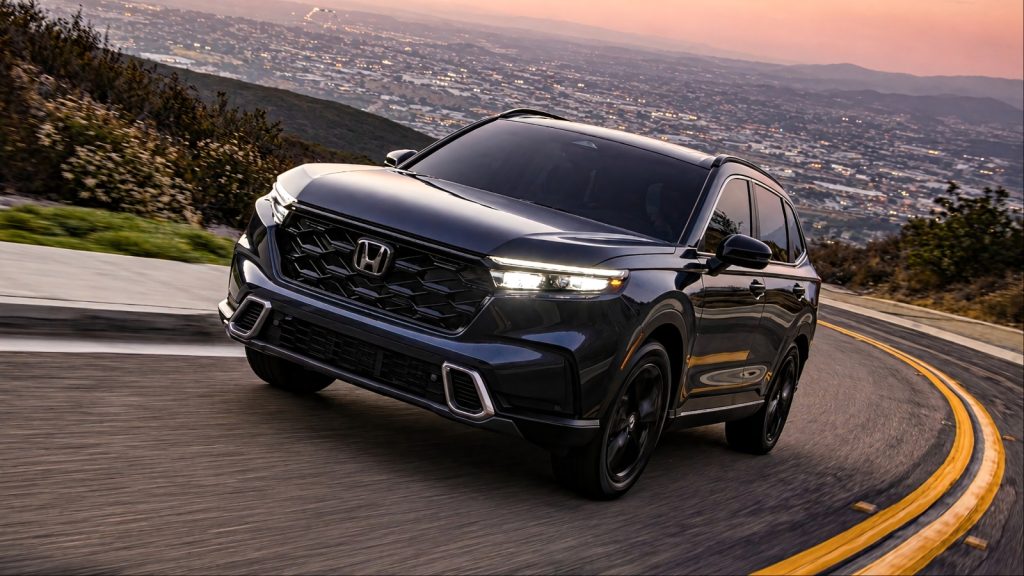
The company has confirmed a bolder new exterior, but detailed photographs and specifications will be needed to understand how substantially the SUV’s appearance and cabin will change.
The seventh-generation CR-V is shaping up to be an important turning point for Honda’s compact SUV. By making hybrid power standard, introducing a new platform, and targeting a fuel-efficiency improvement of more than 10%, the automaker is preparing a significant change to one of its highest-volume vehicles.
Its success will depend on whether the final model can deliver the efficiency, practicality, performance, and pricing that CR-V customers expect.