
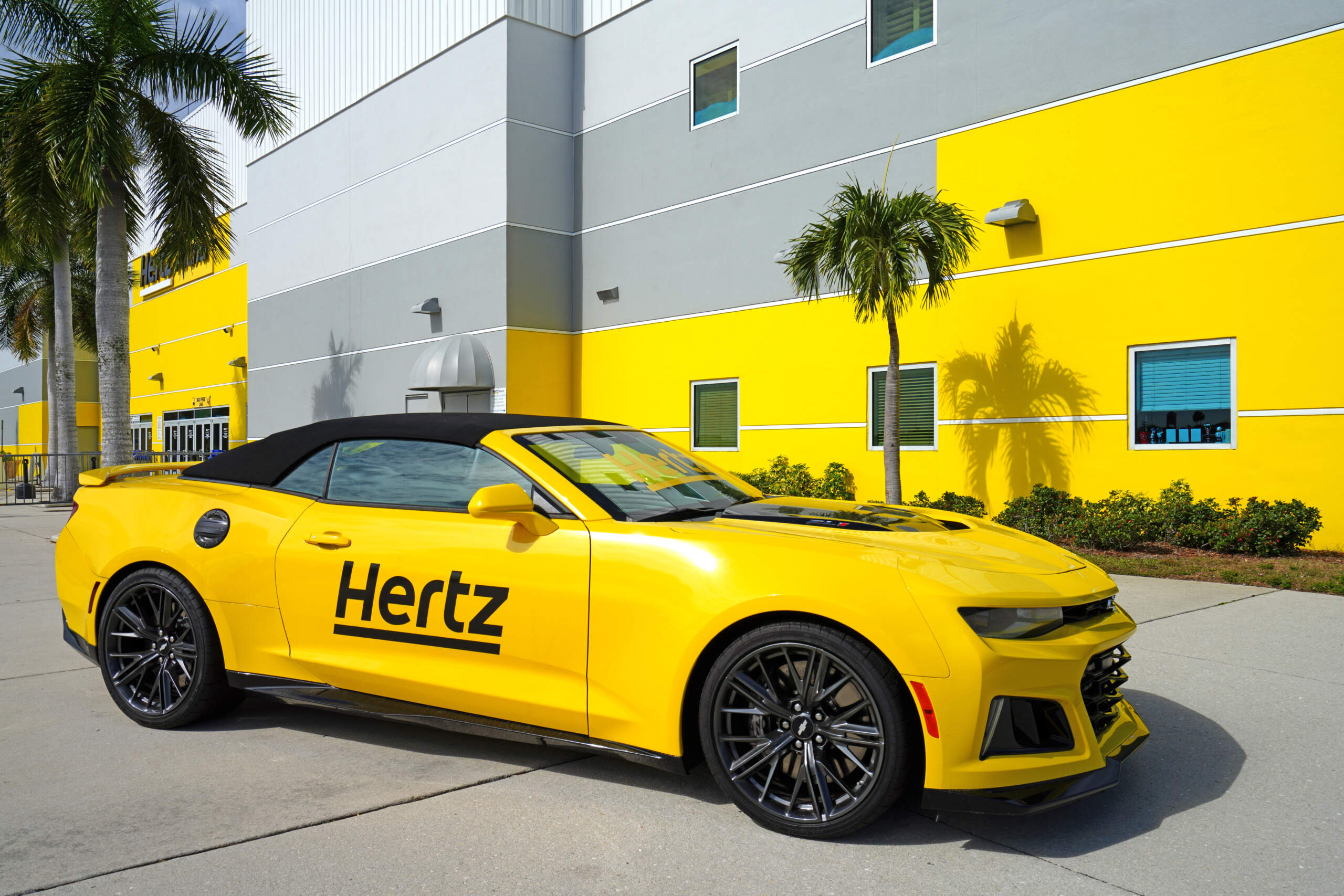
Hertz is ending its network of dedicated Hertz Car Sales stores as it moves toward a used-vehicle retail strategy built around online marketplaces, rental locations, and partnerships with larger retailers.
The decision marks a significant change for a company that has sold vehicles from its rental fleet directly to consumers through physical dealerships for years.
Customers will still be able to purchase Hertz vehicles, but the buying process will increasingly take place through HertzCarSales.com, Amazon Autos, eBay, and the company’s TestDrive+ program. The shift is intended to simplify operations, reduce selling costs, and reach shoppers through channels they already use.
Hertz Is Closing Its Dedicated Car Sales Locations
Hertz confirmed that it plans to close its dedicated Hertz Car Sales retail locations as it concentrates on digital sales and its nationwide rental network. The company explained that its retail strategy has evolved over the past year, with greater emphasis on online purchasing, retail partnerships, and the TestDrive+ program at participating rental branches.
Lauren Luster, Hertz’s senior director of external communications, said the company is focusing on these channels and using its extensive rental network instead of maintaining separate Hertz Car Sales locations.
The statement confirms the direction of the change, although Hertz has not publicly disclosed the exact number of stores affected or a final closure timetable.
DealershipGuy reported on November 9 that all physical Hertz Car Sales stores were expected to close, with closures reportedly scheduled to be finalized on November 20. However, the company did not confirm that date when contacted.
It is therefore important to distinguish the confirmed decision to close the dedicated retail network from the reported completion date.
The change follows a gradual reduction in Hertz’s physical sales footprint. The company operated approximately 70 Hertz Car Sales locations in June 2024. By August 2025, the network had fallen to around 45 stores.
Hertz’s own May 2026 announcement described a network of more than 46 locations, showing that the exact count varied with the timing of the reporting.
Hertz Car Sales was created to sell vehicles from the company’s rental fleet directly to consumers. Rental companies regularly replace vehicles to maintain fleet age, mileage, reliability, and customer expectations.
Selling those vehicles through retail channels can allow Hertz to reach buyers directly rather than relying exclusively on wholesale auctions or dealer transactions.
The dedicated stores provided customers with a traditional used-car buying experience, including the ability to view vehicles and work with sales staff in person. Closing these outlets does not mean Hertz is withdrawing from used-car retailing. Instead, it is changing where and how customers access its inventory.
The company has not announced what will happen to employees at the closing stores. Nor has it provided a store-by-store schedule or details about possible staff transfers. Those questions remain unresolved as the transition proceeds.
Online Marketplaces and TestDrive+ Will Replace the Store Network
Hertz says customers will continue purchasing vehicles through three primary channels, including its website, third-party online marketplaces, and TestDrive+ at more than 300 rental locations.
HertzCarSales.com is the company’s direct online sales platform. It allows shoppers to browse available vehicles and complete much of the purchasing process digitally. Hertz relaunched the website as a full e-commerce experience in 2025, reflecting its intention to make online retail a central part of its used-vehicle business.
The company has also expanded its relationship with Amazon Autos. Hertz joined the platform in August 2025 as its first fleet dealer, allowing customers to browse and purchase used vehicles through Amazon’s automotive marketplace.
The initial program covered customers within 75 miles of Dallas, Houston, Los Angeles, and Seattle, with vehicle pickup arranged through Hertz locations.
A second marketplace partnership followed in May 2026, when Hertz launched a dedicated digital showroom on eBay. The showroom initially offered more than 8,000 Hertz Certified vehicle listings, giving shoppers another way to search its rental-fleet inventory.
Hertz said vehicles listed through the eBay showroom undergo a 115-point inspection. The company’s announced Hertz Certified benefits included a 12-month or 12,000-mile limited warranty and a seven-day buy-back guarantee, subject to program terms.
These details are important because online vehicle purchases require shoppers to understand inspection standards, warranty coverage, return conditions, and delivery arrangements before committing.
The third channel is TestDrive+, an updated version of Hertz’s Rent2Buy program. It allows customers to rent a vehicle before deciding whether to purchase it. Hertz says the program is now available at more than 300 participating rental locations.
This approach gives shoppers an opportunity to experience a vehicle in everyday driving before completing a purchase. It also uses Hertz’s existing rental infrastructure rather than requiring the company to operate a separate used-car dealership.
Customers can access vehicles through rental branches, while Hertz can potentially convert some rental transactions into retail sales.
The combination of online marketplaces and rental locations gives Hertz a broader reach without relying on dedicated showrooms.
However, customers should check which vehicles are available in their area, whether test drives are offered for a particular listing, and what fees or delivery arrangements apply. Availability and program conditions can differ by location and vehicle.
Cost Control and Fleet Management Are Driving the Strategy
Hertz’s decision is part of a wider effort to simplify its business and improve the economics of selling vehicles. During the company’s November 5, 2026, earnings call, CEO Gil West said Hertz was prioritizing higher-yielding digital sales channels while using the scale of its used-car operation and rental locations.
West also described plans to build deeper relationships with a select group of large used-car retailers. Selling vehicles in volume to established retail partners can accelerate the disposal process and reduce the cost of selling each vehicle. Hertz says its goal is to sell cars faster, spend less on each sale, and earn more from every vehicle.
Operating physical dealerships involves expenses such as property, staffing, utilities, inventory display, and local retail operations. Moving more sales online and through existing rental locations could reduce the need for a separate store network. It may also allow Hertz to reach buyers outside the immediate areas surrounding its former sales locations.
The strategy is particularly relevant because Hertz manages a large vehicle fleet that must be regularly rotated. The company needs to balance rental demand, vehicle age, maintenance costs, resale values, and the timing of vehicle purchases and disposals. Retail sales are one way to recover value when vehicles leave rental service.
Hertz has previously said that retail sales can generate additional revenue from financing, warranties, title services, and other products. Its 2025 annual report described retail as an important vehicle-disposition channel because it can produce higher margins than wholesale alternatives.
The expanded online strategy is designed to preserve that retail opportunity while changing the cost structure used to reach customers.
There are still challenges. Online used-car retail depends on accurate vehicle descriptions, transparent pricing, reliable inspections, and convenient delivery or pickup. Customers may also want in-person assistance when evaluating a used vehicle, particularly when they cannot inspect it before purchase.
TestDrive+ and rental-location access could help address some of those concerns, but they will not fully replicate every feature of a traditional dealership.
The company has not disclosed how much it expects to save by closing the dedicated stores, how many sales will shift to Amazon or eBay, or what share will come through TestDrive+. It has also not published a final closure schedule or detailed employment plan.
For used-car shoppers, the main point is that Hertz is not stopping consumer vehicle sales. It is changing its retail model from a network of dedicated stores to a combination of online platforms, retail partners, and rental locations.
If the transition works as intended, Hertz could lower selling expenses while keeping access to a nationwide customer base. The results will depend on how smoothly the company manages the closures and whether its digital channels can deliver the convenience and confidence buyers expect.
