
Tesla has finally revealed its long-delayed next-generation Roadster, but the electric sports car’s most unusual feature is not its acceleration or claimed top speed.
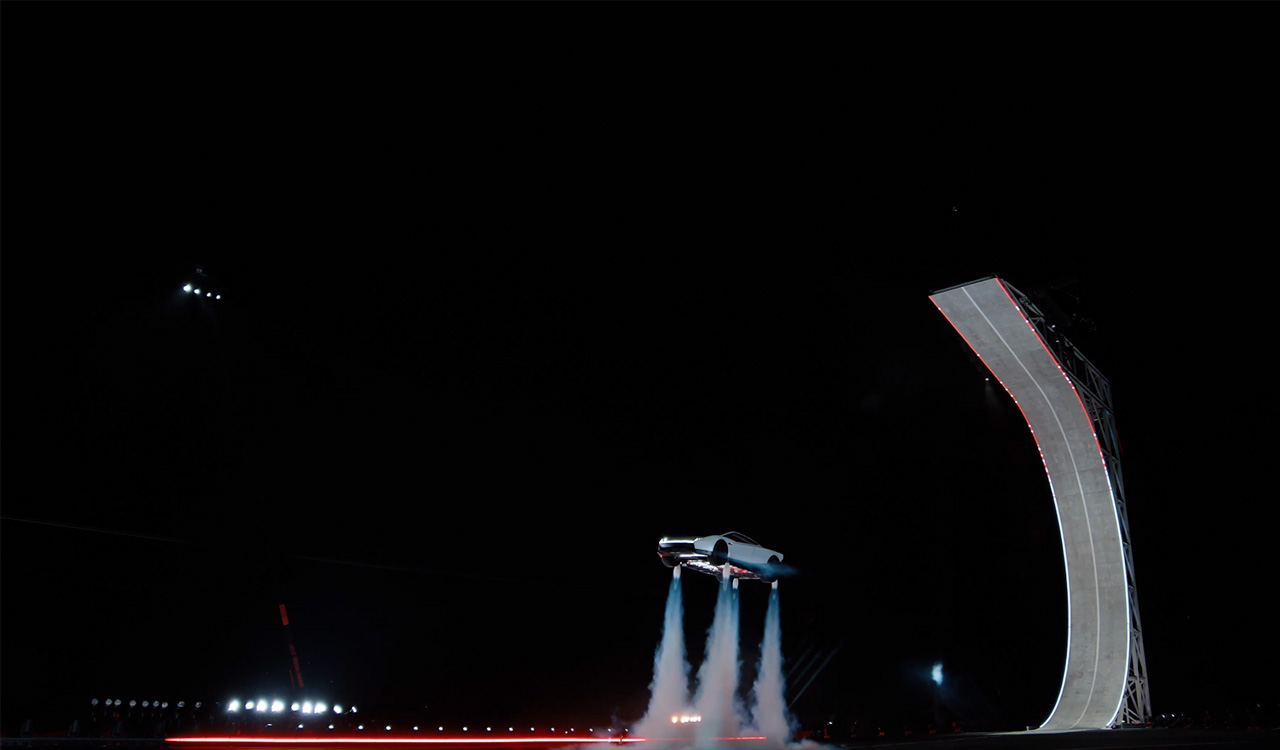
At an event held at SpaceX’s testing facility in McGregor, Texas, on October 15, 2026, Elon Musk presented a redesigned Roadster equipped with cold-gas thrusters developed with SpaceX. A demonstration showed the vehicle performing airborne maneuvers impossible for a conventional production car.
Tesla says the Roadster is targeted for production in 2028, nearly nine years after the second-generation model was first introduced in 2017.
The latest unveiling provides a clearer picture of the company’s ambitions, but major questions remain about final specifications, pricing, road legality, and whether the most dramatic features will be available to ordinary customers.
SpaceX Technology Gives the Roadster Its Most Unusual Feature
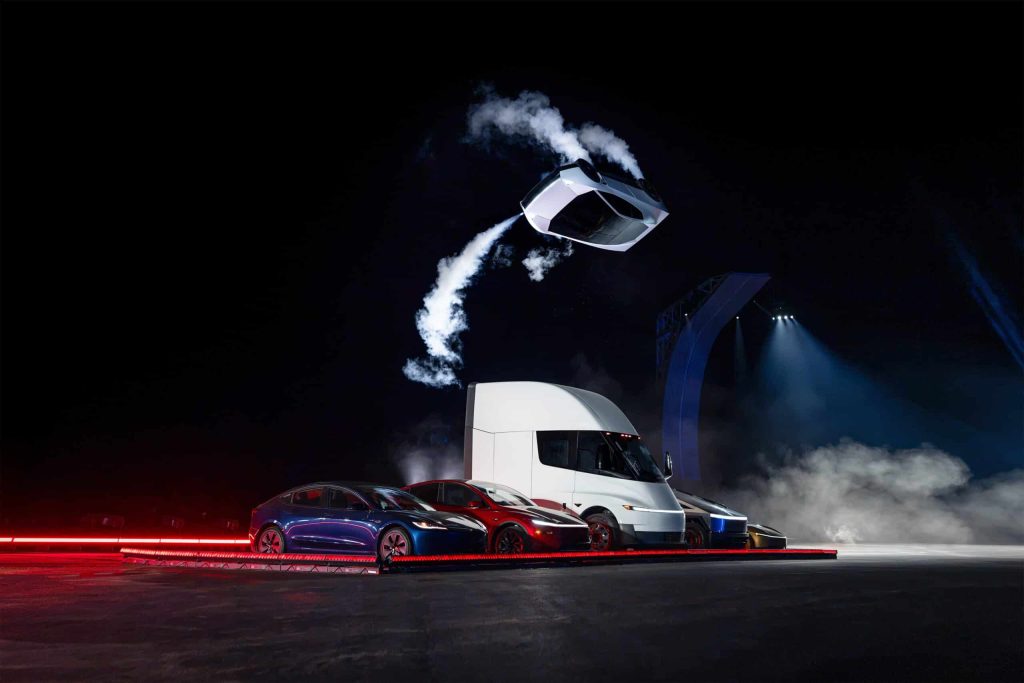
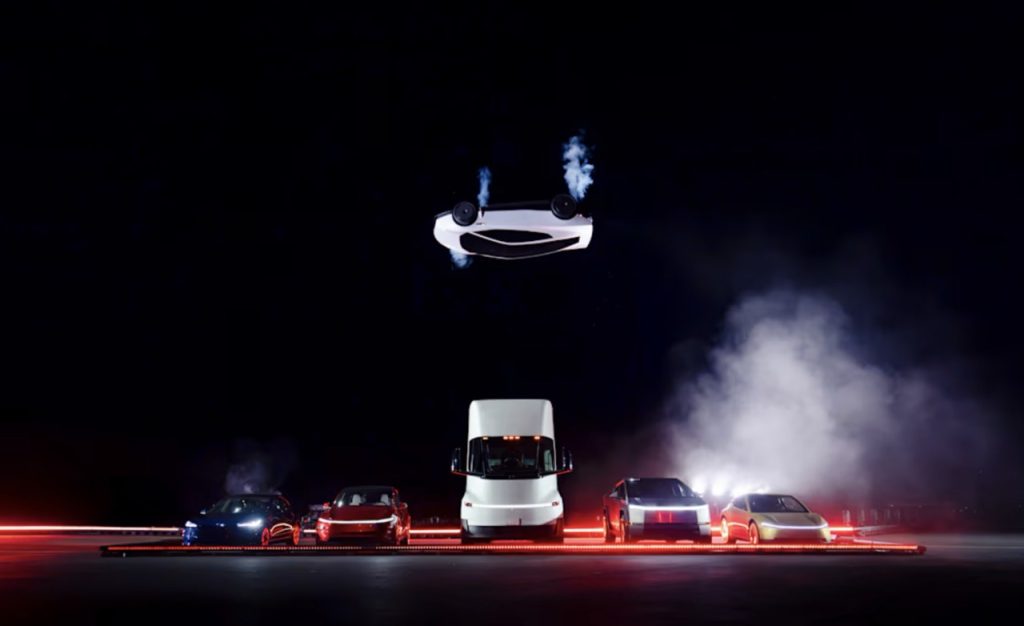
The event’s headline attraction was a demonstration of the Roadster lifting into the air, rotating, and landing. Tesla also showed the vehicle moving along an inverted ramp and jumping over a lineup of other Tesla products.
These maneuvers combined a suction-based system with compressed-gas thrusters, taking the concept far beyond the capabilities normally associated with an electric sports car.
Tesla engineering executive Lars Moravy described a system using 10 thruster nozzles connected to approximately 600 liters of compressed air. Unlike conventional rocket propulsion, which typically produces thrust through the combustion and expulsion of propellant, a cold-gas system releases stored pressurized gas to generate force.
The system demonstrated on the Roadster is therefore better understood as rocket-style propulsion than as a conventional rocket engine burning fuel.
The vehicle also uses a multi-mode suction system for the inverted-driving demonstration. Fans can create a pressure difference that helps hold a vehicle against a surface, although Tesla has not published enough engineering data to establish how the system performs across different speeds, road surfaces, or weather conditions.
These technologies could have applications beyond spectacle. Additional thrust could theoretically help a vehicle accelerate, while carefully controlled forces could contribute to specialized performance maneuvers.
However, the demonstration does not establish how frequently the system could be used, how much compressed gas each maneuver consumes, or what operating limitations would apply.
Packaging is another important consideration. High-pressure tanks, valves, plumbing, and thruster hardware require space and add complexity.
The Rocket version is described as a single-seat configuration, reflecting the compromises associated with the more extreme system. Tesla has not disclosed complete production engineering details or independently verified the system’s durability.
The demonstration nevertheless marks a notable development for the Roadster project. Musk first discussed a SpaceX-inspired thruster package in 2018, but the car remained delayed while Tesla concentrated on other vehicles and manufacturing priorities.
The October 2026 event finally showed a working demonstration of the idea, but that doesn’t mean the final consumer vehicle has completed development or received regulatory approval.
Sub-One-Second Acceleration and 230-MPH Speed Remain Claims to Verify
Tesla is promoting extraordinary performance figures for the new Roadster. The company claims acceleration from zero to 60 mph in less than one second and a top speed exceeding 230 mph.
Those numbers would place the car among the most extreme performance vehicles ever proposed for public-road use, but they should be treated as manufacturer claims rather than independently verified production-car results.
The sub-one-second acceleration figure deserves particular scrutiny. Performance measurements depend on factors such as the timing method, surface conditions, tire grip, and whether a rollout is excluded from the measurement.
A vehicle capable of producing exceptional thrust for a brief period may also face different operating constraints from one relying exclusively on tire traction. Tesla has not yet provided a complete, independently verified set of production-car test results.
The claimed top speed raises separate engineering questions. Sustaining speeds above 230 mph requires more than powerful motors. Aerodynamic stability, tire ratings, braking performance, cooling, and structural integrity all become critical as speed increases.
The Roadster’s final performance will depend on how these systems work together in a production configuration.
Tesla also says the Roadster will offer approximately 300 miles of range. That figure is notably more modest than the roughly 600-mile range associated with early promises for the next-generation model.
The company has not yet supplied a full set of independently verified range figures for the newly revealed vehicle, and the effect of different trims and optional hardware remains unclear.
The thruster-equipped version could create additional trade-offs. Space, weight, and energy requirements for its supporting equipment may affect passenger accommodation, practicality, and the final vehicle’s operating characteristics. Tesla has not published enough technical information to determine the full impact.
Buyers can choose from three versions, namely Performance, Thrust, and Rocket. Performance is built for road use, while Thrust includes cold-gas thrusters for a race-focused experience. At the top of the lineup, Rocket features 10 thrusters and is reserved for customers who receive an invitation to purchase.
Tesla’s reservation page listed payments of $50,000 for Performance and $250,000 for Thrust at the time of the announcement, but a final retail price for the complete lineup has not been confirmed.
Those reservation payments should not be confused with the final purchase price. Buyers would need confirmed pricing, delivery terms, refund conditions, and production specifications before making a decision based on the vehicle’s headline performance claims.
Is the Roadster Really a Flying Car?
The demonstration showed that the Roadster could briefly leave the ground and perform controlled airborne maneuvers in a prepared environment.
That is different from operating as a conventional flying car or aircraft. It did not demonstrate sustained flight, independent navigation through the air, or the ability to travel between destinations without road infrastructure.
The distinction has practical consequences. An aircraft must satisfy requirements covering matters such as airworthiness, operational safety, and pilot or operator responsibilities. A road vehicle must meet its own applicable safety and equipment standards.
A vehicle attempting to combine both roles would face additional technical and regulatory challenges, particularly if its propulsion system could lift it above the road.
Tesla has indicated that the Rocket version is not approved for public-road use. Its invitation-only status also means that the most dramatic demonstration configuration should not be assumed to represent a version available for normal commuting.
Safety will be central to any future approval. A vehicle that can generate enough thrust to lift itself presents risks involving stability, unintended activation, nearby people and objects, and safe landing.
Demonstrations at a controlled test facility cannot establish that the same maneuvers would be safe in public environments. Tesla has not announced a regulatory pathway that would permit the Rocket version to operate as an aircraft or perform airborne stunts on public roads.
The production schedule also deserves caution. Musk is targeting 2028, but the Roadster’s history includes repeated delays since its original 2017 unveiling.
The latest demonstration proves that Tesla has developed a working showcase for its unusual technology, not that every version is ready for manufacturing or customer delivery.
For American enthusiasts, the new Roadster is both a performance-car announcement and a test of Tesla’s ability to turn ambitious engineering into a practical product. The standard versions may ultimately be judged on acceleration, range, handling, and price.
The Rocket version faces a different challenge: making its airborne capability safe, reliable, and legally usable.
Until production vehicles are independently tested and regulatory details become clearer, the Roadster’s most extraordinary claims remain promises to verify, not established results.
