Toyota is widely associated with safety and reliability, but its 2026 IIHS results reveal a notable gap in the SUV lineup. No Toyota SUV earned either a Top Safety Pick or Top Safety Pick+ award. Toyota did receive three awards in other categories, with the Prius and Camry earning Top Safety Pick+ honors and the Tundra crew cab receiving Top Safety Pick recognition as a pickup.
The results also correct claims about Toyota’s electric SUVs and headlights. The 2026 bZ had a poor headlight rating on models built before June, while later versions earned a good rating. The bZ Woodland and C-HR also received good headlight ratings.
The larger issue was crashworthiness. Both the bZ and bZ Woodland received acceptable ratings in key frontal crash tests, falling short of the good ratings required for a 2026 IIHS award. This highlights how tougher safety standards are shaping Toyota’s latest SUV results.
Toyota’s SUV Lineup Falls Short of the 2026 Requirements
IIHS changed the way it determines Top Safety Pick awards for 2026. To earn the basic Top Safety Pick award, a vehicle must receive good ratings in the small overlap front and updated moderate overlap front and side crash tests.
It must also have acceptable or good headlights available as standard equipment and an acceptable or good pedestrian front crash prevention system.
Top Safety Pick+ adds another requirement. The vehicle needs a good pedestrian front crash prevention rating and an acceptable or good rating in IIHS’s updated vehicle-to-vehicle front crash prevention test, with qualifying systems standard on the vehicle.
That means a vehicle can perform well in several areas and still miss the award because of one weak result. Toyota’s 2026 BZ is a good example.
The all-electric BZ earned an acceptable rating in the small overlap front test, an acceptable rating in the updated moderate overlap front test, and a good rating in the updated side test. Its standard vehicle-to-vehicle front crash prevention system earned a Good rating, while its pedestrian front crash prevention system also earned a Good rating.
The problem is immediately apparent when those scores are compared with the award requirements. The bZ needs good ratings in all three crashworthiness categories for the Top Safety Pick award. Its acceptable results in the two frontal evaluations prevent it from qualifying.
The BZ’s headlight story is more complicated. IIHS tested two different headlight configurations because the vehicle changed during the 2026 model year.
Vehicles built before June 2026 received a poor rating, with inadequate low-beam visibility on both sides of the straightaway and inadequate visibility on several curves. The high beams improved the situation, but the low-beam limitations were enough to produce the poor rating.
For vehicles built after May 2026, however, IIHS recorded a good headlight rating. The updated low beams provided better illumination, although IIHS still found inadequate visibility on some left-hand curves. The headlights did not exceed glare limits.
That production change is important because saying simply that “the 2026 Toyota bZ has poor headlights” would now be misleading. The earlier-build vehicles did, but the later production version received a good rating.
The bZ Woodland, Toyota’s more rugged electric SUV variant, performed better in the lighting evaluation. IIHS gave it a good headlight rating across all trims. Its LED projector headlights use high-beam assist, and IIHS found no excessive glare from the low beams.
However, the Woodland still missed the award because its crash-test results were not strong enough. IIHS gave it acceptable ratings in both the small overlap front and updated moderate overlap front evaluations, while the updated side test was good.
The C-HR tells a similar story. The 2026 Toyota C-HR is an all-electric small SUV and received a good headlight rating, along with good ratings for its standard vehicle-to-vehicle and pedestrian front crash prevention systems.
But its overall IIHS evaluation still does not qualify it for a Top Safety Pick. The available crashworthiness results include an acceptable small-overlap front rating, which falls short of the good rating required for the award.
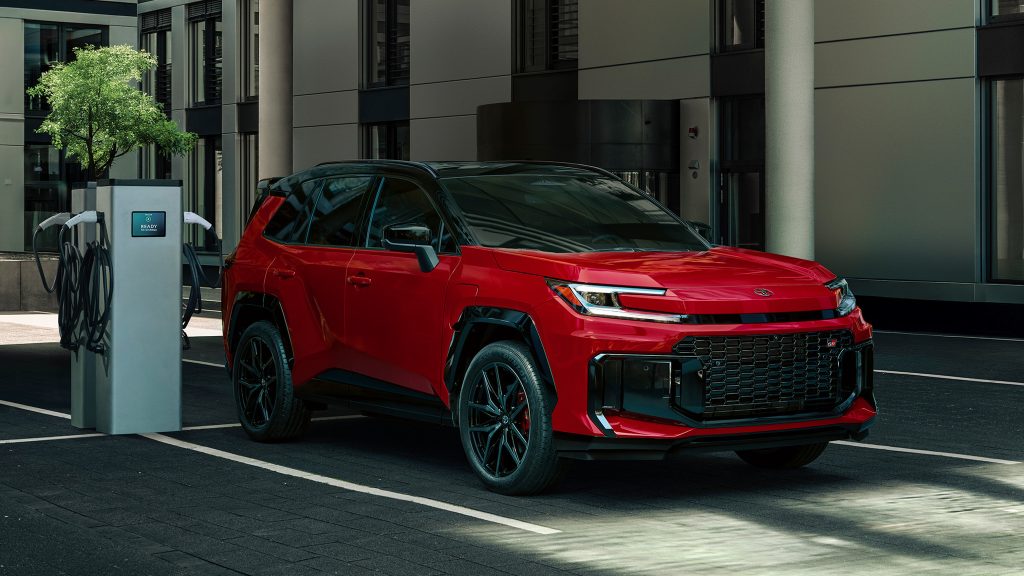
The C-HR’s crash-test ratings also draw on testing of the closely related Subaru Solterra, with IIHS stating that the results apply to the Toyota C-HR, bZ and Woodland as well as several Subaru models.
That distinction matters because the absence of a Top Safety Pick badge does not mean these Toyota SUVs are unsafe. Instead, it means they did not meet a particularly demanding collection of IIHS requirements.
Toyota Still Has Three 2026 Safety Award Winners
Toyota’s lack of an SUV award becomes more interesting when the company’s entire 2026 lineup is considered.
The Toyota Prius earned Top Safety Pick+, while the Toyota Camry also earned Top Safety Pick+. The Toyota Tundra crew cab earned Top Safety Pick in the large-pickup category.
That means Toyota has demonstrated that its vehicles can meet IIHS’s tougher 2026 requirements. The issue is not that the company has suddenly abandoned safety engineering. Instead, different vehicle programs have produced different results under the latest testing regime.
The Tundra is particularly important because it demonstrates that Toyota’s larger vehicles can meet the new standards.
IIHS lists the 2026 Tundra crew cab as a Top Safety Pick, with good ratings in the small overlap front, moderate overlap front and side tests, and an acceptable headlight rating. Toyota’s SUV situation is therefore quite different from the brand’s entire safety portfolio. The 2026 award list includes numerous SUVs from competing manufacturers.
In the midsize SUV class, for example, IIHS lists Top Safety Pick winners such as the Buick Enclave, Ford Explorer and Ford Mustang Mach-E, while Top Safety Pick+ winners include the Honda Passport, Hyundai Ioniq 9, Hyundai Palisade, Hyundai Santa Fe, Kia EV9, Kia Sorento, Mazda CX-70, Mazda CX-70 PHEV, Mazda CX-90, Mazda CX-90 PHEV, Nissan Murano, Nissan Pathfinder and Subaru Ascent.
The small-SUV category is similarly competitive. IIHS lists Top Safety Pick+ winners, including the BMW X1, Mazda CX-30, Mazda CX-5, Mazda CX-50, Subaru Forester, Hyundai Ioniq 5, Hyundai Tucson, Kia Sportage, and Genesis GV60.
That context makes Toyota’s absence more notable. It is not simply that IIHS awarded fewer SUVs in 2026. Several competing manufacturers have managed to satisfy the more demanding criteria. Headlights themselves have also become an increasingly important part of the equation.
IIHS says its headlight evaluations are technology-neutral. LED, HID, and halogen systems are judged according to their performance rather than the type of technology used. The organization notes that LED headlights have become increasingly common, but using LED technology does not automatically produce a good rating.
There has been considerable improvement in headlight performance across the industry. According to IIHS, only 5% of headlight systems tested for the 2026 model year had excessive glare, compared with 21% in 2017.
That makes the BZ’s early-build poor rating particularly relevant. Modern lighting technology can deliver excellent road illumination, but the hardware and calibration still have to perform properly in real-world scenarios.
For Toyota, the good news is that the BZ’s later-build headlights show that the company has already addressed part of the problem. The bad news is that improving the lights alone is not enough for an award.
The frontal crash-test results remain the bigger obstacle for the bZ and bZ Woodland. Both received acceptable ratings, whereas IIHS requires good. That distinction is important for consumers.
A vehicle without a Top Safety Pick award should not automatically be dismissed as unsafe. IIHS itself describes these awards as identifying the best choices within vehicle size categories for a given year. The absence of an award simply means the vehicle did not satisfy every requirement established for that model year.
For the 2026 Toyota lineup, the evidence therefore paints a more nuanced picture than the original headline suggests.
No Toyota SUV currently earned a 2026 Top Safety Pick or Top Safety Pick+ award. That part is correct. Toyota’s Prius, Camry, and Tundra did earn awards, but the Tundra is a pickup rather than an SUV.
However, the BZ, BZ Woodland, and C-HR did not all receive poor headlight ratings. The bZ’s earlier-build headlights were poor, while later-build versions were rated good. The bZ Woodland and C-HR are also rated good for headlights.
The more significant issue is that Toyota’s new electric SUVs fell short of the good crashworthiness scores demanded by IIHS for its 2026 awards.
That makes the 2026 results an important reminder that safety awards are becoming harder to earn. A vehicle can have strong driver-assistance technology, effective headlights, and good side-impact protection, yet still miss the highest recognition because its performance in one or more frontal crash tests does not reach the required level.
For Toyota, the challenge is clear. The company already has award-winning cars and a Top Safety Pick Tundra. Its next task is bringing its SUV lineup, particularly its newer electric models, up to the same standard.