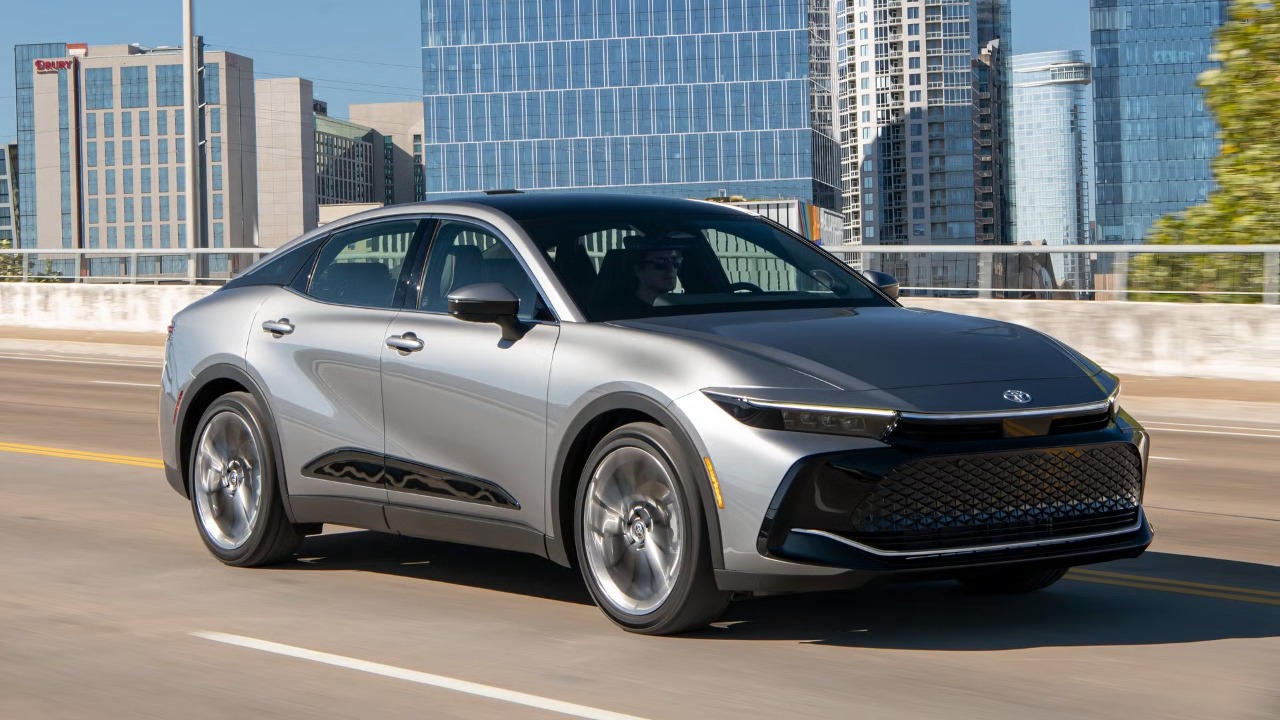
The 2026 Toyota Crown sits in an unusual position in Toyota’s lineup. It has the styling and elevated seating position of a crossover, the proportions of a sedan, standard all-wheel drive, and a hybrid powertrain across most of the range.
For buyers planning to keep the car for several years, resale value becomes an important part of the decision. The question is how much value each Crown trim is expected to lose over time.
Kelley Blue Book’s current five-year cost-to-own data offers a useful way to compare the four 2026 Crown trims, including the XLE, Limited, Nightshade, and Platinum.
The numbers reveal an interesting result. The least expensive Crown is not necessarily the strongest performer in percentage-based residual value, and the most expensive Platinum does not retain the largest share of its original price either.
Based on KBB’s current MSRP and five-year depreciation estimates, the Limited has the highest projected residual percentage, narrowly ahead of the Nightshade. The Platinum retains a smaller percentage despite having a higher projected dollar value after five years.
Toyota’s own build-and-price information helps explain why. The Limited adds desirable equipment without moving into the much more expensive Hybrid MAX powertrain used by the Platinum. It also maintains the same 2.5-liter hybrid system and fuel economy as the XLE and Nightshade.
What KBB’s Five-Year Numbers Show
KBB currently lists the 2026 Crown XLE with an MSRP of $42,535, the Limited at $47,045, the Nightshade at $49,860, and the Platinum at $56,085. These KBB figures differ slightly from Toyota’s advertised base MSRPs because KBB uses its own pricing data.
Toyota’s official base MSRPs are $41,440 for the XLE, $45,950 for the Limited, $48,765 for the Nightshade, and $54,990 for the Platinum.
KBB estimates that the XLE will depreciate by $19,832 over five years. That leaves an estimated residual value of $22,703. In percentage terms, the XLE would retain about 53.4% of its KBB-listed original price.
The Limited is more interesting. KBB estimates five-year depreciation at $20,107. Subtracting that from its $47,045 listed MSRP produces an estimated residual value of approximately $26,938, or about 57.3% of its original value. KBB’s individual limited page confirms the $20,107 depreciation estimate.
The Nightshade has a projected five-year depreciation of $21,471. KBB gives it a residual value of $28,389. That represents approximately 56.9% of its $49,860 KBB MSRP. So although the Nightshade has a higher estimated dollar value after five years than the Limited, it starts at a higher price, meaning it retains a slightly smaller percentage of its original value.
The Platinum has the highest residual value in raw dollars. KBB estimates that it will be worth $30,988 after five years. However, because its original KBB MSRP is $56,085, that works out to approximately 55.3% retained value. Its estimated five-year depreciation is $25,097, the highest of the four trims.
That produces a useful comparison:
| 2026 Crown Trim | KBB MSRP | 5-Year Depreciation | Estimated Residual | Approx. Value Retained |
|---|---|---|---|---|
| XLE | $42,535 | $19,832 | $22,703 | 53.4% |
| Limited | $47,045 | $20,107 | ~$26,938 | 57.3% |
| Nightshade | $49,860 | $21,471 | $28,389 | 56.9% |
| Platinum | $56,085 | $25,097 | $30,988 | 55.3% |
These calculations show why the answer is slightly different from simply looking at the dollar amount of depreciation. The Limited currently has the strongest estimated five-year residual percentage according to the KBB data.
Why the Limited Has an Advantage
The Limited occupies the middle of the Crown lineup, and that positioning may be important for resale.
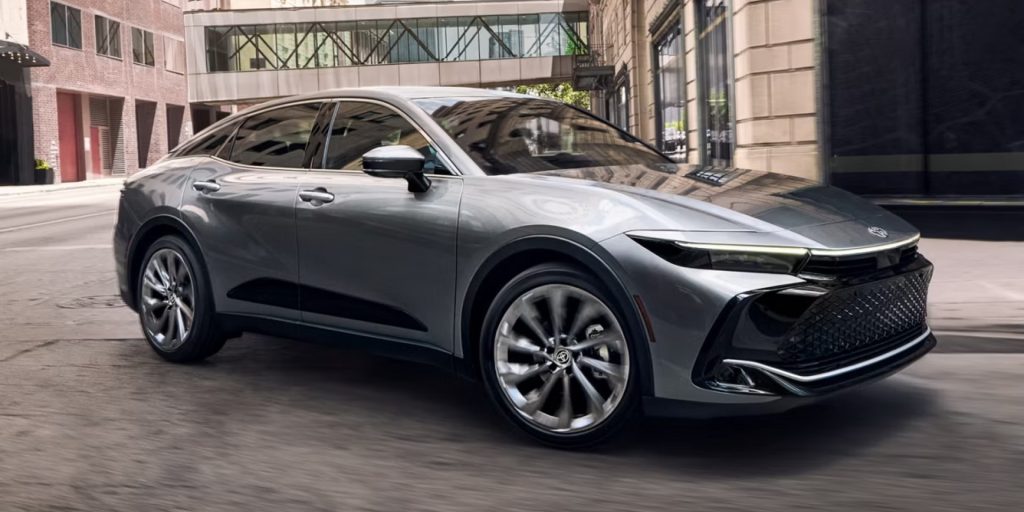
The XLE is the entry-level model, but the Limited adds several features that can make a used example more attractive without changing the fundamental mechanical package.
Toyota equips the Limited with quad-LED projector headlights, a panoramic fixed-glass roof with a power sunshade, and an 11-speaker JBL premium audio system. It continues to use the 2.5-liter four-cylinder hybrid system with all-wheel drive and Toyota’s estimated 42 mpg city and 41 mpg highway ratings.
That combination gives the Limited a broad appeal. A future used-car buyer gets the Crown’s hybrid system, standard AWD, and relatively strong fuel economy while also receiving equipment that makes the car feel more upscale than the entry-level XLE.
The XLE is not poorly equipped. Toyota gives it leather-trimmed heated and ventilated front seats, AWD, and the 2.5-liter hybrid system. However, the Limited adds enough comfort and technology to make the step upward more noticeable.
The Limited also avoids the Platinum’s more specialized powertrain. That could matter in the used market because not every buyer shopping for a Crown is looking for maximum performance.
The Limited produces 236 horsepower and takes approximately 7.6 seconds to reach 60 mph, according to KBB. The Platinum produces 340 horsepower and cuts the 0-to-60 mph time to approximately 5.7 seconds.
For an enthusiast, the Platinum’s additional performance may be a major attraction. But the larger audience for a used Crown may be more interested in the combination of comfort, efficiency, AWD, and equipment offered by the Limited.
Where the Nightshade and Platinum Fit
The Nightshade is particularly interesting because its projected residual percentage is almost identical to the Limited’s. Its 56.9% estimated retention trails the Limited’s 57.3% by less than half a percentage point.
Toyota positions the Nightshade as a more visually distinctive version of the Crown. It uses the same 2.5-liter hybrid powertrain as the XLE and Limited, with 236 horsepower and the same 42/41 mpg city/highway estimates. It adds 21-inch matte-black wheels, black mirror caps, dark exterior badging, and the panoramic fixed-glass roof.
That styling could help its appeal to used buyers who want something less conventional than the standard Crown. At the same time, its higher initial price means buyers should not assume that distinctive styling automatically translates into better percentage-based depreciation.
The Platinum is a different proposition altogether. Toyota’s flagship Crown trim uses the Hybrid MAX powertrain, combining a turbocharged 2.4-liter four-cylinder engine with hybrid assistance. KBB lists output at 340 horsepower. It also receives equipment such as 21-inch machined-finish alloy wheels with black accents and a 10-inch head-up display.
The trade-off is fuel economy. While the XLE, Limited, and Nightshade are rated at 42 mpg city and 41 mpg highway, the Platinum is rated at 29 mpg city and 32 mpg highway by Toyota.
KBB’s cost-to-own data reflects that difference. The Platinum has a five-year cost to own of $75,827 and $25,097 in estimated depreciation. The Nightshade is estimated at $68,736 in total five-year ownership costs, including $21,471 in depreciation.
The Platinum, therefore, remains valuable in absolute terms, but its much higher purchase price means it does not have the strongest percentage retention.
What This Means for a Crown Buyer
The numbers suggest that the Limited is the trim to watch if resale value is the priority. Its estimated 57.3% five-year residual percentage is slightly higher than Nightshade’s 56.9%, while the XLE trails both at approximately 53.4%. The Platinum comes in at roughly 55.3%.
That does not mean every Limited will necessarily sell for more than every Nightshade or Platinum five years from now.
KBB’s estimates are projections, and actual resale prices can vary significantly depending on mileage, condition, accident history, maintenance records, location, market demand, and the incentives available when the vehicle was originally purchased.
The distinction between residual percentage and resale dollars is also important. The Platinum is projected to be worth approximately $30,988 after five years, substantially more in dollars than the XLE’s $22,703 estimate.
But the Platinum also starts at a much higher price. For someone measuring how much of their original investment the vehicle is expected to preserve, the percentage is the more useful comparison.
The Limited’s position is helped by its middle-of-the-line pricing and equipment. It avoids the compromises associated with the base model while also avoiding the substantial price jump and lower fuel economy of the Platinum.
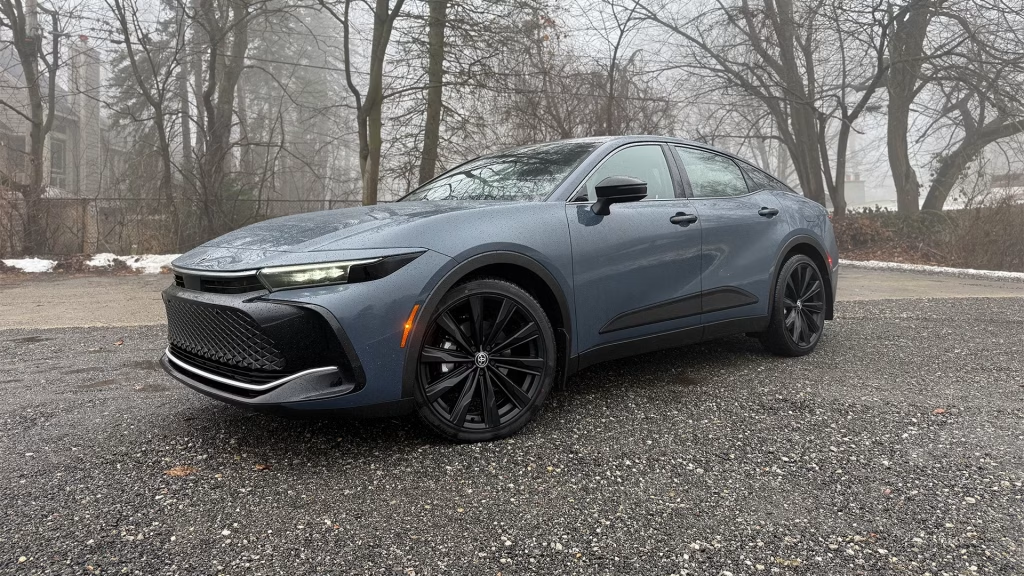
The Nightshade comes extremely close and could be particularly appealing to buyers who place greater importance on exterior styling. Its projected residual percentage is only about 0.4 percentage points below the Limited’s in the current KBB data.
One correction to the earlier comparison is necessary. Based on KBB’s five-year depreciation figures as a percentage of each trim’s listed MSRP, the Limited currently has the lower depreciation rate than the Nightshade. The Nightshade remains very close behind.
For buyers who intend to sell or trade their Crown after several years, the Limited currently represents the strongest combination in KBB’s projections.
The Nightshade follows closely, while the Platinum’s performance-focused powertrain gives it a higher absolute residual value but a lower percentage of retained value. The XLE has the lowest entry price but also the weakest projected five-year retention percentage among the four.
As the 2026 Crown ages, actual transaction prices will provide a clearer picture than today’s projections. For now, however, the KBB data and Toyota’s build-and-price lineup point toward the Limited as the 2026 Toyota Crown trim with the strongest projected value retention.