

Walking into a car dealership feels exciting. You have done your research, you know the model you want, you have a budget in mind, and you are ready to drive home happy. Then you sit down in the finance office, and somehow the number on the final contract is $3,000 to $5,000 higher than everything you discussed on the showroom floor. Sound familiar? You are not alone, and you were not being careless. You were simply not warned.
Dealers are professionals at presenting vehicles attractively and keeping your attention on the monthly payment rather than the full picture. By the time the paperwork is in front of you, you are emotionally invested, excited, and often tired from hours of back-and-forth. That is exactly when surprise charges feel easiest to accept.
Here is what this page does for you: it pulls back the curtain on nine costs that routinely appear in car deals without being honestly discussed up front. These are not illegal. Some are legitimate. But all of them affect how much you actually pay, and every single one of them should be on your radar before you ever step foot in a showroom.
Whether you are shopping for a practical daily driver, a weekend truck, or something that turns heads at a stoplight, these hidden costs apply across the board. Buyers purchasing a 2026 Chevrolet Trax 2RS, a 2026 Infiniti QX60 Autograph, or a 2026 Audi Q5 S Line Premium all face the same finance office reality: the deal is not done until you understand every line on that contract.
Read this before you buy. Share it with someone who is about to buy. The more you know going in, the harder it is for a single line item to catch you off guard and cost you money you never planned to spend.

1. Dealer Documentation Fees: The Charge for Doing Their Job
Why You Are Paying for Paperwork That Benefits the Dealership
Let’s start with one of the most universal hidden charges in car buying: the documentation fee, also called the doc fee or processing fee. Every dealership charges one. Most buyers see it on the contract and assume it is a standard, fixed government charge. It is not. It is a dealership fee, set by the dealer, and in many states it is almost entirely unregulated.
Doc fees exist to cover the cost of processing your title, preparing the loan paperwork, and filing documents with the state. That sounds reasonable. But when a dealer charges $999 for documentation on a 2026 Mitsubishi Outlander SE S-AWC, you are not paying for a complicated legal service. You are paying a markup on a process that takes their staff 20 minutes and a printer.
Across the United States, doc fees range from under $100 in states where they are capped by law to over $1,000 in states with no regulation. Florida, for example, allows dealers to set their own doc fees with minimal restriction, which is why you will commonly see fees of $700 to $999 at Florida dealerships.
In California, the cap sits around $85. If you live in a state with no cap, the doc fee is essentially whatever the dealer decides to charge. Here is the important thing to understand: while you cannot always eliminate the doc fee, you absolutely can factor it into your negotiation.
If a dealer is firm on their doc fee of $800, you have every right to ask them to reduce the vehicle price by a corresponding amount. Total out-the-door cost is what matters, not any individual line item. A dealer who tells you the doc fee is non-negotiable is telling you they choose not to negotiate it. That is a very different thing.
Some buyers attempt to comparison shop doc fees by calling multiple dealerships in their area. This is a smart strategy. If you are weighing two dealers, both selling the 2026 Nissan Frontier Pro-4X Crew Cab, and one charges $299 in doc fees while the other charges $899, that difference goes directly into your out-of-pocket cost. Do not let enthusiasm about finding “your” vehicle make you forget to ask this question before you get to the finance office.
A practical approach: always ask for the full out-the-door price in writing before you visit the dealership. Request that the quote include all dealer fees, taxes, registration, and any installed accessories. Getting this number via email creates a paper trail that makes it harder for fees to quietly increase by the time you are sitting across from the finance manager.
Doc fees are not going away. Dealerships run businesses and have legitimate overhead. But paying $900 for paperwork processing on a $30,000 vehicle, without questioning it, is $900 you did not have to spend.

2. Dealer-Installed Accessories: Options You Never Asked For
What Those Stickers on the Window Really Mean for Your Total Price
You found the exact trim level you wanted. You confirmed the color online, called ahead, and the sales rep assured you the vehicle was ready. Then you arrive and see a second sticker next to the Monroney label listing $1,895 in dealer-installed accessories. Nitrogen-filled tires.
Door edge guards. A wheel lock kit. Paint sealant. All pre-installed. All added to your price without your input. Dealer-installed accessories, sometimes called dealer add-ons or dealer packs, are products that the dealership physically installs or applies to the vehicle before putting it on the lot.
They then add the cost of these items to the vehicle’s price, often at margins far exceeding what the products are actually worth. A paint sealant product that costs the dealer $40 to apply gets listed on your contract at $395. A fabric protection spray worth $15 shows up at $299.
On a vehicle like the 2026 Buick Envision Avenir AWD, where buyers are already spending in the mid-to-high $40,000 range, a $2,000 dealer accessories package can feel like a relatively small addition. That is exactly how dealers count on you to respond. The anchoring effect of a large purchase price makes smaller additions feel minor, even when they represent 100 to 400 percent markups on products with little long-term value.
Your rights here are clearer than most buyers realize. If an accessory has already been installed, you cannot return it. But you can refuse to pay the dealer’s inflated price for it. You can negotiate the accessory package down, ask for it to be included in the base price, or push back on items that add no value to your ownership experience.
A wheel lock set is useful. A “nitrogen tire fill” is not meaningfully better than regular air for the average driver, and it is certainly not worth $189. Before visiting any dealership, research whether the specific vehicle you want has any dealer add-ons by asking your sales rep over the phone or via email.
If they confirm add-ons are present, ask for an itemized list and pricing before you go. That gives you time to research fair market values and prepare your response. Showing up informed about what a ceramic coating or door sill guard actually costs sends a clear message that you did your homework.
Buyers considering a 2026 Jeep Grand Cherokee Overland 4xe should be especially alert to this. Popular models with limited local inventory tend to carry heavier add-on packages because dealers know demand reduces your leverage. The fewer alternatives you have nearby, the more they lean on accessories to pad the deal.
Also Read: 10 Stains on a Used Car Seat That Indicate Serious Problems

3. Extended Warranties and Service Contracts: Profit Centers Dressed as Protection
Understanding What You Are Actually Buying in the Finance Office
Once you agree on the vehicle price, you are guided into the finance office, where the real upselling begins. Extended warranties and vehicle service contracts are the highest-margin products sold in that room, and they are presented with language designed to make declining them feel irresponsible. “This vehicle has a lot of electronics.” “Repairs on this model are expensive out of warranty.” “For just $39 more per month, you are completely protected.” These are scripts, and they are effective because they contain grains of truth wrapped in urgency.
Extended warranties, more accurately called vehicle service contracts, pay for covered repairs after your factory warranty expires. Factory warranties on most new vehicles cover the powertrain for 5 years or 60,000 miles and provide bumper-to-bumper coverage for 3 years or 36,000 miles. An extended service contract picks up where those leave off. On paper, that sounds worthwhile. In practice, the details matter enormously.
Take a buyer purchasing a 2026 Lincoln Corsair Reserve AWD. The finance manager offers a 7-year, 100,000-mile extended service contract for $3,800. The contract has a $200 deductible per visit. It excludes wear items like brakes, tires, and belts. It excludes any pre-existing conditions.
It excludes repairs at independent shops, requiring only authorized dealer service. What sounds like comprehensive protection is actually a narrow product full of exclusions. Dealer-sold extended warranties are also dramatically more expensive than third-party alternatives.
The same coverage level available through a reputable third-party provider might cost $1,200 to $1,800 for the same vehicle. That gap is pure dealer margin. You can purchase extended coverage after you buy the vehicle, at any point before your factory warranty expires, which means you do not need to decide in the finance office.
If you want extended coverage, research it independently. Compare providers, read the exclusions carefully, and buy it on your own timeline, not under pressure at the dealership.
4. Gap Insurance Markups: Necessary Coverage, Unnecessary Price
Why You Should Never Buy Gap Insurance From the Dealership
Gap insurance is genuinely useful. If your vehicle is totaled or stolen and your loan balance exceeds the car’s actual cash value, gap coverage pays the difference. Without it, you could owe thousands on a car you no longer have. That is a real financial risk, and gap insurance protects you from it.
Here is the problem: dealers charge $400 to $900 for gap insurance that your auto insurer will typically add to your policy for $20 to $40 per year. Some credit unions and banks include it free with their financing. You are not buying a better product at the dealership. You are buying the same protection at a 400 to 800 percent markup, and often rolling it into your loan so you pay interest on it for years.
A buyer financing a 2026 Toyota Crown Platinum at $52,000 who rolls $700 of dealer gap insurance into a 72-month loan at 7 percent interest ends up paying roughly $830 total for that $700 product by the time interest is added. Meanwhile, adding a gap to their existing auto policy might cost $30 per year, or $180 total over the same 6-year period. That is a $650 difference for identical protection.
Always call your auto insurer before heading to the finance office. Ask whether they offer gap coverage and what it costs to add. If your lender provides it, confirm that in writing. When the finance manager presents gap insurance, you can politely decline and explain that you have already arranged it independently. You have every right to do so.

5. Credit Life and Disability Insurance: The Add-On Most Buyers Forget About
A Product That Sounds Important and Rarely Delivers Its Value
Buried in the finance office presentation, often after extended warranties and gap insurance have already been discussed, comes another product: credit life and disability insurance. This coverage pays your car loan if you die or become disabled and cannot work. It sounds responsible. The actual math on it tells a different story.
Credit life insurance is priced based on your loan balance, which means you pay more for it at the beginning of the loan, when you owe the most, and less toward the end. It is almost always more expensive per dollar of coverage than a straightforward term life insurance policy purchased independently. A $25 monthly addition to your car payment adds $300 per year, or $1,800 over a 72-month loan, for coverage that decreasing-balance life insurance or a simple term policy could provide at a fraction of that cost.
Buyers financing a 2026 Chrysler Pacifica Pinnacle Plug-In Hybrid are often presented with this product alongside the extended warranty pitch, making it easy to nod along and add both. Dealers sometimes present credit life and disability as practically required by the lender, which is false. Lenders do not require this coverage. It is optional, and declining it has zero impact on your loan approval.
If income protection or life coverage during your loan period genuinely matters to your family’s financial planning, consult a licensed insurance professional and purchase it independently. You will get better coverage, clearer terms, and a lower price.

6. Advertising Fees: Charges You Definitely Did Not Agree To
Why Regional Marketing Costs Are Showing Up on Your Car Contract
Sit down with a car contract, and you may find a line item called an “advertising fee,” a “regional advertising assessment,” or a “market development fee.” Most buyers assume this is another government charge and move past it. It is not a government charge. It is a fee that dealers pass directly to customers to recover the cost of their own marketing.
Auto manufacturers often require regional dealer groups to contribute to local advertising campaigns. These are legitimate business expenses, but they belong to the dealership’s cost of doing business, the same way a restaurant does not add a line item to your bill for their Yelp advertising costs. Passing that fee to the consumer is a choice, and it is a choice buyers can push back on.
Advertising fees typically range from $200 to $500, though some high-volume dealers in competitive metro markets charge more. On a vehicle like the 2026 GMC Sierra 1500 Denali Ultimate Crew Cab, where the purchase price is already well above $60,000, a $400 advertising fee blends into the contract easily.
Combined with doc fees, add-on accessories, and registration costs, these smaller charges stack into real money. Ask about advertising fees during your price negotiation, not at the finance office. Request that all fees be listed in the initial out-the-door price quote.
If an advertising fee appears that was not in your original quote, you have a legitimate reason to ask that the vehicle price be adjusted to compensate, or that the fee be removed entirely. Not every dealer will comply, but some will, especially if you are close to a deal and they do not want to lose the sale over $300.
Price transparency starts with you asking the right questions at the right time. A dealer who refuses to provide a full fee breakdown before you enter the finance office is a dealer worth walking away from.

7. Prepaid Maintenance Packages: Convenience That May Not Fit Your Life
What the Dealership Service Package Is Really Selling You
Prepaid maintenance plans are presented as a value-packed convenience. Pay a flat fee upfront, and all your routine service visits for the next three years are covered. No surprises. No service bills. Just bring the car in and leave. For certain buyers in certain situations, these plans genuinely work out. For a lot of buyers, they are an overpayment for services they will not fully use.
Prepaid plans are priced based on the dealership’s retail service rates, which are almost always higher than independent shop rates. A plan that includes four oil changes, four tire rotations, and two multi-point inspections over 36 months sounds useful. But if a dealer charges $140 per synthetic oil change, the “value” in their plan is based on a price point you might never have paid at an independent shop charging $75 for the same service.
Consider a buyer purchasing a 2026 Lexus NX 350 F Sport AWD and being offered a three-year prepaid maintenance package for $1,200. At first glance, the math seems to work. Three years of dealer service visits for under $35 a month feels reasonable on a vehicle this size.
But Lexus vehicles are known for excellent reliability and modest service costs. If you drive average mileage and keep up with the schedule, you may not need every service included in the plan during that window, and unused services rarely carry over or are refunded. Before agreeing to any prepaid package, ask for an itemized breakdown of exactly what is included and when each service falls due.
Match that against your anticipated driving habits and compare the total cost against what those services would cost at an independent shop or even a competing dealer. Purchase this separately after you buy the vehicle if you decide you want it, rather than letting it pressure you into a decision you have not fully evaluated.
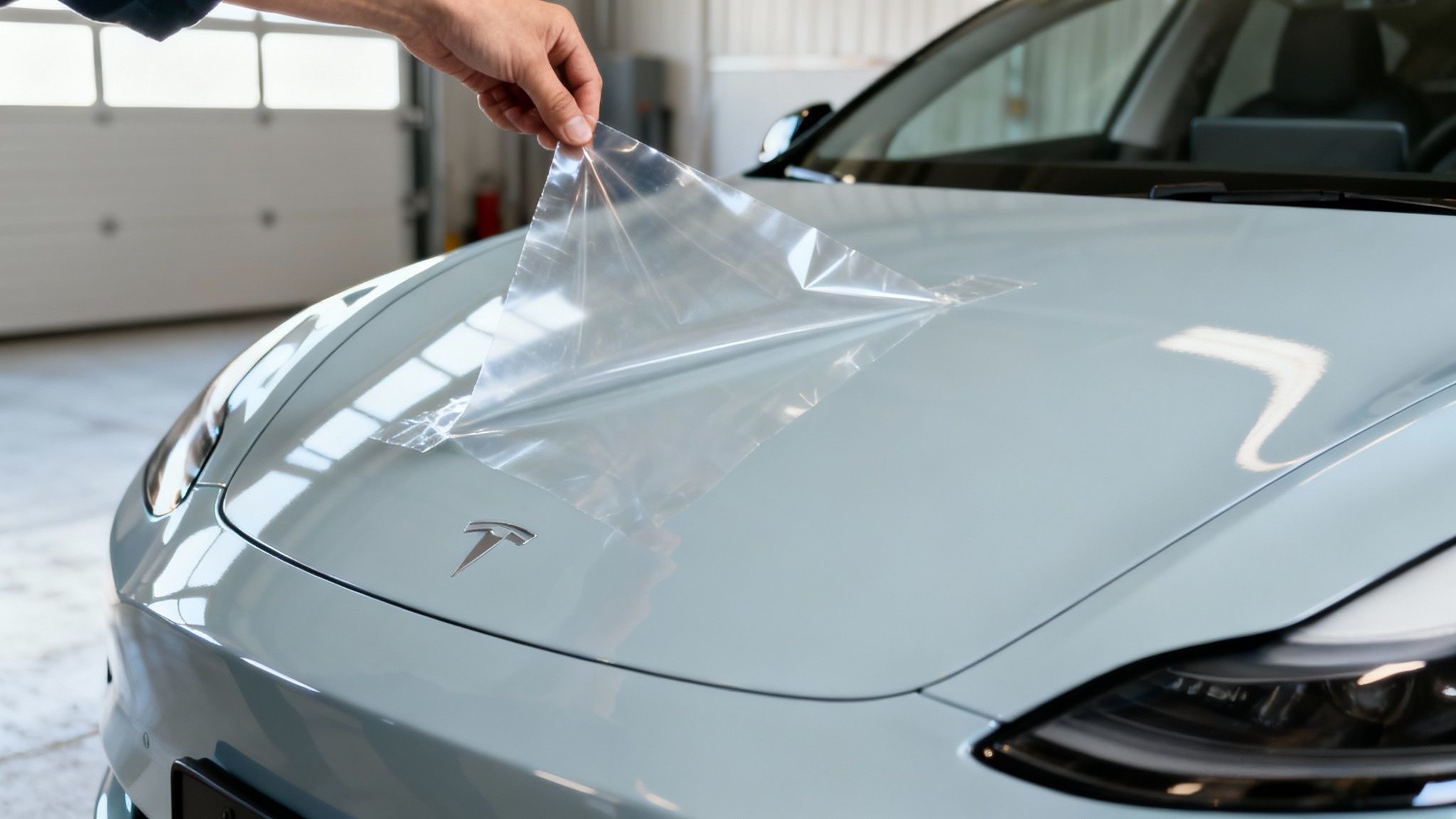
8. Window Tint, Paint Protection Film, and Appearance Packages: Real Products, Inflated Prices
Dealer-Applied Appearance Work Almost Always Costs More Than It Should
Appearance upgrades are not inherently a scam. Window tinting improves comfort and privacy. Paint protection film guards against rock chips. Ceramic coatings reduce paint maintenance. These are legitimate products with real-world benefits. Where buyers lose money is not in wanting these things, but in paying dealer retail pricing for work that third-party specialists do for less.
A dealer charging $895 for window tinting on a 2026 Hyundai Tucson N Line AWD is not necessarily using better film than a dedicated window tint shop. In most cases, the film is similar, and the installation quality is comparable. A reputable independent tint shop in most American cities charges $150 to $350 for the same result, depending on the number of windows and film grade. That is a potential $500 to $600 difference for the same outcome.
Paint protection film is where the gap becomes even more dramatic. Full front-end PPF installation at a dealer can be priced at $2,000 to $3,500. A certified independent PPF installer using the same brand of film often charges $900 to $1,800 for identical coverage.
Ceramic coating packages follow a similar pattern, with dealers charging $800 to $2,000 for coatings that independent detailers apply for $400 to $900 with equal or better results. If appearance protection matters to you, research independent specialists in your area before you visit the dealership.
Get quotes. Look at reviews. When the finance manager presents an appearance package, you can decline confidently because you already know you can get the same service done better for less. Buyers considering a 2026 Kia EV9 GT-Line AWD or any premium vehicle should absolutely take this approach, since the dollar gap on these packages grows with the vehicle’s price point.
Also Read: 8 Smells in a Used Car That Cost Thousands to Fix Later
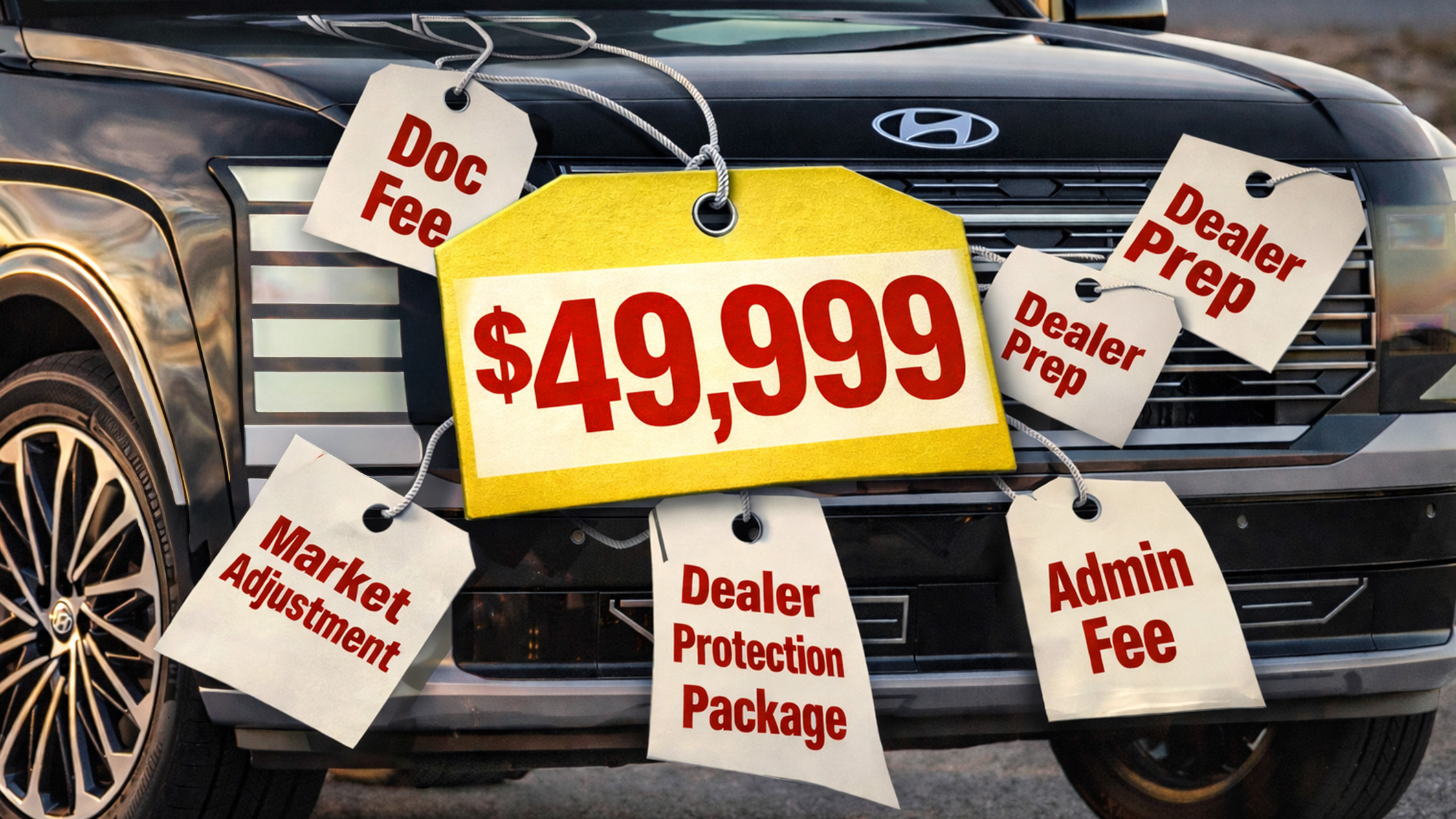
9. Destination Charge Confusion and Market Adjustments: The Costs You Might Not Realize You Can Question
What the Sticker Says and What You Can Actually Challenge
Two charges that appear on or near the window sticker cause enormous confusion for buyers: the destination charge and the dealer market adjustment. Both deserve a clear explanation, because they are very different in nature, and only one of them is truly fixed.
Destination charges appear on the Monroney label and represent the manufacturer’s cost of shipping the vehicle from the assembly plant to the dealership. For 2026 model year vehicles, destination charges typically range from $1,000 to $1,895, depending on the manufacturer and model.
A 2026 Dodge Durango R/T AWD carries a destination charge of around $1,695. A 2026 Mazda CX-5 2.5 S Carbon Edition carries one closer to $1,100. These charges are set by the manufacturer, are the same at every dealer selling that model, and are legitimately non-negotiable. Every dealer pays the same cost and passes it on identically.
Dealer market adjustments are an entirely different story. These are additional charges that dealers add above the MSRP, typically labeled as “market adjustment,” “dealer markup,” “ADM” (additional dealer markup), or simply an unlabeled price increase above sticker.
During periods of tight inventory, popular vehicles carry market adjustments of $2,000, $5,000, or even $10,000 above MSRP. A 2026 Land Rover Defender 110 S in a constrained market can carry a $4,000 to $8,000 market adjustment with no justification beyond demand.
Unlike destination charges, market adjustments are entirely negotiable and discretionary. Dealers add them because some buyers pay them without question. Your response to a market adjustment should be to shop competing dealers in your region, search dealer inventories online, and be willing to drive further or wait for inventory to normalize. Paying $5,000 above MSRP on a vehicle you could find at another dealer for sticker price is a choice, not a requirement.
Be clear about both charges when requesting your out-the-door price. Confirm that the destination charge shown matches the manufacturer’s published figure. Ask directly whether any dealer markup above MSRP is included. Get everything in writing before your showroom visit. A dealer unwilling to provide a complete itemized quote before you arrive is a dealer with something to hide in that contract.
