

Buying a Subaru Forester involves much more than the amount shown on the sticker at the dealership. The purchase price is only the beginning because ownership expenses such as fuel, maintenance, insurance, repairs, and depreciation continue to affect your budget for years. Many buyers focus on the initial cost but do not calculate what the vehicle will require during daily use.
For many drivers, the Forester remains a popular choice because of its dependable all-wheel-drive system, practical interior space, and ability to handle family needs, outdoor equipment, pets, and long road trips. These qualities have helped it earn trust among owners who want a reliable compact SUV.
Before making a decision, it is important to look beyond the sales price and understand the full cost of ownership. A vehicle that appears affordable at purchase can still require a large amount of money for fuel, routine servicing, insurance coverage, and unexpected repairs.
Taking time to review these expenses gives buyers a clearer idea of what owning a Forester for five years may look like. From maintenance costs to value loss, each expense plays a role in the total amount spent. Having this information before signing the paperwork helps drivers create a realistic budget and avoid surprises after bringing the vehicle home.
Depreciation: The Biggest Hidden Cost
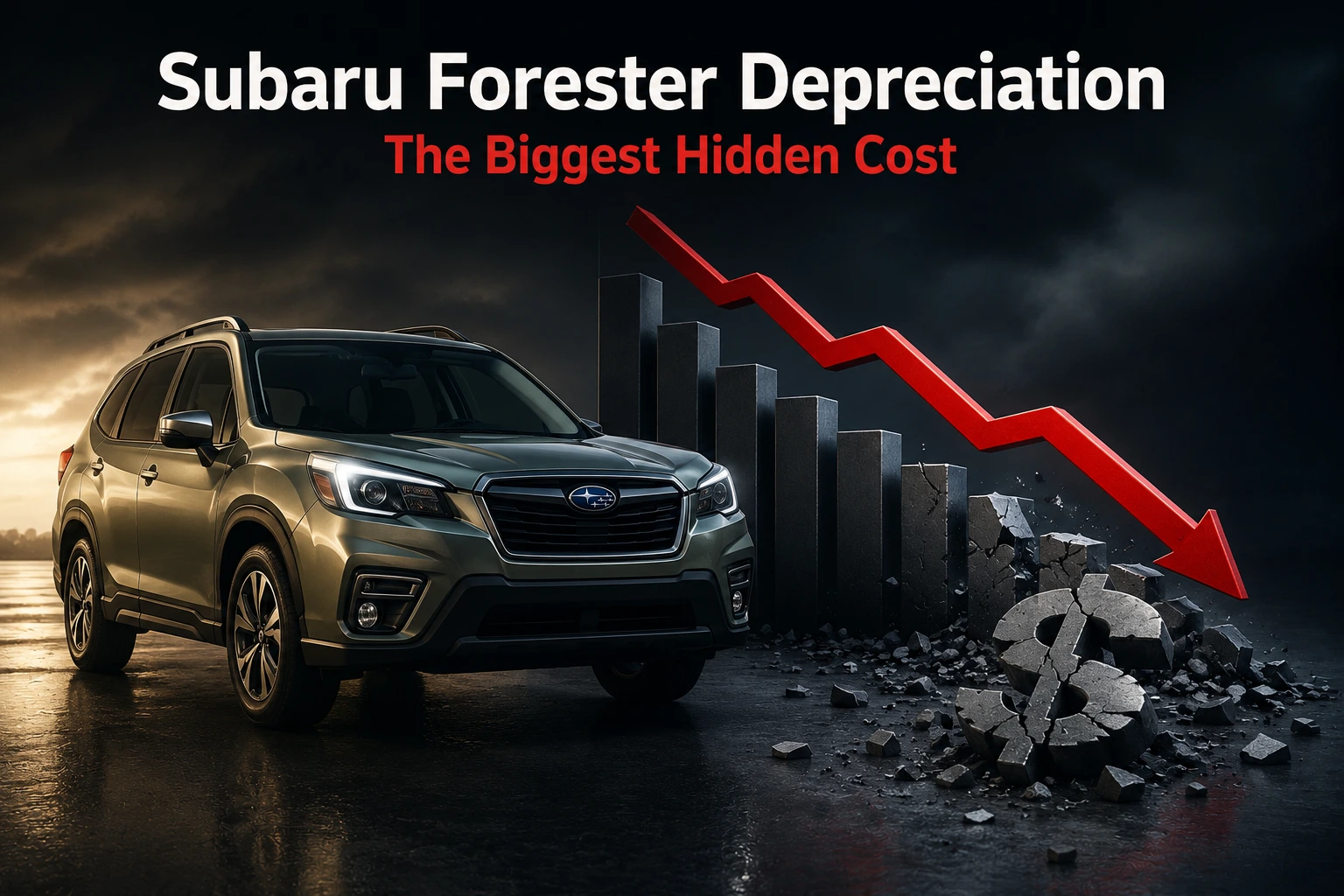
Nothing drains your wallet quite as quietly as depreciation, and it’s almost always the single largest expense across five years of ownership, even though no monthly bill ever arrives for it. A new Forester loses a meaningful chunk of its value within the first year alone, then continues shedding value at a slower, steadier pace through years two, three, four, and five.
Subaru’s reputation for reliability actually helps the Forester hold value better than plenty of competitors in the compact SUV segment. Buyers shopping the used market trust that a Forester with 60,000 miles still has plenty of life left, and that trust translates into stronger resale prices compared to brands with shakier reliability reputations. Still, “better than average” doesn’t mean immune to the math.
By the five-year mark, a Forester typically retains somewhere in the range of 45% to 55% of its original value, depending on trim level, mileage, and regional market conditions. That means roughly half the original purchase price simply evaporates, unrecoverable, over your ownership window, regardless of how well you maintained the vehicle.
Trim level matters here too. Base models tend to depreciate at a slightly different rate than loaded Touring or Wilderness trims, since buyers shopping the used market often gravitate toward feature-rich versions, sometimes propping up resale values on higher trims relative to their original price premium.
Mileage accumulation accelerates this process considerably. A Forester driven 15,000 miles annually depreciates faster in raw dollar terms than one driven closer to 8,000 miles a year, simply because higher mileage signals more wear to prospective used buyers.
If minimizing this cost matters to you, driving less, maintaining detailed service records, and keeping the vehicle in clean cosmetic condition all help protect resale value when the time eventually comes to sell or trade in.
Fuel Costs Over Five Years
Gas isn’t glamorous, but it adds up fast, and the Forester’s four-cylinder engine paired with standard all-wheel drive lands it in a reasonably efficient spot within its segment, without quite matching front-wheel-drive competitors that skip the added weight and drivetrain complication.
Most Forester trims average somewhere between 26 and 29 miles per gallon combined, depending on the specific configuration and driving conditions. Highway-heavy commuters typically see figures on the higher end of that range, while city driving with frequent stops pulls efficiency downward noticeably.
Assuming a driver covers roughly 12,000 miles annually, a reasonably typical figure for average American drivers, fuel costs over five years land somewhere in the neighborhood of $8,000 to $10,000, though this swings considerably based on regional gas prices and individual driving habits. Someone commuting through dense city traffic in a state with higher fuel prices will land toward the upper end of that range, while a rural highway commuter somewhere with cheaper gas prices might land noticeably lower.
Driving style influences this figure more than most owners realize. Aggressive acceleration, excessive idling, and frequent short trips that never let the engine reach optimal operating temperature all reduce real-world fuel efficiency compared to the EPA’s controlled testing conditions. Smooth, steady driving habits can meaningfully improve actual fuel economy compared to those official estimates.
Regional gas price differences create some of the widest swings in this entire calculation. A Forester owner in a state with consistently cheap gas might spend considerably less over five years than an otherwise identical owner in a region where prices run persistently higher.
Since fuel represents one of the few truly controllable costs in this entire ownership equation, through route planning, driving habits, and vehicle care, it’s worth paying attention to rather than writing off as a fixed, unavoidable expense.
Also Read: 8 Hidden Features in the Subaru Crosstrek
Routine Maintenance Expenses
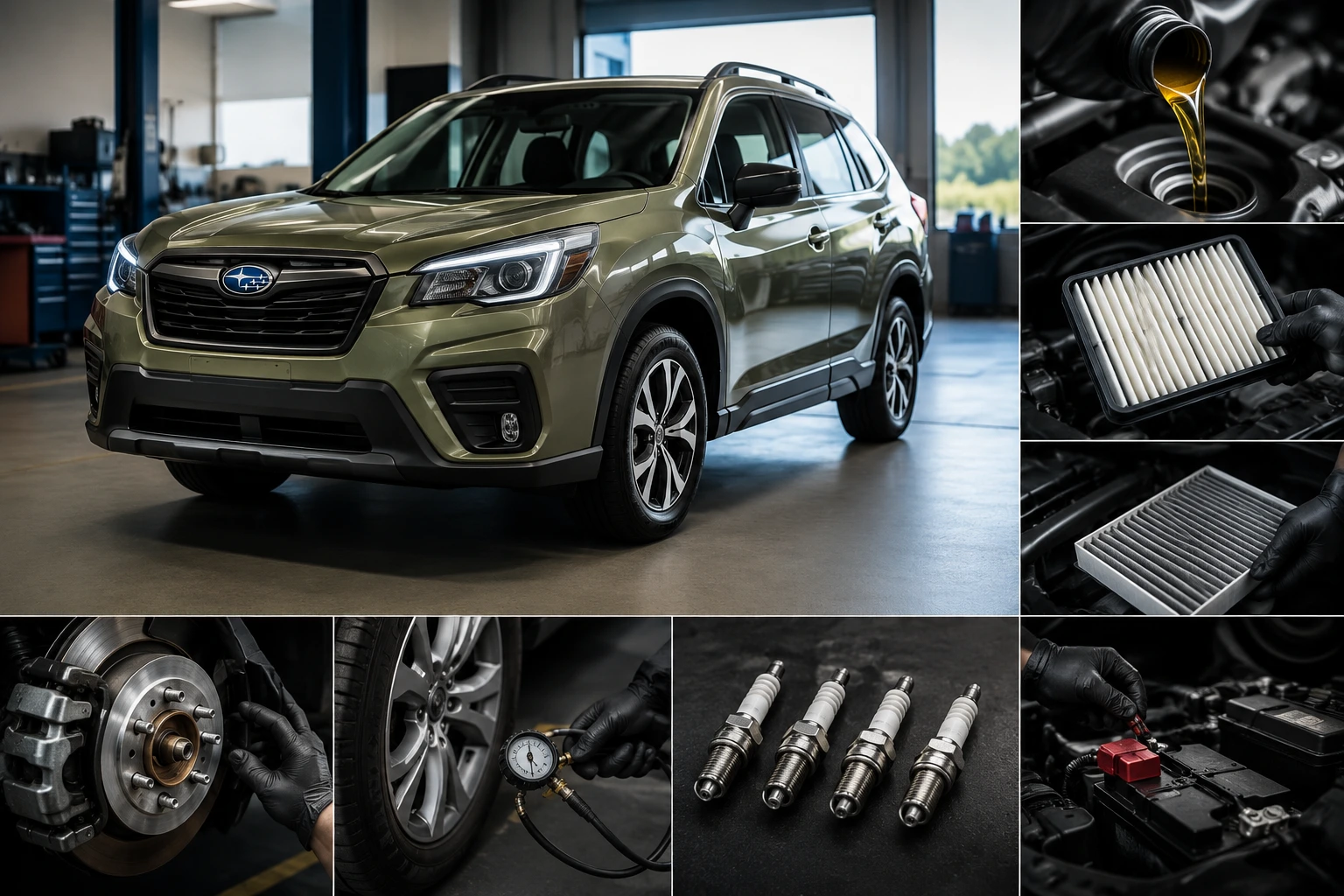
Keeping a Subaru Forester in good condition requires more than just paying for fuel. Regular services such as oil replacements, tire changes, brake checks, and cabin filter replacements may seem affordable when handled separately, but these expenses can add up over five years and about 60,000 miles of ownership.
Subaru advises owners to carry out maintenance around every 6,000 miles for oil service, with additional checks for brakes, fluids, belts, and the all-wheel-drive system. Since the Forester uses a more advanced drivetrain than many front-wheel-drive SUVs, proper care helps maintain smooth operation. Over a five-year period, routine service costs usually fall between $3,500 and $5,000, depending on the repair shop chosen and the type of work required.
Many owners choose independent mechanics because they often charge less than dealerships. Dealerships may cost more, but they have technicians familiar with Subaru systems, including the all-wheel-drive setup and continuously variable transmission.
Tire replacement is another expense Forester owners should prepare for. All-wheel-drive vehicles usually require replacing all four tires together to maintain balanced performance and reduce stress on the drivetrain. A complete set can cost about $600 to $1,200, depending on the tire brand and size.
Brake work, fluid services, and filter replacements are easier to manage when planned ahead. Following Subaru’s recommended service schedule helps reduce the chance of expensive repairs and supports better vehicle performance for many years.
Repair Costs and Reliability
Reliability reputations matter for a reason, and the Forester generally earns its favorable standing through a track record of fewer major mechanical surprises compared to plenty of competitors. That said, “reliable” doesn’t mean “repair-free,” and understanding what typically goes wrong helps set realistic expectations.
Across five years, unscheduled repair costs for a Forester typically average somewhere between $1,500 and $3,000, though this figure varies considerably based on driving conditions, maintenance history, and simple luck. Vehicles maintained closely according to Subaru’s recommended schedule tend to land toward the lower end of that range, while neglected maintenance schedules often lead to accelerated wear and correspondingly higher repair bills later.
Certain components warrant particular attention on the Forester specifically. The continuously variable transmission, standard across most trims, has occasionally drawn scrutiny in owner forums and independent reliability surveys, though widespread catastrophic failures remain relatively uncommon when the vehicle receives proper fluid maintenance on schedule.
Head gasket concerns, historically associated with earlier Subaru generations, have become considerably less common on modern Forester model years thanks to design improvements, though it remains worth researching specific model years if buying used.
Warranty coverage softens much of this financial exposure during the earlier portion of ownership. Subaru’s standard new vehicle warranty typically covers the first three years or 36,000 miles for most components, with powertrain coverage extending further, meaning major repair costs during roughly the first half of a five-year ownership window often fall on Subaru rather than the owner directly.
Once warranty coverage expires, owners bear full responsibility for repair costs, making years four and five statistically more expensive from a repair standpoint than the earlier, warranty-protected years. Setting aside a modest repair fund starting around year three helps smooth out this predictable cost curve rather than facing an unexpected bill during year four or five.

Insurance Premiums for the Forester
Several factors affect how much a Subaru Forester owner pays for insurance, including location, driving history, age, and the level of protection selected. Compared with many similar SUVs, the Forester often stays within a reasonable insurance range because of its strong safety record and standard all-wheel-drive system, which can help provide better control in difficult weather conditions.
For a typical driver with a clean record and regular coverage, five years of insurance may cost around $7,000 to $10,000. The amount can be much higher for younger drivers or people living in areas with more accidents and vehicle theft cases. Personal details play a major role in determining the final premium.
Many Forester models come with safety equipment such as automatic emergency braking and lane departure warnings. These features may help some owners qualify for discounts because insurance companies often consider safer vehicles less likely to experience severe accidents. Asking your provider about available savings can help lower yearly payments.
Another factor that affects insurance pricing is the type of coverage selected. Full coverage with collision and comprehensive protection usually costs more than basic liability insurance. Owners should consider the vehicle’s value, loan status, and personal financial situation before choosing a plan.
Comparing quotes from several insurance companies before buying a Forester can reveal better rates. Taking time to check different options may help drivers save hundreds of dollars each year instead of staying with the first provider they find.
Taxes, Fees, and Financing Charges
Sales tax alone can add thousands of dollars to a Forester’s effective purchase price, varying enormously depending on your state, with some states charging upward of 8% or more on the vehicle’s purchase price, while a handful of states charge no sales tax on vehicle purchases whatsoever.
Registration and title fees add further cost, typically ranging from under $100 annually in some states to several hundred dollars in others, particularly in states that calculate registration fees based partly on vehicle value rather than a flat rate. These fees recur annually throughout the five-year ownership period, adding up to a meaningful sum by the time you tally the full window.
Financing charges represent another cost many buyers underestimate when focused purely on the monthly payment figure. A Forester financed over five or six years at a typical interest rate can accumulate thousands of dollars in interest charges beyond the vehicle’s actual purchase price, with the exact figure depending heavily on your credit score, loan term, and prevailing interest rates at the time of purchase.
Buyers with strong credit scores typically qualify for considerably lower interest rates than those with average or below-average credit, sometimes differing by several percentage points, a gap that translates into real dollar savings or losses across a multi-year loan term. Shopping multiple lenders, including credit unions alongside traditional banks and dealership financing, often reveals better rates than accepting the first financing offer presented at the dealership.
Together, taxes, fees, and financing charges frequently add somewhere between $3,000 and $6,000 to the true five-year cost of Forester ownership, a figure rarely advertised alongside the vehicle’s sticker price but very much a real part of the total financial picture.
Also Read: 5 Best Subaru Forester Years vs 5 to Avoid
Total Five-Year Cost Breakdown
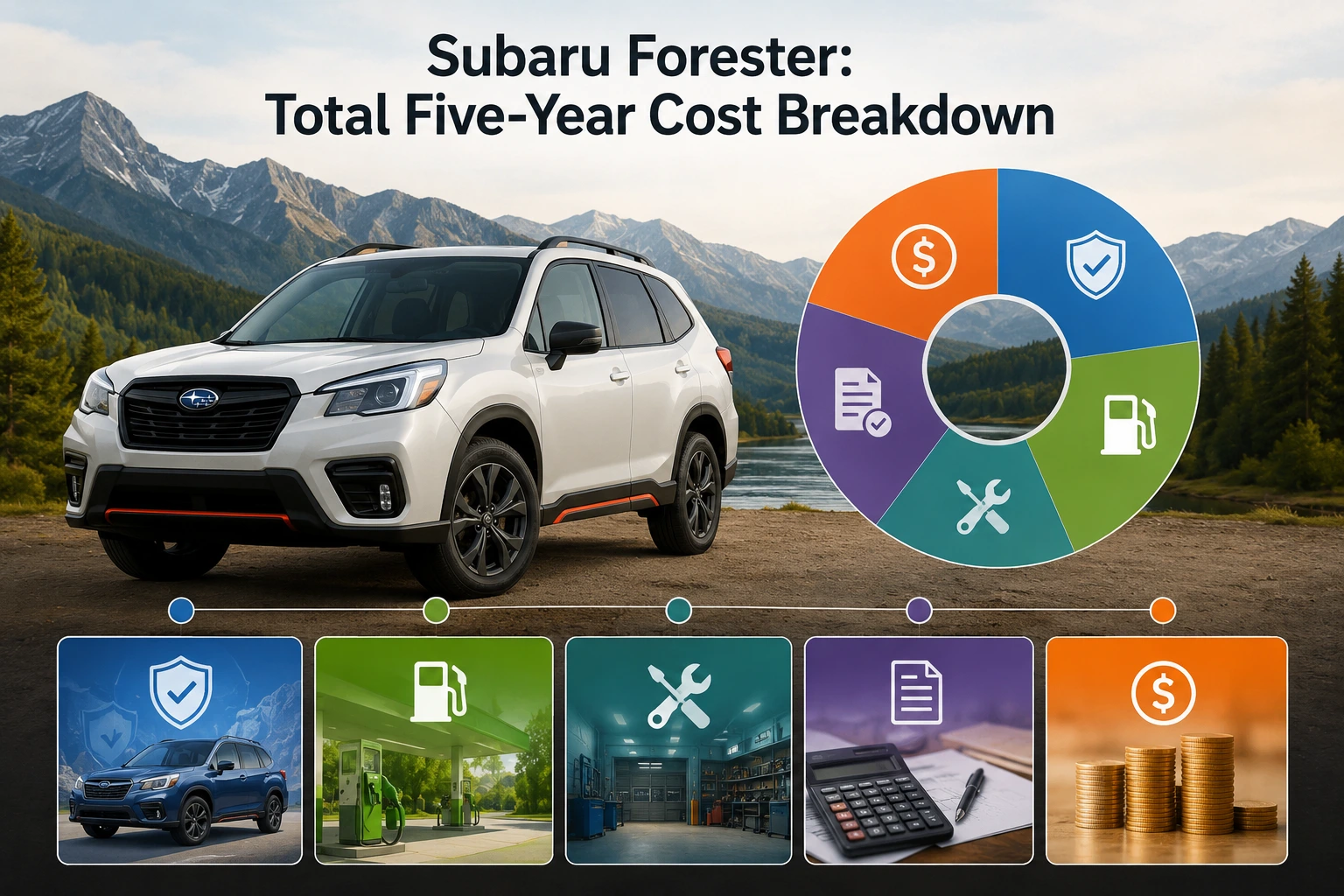
Adding depreciation, fuel, maintenance, repairs, insurance, taxes, fees, and financing together, the five-year cost of owning a Subaru Forester can reach about $35,000 to $45,000 beyond the purchase price, depending on location, driving habits, and personal circumstances.
Among these expenses, depreciation usually takes the largest portion of the cost, while fuel and insurance create regular yearly expenses. Maintenance and repairs may appear smaller, but they can add thousands of dollars during ownership, especially after warranty coverage ends.
When compared with other compact SUVs, the Forester remains a practical choice because of its resale value and reliability. Its standard all-wheel-drive system may add some expenses compared with front-wheel-drive models, but many owners consider the extra ability worth the cost.
Before buying, remember that the sticker price does not show the full ownership expense. Planning for yearly costs of around $7,000 to $9,000 gives buyers a clearer idea of what ownership requires.
