
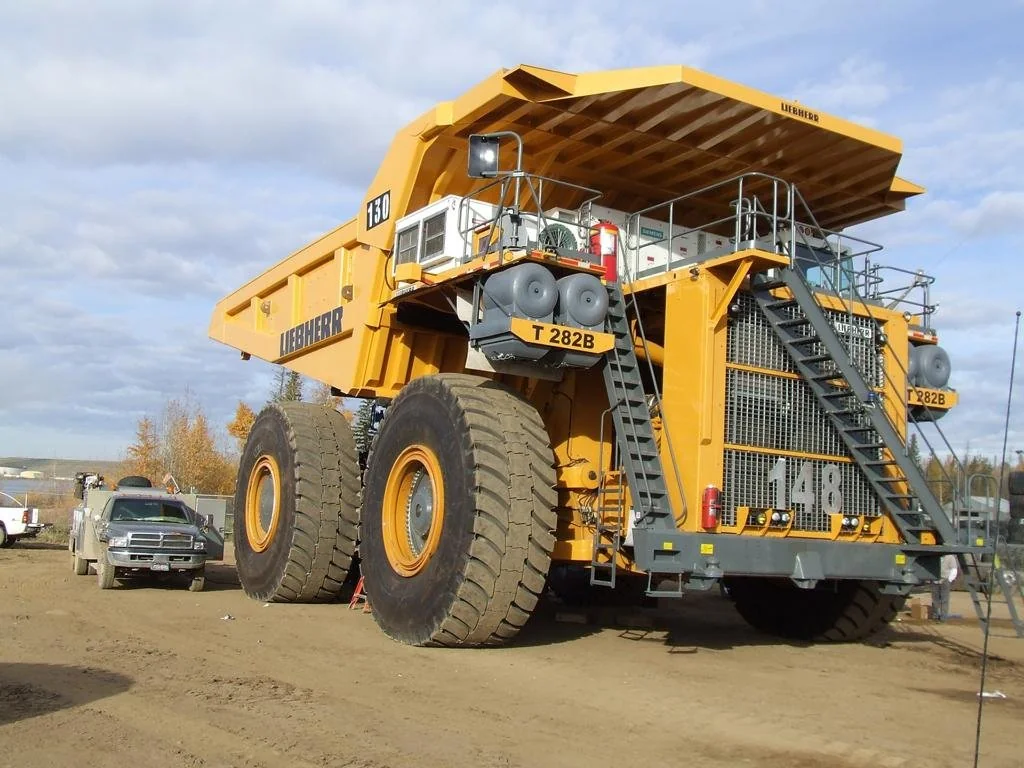
The journey into extreme industrial machinery begins with the Liebherr T 282B, a machine that represents the upper boundary of haulage engineering. Introduced in 2004 by Liebherr, it was designed to move staggering volumes of rock and ore in large-scale open-pit mining operations. With a payload capacity of up to 400 tons and an empty weight of nearly 278 tons, it operates on a scale comparable to small buildings in motion.
Its massive frame stretches over 50 feet in length and more than 31 feet in width, requiring an elevated ladder system just to reach the operator’s cab. Powered by a 20-cylinder diesel-electric engine producing around 3,650 horsepower, it combines raw mechanical force with advanced electrical drive systems.
The AC drive architecture eliminates traditional gear shifting, improving efficiency and control. Its suspension system stabilizes enormous loads across uneven terrain, making it a cornerstone of ultra-class mining development and global mining ops
1. Liebherr T 282B
The Liebherr T 282B stands as one of the most powerful ultra-class mining vehicles ever built, introduced in 2004 by German manufacturer Liebherr. Designed for large-scale open-pit mining, it can haul up to 400 tons of material while weighing around 278 tons empty. Its enormous frame exceeds 50 feet in length and 31 feet in width, with a towering structure that requires a 16-step ladder to reach the operator cab.
It is powered by a 20-cylinder diesel-electric engine producing around 3,650 horsepower, paired with Liebherr-Siemens AC drive technology that eliminates traditional gear shifting and improves torque control. This system allows continuous acceleration, dynamic braking, and reduced mechanical wear, making it highly efficient in demanding mining environments. Its double A-frame suspension enhances stability, ensuring tire contact remains consistent even on uneven and rocky terrain while supporting extreme payload loads.
The truck’s operational design includes a fuel tank capacity of about 193 gallons, with consumption that can exceed 46 gallons per hour under heavy load conditions. The operator cab is engineered for comfort, featuring reduced vibration, low noise levels, and wide visibility to support long working shifts in harsh mining sites. Its massive cargo bed is capable of handling multiple heavy vehicles or large volumes of ore with ease.
Beyond industrial use, the T 282B has influenced mining engineering standards and remains a reference point for ultra-class haul truck development. Scale replicas are also popular among collectors, often featuring working suspension and hydraulic systems that replicate the machine’s engineering detail in miniature form for display and educational purposes worldwide today globally.
- Engine: MTU / Detroit Diesel 20V4000 (20-cylinder V-type, 90L diesel)
- Horsepower: 3,650 hp @ 1,800 rpm
- Torque: ~10,600 lb-ft (14,370 Nm)
- Length: 14.5 m (47.6 ft)
- Width: 8.8 m (28.9 ft)
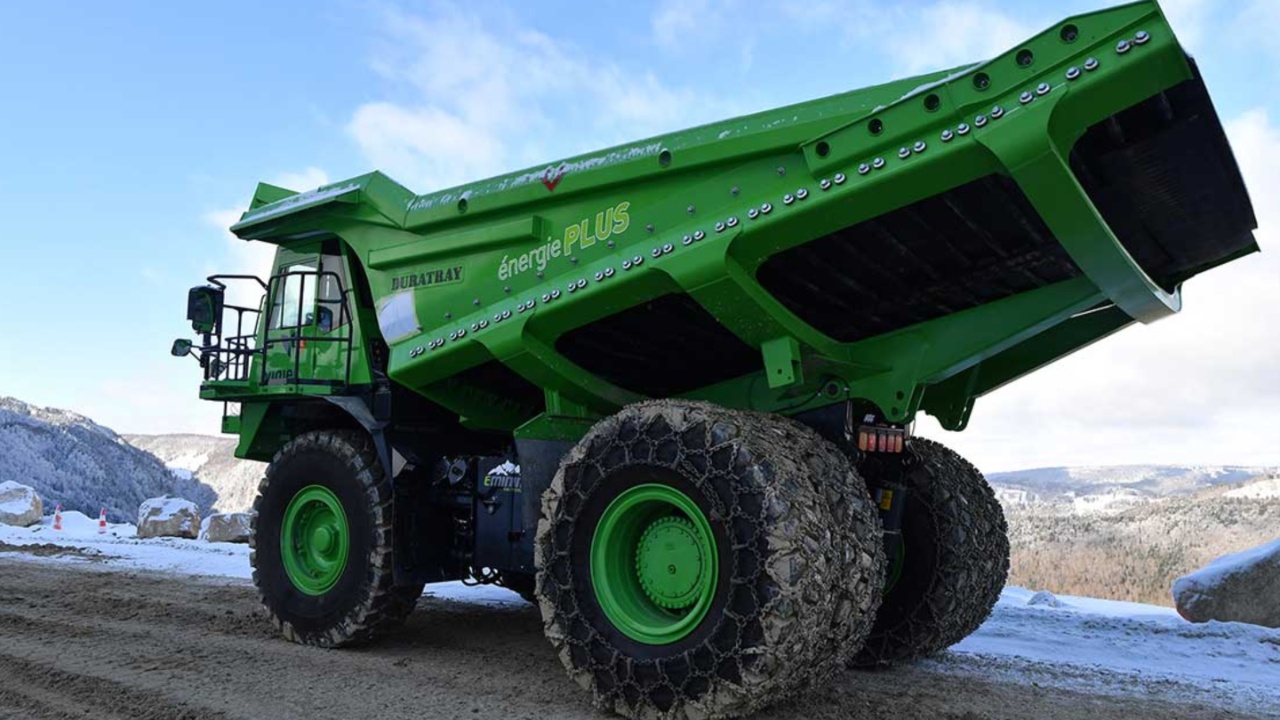
2. eDumper
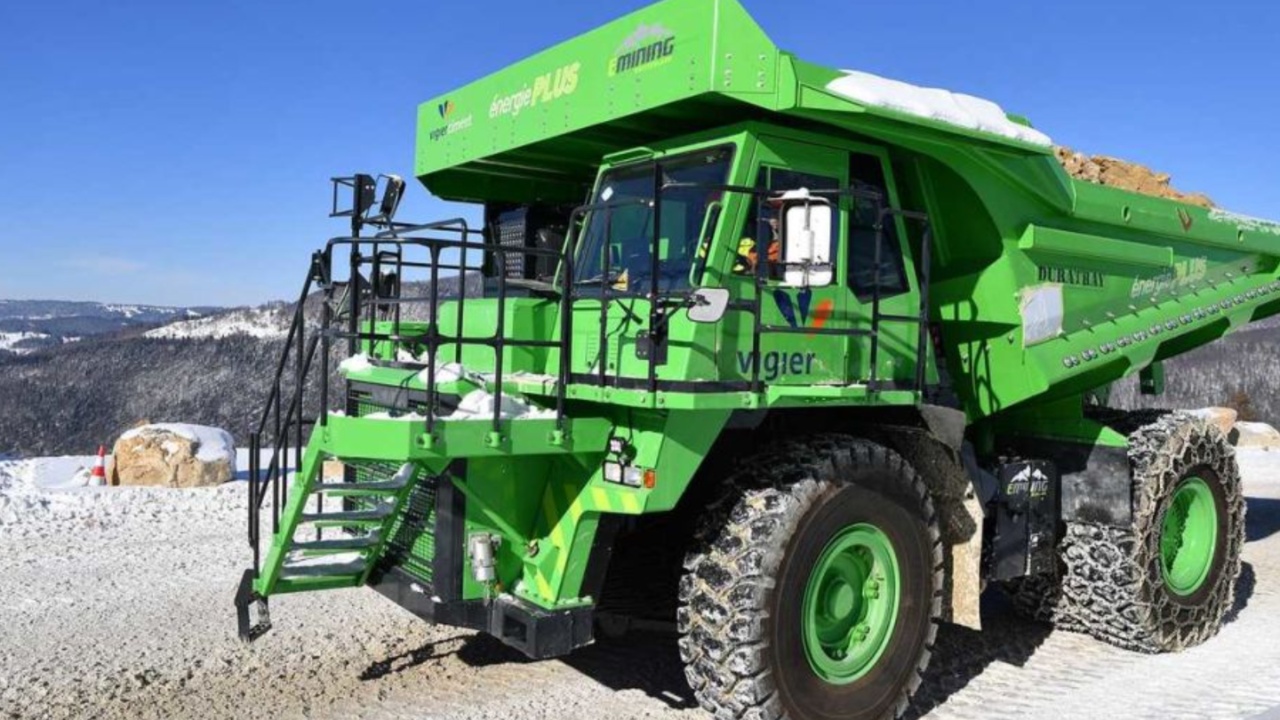
Swiss engineers and Kuhn Group, collaborating with Komatsu Mining, have created the world’s largest electric vehicle: the eDumper. Built on the frame of a massive Komatsu HD 605-7 mining truck, this innovation swaps out a traditional 23.1-liter turbodiesel engine for a fully electric powertrain.
At the heart of the eDumper is a gigantic lithium-ion battery pack weighing over 10,000 pounds (four tonnes). With a massive capacity of 600 to 700 kWh, roughly six times that of a Tesla Model X, this heavy-duty system allows the truck to operate with virtually zero direct emissions. Over a decade of operation, engineers estimate the vehicle will move approximately 330 million pounds of material while saving an impressive 50,000 tonnes of diesel annually.
What truly sets the eDumper apart, however, is its ingenious application of physics through regenerative braking. Designed for quarry environments, the 45-tonne truck climbs a steep 13 percent incline to load up with 65 tonnes of materials. On its descent to the cement factory, the immense weight of the fully loaded truck forces the regenerative braking system to capture energy. This process is so efficient that the eDumper actually generates more electricity on the way down than it consumes on the way up, making it a net positive energy producer during its descent.
While the development costs compared to standard internal combustion variants remain closely guarded, the eDumper represents a massive milestone for heavy industry. It proves that even the dirtiest, most gargantuan industrial vehicles can be successfully electrified, offering a cleaner, more sustainable future for global mining and construction operations.
- Motor: Synchronous electric motor (battery-electric conversion replacing 23.1L diesel engine)
- Horsepower: 862 hp (634 kW continuous output)
- Torque: ~12,000 Nm
- Length: ~9.14 m (30.0 ft)
- Width: ~4.27 m (14.0 ft)
3. Komatsu 930E-4
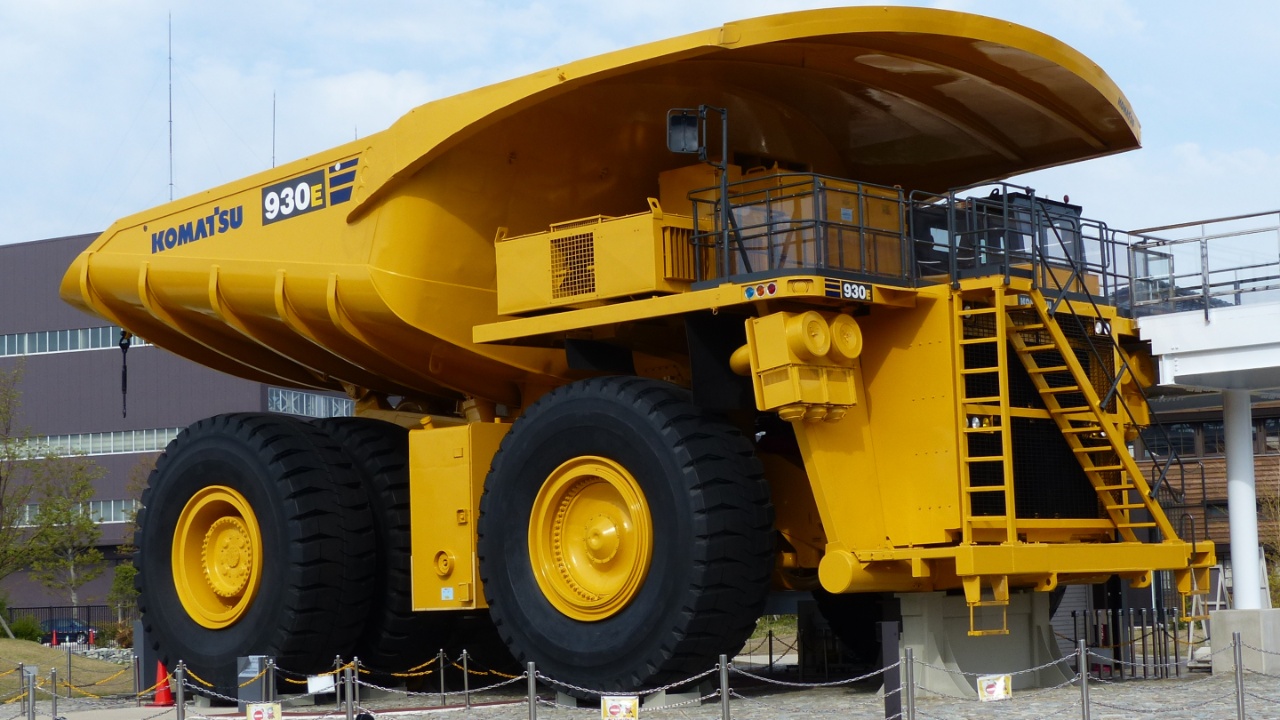
Engineered by Japanese heavy-equipment giant Komatsu, the 930E-4 sets the industry standard for ultra-class dump trucks in large-scale, open-cast mining. By combining an immense 292-metric-tonne (320-ton) payload capacity with cutting-edge automated systems, this massive vehicle delivers a double win for deep-pit operations: it maximizes hauling productivity while minimizing operator error. The result is a reliable powerhouse that thrives in the most brutal environments while maintaining a remarkably low cost per tonne.
Powering this giant is a robust engine configuration delivering between 2,700 and 3,500 horsepower, paired with an advanced AC electric drive system. This setup allows the truck to reach top speeds of 64.5 km/h (40 mph) while advanced engine-management software works to lower emissions. To ensure safety while transporting heavy payloads down steep mining roads, the truck is equipped with a powerful 4,026 kW electric dynamic retarder for secure downhill braking.
The vehicle boasts several engineering advantages that maximize uptime and operator satisfaction on the job. Its AC electric drive system requires fewer moving parts than mechanical alternatives, significantly reducing wear and routine maintenance. Furthermore, a simplified hydraulic system uses a single tank for steering, braking, and hoisting to streamline servicing, while a Hydrair II nitrogen-over-oil suspension ensures a smooth, stable ride. Notably, the 930E-4 integrates advanced diagnostic software to prevent catastrophic failures and fully supports Komatsu’s Autonomous Haulage Systems (AHS) for driverless operations.
However, operating such an enormous asset comes with distinct financial challenges. The initial capital expense required to purchase and assemble an ultra-class truck of this scale is incredibly high, making it a major upfront investment for any mining operation. Additionally, the continuous maintenance and replacement of its massive 53/80 R63 tires represent a substantial and ongoing operational expenditure that fleets must constantly manage.
- Engine: Komatsu SSDA16V160 (standard) / SSDA18V170 (SE variant), 60L diesel V-type
- Horsepower: 2,700 hp (standard) up to 3,500 hp (SE)
- Torque: ~11,540 Nm (standard) / ~13,678 Nm (SE)
- Length: 51 ft 2 in (15.6 m)
- Width: 30 ft 2 in (9.19 m)
4. Caterpillar 797
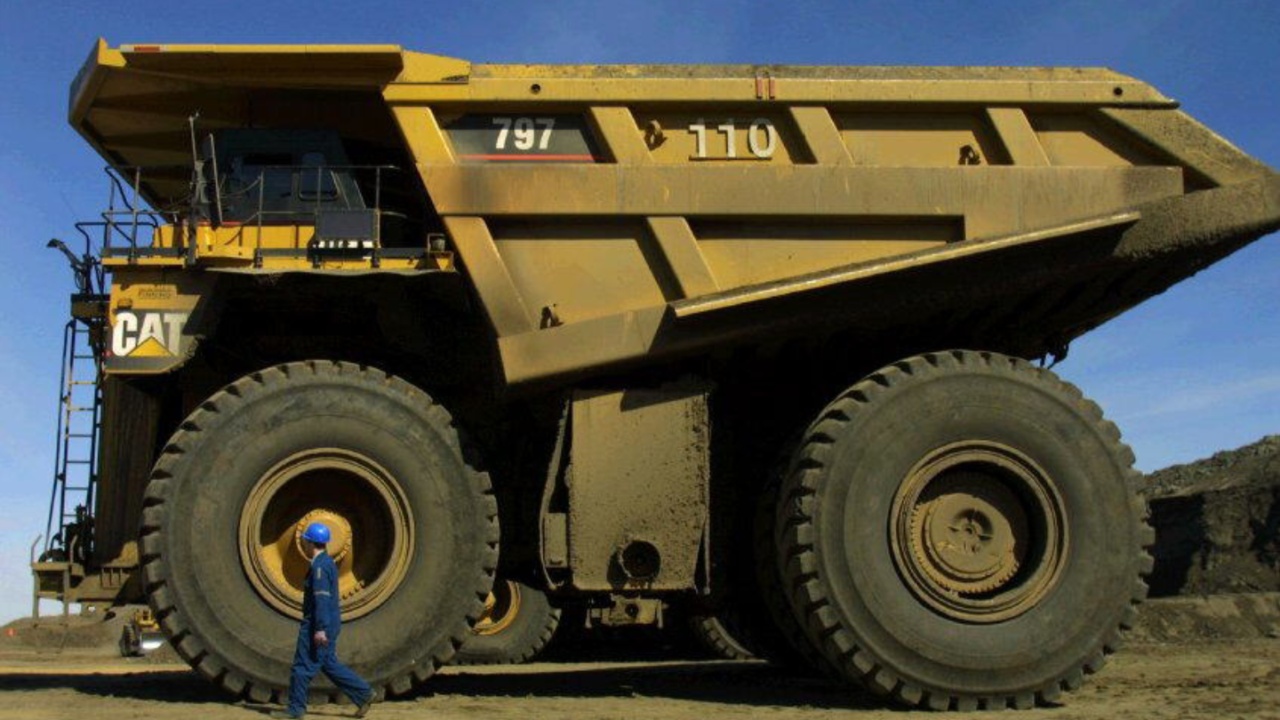
The Caterpillar 797 is an engineered marvel designed to conquer Earth’s most demanding large-scale mining operations. Standing nearly 24 feet tall, 30 feet wide, and 48 feet long, this colossal vehicle dwarfs standard heavy machinery. It is built for sheer utility rather than show, carrying an immense payload capacity of 360 to 400 tons, roughly equivalent to hauling 120 Ford Excursions at once.
Powering this giant is a 117-liter, quad-turbo V-24 diesel engine, which effectively merges two V-12 powerplants. Generating 3,400 to over 4,000 horsepower and an astonishing 12,170 pound-feet of torque, the 797 channels power via a direct-drive seven-speed automatic transmission. This mechanical muscle allows the 560,000-pound truck (empty weight) to reach a top speed of 40 mph, even when fully burdened to a maximum gross weight of 1,280,000 pounds.
Supporting this massive frame is a welded chassis made of nine heavy castings, utilizing a four-link rear suspension and massive hydraulic front cylinders. The truck rides on six specialized Michelin radial tires, each standing nearly 13 feet tall and weighing over 10,000 pounds.
Operating a vehicle of this magnitude requires a staggering logistical and financial commitment. Priced at $3.4 million, the 797 must be shipped in pieces aboard 12 semi-trucks and assembled on-site at remote mines. Furthermore, mine operators must overhaul their infrastructure to accommodate the truck, including widening roads to three times the vehicle’s width, enlarging service shops, retraining drivers, and maintaining massive fuel depots to feed its optional 1,800-gallon fuel tank. As mining shovels continue to grow, the Caterpillar 797 stands as a testament to the ever-expanding scale of industrial engineering.
- Engine: Cat C175-20, 20-cylinder quad-turbocharged diesel (175L)
- Horsepower: 4,000 hp gross (3,793 hp net)
- Torque: 13,500 lb-ft (18,303 Nm)
- Length: 49.5 ft (15,080 mm)
- Width: 32.0 ft (9,755 mm) overall / approximately 30 ft canopy width overall / approximately 30 ft cano
5. Euclid 1LLD
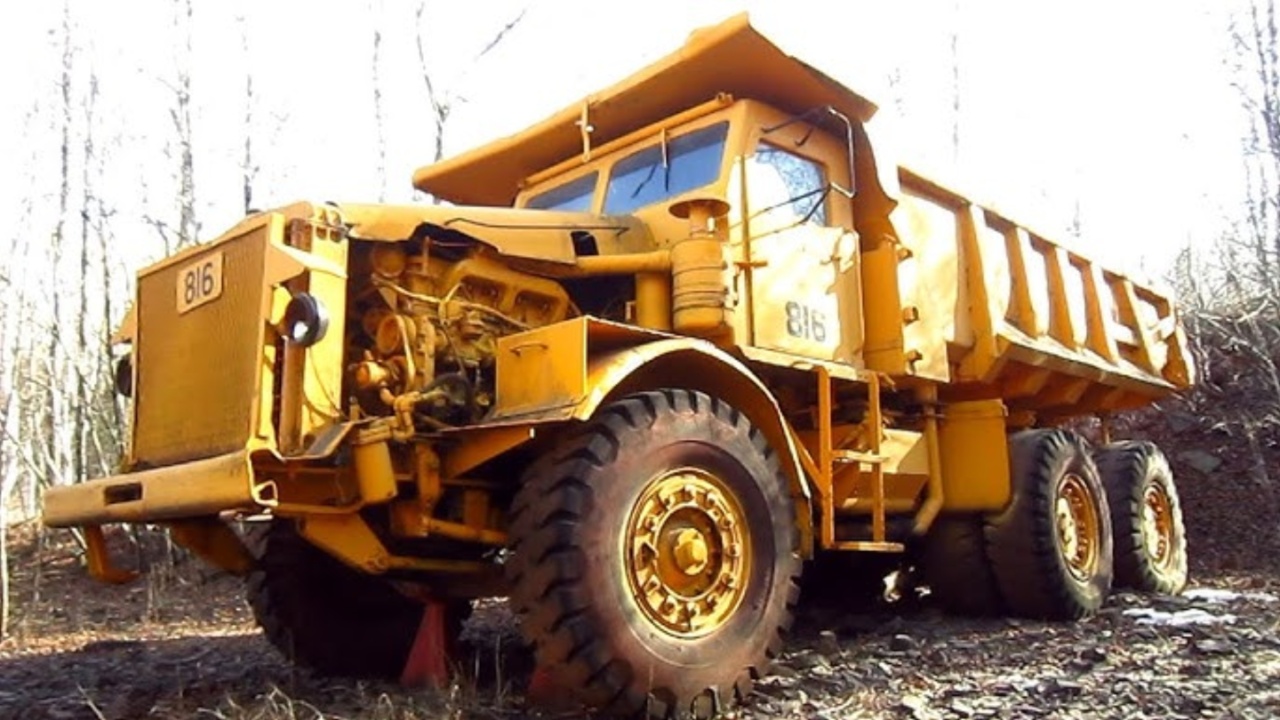
Introduced in the early 1950s by the Euclid Trucks division, the Euclid 1LLD stands out as one of the most unique heavy haul machines ever engineered. Custom-built to meet the grueling demands of deep pit mining and massive dam construction projects, this off-highway giant pioneered new capabilities in material transportation.
At the time, individual diesel engines lacked the necessary strength to haul immense loads over steep and rugged terrain. Euclid bypassed this limitation through a radical engineering feat by linking two separate and synchronized powertrains. The truck was powered by twin Cummins V12 diesel engines. While they were originally rated at 300 horsepower each for a combined 600 horsepower, later configurations pushed them up to 425 horsepower each. This design featured a unique layout where each engine independently powered its own Allison transmission and corresponding rear axle. To protect components from harsh terrain vibrations and optimize airflow, engineers even rerouted the exhaust system above the hood.
By proving the concept of synchronized multi-engine setups controlled by a single hand lever, the 1LLD paved the way for the massive vehicles used in modern industrial operations. While officially rated as a 50-ton dump truck, its incredibly robust frame allowed contractors to modify the vehicle into articulated bottom dumps or Western-style tippers. These modifications enabled the colossal machine to carry anywhere from 100 to 165 tons of material, cementing its legacy as a revolutionary trailblazer in heavy-duty earthmoving history.
- Engine: Twin diesel engines (commonly dual Cummins or GM two-stroke diesels such as dual GM 6-71s; some later conversions used twin GM 12V-71s)
- Horsepower: 400–600 hp combined (factory versions) up to 1,700 hp combined (modified twin 850 hp engines)
- Torque: Typically exceeds 1,600 lb-ft combined (varies by engine configuration)
- Length: 26–30 ft (7.9–9.1 m) factory configuration / 53 ft (16.2 m) Western 150-ton conversion
- Width: 11–12 ft (3.4–3.7 m) factory configuration / 15.5 ft (4.7 m) Western 150-ton conversion
Also read: 10 Cars That Are Cheaper in Texas Than the Rest of America
6. Rosenbauer Buffalo Extreme
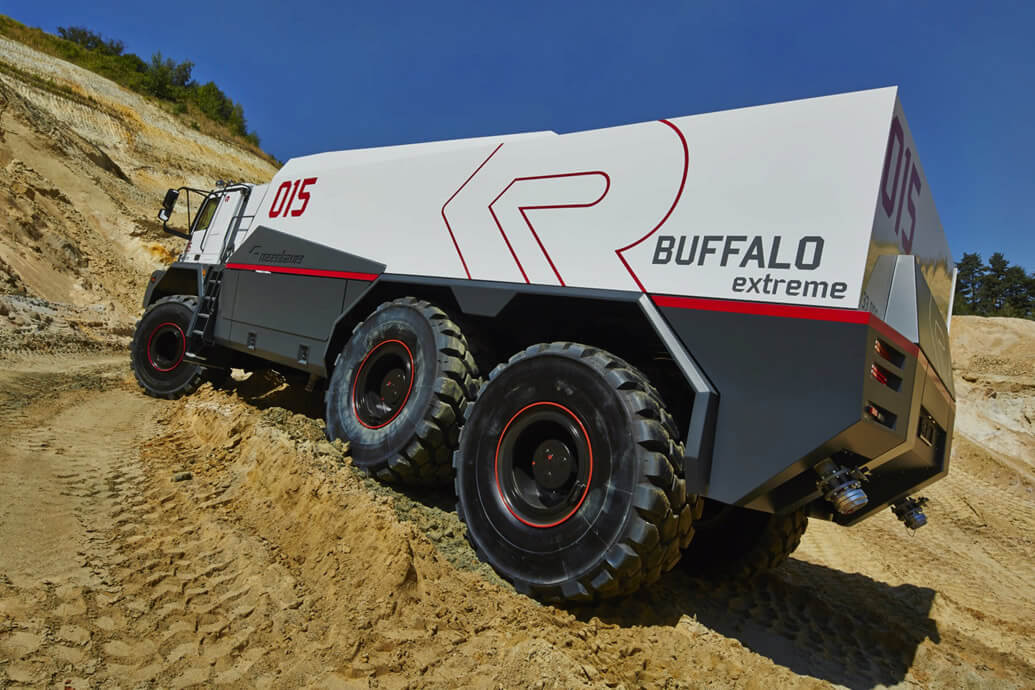
While most massive vehicles are built for mining, the Rosenbauer Buffalo Extreme is engineered to fight fires in the world’s toughest environments. As one of the largest off-road fire trucks ever created, this heavy-duty tanker-pumper is specifically designed to transport massive volumes of extinguishing agents to remote, rugged locations lacking hydrant networks, such as deserts and opencast mines.
Built on a specialized all-wheel-drive chassis using Mercedes-Benz technology, the Buffalo Extreme handles severe terrain with ease. It features planetary axles, differential locks, a $35^\circ$ slope angle, and high ground clearance. Despite weighing up to 75 tons (68 metric tons) when fully loaded, its exceptional 3.5-meter width and massive 670 mm wide tires ensure remarkable driving stability over sand, rough roads, and cross-country landscapes.
The centerpiece of the truck is its over-dimensional single-chamber tank, capable of carrying an astonishing 8,700 gallons (33,000 liters) of water or foam. It is equipped with a newly developed N65 integrated pump delivering 6,500 l/min at 10 bar, alongside an optional foam proportioning system. For firefighting operations, it features a lowerable RM60C roof monitor controlled via joystick from the cab, which pneumatically raises by 450 mm during deployment.
The vehicle utilizes a corrosion-resistant, bolted aluminum Custom Body System (CBS). Powered by a 571 hp Mercedes-Benz V8 engine with a specialized high-temperature cooling system, it expands Rosenbauer’s water tanker (GTLF) range into the heaviest class available, completely redefining remote fire defense.
- Engine: V8 heavy-duty diesel engine (mounted on a Paul Heavy Mover 6×6 chassis)
- Horsepower: 571 hp (420 kW)
- Torque: ~2,000–2,700 Nm
- Length: 13,000 mm (13.0 m / 42.7 ft)
- Width: 3,550 mm (3.55 m / 11.6 ft)
7. Terex 33-19 Titan
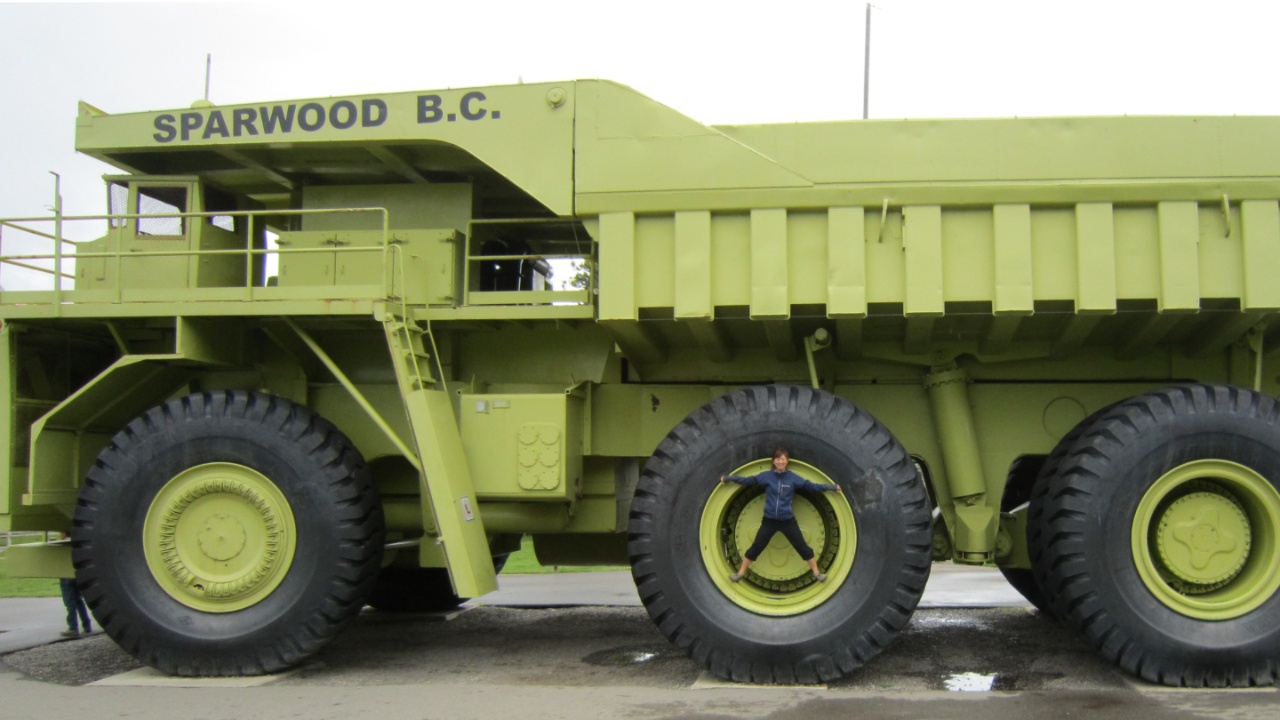
Designed by General Motors’ Terex Division and assembled in London, Ontario, the 1973 Terex 33-19 “Titan” was a revolutionary prototype rigid-frame haul truck. Built to maximize open-pit mining efficiency amid shifting global energy demands, it stood as the world’s largest, highest-capacity truck for 25 years.
The three-axle Titan was a massive machine, measuring 66 feet long, 26 feet wide, and 23 feet tall. It had a net weight of 254.8 short tons and a massive 350-ton payload capacity. Instead of a traditional engine, it utilized a 16-cylinder locomotive-style diesel/AC electric powertrain. This 10,320-cubic-inch turbocharged engine generated 3,300 horsepower, pushing the fully loaded truck to a top speed of nearly 30 mph. It also featured an advanced all-wheel steering system to navigate tight mining terrain.
While GM projected a $1.5 million price tag for regular production, a softening late-1970s coal market killed global demand, leaving the prototype as the only unit ever built. It entered service in 1975 at a California iron mine, hauling 3.5 million short tons of earth over four years. In 1978, it moved to a mine in Sparwood, British Columbia, where it achieved an impressive 70% uptime rate before its retirement in 1991.
Beyond its industrial service, the Titan famously starred in a 1977 television commercial alongside golfing legend Jack Nicklaus. In 1993, the Sparwood Chamber of Commerce restored the truck’s iconic lime-green livery. Today, it is preserved as a major public tourist attraction in Titan Park, Sparwood, Canada, though its engine has been removed.
- Engine: GM Electro-Motive Division (EMD) 16-645E4, 169.5L V16 two-stroke diesel locomotive engine
- Horsepower: 3,300 hp
- Torque: Not officially published; diesel-electric drivetrain generated enormous tractive effort for 320–350 ton payloads
- Length: 66 ft 9 in (20.35 m)
- Width: 25 ft 7 in (7.80 m)
8. BelAZ 75710
The Belarus-built BelAZ 75710 is the world’s largest mining dump truck, designed to combat rising costs and commodity volatility in global mining. Measuring 67 feet long and 26 feet high, this engineering marvel is as long as two double-decker buses and weighs more than a loaded Airbus A380. It features an unprecedented eight-wheel configuration, with each massive tire capable of supporting 102 tons.
To haul its massive payload, the truck utilizes a unique diesel-electric transmission system. Twin 16-cylinder diesel engines drive generators that power four electric motors, producing a combined 4,600 horsepower and an extraordinary peak torque of 13,738 lb/ft. This setup allows the truck to hit a top speed of 40 mph and climb 10 percent gradients at 25 mph. While it burns roughly 1,300 liters of fuel per 100 km, it can operate on a single engine when empty to save fuel.
Engineered by Siemens, the truck employs an advanced all-wheel-drive system on both axles, providing superior traction in harsh conditions, such as the Siberian coal mine where it first shifted rocks. This dual-axle steering gives the behemoth a remarkably tight turning radius of 65 feet. Furthermore, Siemens engineers can monitor performance and diagnose issues remotely from the United States.
With an official carrying capacity of 496 tons, obliterating the previous record-holder’s 363-ton limit, the BelAZ 75710 once hauled a record 555 tons in a single load. Priced at just over 6 million dollars, this giant significantly reduces production costs per ton, making it a highly valuable asset for major iron, copper, and coal operations worldwide.
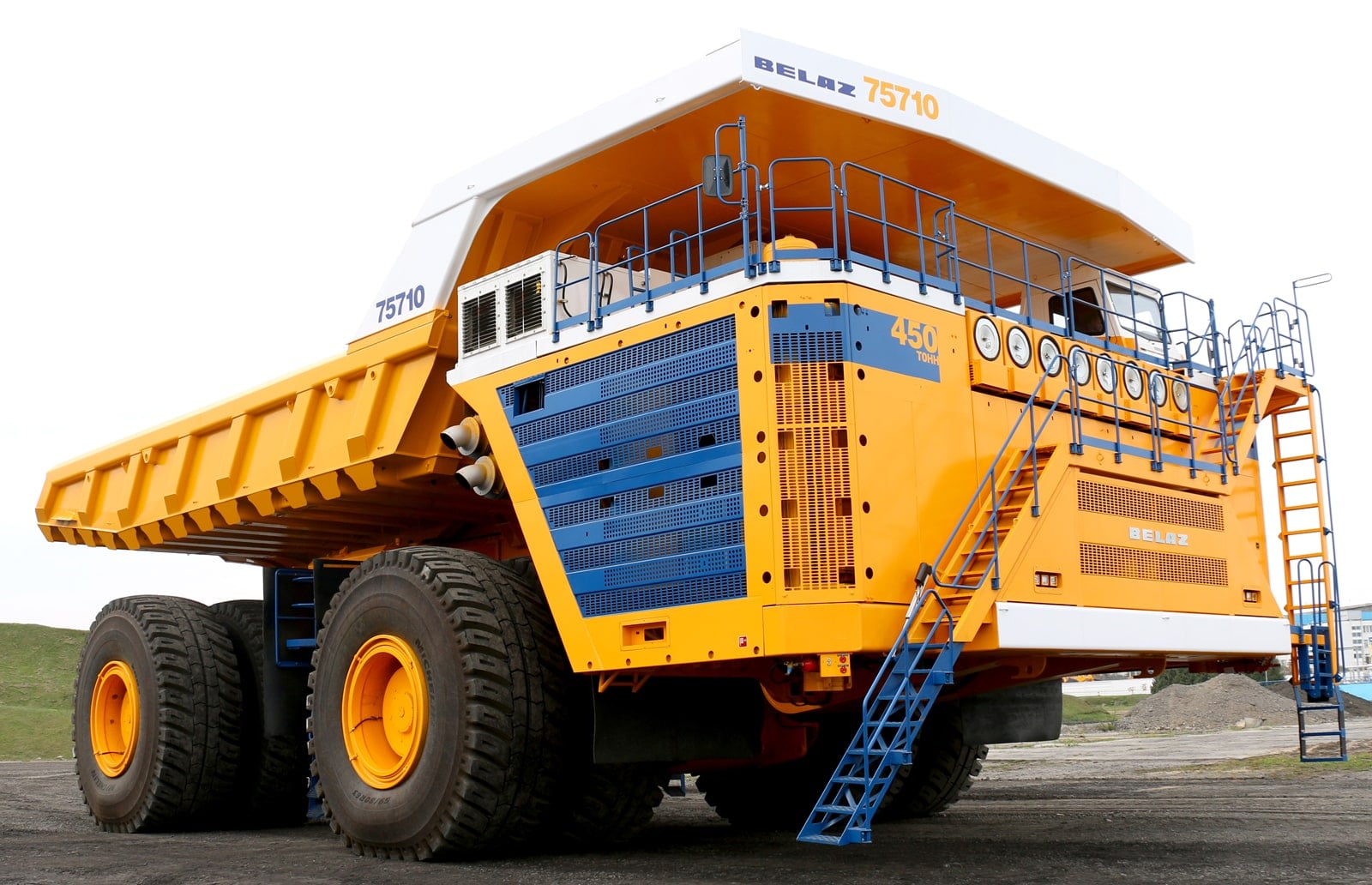
- Engine: Dual MTU DD 16V4000, 65L 16-cylinder four-stroke turbocharged diesel engines
- Horsepower: 4,600 hp total (2 × 2,300 hp)
- Torque: 18,626 Nm (13,738 lb-ft)
- Length: 20.6 m (67 ft 7 in)
- Width: 9.87 m (32 ft 4 in)
9. ETF MT-240
The ETF MT-240, engineered by the European Truck Factory, is a revolutionary modular mining haul truck that is redefining heavy industry standards. Celebrated for its hyper-efficient, “Formula 1 pit stop” maintenance philosophy, the vehicle guarantees an impressive 95% technical availability. This high uptime is achieved by allowing major mechanical components to be completely swapped out in under 45 minutes, drastically minimizing costly operational downtime in the field.
At the core of its innovation is a highly adaptable modular design that allows the MT-240 to function as a scalable base unit. Multiple trucks can be interconnected into massive “haul trains” to scale up payload capacities on demand. Furthermore, the vehicle utilizes advanced multi-axle, speed-proportional steering for a tight turning radius at low speeds and maximum stability at high speeds, while an active suspension with oscillating axles protects tires from overloading.
Industry experts and automotive publications like Jalopnik praise the truck’s unprecedented scalability and standardized parts, which simplify maintenance across payloads ranging from 180 to over 700 tons. However, critics caution that the complex, computer-controlled steering and intricate modular systems introduce numerous potential points of failure. These sophisticated elements could pose reliability risks in harsh, unpredictable mining environments compared to traditional rigid haul trucks.
Beyond the industrial sector, the unique design of the MT-240 has achieved cult status among vehicular engineering enthusiasts. This popularity has successfully crossed over into the gaming world, where the gaming community has embraced its futuristic aesthetic. Fans have faithfully recreated player-driven models of the truck on the Steam Community for sandbox titles like Space Engineers, cementing its legacy in both reality and virtual simulation.
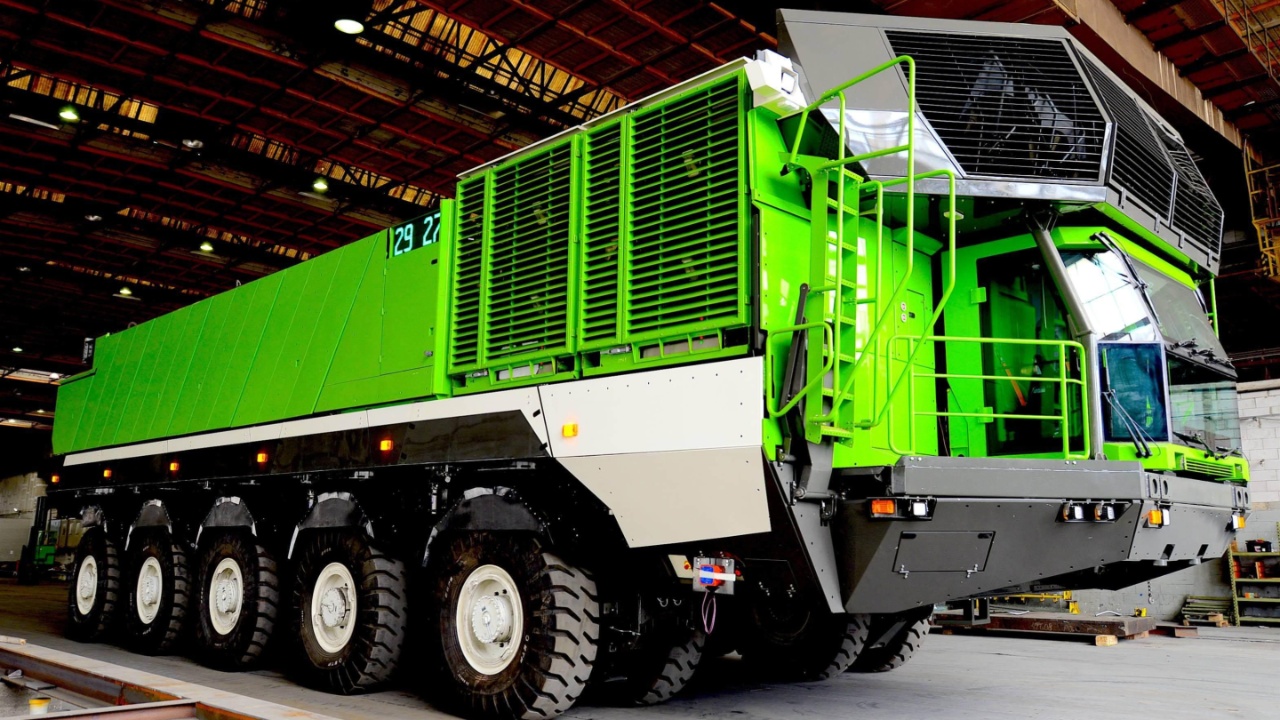
- Engine: 4 × Mercedes-Benz OM-502 V8 turbo-diesel power units (modular independent drive systems)
- Horsepower: 2,612 hp total (4 × 653 hp)
- Torque: ~11,200 Nm nominal combined (up to ~13,440 Nm peak combined @ ~1,300 rpm)
- Length: 12.5–40 m (41–131 ft, modular depending on axle configuration)
- Width: 7.6 m (24.9 ft)
10. Australia’s Giant Road Trains
Australia’s legendary road trains take cargo transportation to extreme lengths. While American semi-trucks are capped at around 70 to 80 feet, and rare triple-trailers reach 115 feet, Australia operates “trackless freight trains” across the brutal Outback. A standard Type 1 road train stretches up to 120 feet, while Type 2 variants haul three trailers at 175 feet. In remote areas like Western Australia, quad trains and even longer combinations dominate. In 2006, a record-setting Mack truck even hauled 112 trailers spanning nearly a mile and weighing over 1,430 tons.
Despite their hyper-efficiency in cutting shipping costs, road trains cannot be adopted in the United States due to structural, geographical, and regulatory barriers. The American interstate system was engineered for standard commercial vehicles. Navigating tight cloverleaf interchanges or suburban hubs with a 175-foot vehicle would cause severe infrastructure destruction.
Furthermore, the Federal Highway Administration strictly enforces a gross vehicle weight limit of 80,000 pounds to preserve bridges and roads, which is vastly lower than the 380,000-pound capacity of Australian rigs. Traffic density is another major obstacle; mixing massive vehicles that require enormous braking distances with America’s congested stop-and-go traffic presents severe safety risks, unlike the sparsely populated Australian Outback.
Implementing road trains in America would require a multi-billion-dollar infrastructure overhaul. Federal laws would need to be rewritten to abolish current weight limits, highway off-ramps would require wider geometric curves, and hundreds of bridges would need structural reinforcement.
Rest areas would require massive staging zones. While flat, desolate stretches like Interstate 80 in Nevada or Interstate 10 in West Texas could hypothetically mimic the Outback’s openness, the staggering costs and safety hazards ensure the American road train remains a logistical pipe dream.
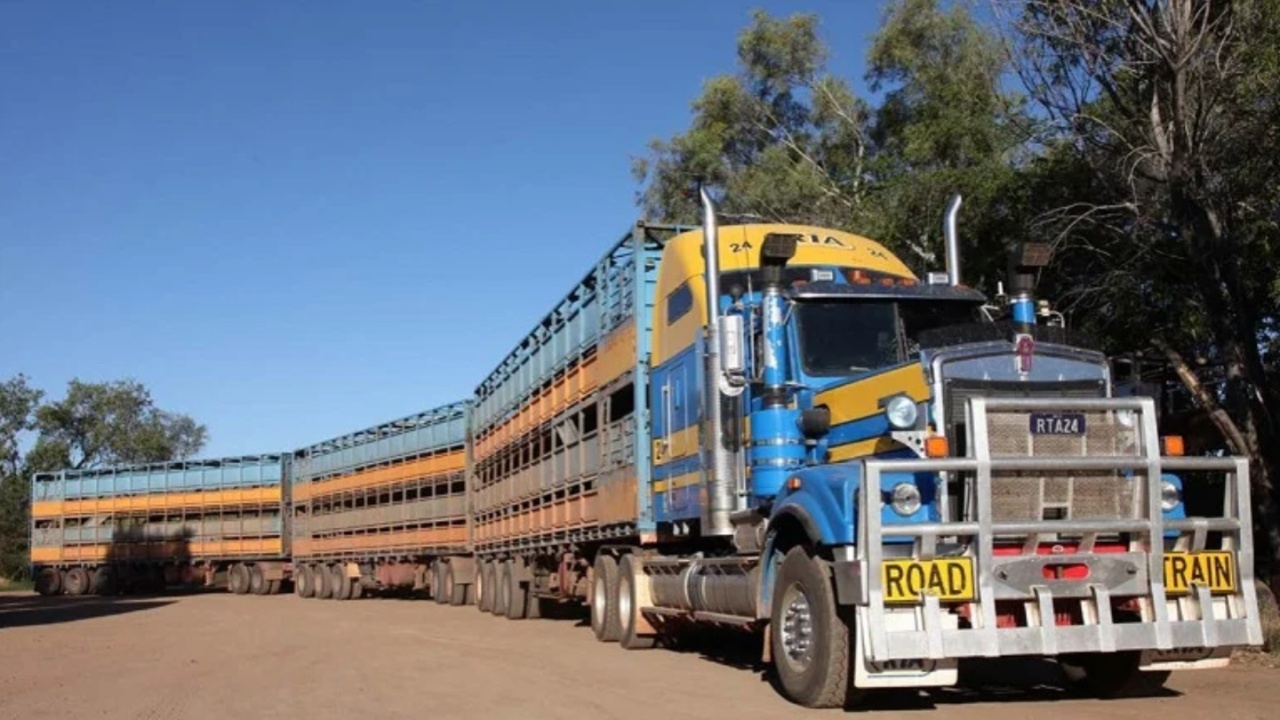
- Engine: 16-litre Volvo diesel engine
- Horsepower: 700 hp
- Torque: 3,150 Nm
- Length: 53.5 m (176 ft)
- Width: 2.55 m (8.3 ft)
This machine sets a benchmark for what is possible in large-scale industrial transport, demonstrating how engineering can scale to meet the demands of modern mining. The Liebherr T 282B illustrates the balance between extreme payload capacity and operational control, proving that even the heaviest loads can be managed with precision through diesel-electric power systems.
Its introduction reshaped expectations for haul truck efficiency, particularly through its AC drive technology that reduces mechanical losses and maintenance demands. Beyond raw power, its suspension and structural design allow it to function reliably in some of the harshest working environments on Earth.
The machine also influenced the development of future ultra-class vehicles by setting new standards for durability and operator ergonomics. In industrial terms, it remains a reference point for comparing mining truck capability and design evolution. Its legacy continues in modern heavy equipment engineering, where efficiency and scale must coexist without compromise today globally.
