
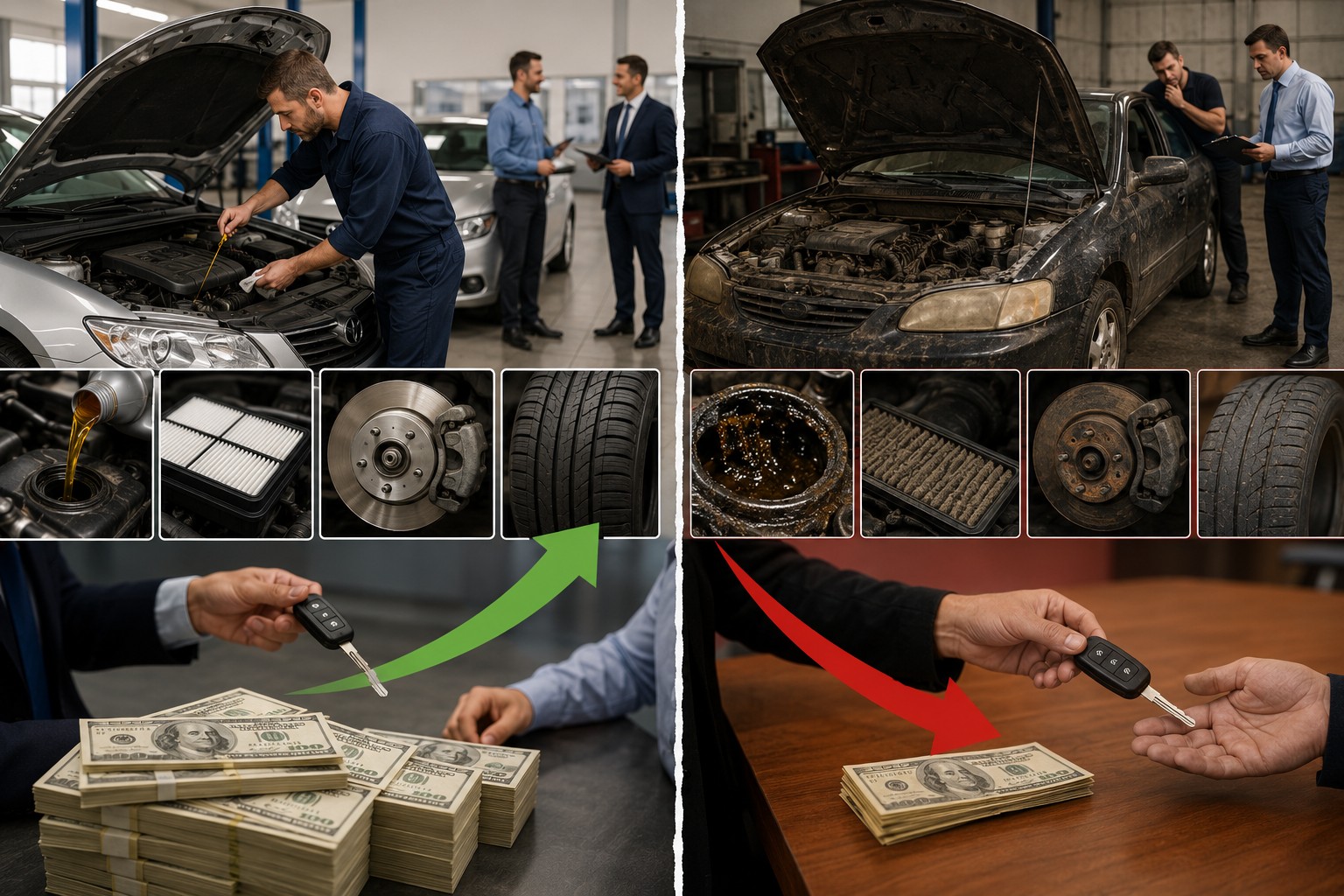
Every car owner faces the temptation to skip routine maintenance. Oil changes, tire rotations, brake inspections, they all cost money, and when budgets are tight, these services feel easy to postpone. Many drivers believe they can “catch up” on missed maintenance before trading in their vehicle, but dealers and appraisers are trained to spot neglect instantly.
The trade-in process is not just about mileage and model year. It is a detailed inspection of how well you treated your vehicle over the years. A car that has been consistently maintained tells a story of responsible ownership. A car that has been neglected tells a very different story, and dealerships price that story into their offer.
What most drivers don’t realize is that skipping maintenance doesn’t just hurt the car mechanically. It creates a financial ripple effect that compounds quietly over the years until the moment you try to sell or trade. The true cost of skipping maintenance is rarely a single repair bill.
It is the accumulated difference between what your car could have been worth and what the dealer actually offers you on trade-in day. This article breaks down exactly where that money goes and why the math almost never works in the neglectful owner’s favor.
1. How Dealers and Appraisers Detect Neglected Vehicles Immediately
When you drive a trade-in to a dealership, the appraisal process begins before you even park the car. Experienced appraisers conduct a systematic evaluation designed to uncover deferred maintenance within minutes. They are not guessing they are reading a vehicle’s history through physical evidence, digital records, and sensory cues.
The first thing an appraiser checks is the engine oil. Dark, sludgy, or gritty oil tells them immediately that oil changes were irregular. They also pull the dipstick and check the transmission fluid, coolant reservoir, and brake fluid. Discolored or low fluids confirm a pattern of neglect that goes beyond one missed service.
Modern dealerships also run a vehicle history report the moment they have your VIN. Services recorded at dealerships and many independent shops appear on these reports. Gaps in service history, particularly gaps longer than 6,000 to 8,000 miles between oil changes, are red flags that appraisers weigh heavily in their calculations.
The tires are examined next. Uneven tread wear indicates missed tire rotations, and sometimes a misaligned suspension that has been running incorrectly for thousands of miles. Appraisers know that uneven wear means additional costs before the car can be resold. That cost comes directly out of your trade-in offer.
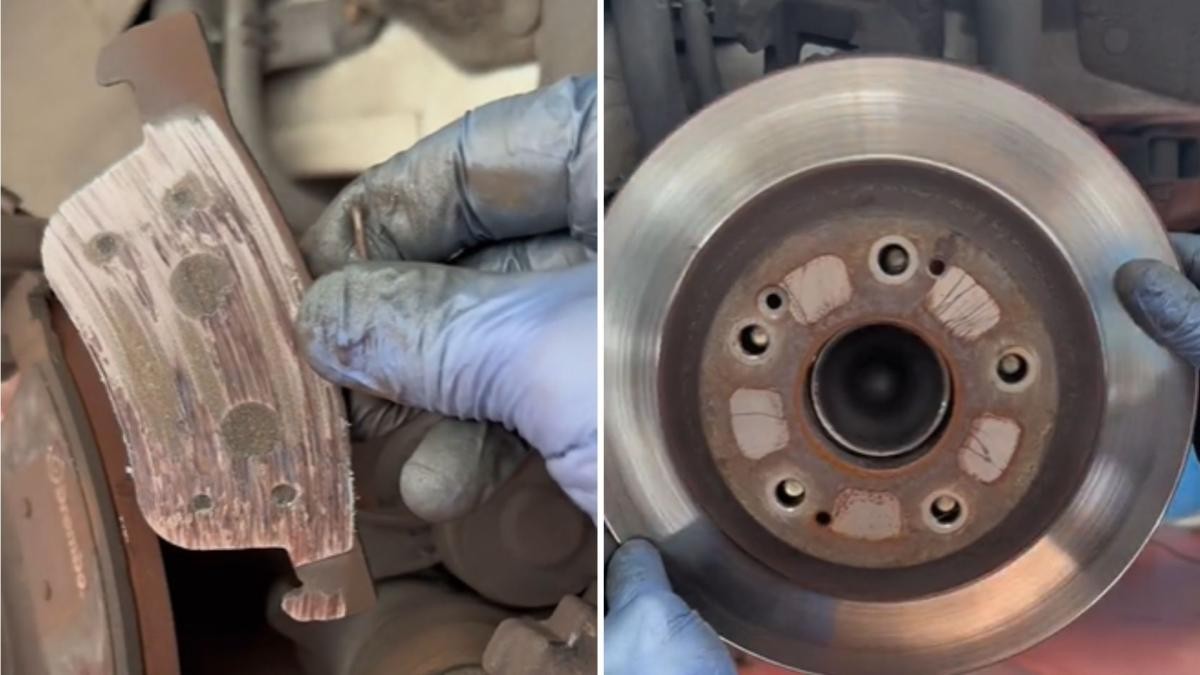
Brake pad thickness is measured, and rotor condition is checked visually and by touch. Heavily grooved or warped rotors indicate that brake pads were allowed to wear completely through before replacement. This kind of damage costs significantly more to fix than standard pad replacement, and dealers discount the trade-in value accordingly.
The undercarriage is inspected for rust, fluid leaks, and worn suspension components. A vehicle that has had regular undercarriage care shows clean seals and intact rubber bushings. A neglected vehicle often shows weeping oil seals, cracked CV boots, and rust creeping along brake lines, all of which translate directly into dollar deductions on your offer sheet.
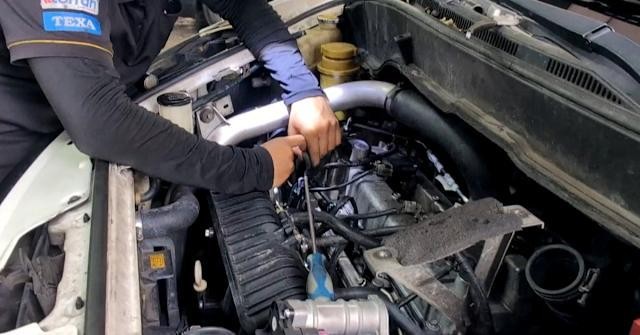
The diagnostic port, known as the OBD-II port, is connected to a scanner within the first few minutes. This tool reads stored error codes, even codes that were cleared by disconnecting the battery. Pending codes reveal issues the car is developing. Confirmed codes reveal problems that have been ignored. Appraisers use this data to identify costly repairs lurking beneath the surface.
The cabin air filter, engine air filter, and spark plugs are often physically inspected as well. A severely clogged cabin filter suggests the owner rarely paid attention to scheduled services. A fouled spark plug shows that ignition maintenance was deferred, which, over time, causes engine misfires and reduced fuel economy. Each finding adds to the appraiser’s mental tally of what reconditioning this vehicle will cost the dealership.
By the time the appraiser returns to the desk to make their offer, they have already estimated the total cost to bring the vehicle to resalable condition. Every dollar of that reconditioning estimate is subtracted from your trade-in value. The process is systematic, experienced, and heavily weighted against vehicles that have been poorly maintained.
2. The Real Dollar Amounts: What Each Skipped Service Actually Costs at Trade-In
Understanding the individual financial impact of each skipped service helps reveal how quickly small deferrals compound into serious trade-in losses. These are not hypothetical numbers. They reflect average reconditioning costs that dealerships factor into offers nationwide.
Skipping Oil Changes Irregular oil changes are the most common form of neglect. Engine sludge begins forming when oil is not changed within recommended intervals, typically every 5,000 to 7,500 miles for conventional oil and up to 10,000 miles for full synthetic. Sludge restricts oil flow to critical engine components and causes accelerated wear on pistons, camshafts, and bearings.
A vehicle with visible sludge buildup can lose anywhere from $500 to $3,000 in trade-in value. In severe cases where sludge has caused oil consumption issues or early engine wear, the deduction can reach $5,000 or more. Dealers who plan to resell the vehicle must either perform an engine flush and repair or disclose the issue to the next buyer, and they price that risk into your offer.
Skipping Transmission Service Automatic transmission fluid should be changed every 30,000 to 60,000 miles, depending on the manufacturer’s recommendation. Neglecting this service allows the fluid to break down, causing increased friction and heat inside the transmission. Over time, worn fluid accelerates clutch pack wear and valve body deterioration.
A transmission showing signs of rough shifting or hesitation due to fluid neglect can cost $1,500 to $4,500 to repair or rebuild. Dealers routinely deduct this full amount from trade-in offers when they detect transmission issues during the appraisal drive. Even a transmission that hasn’t failed yet but shows contaminated fluid receives a risk-adjusted deduction.
Ignoring routine brake service can become an expensive mistake. Brake pads generally last between 25,000 and 70,000 miles, although their lifespan depends on driving habits. Once the pads wear down completely, the metal backing grinds directly against the brake rotors, leaving deep grooves and permanent damage. Replacing rotors on a mid-size sedan typically costs between $300 and $700 per axle, while trucks and SUVs can require $900 or more per axle for the same repair.
When appraisers find damaged rotors, they deduct the full replacement cost from your trade-in offer. The owner who skipped a $150 brake pad service ends up losing $600 to $1,400 in trade-in value. The financial logic of deferring brake maintenance simply does not hold up under scrutiny.
Neglecting regular tire rotations can shorten the life of your tires and reduce their value. Rotating the tires every 5,000 to 7,500 miles helps distribute wear evenly across all four wheels. When rotations are skipped, the front tires on front-wheel-drive vehicles usually wear out much faster than the rear tires. By the time the vehicle is ready to be traded in, uneven tread depth can make the tires unsuitable for resale as a matching set.
A set of replacement tires for a standard sedan costs $400 to $800 installed. For trucks, SUVs, or performance vehicles, that number climbs to $800 to $1,500 or higher. Dealers deduct the cost of new tires when tread depth is inadequate or wear patterns are uneven. A service that costs nothing extra when done alongside oil changes ends up costing hundreds at trade-in time.
Skipping Coolant and Belt Service Coolant degrades over time and becomes acidic, which corrodes cooling system components, including the radiator, water pump, and heater core. Timing belts and serpentine belts have specific replacement intervals, typically 60,000 to 100,000 miles for timing belts. A failed timing belt can cause catastrophic engine damage, costing $3,000 to $8,000 in repairs.
If a vehicle is approaching its timing belt interval and has no service record showing replacement, dealers treat the pending service as a hard liability. They either deduct the full service cost from the trade-in offer or refuse to include the vehicle in their used inventory without completion of the service. Either way, the neglectful owner absorbs the cost.
3. The Compounding Effect: Why Neglect Multiplies Its Own Damage Over Time
The most financially dangerous aspect of skipping maintenance is not any single missed service. It is the way neglect compounds where one deferred service creates conditions that accelerate damage in related systems, multiplying both repair costs and trade-in deductions.
Consider the relationship between oil changes and engine longevity. Old, broken-down oil loses its lubricating properties and increases friction between moving parts. Increased friction generates heat, and excessive heat accelerates wear on seals, gaskets, and bearings. When those seals begin to fail, the engine starts consuming oil and leaking externally.
Now what began as a missed $50 oil change has evolved into a leaking valve cover gasket, worn piston rings, and oil contamination throughout the engine bay, a condition that can cost $1,000 to $4,000 to address.
The same compounding principle applies to the cooling system. Degraded coolant becomes corrosive and begins attacking the water pump impeller and thermostat housing.
A failing water pump causes the engine to overheat. A single overheating event can warp the cylinder head, blow the head gasket, or, in severe cases, crack the engine block. Head gasket replacement on a four-cylinder engine costs $1,200 to $2,500. On a V6 or V8, that repair climbs to $2,500 to $5,000 or more.

Suspension neglect follows a similar compounding pattern. Worn shocks and struts cause the vehicle to bounce excessively, which accelerates wear on tires, ball joints, and wheel bearings.
A set of struts costs $600 to $1,200 to replace. If strut neglect causes ball joint failure, add another $300 to $600. If uneven tire wear results from the failing suspension, add another $400 to $800 in tires. Three interrelated failures, each caused by one deferred service, compound into a $1,300 to $2,600 trade-in deduction.
Dealers understand this compounding effect extremely well. When they detect one sign of neglect, they inspect adjacent systems more closely, knowing that neglectful owners rarely deferred only one type of service.
A vehicle with dirty oil almost always has dirty transmission fluid. A vehicle with worn brake rotors often has worn brake hoses and low brake fluid. Appraisers mentally group these findings into a total reconditioning estimate, and that estimate directly determines your offer.
There is also a psychological compounding effect that many owners underestimate. Once neglect becomes visible, it signals to the dealer that the vehicle carries an unknown risk. Even systems that are functioning normally on the day of appraisal may carry higher-than-average failure probability due to cumulative wear from neglect.
Dealers build a risk premium into their offer to compensate for this uncertainty. That risk premium is an additional deduction on top of the visible reconditioning costs, essentially a penalty for being an owner who doesn’t maintain their vehicle.
The cumulative trade-in loss from compounded neglect across a typical five-year ownership period often ranges from $3,000 to $8,000 on a mainstream vehicle.
On premium vehicles, trucks, and SUVs, that range can extend from $6,000 to $15,000 or more. When measured against the cost of proper maintenance over the same period, typically $1,500 to $3,000 for a standard vehicle, the financial argument for consistent maintenance is overwhelming.
Proper maintenance is not an expense that competes with your budget. It is an investment that protects the largest asset most households own outside of their home. Every oil change, every tire rotation, every fluid service is a deposit into the trade-in value you will eventually collect. Skipping those deposits doesn’t save money. It transfers money quietly and steadily from your future self to the dealership that will eventually write you a check far smaller than you expected.
Also Read: Why a Heavier Car Quietly Inflates Your Lifetime Fuel Bill
