
Few moments in motorsport history have reshaped the automotive world quite like the 1966 24 Hours of Le Mans. What unfolded on the Circuit de la Sarthe was far more than a race. It was the culmination of one of the fiercest rivalries in automotive history, born from a failed business deal and fueled by wounded pride.
By the end of the grueling 24-hour endurance contest, Ford had achieved something no American manufacturer had ever done before: a dominant 1-2-3 finish at the world’s most prestigious endurance race.
The victory did not happen overnight. It came after years of failed attempts, millions of dollars in investment, relentless engineering, and a determination to beat Ferrari on its own turf.
According to Ford Motor Company archives, the GT40 program became one of the company’s most expensive motorsport projects of the era, with estimates placing development costs well into the tens of millions of dollars, an enormous figure for the 1960s.
The image of three Ford GT40 Mk II race cars crossing the finish line together has become one of the defining photographs in motorsport history. Yet the road to that historic moment began three years earlier when a proposed acquisition between Ford and Ferrari collapsed dramatically.
Also Read: 10 Repairs That Now Require an ADAS Sensor Recalibration
The Deal That Started an International Racing War
By the early 1960s, Ford wanted to transform its image. While the company dominated sales in the United States, executives believed success in international motorsport would strengthen the brand worldwide.
Ferrari, meanwhile, had become synonymous with racing excellence, having won multiple Formula One championships and numerous editions of the 24 Hours of Le Mans.
In 1963, Ford entered negotiations to purchase Ferrari. According to accounts documented by Ford Motor Company, Ferrari historian sources, and former executives involved in the discussions, Ford spent weeks conducting financial reviews and drafting agreements that would allow Ferrari to continue producing sports cars while benefiting from Ford’s resources.
The negotiations appeared close to completion. However, one clause gave Ford significant control over Ferrari’s racing budget and competition decisions. For Enzo Ferrari, whose identity was inseparable from racing, the condition was unacceptable.
Multiple historical accounts, including Ford archives and biographies of Enzo Ferrari, describe how Ferrari abruptly ended the negotiations after realizing he would lose authority over his racing operations. Henry Ford II reportedly viewed the rejection as a personal humiliation.
Rather than pursuing another acquisition, Ford made a different decision. If it could not buy Ferrari, it would beat Ferrari at Le Mans.
That objective launched the GT40 program, an unprecedented effort involving Ford engineers in the United States, British racing specialists, Carroll Shelby’s Shelby American team, and some of the finest drivers in endurance racing.
Early progress was far from smooth. The original GT40 struggled with reliability during the 1964 and 1965 Le Mans races. Mechanical failures prevented the cars from challenging Ferrari, despite showing promising speed. According to race records maintained by the Automobile Club de l’Ouest (ACO), none of Ford’s entries finished the 1964 or 1965 races.
Rather than abandoning the project, Ford intensified development. Carroll Shelby, already famous for transforming the AC Cobra into a world-class sports car, was brought in to improve reliability and race preparation.
Engineers also replaced the smaller V8 with a massive 7.0-liter engine derived from Ford’s NASCAR program. The resulting GT40 Mk II combined exceptional straight-line speed with significantly improved durability.
By 1966, Ford arrived at Le Mans with one of the largest factory-backed racing efforts ever assembled.
The Race That Changed Endurance Racing Forever
The 1966 24 Hours of Le Mans featured an extraordinary Ford assault. Eight GT40 Mk II cars entered the race, supported by extensive engineering teams, spare parts, logistics personnel, and factory resources rarely seen in endurance racing.
Ferrari remained a formidable opponent with its proven 330 P3 prototypes. However, Ford’s extensive testing had addressed many of the reliability issues that had plagued previous campaigns.
From the opening hours, the GT40 demonstrated remarkable pace. Its powerful 427-cubic-inch V8 produced well over 480 horsepower in race trim, allowing the cars to dominate the long Mulsanne Straight.
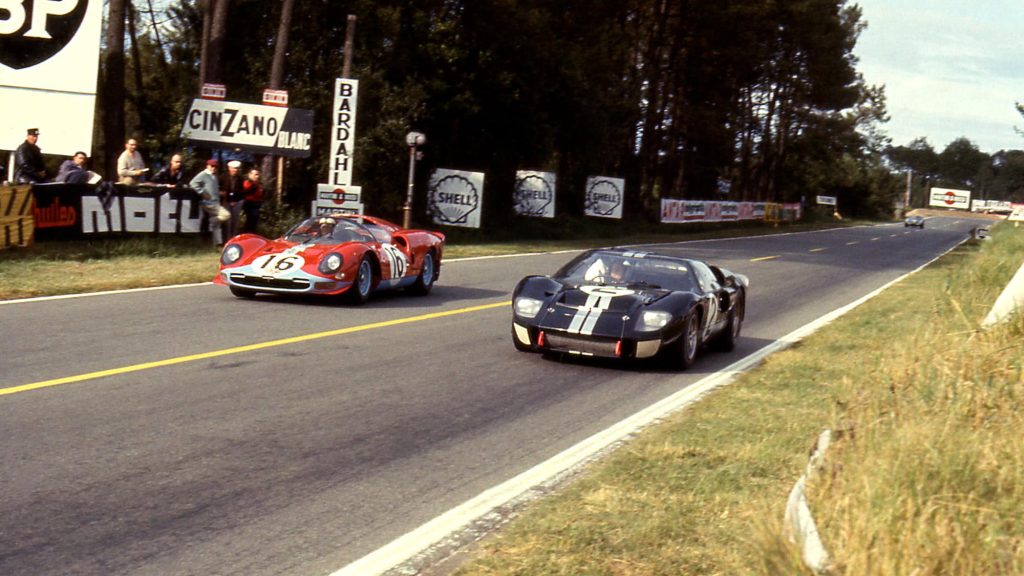
Contemporary reports from Road & Track and race analyses published by the ACO noted that Ford’s outright speed was unlike anything Ferrari could consistently match that year.
Reliability, historically Ford’s greatest weakness, also improved dramatically. While several GT40s retired because endurance racing remained brutally demanding, enough cars survived deep into the race to establish overwhelming control.
Ferrari’s challenge gradually faded as mechanical problems and retirements reduced its presence at the front. By the final hours, Ford held a commanding advantage. Company executives then made a decision that would remain controversial for decades.
Rather than allowing teammates Ken Miles and Denny Hulme to race flat out to the finish, Ford management instructed the leading cars to stage a symbolic formation finish celebrating the company’s achievement. Three GT40 Mk II cars approached the finish line side by side, creating one of motorsport’s most iconic photographs.
However, the celebration produced an unexpected consequence. According to ACO regulations, race victory was determined not simply by crossing the finish line first but by the total distance covered over 24 hours.
Because Bruce McLaren and Chris Amon’s GT40 had started farther back on the grid than Ken Miles and Denny Hulme, they had actually traveled a slightly greater distance during the race.
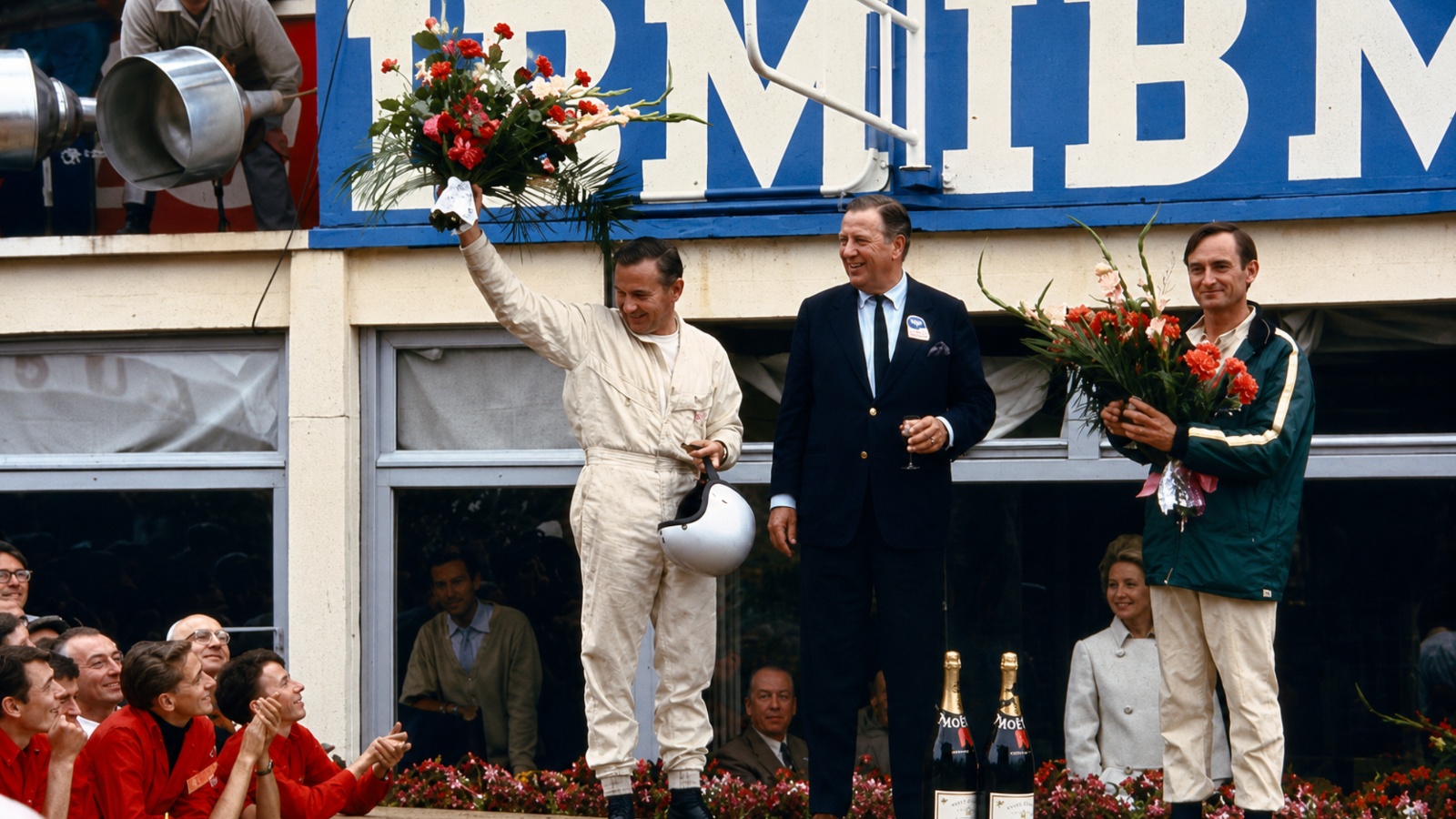
When the checkered flag fell, McLaren and Amon were officially declared the winners. Ken Miles, who had led much of the race and had already won the Daytona and Sebring endurance classics earlier that year, missed what would have been an unprecedented Triple Crown of endurance racing.
Motorsport historians continue to debate whether Ford’s decision cost Miles one of the greatest achievements in racing history. Regardless of the finishing order, Ford accomplished its primary objective.
The official results recorded a Ford GT40 sweep of first, second, and third places, ending Ferrari’s remarkable six-year winning streak at Le Mans that had lasted from 1960 through 1965, according to official ACO race records.
Why the 1966 Victory Still Matters Today
Ford’s triumph represented far more than a single race victory. It demonstrated that an American manufacturer could defeat Europe’s most celebrated sports car company at its own signature event through engineering, investment, and persistence.
The victory transformed the GT40 into one of the most celebrated racing cars ever built. Ford returned to Le Mans in 1967 with the updated GT40 Mk IV and secured another full victory before the lighter Gulf-liveried GT40s added wins in 1968 and 1969.
Those four consecutive Le Mans victories established one of the greatest eras in American motorsport history.
The rivalry also upgraded Carroll Shelby’s reputation as one of the most influential performance engineers in automotive history. His team’s contributions to improving reliability, race preparation, and engine integration proved essential to Ford’s success after earlier factory efforts had fallen short.
The 1966 race has inspired countless books, documentaries, and films, most notably Ford v Ferrari, which introduced the story to a new generation of enthusiasts. While the movie dramatizes certain events for storytelling purposes, its central narrative of Ford’s determination to challenge Ferrari remains grounded in historical fact.
Perhaps the most enduring legacy is the GT40 itself. Original race-winning examples are now among the most valuable competition cars ever sold, frequently commanding multi-million-dollar prices at international auctions.
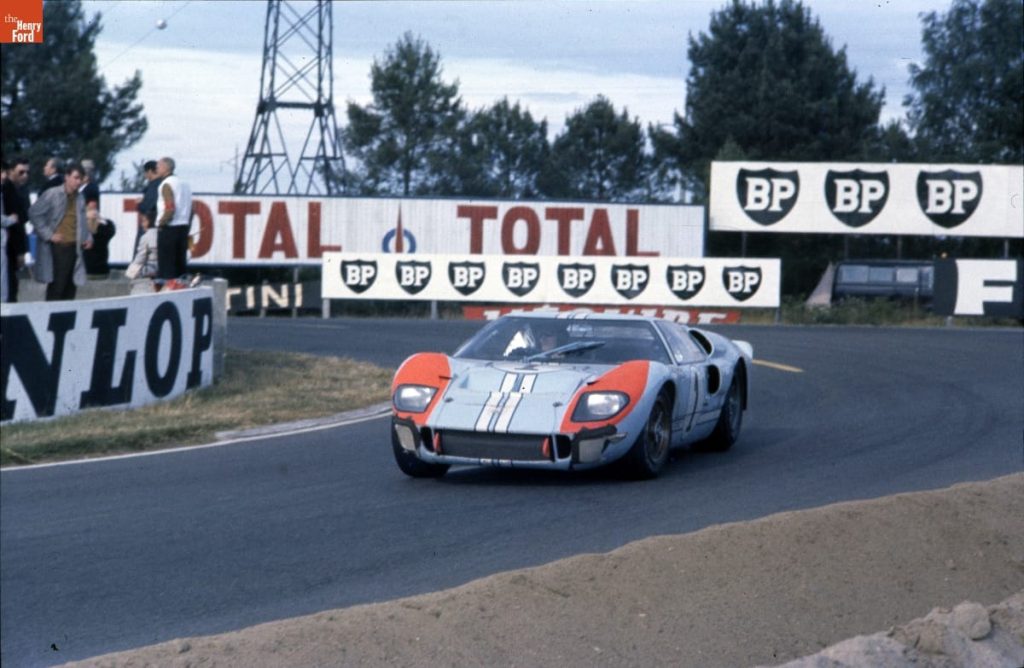
Their significance extends beyond rarity; they represent a moment when engineering ambition, corporate determination, and elite driving talent combined to rewrite motorsport history.
The famous 1-2-3 finish at Le Mans remains one of the rarest achievements in endurance racing. Winning the event is difficult enough. Sweeping the podium against the world’s strongest competition is something only a handful of manufacturers have ever accomplished.
For Ford, the 1966 victory settled a score that had begun in a corporate boardroom three years earlier. Ferrari’s decision to walk away from the acquisition negotiations unintentionally sparked one of the greatest rivalries the automotive world has ever witnessed.
By the time the checkered flag waved at Le Mans, Ford had done exactly what Henry Ford II demanded: it had beaten Ferrari on the biggest stage in endurance racing, and it had done so with a historic podium sweep that remains one of the defining moments in automotive history.
Also Read: Every Truck and SUV Leaving the U.S. Market for 2027
