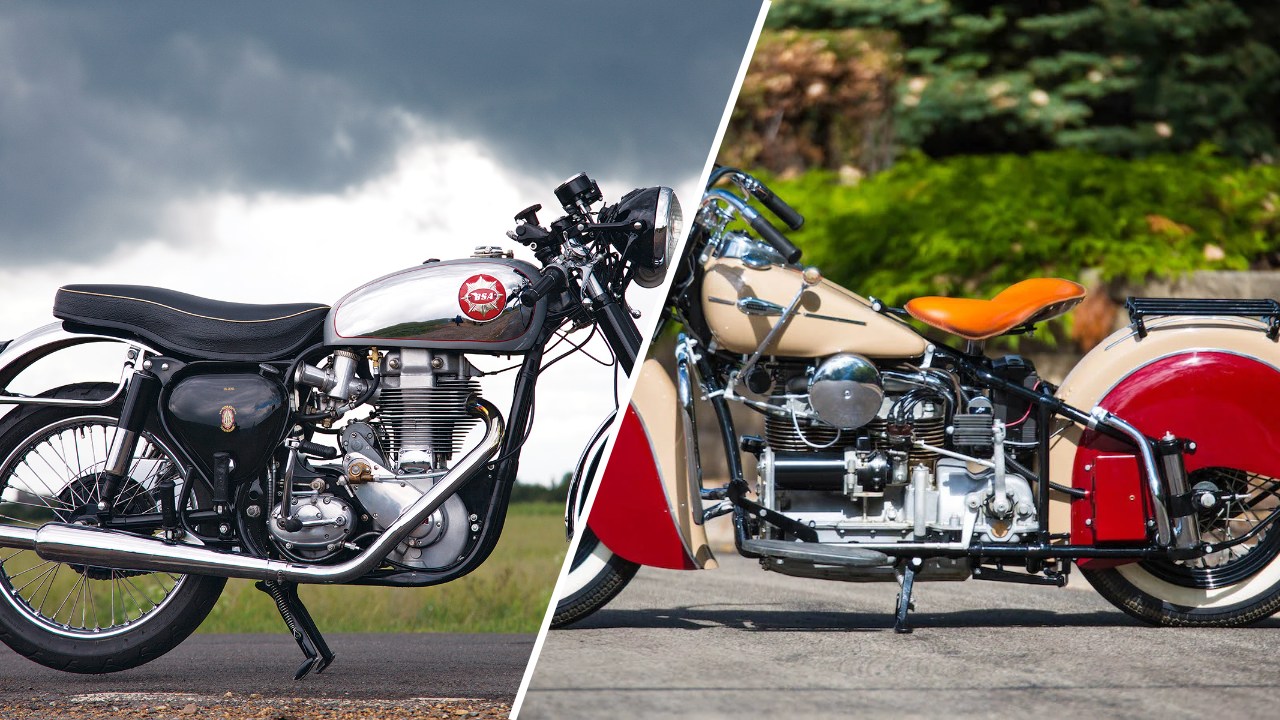
Motorcycle history is filled with legendary machines, but not every great motorcycle came from a company that survived. Economic recessions, changing consumer tastes, poor management, and increasing competition forced many respected manufacturers to close their doors, leaving behind motorcycles that refused to fade into history.
Some remain prized collector’s items, while others are still ridden across America decades after their makers disappeared. Their durability, engineering, and unique character have allowed them to outlast the very companies that created them.
These motorcycles prove that a manufacturer’s lifespan does not always determine the lasting impact of its greatest machines.
Also Read: 10 SUVs With the Longest Range on a Single Tank
1. Victory Cross Country (Victory Motorcycles)
When Polaris Industries announced in January 2017 that it would discontinue Victory Motorcycles, many riders questioned what would happen to one of America’s newest motorcycle brands.
Although Victory existed for only 18 years, from 1998 to 2017, several of its motorcycles had already established reputations for reliability and long-distance comfort. Among them, the Cross Country became the model most enthusiasts associate with the brand’s enduring legacy.
Introduced for the 2010 model year, the Cross Country entered the competitive American touring segment dominated by Harley-Davidson and Honda. Instead of copying existing designs, Victory developed a motorcycle with modern styling, an aluminum frame, fuel injection, cruise control, and a powerful Freedom 106 V-twin engine.
The combination attracted riders looking for a dependable touring machine capable of covering hundreds of miles in a single day without sacrificing performance.
One reason the Cross Country continues to enjoy strong owner support is its mechanical durability. The air and oil-cooled Freedom engine earned praise for routinely exceeding well over 100,000 miles with scheduled maintenance.
Even after Victory production ended, Polaris committed to supplying replacement parts for years, while an active aftermarket and enthusiast community continues supporting owners throughout the United States. Independent service shops also remain familiar with the engine because of its relatively straightforward construction.
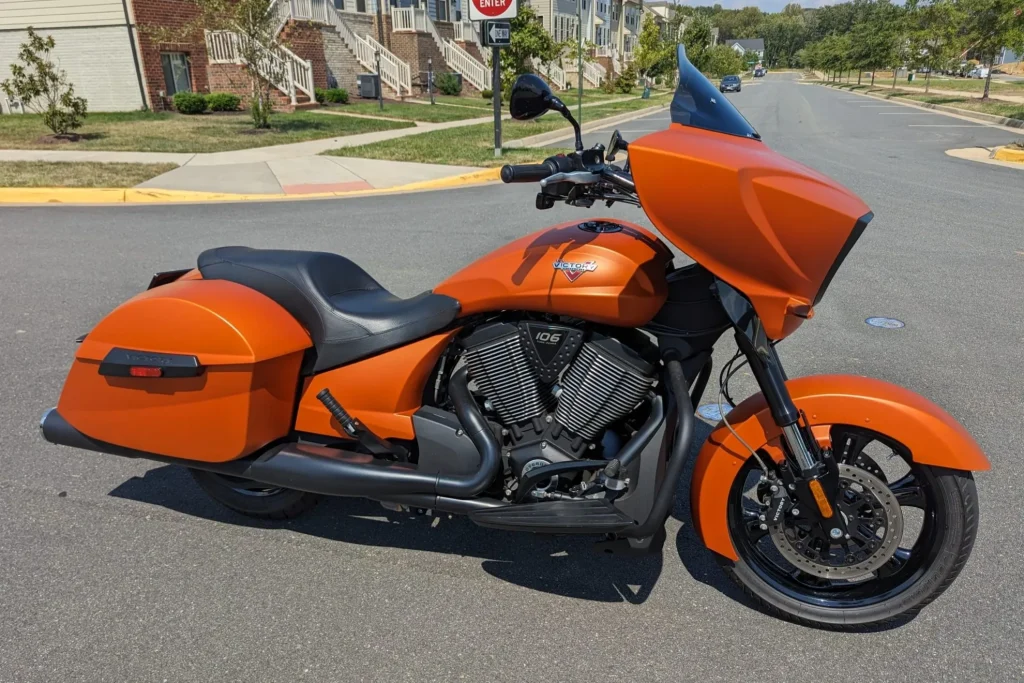
Today, used cross-country models often represent excellent value compared with competing American touring motorcycles. Riders appreciate their comfortable ergonomics, generous luggage capacity, and proven reliability.
The company that engineered the motorcycle may no longer build motorcycles, but thousands of Cross Country models remain on American roads, demonstrating that a well-designed machine can easily outlive the brand name displayed on its fuel tank.
Specifications
- Engine: 1,731 cc Freedom 106 V-twin
- Torque: 109 lb-ft
- Horsepower: Approximately 92 hp
- Length/Width: 106.3 inches / 39.4 inches
2. Buell XB12X Ulysses (Buell Motorcycle Company)
Adventure motorcycles became mainstream in America long before many riders realized it, and the Buell XB12X Ulysses helped accelerate that movement.
Developed by Buell Motorcycle Company and introduced in 2005, the Ulysses combined sporty handling with upright ergonomics and long-travel suspension, creating a motorcycle unlike anything else produced by an American manufacturer at the time.
Unfortunately, Harley-Davidson shut down Buell’s production operations in 2009 during the global financial crisis, ending one of the industry’s most innovative brands.
The Ulysses stood apart because of Erik Buell’s unconventional engineering philosophy. Fuel was stored inside the aluminum frame, engine oil was carried in the swingarm, and a perimeter front brake rotor reduced unsprung weight.
These solutions allowed the motorcycle to maintain excellent mass centralization while keeping full weight competitive with larger adventure bikes available during that period.
Power came from the proven 1,203 cc Thunderstorm V-twin, an evolution of Harley-Davidson’s Sportster engine. Although the engine retained its traditional air-cooled architecture, Buell’s tuning produced stronger performance and a broader powerband suitable for both highway touring and unpaved roads.
Owners frequently praised its character, comfortable riding position, and dependable mechanical components, even if some early models required software updates and minor warranty improvements.
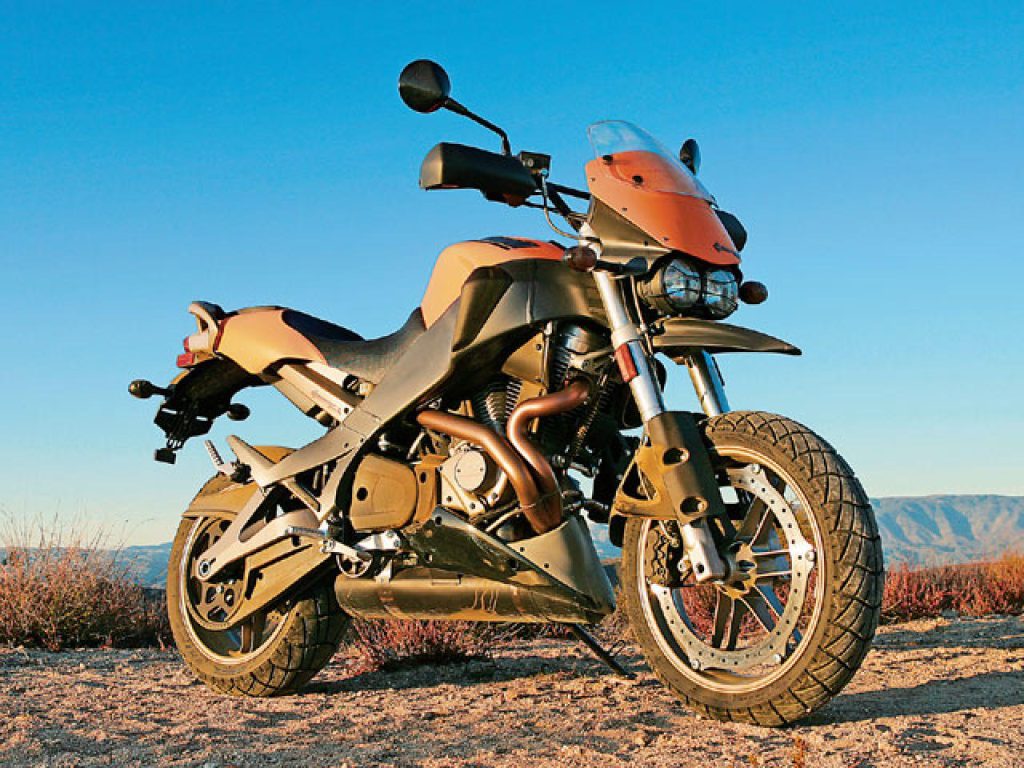
More than 15 years after Buell’s original closure, the XB12X continues to attract loyal owners and collectors. Aftermarket suppliers still manufacture maintenance parts, and enthusiast groups actively share technical knowledge that helps keep these motorcycles operating.
While the original company disappeared, the Ulysses remains one of the clearest examples of innovative American engineering surviving long after its manufacturer exited the market.
Specifications
- Engine: 1,203 cc Air-cooled V-twin
- Torque: Approximately 84 lb-ft
- Horsepower: Approximately 103 hp
- Length/Width: 85.0 inches / 36.0 inches
3. Indian Four (Original Indian Motorcycle Company)
Long before today’s Indian Motorcycle brand returned under Polaris ownership, the original Indian Motorcycle Company was one of America’s greatest motorcycle manufacturers. Founded in 1901, Indian became Harley-Davidson’s fiercest rival for decades before financial struggles led to the company’s collapse in 1953.
Although the manufacturer disappeared, one motorcycle refused to fade into history. The Indian Four remains one of the most celebrated American motorcycles ever built and continues attracting collectors more than 70 years after the original company closed.
The Indian Four traces its roots to the Ace Motorcycle Company, whose innovative inline four-cylinder design impressed Indian enough to acquire the business in 1927.
Engineers refined the motorcycle throughout the following decades, producing increasingly smoother engines, improved suspension, and distinctive styling that separated it from every V-twin competitor on American roads.
The motorcycle quickly became known for refinement rather than outright performance. Its longitudinal inline-four engine delivered remarkably smooth power at a time when most motorcycles relied on simpler twin-cylinder layouts.
Riders appreciated the relaxed highway manners, making the Indian Four one of the most luxurious touring motorcycles available before World War II. Wealthy enthusiasts, police departments, and long-distance travelers all recognized its engineering sophistication.
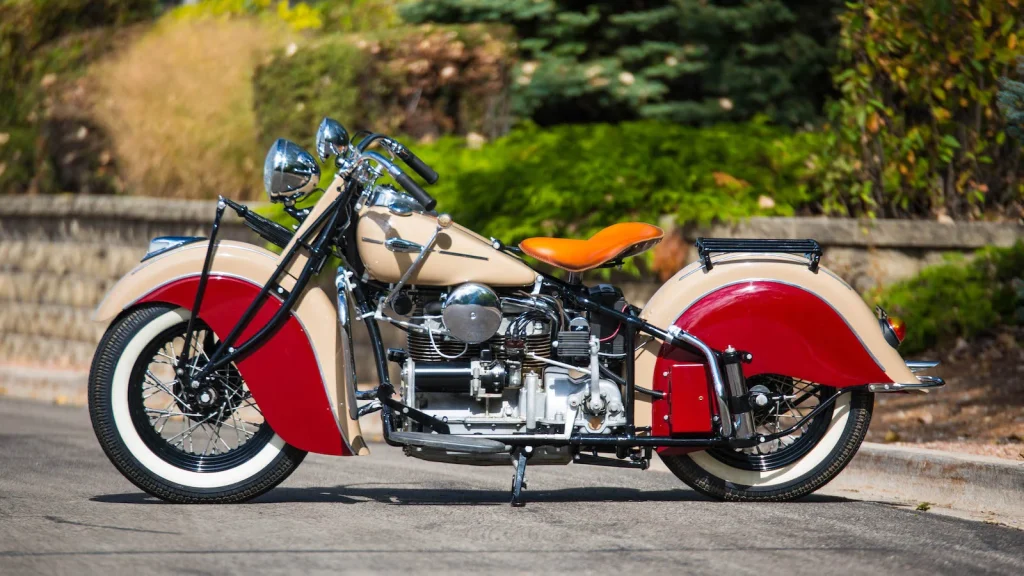
Even after Indian ceased production in 1953, the Four never disappeared from motorcycle culture. Restored examples routinely command six-figure prices at major collector auctions, while original parts remain highly sought after because relatively few motorcycles survived.
Dedicated restoration specialists continue rebuilding engines, fabricating obsolete components, and preserving these machines for future generations. The original company may have vanished decades ago, but the Indian Four remains one of the defining symbols of early American motorcycle engineering.
Specifications
- Engine: 1,265 cc Inline-4
- Torque: Approximately 60 lb-ft
- Horsepower: Approximately 40 hp
- Length/Width: Approximately 87.0 inches / 32.0 inches
4. Excelsior-Henderson Super X (Excelsior-Henderson)
The story of the Excelsior-Henderson Super X is one of the most ambitious comeback attempts in American motorcycle history. The original Excelsior-Henderson company had disappeared in the early 1930s, but entrepreneurs Dan and Dave Hanlon revived the legendary name during the 1990s.
Their goal was to create a premium American cruiser capable of competing directly with Harley-Davidson.
After years of development, the Super X finally reached customers in 1999. Sadly, financial difficulties forced the reborn company into bankruptcy by 2000, making the Super X both its first and last production motorcycle.
Despite the company’s short lifespan, the motorcycle itself earned widespread praise. Rather than relying on outdated engineering, Excelsior-Henderson designed an all-new 1,386 cc fuel-injected V-twin paired with modern suspension, belt drive, and quality components.
The bike delivered smooth power, comfortable touring manners, and excellent highway stability. Many reviewers noted that build quality matched or exceeded expectations for a completely new manufacturer.
Because fewer than 2,000 Super X motorcycles were produced before the company failed, the model immediately became a collector’s item. Owners formed clubs across the United States, sharing technical information and helping source replacement parts.
Several independent suppliers continue manufacturing service components, ensuring these motorcycles remain rideable instead of becoming static museum pieces.
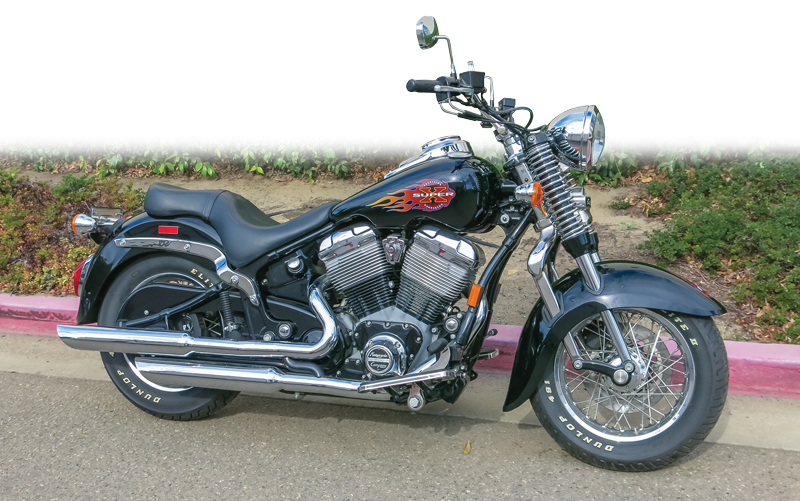
One reason the Super X continues earning respect is that its downfall had little to do with the motorcycle itself. Industry analysts often point to financing challenges, production costs, and unfavorable market conditions rather than engineering flaws.
Today, enthusiasts view the Super X as a fascinating example of what might have been if the company had survived. Its rarity, dependable powertrain, and unmistakable styling ensure that the motorcycle’s legacy continues long after the manufacturer disappeared.
Specifications
- Engine: 1,386 cc Fuel-injected V-twin
- Torque: Approximately 88 lb-ft
- Horsepower: Approximately 63 hp
- Length/Width: 96.0 inches / 37.0 inches
5. BSA Gold Star DBD34 (BSA)
At one time, Birmingham Small Arms Company, better known as BSA, was the world’s largest motorcycle manufacturer. During the 1950s, the British company exported thousands of motorcycles to the United States, earning a loyal following among racers and everyday riders alike.
Financial problems, increased Japanese competition, and management challenges eventually forced BSA into decline, with motorcycle production effectively ending after the early 1970s. Yet one model continues to define the company’s reputation long after its disappearance: the legendary Gold Star DBD34.
Introduced in its final and most refined form during the mid-1950s, the Gold Star became famous for combining lightweight construction with exceptional performance. Its hand-finished single-cylinder engine was assembled to tighter tolerances than standard production motorcycles, giving riders stronger acceleration and impressive top-end speed.
Depending on gearing, factory testing showed some Gold Star models could approach 110 mph, an extraordinary achievement for a production single-cylinder motorcycle of that era.
The Gold Star’s reputation grew on both racetracks and public roads. Club racers appreciated its responsive handling, while experienced street riders admired its mechanical simplicity and reliability when properly maintained.
Because the motorcycle required careful tuning, many owners developed a close understanding of the engine, contributing to the model’s lasting appeal among enthusiasts.
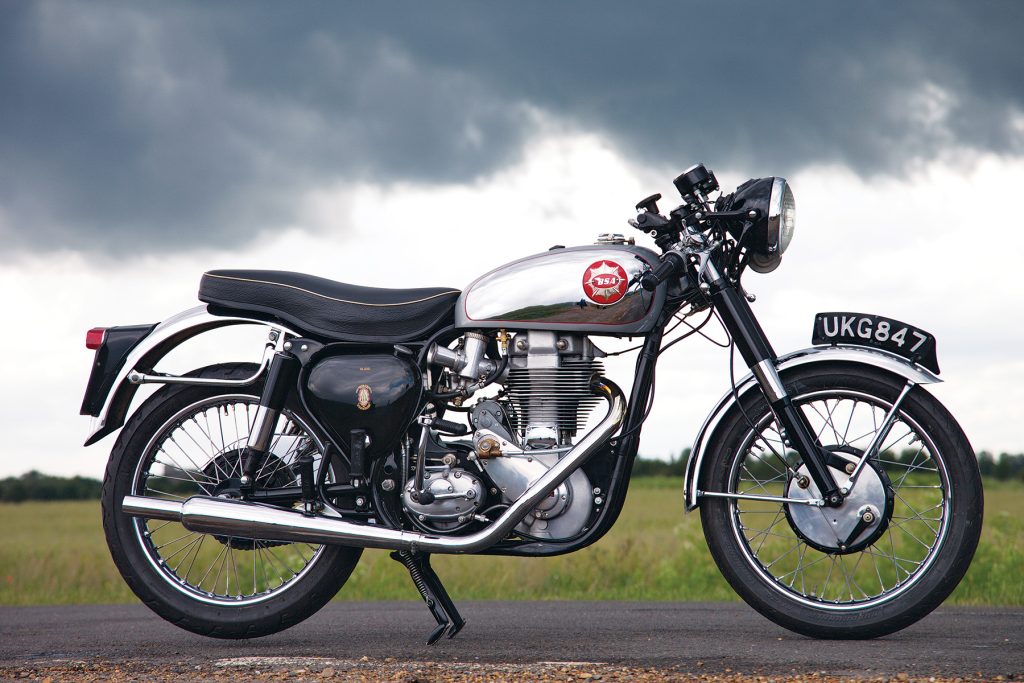
Today, restored Gold Stars regularly command premium prices at American and European collector auctions. Replacement parts remain available through specialist suppliers, and vintage racing organizations continue welcoming the motorcycle into classic competition events.
While BSA’s original motorcycle division disappeared decades ago, the Gold Star remains one of Britain’s most celebrated performance motorcycles and a benchmark against which many classic singles are still measured.
Specifications
- Engine: 499 cc Air-cooled Single-cylinder
- Torque: Approximately 33 lb-ft
- Horsepower: Approximately 42 hp
- Length/Width: Approximately 83.0 inches / 30.0 inches
6. Matchless G80CS (Matchless)
Few British motorcycle manufacturers enjoyed a racing pedigree as rich as Matchless. Founded in the late nineteenth century, the company became well known for producing dependable road motorcycles and successful competition machines.
Financial difficulties eventually led Matchless into Associated Motor Cycles, and after years of declining sales, the famous brand disappeared from motorcycle production during the 1960s. Even so, one motorcycle refused to become forgotten. The G80CS remains one of the finest classic off-road motorcycles ever built.
Originally developed for scramble competitions, which later evolved into modern motocross, the G80CS emphasized durability over unnecessary complexity. Its large four-stroke single-cylinder engine produced strong low-end torque, allowing riders to climb steep hills and negotiate rough terrain without constantly changing gears.
The lightweight frame and predictable handling made it highly competitive in off-road events across Britain and the United States.
American riders played an important role in preserving the motorcycle’s legacy. During the late 1950s and early 1960s, many desert racers and off-road competitors favored the G80CS because it could withstand punishing conditions while remaining relatively easy to repair in remote locations.
Legendary racers, including Steve McQueen, were closely associated with Matchless motorcycles, further strengthening the brand’s reputation among enthusiasts.
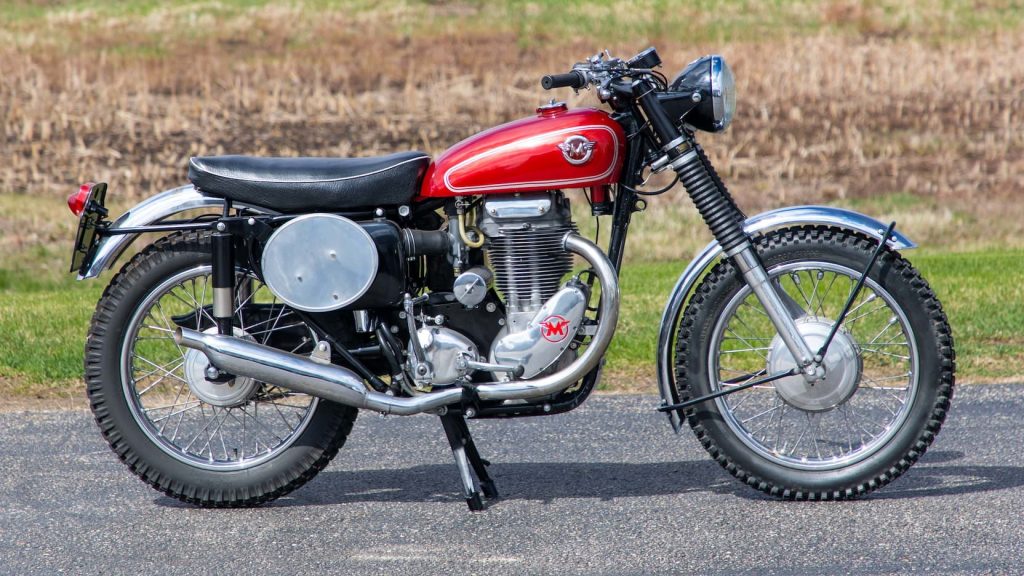
More than half a century after Matchless disappeared, the G80CS continues appearing at vintage motocross events, motorcycle museums, and collector auctions throughout America. Its straightforward engineering makes restoration practical, while specialist suppliers still reproduce many essential mechanical components.
The company’s factories may have closed long ago, but the G80CS continues proving why Matchless earned worldwide respect during the golden age of British motorcycling.
Specifications
- Engine: 498 cc Air-cooled Single-cylinder
- Torque: Approximately 32 lb-ft
- Horsepower: Approximately 36 hp
- Length/Width: Approximately 84.0 inches / 31.0 inches
7. Norton Commando 850 (Original Norton-Villiers)
The Norton Commando arrived at a time when the British motorcycle industry was struggling to keep pace with increasingly sophisticated Japanese competitors. Introduced in 1967 and later refined into the 850 model, the Commando became the motorcycle that many enthusiasts believe represented Norton’s engineering at its peak.
Unfortunately, financial instability, labor disputes, and growing competition eventually forced the original Norton-Villiers operation into collapse during the mid-1970s. Even so, the Commando continued building the company’s reputation long after production stopped.
One feature that immediately distinguished the Commando was Norton’s innovative Isolastic frame system. Instead of allowing the parallel-twin engine’s vibration to transfer directly to the rider, engineers mounted the powerplant in rubber isolators that significantly improved comfort while preserving the motorcycle’s sharp handling.
This design helped the Commando earn repeated “Machine of the Year” awards from Motor Cycle News between 1968 and 1972, a remarkable achievement during an increasingly competitive era.
Power came from an 828 cc parallel-twin engine producing strong midrange performance and relaxed highway cruising characteristics. American riders appreciated the motorcycle’s combination of classic British styling and genuine touring capability.
Although routine maintenance demanded more owner involvement than many modern motorcycles, enthusiasts considered the experience part of the Commando’s personality rather than a drawback.
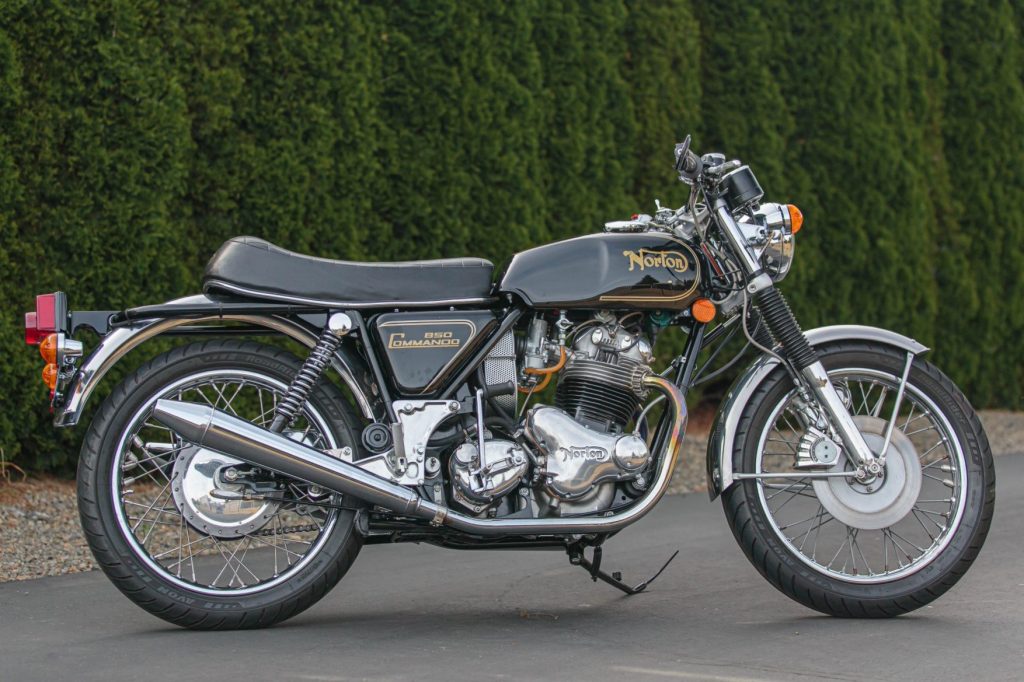
Today, the Norton Commando remains one of the most desirable British classics on the collector market. Numerous restoration specialists across the United States continue rebuilding engines, reproducing bodywork, and supplying upgraded components that improve reliability while preserving originality.
Vintage motorcycle rallies frequently feature beautifully restored Commandos still covering hundreds of miles with ease. The original Norton company may have disappeared decades ago, but the Commando continues to represent one of the greatest achievements in British motorcycle history.
Specifications
- Engine: 828 cc Air-cooled Parallel Twin
- Torque: Approximately 43 lb-ft
- Horsepower: Approximately 60 hp
- Length/Width: Approximately 86.0 inches / 32.0 inches
8. Vincent Black Shadow Series C (Vincent Motorcycles)
Few motorcycles have achieved legendary status quite like the Vincent Black Shadow. Introduced after World War II, it stunned the motorcycling world by delivering performance that few production motorcycles could match for decades.
Vincent Motorcycles ceased production in 1955 because of financial difficulties and changing market conditions, but the Black Shadow’s reputation only continued to grow. Today it is widely recognized as one of the most influential motorcycles ever produced.
The Black Shadow was revolutionary because nearly every major component reflected advanced engineering. The engine served as a stressed member of the chassis, reducing unnecessary weight while improving rigidity.
High-quality suspension, efficient braking for the period, and precision manufacturing helped distinguish the motorcycle from virtually every competitor available during the late 1940s and early 1950s.
Performance established the motorcycle’s legendary status. Contemporary road tests documented top speeds approaching 125 mph under favorable conditions, making the Black Shadow the fastest production motorcycle of its era.
That level of performance was extraordinary at a time when many family automobiles struggled to exceed half that speed. Riders admired not only its acceleration but also its stability and refinement at highway speeds.
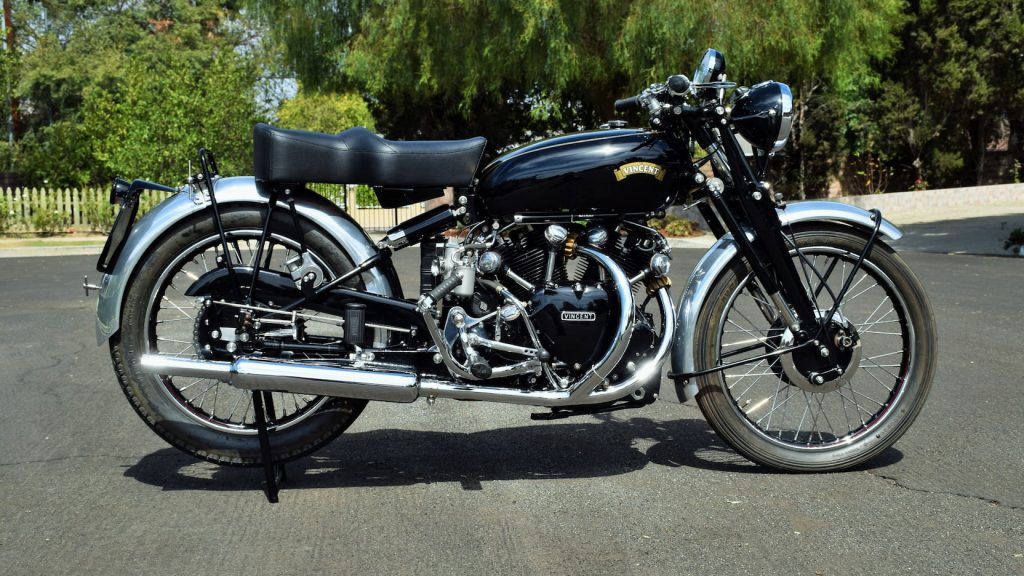
Collectors now consider the Black Shadow among the most valuable production motorcycles ever built. Exceptional examples routinely sell for several hundred thousand dollars at major international auctions, while historically significant motorcycles have exceeded one million dollars.
Owners continue riding these machines during vintage touring events, proving that careful engineering can stand the test of time. Although Vincent disappeared more than seventy years ago, the Black Shadow remains a benchmark for innovation and performance that continues inspiring motorcycle enthusiasts around the world.
Specifications
- Engine: 998 cc Air-cooled 50-degree V-twin
- Torque: Approximately 60 lb-ft
- Horsepower: 55 hp
- Length/Width: Approximately 87.0 inches / 30.5 inches
9. Ariel Square Four Mk II (Ariel Motors)
Ariel was once one of Britain’s most respected motorcycle manufacturers, producing everything from lightweight commuters to high-performance machines. By the 1950s, however, intense competition, declining sales, and financial pressures placed enormous strain on the company.
Motorcycle production eventually ended in 1967 after Ariel’s parent company reorganized its operations. While the manufacturer disappeared, the Square Four continued earning admiration from riders and collectors who appreciated its unique engineering and smooth performance.
Designed by legendary engineer Edward Turner before he joined Triumph, the Square Four featured an unusual engine layout that essentially paired two parallel twins sharing a common crankcase.
This compact design delivered the refinement of a four-cylinder motorcycle without the excessive width normally associated with inline-four engines. Riders enjoyed exceptionally smooth power delivery and effortless highway cruising, characteristics that distinguished the motorcycle from many of its British rivals.
The later Mk II version introduced improved aluminum cylinder heads to replace the earlier cast-iron design, helping address cooling concerns while enhancing reliability.
Its generous torque allowed relaxed riding with fewer gear changes, making the Square Four a favorite among long-distance touring enthusiasts. During the 1950s, few motorcycles combined comfort, engineering originality, and road manners as successfully as Ariel’s flagship model.
Collectors continue seeking well-preserved Square Four motorcycles because relatively few survive in excellent condition. Specialist workshops in both the United States and Europe reproduce engine components, electrical parts, and cosmetic trim, ensuring these motorcycles remain fully functional instead of becoming static display pieces.
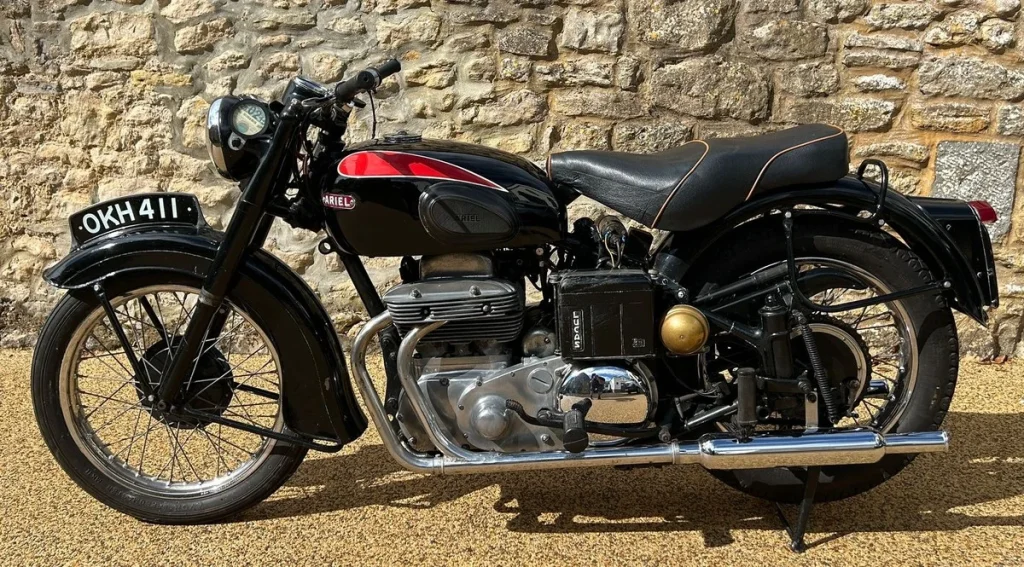
Vintage motorcycle events frequently feature Square Fours completing long-distance rides, demonstrating that thoughtful engineering can remain enjoyable generations after production ends.
Ariel may no longer manufacture motorcycles, but the Square Four continues to preserve the company’s reputation as one of Britain’s most innovative motorcycle builders.
Specifications
- Engine: 997 cc Air-cooled Square Four
- Torque: Approximately 52 lb-ft
- Horsepower: Approximately 45 hp
- Length/Width: Approximately 86.5 inches / 31.5 inches
10. Excelsior Super X (Excelsior)
Long before Harley-Davidson dominated the American motorcycle industry, Excelsior stood among the nation’s premier manufacturers.
Founded in Chicago in 1907, the company quickly earned a reputation for building rugged, high-performance motorcycles that competed successfully in racing and endurance events. In 1911, Excelsior was acquired by Ignaz Schwinn, the bicycle manufacturing pioneer, and later merged with Henderson Motorcycles.
Despite its success, Schwinn unexpectedly shut down motorcycle production in 1931 as the Great Depression deepened, believing the market would not recover quickly enough.
Among the company’s greatest achievements was the Excelsior Super X. Introduced during the mid-1920s, the motorcycle became known for combining dependable engineering with excellent handling and competitive performance.
Available in several engine sizes over its production life, the Super X gained popularity with civilian riders, police departments, and racing enthusiasts throughout the United States. It proved that American manufacturers could produce motorcycles capable of challenging the best machines from Europe.
The Super X also established an impressive competition record. Excelsior motorcycles achieved numerous victories in hill climbs, board-track racing, endurance contests, and reliability trials, helping strengthen the company’s reputation during the industry’s formative years.
Many surviving motorcycles continue participating in antique motorcycle demonstrations, allowing modern audiences to experience engineering that is now nearly a century old.
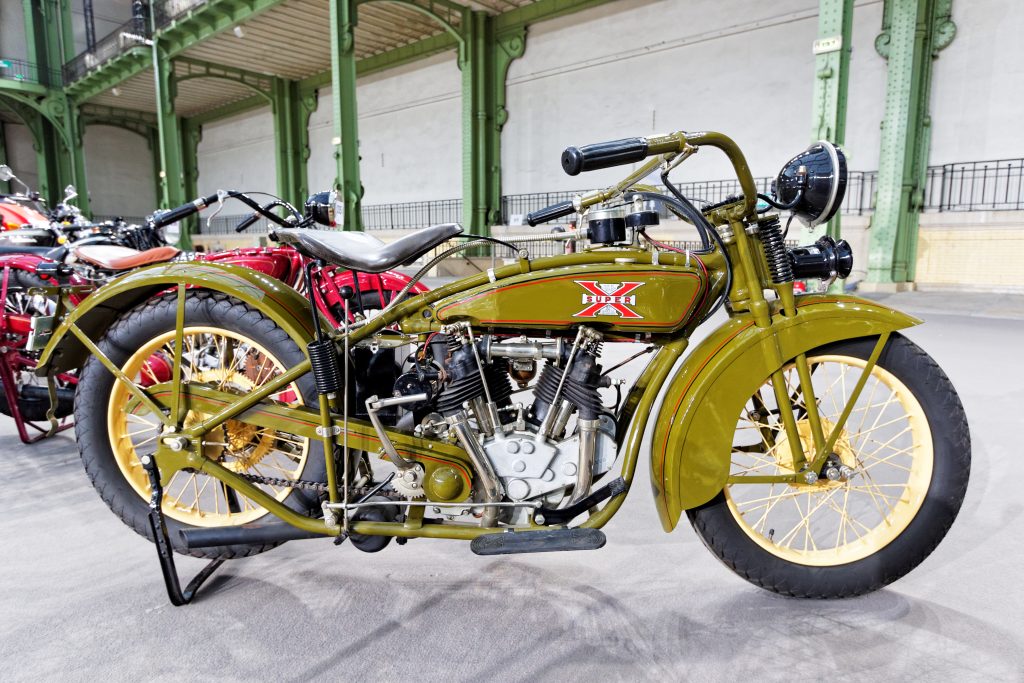
Because production ended abruptly in 1931, surviving Super X motorcycles have become highly desirable collectibles. Restoration specialists continue manufacturing reproduction pistons, gears, ignition components, and body parts to keep these historic machines operational.
Their continued presence at museums, vintage rallies, and collector auctions demonstrates that exceptional engineering can outlast even the strongest companies. Nearly one hundred years after Excelsior closed its doors, the Super X remains one of the defining motorcycles of America’s early motorcycling heritage.
Specifications
- Engine: 747 cc Side-valve V-twin
- Torque: Approximately 38 lb-ft
- Horsepower: Approximately 28 hp
- Length/Width: Approximately 85.0 inches / 31.0 inches
Also Read: Six of the 10 Most American-Made Cars Come From Foreign Brands