

The Toyota Hilux is not officially sold as a new vehicle in the United States, so a fact-based article about its hidden features cannot honestly use U.S.-market Hilux specifications. Toyota’s U.S. midsize pickup is the Tacoma.
For accuracy, this article uses official Toyota Hilux information from markets where the truck is sold, while engine output, torque, and dimensions are converted into horsepower, lb-ft, and inches for U.S. readers.
Many of the Hilux’s most useful functions are easy to overlook because they work quietly in the background or are activated only in specific driving situations.
Toyota documentation identifies systems ranging from rear differential locking and Downhill Assist Control to Hill Start Assist Control, automatic power-window protection, drive modes, and connected safety functions. Availability can change by model year, grade, transmission, and sales market, so owners should verify equipment against the manual for their exact truck.
These are not internet myths or secret button combinations invented for social media. The features covered here are supported by Toyota product pages, technical specifications, or official Hilux operating guidance.
Here are 10 lesser-known Toyota Hilux features that reveal just how much capability is built into the pickup.
Also Read: 8 Hidden Features in the Volvo XC90
1. Rear Differential Lock Can Rescue the Hilux When One Rear Wheel Spins
A spinning rear wheel can make a four-wheel-drive truck appear strangely helpless. The engine produces power, and the driver presses the accelerator, yet one tire continues rotating while the vehicle barely moves. The Toyota Hilux has a specialized feature designed for exactly this type of low-traction situation: its rear differential lock.
Toyota’s official Hilux guidance explains that the rear differential lock assists the truck in low-range L4 operation when additional traction is needed. If one rear wheel is spinning on a slippery surface, locking the rear differential helps the two rear wheels rotate together rather than allowing engine torque to escape primarily through the wheel with less grip.
The feature is more specialized than an ordinary four-wheel drive. A conventional open differential allows the left and right wheels to rotate at different speeds, which is essential when turning on paved roads. During difficult off-road driving, however, that same freedom can become a disadvantage when one tire loses traction.
Toyota’s instructions require the Hilux to be stopped before the rear differential lock is engaged. The driver selects L4, confirms that the four-wheel-drive indicator and low-range indicator are illuminated, and then presses the rear differential lock switch. The indicator flashes while engagement is taking place and remains illuminated once the system is locked.
This is not a feature intended for normal highway driving. Toyota warns that the differential should be unlocked once the vehicle has regained traction. Keeping it engaged on high-grip surfaces can interfere with normal wheel-speed differences during cornering.
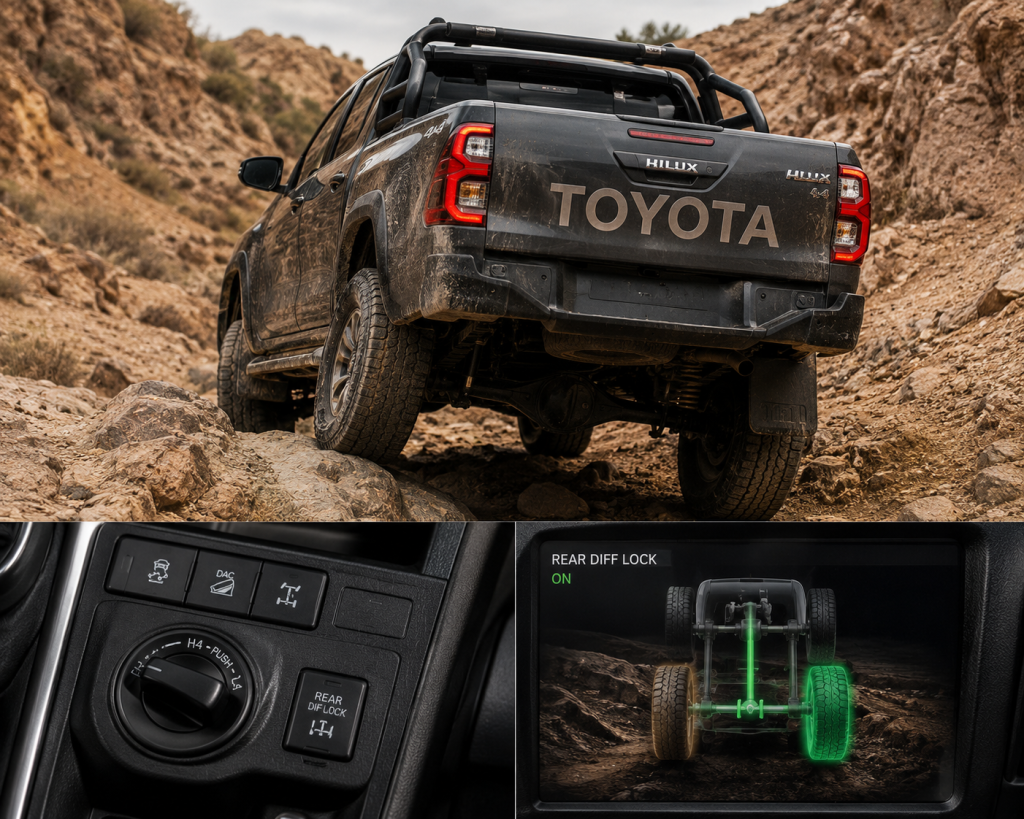
That specific operating purpose is why some Hilux owners may rarely use the button. Yet on mud, loose ground, or a cross-axle obstacle, the rear differential lock can turn wasted wheelspin into usable forward movement. It is one of the Hilux’s most important capability features, hiding behind a small dashboard switch.
2. Downhill Assist Control Manages a Steep Descent Without Constant Brake Pedal Input
Driving up a difficult slope requires traction and engine power. Coming back down can be more intimidating because gravity is constantly accelerating the truck. On suitably equipped Toyota Hilux models, Downhill Assist Control, commonly identified as DAC, can manage vehicle speed during a steep descent.
Toyota’s official Hilux operating guidance states that DAC works when the truck is in four-wheel-drive mode. The driver activates the system using the DAC switch on the center console, and an indicator light confirms that the feature is operational.
The clever part is what happens next. Instead of requiring the driver to repeatedly apply and release the brake pedal, the system automatically controls braking to help maintain a low vehicle speed. Toyota’s Hilux guidance describes DAC as operating at approximately 3 to 4 mph. The driver can concentrate more attention on steering and choosing a safe path.
This function can be especially valuable on loose downhill surfaces. Heavy brake input may cause a tire to lose grip, while uncontrolled acceleration can quickly increase the difficulty of a descent. DAC uses the vehicle’s braking control systems to manage the wheels in a more calculated manner.
Drivers should not mistake the feature for autonomous off-road driving. Steering remains entirely the driver’s responsibility, and terrain conditions still need to be judged carefully. Toyota also specifies operating conditions for the system, which is why owners should follow the instructions for their exact model year and transmission.
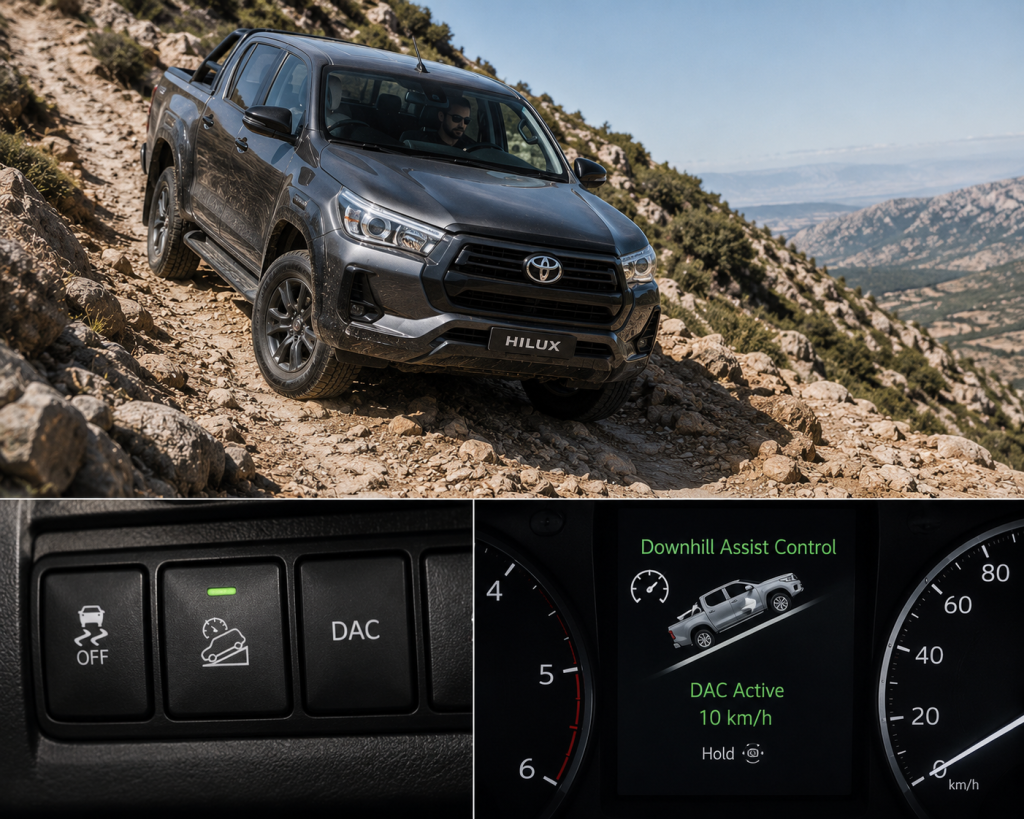
The hidden nature of DAC comes from how rarely many pickup owners encounter a situation requiring it. A Hilux used mainly for commuting may carry the switch for years without the driver discovering what it does.
Once the truck reaches a steep off-road descent, however, the feature’s purpose becomes clear. Rather than riding the brake pedal down the hill, the driver can activate a factory-designed low-speed descent control system and focus on placing the Hilux’s wheels correctly.
3. Hill-Start Assist Control Temporarily Holds the Brakes to Reduce Rollback
A steep uphill start can expose an awkward moment in any heavy pickup. The driver releases the brake pedal and moves toward the accelerator, and the truck begins rolling backward before enough engine torque reaches the wheels. Toyota built Hill-Start Assist Control into equipped Hilux models to reduce that problem.
Toyota classifies Hill-Start Assist Control (HAC) as part of the Hilux’s vehicle stability system. According to Toyota’s official technical information, the feature helps prevent the vehicle from rolling backward when starting on an incline by briefly maintaining brake pressure after the driver releases the brake pedal.
The clever detail is how briefly the assistance works. Toyota describes the system as maintaining braking to all four wheels for a maximum of approximately two seconds. That short window gives the driver time to transition from the brake to the accelerator and begin moving forward.
This is easy to overlook because the driver does not necessarily need to activate a dedicated switch every time. The feature works as part of the truck’s control systems when its operating conditions are met. An owner may simply notice that the Hilux feels more controlled on a hill without immediately realizing electronic brake management is helping.
The function can be particularly useful when the pickup is carrying cargo. Added vehicle weight can make rollback feel more pronounced, while a steep ramp, trail, or parking exit may leave little space behind the truck.
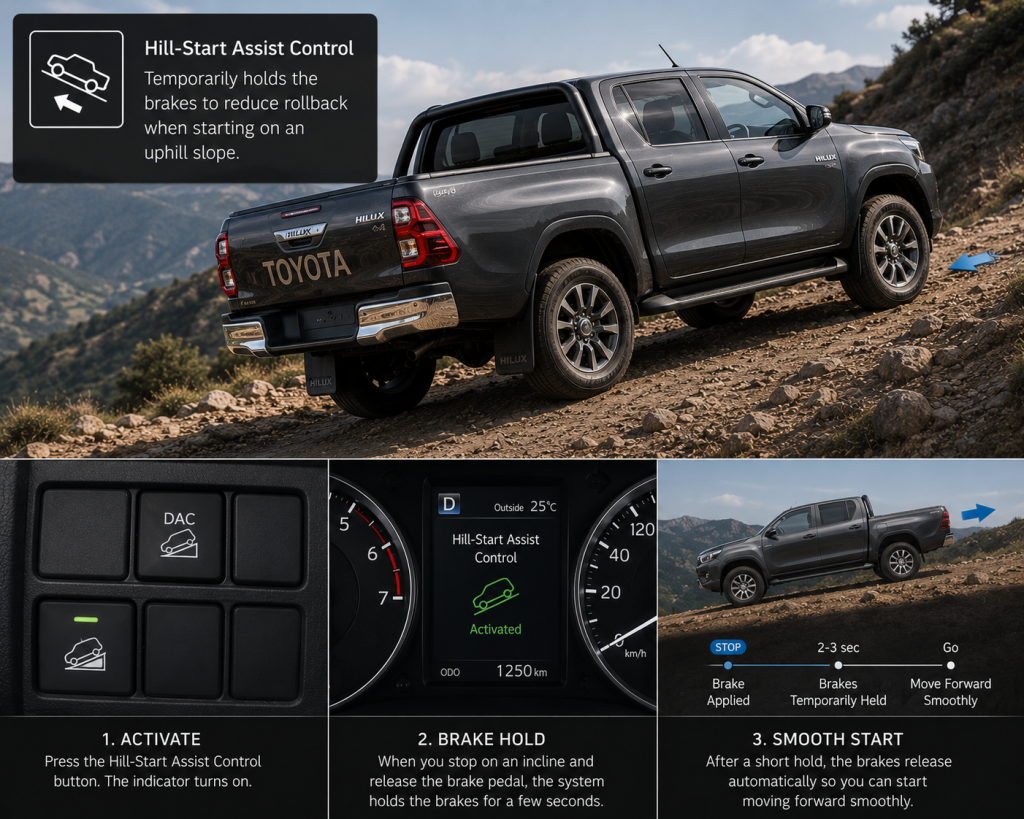
HAC does not replace proper brake and accelerator control. The temporary hold ends, and Toyota’s documentation makes clear that the system is an assistance feature rather than a parking brake.
Its value lies in a very specific moment. For roughly two seconds, the Hilux can help hold itself while the driver prepares to pull away, turning a stressful uphill start into a more controlled maneuver.
4. ECO and PWR Modes Change How the Hilux Responds to the Accelerator
Two small buttons on the center console can noticeably alter the way an equipped Toyota Hilux reacts to the driver’s right foot. Toyota officially lists ECO and PWR driving modes on selected Hilux specifications, giving the pickup different response characteristics without requiring a mechanical engine modification.
ECO mode is intended for more efficiency-focused driving. Rather than adding or removing horsepower, the control system changes vehicle response to driver input.
The practical result is a smoother, less aggressive reaction to accelerator movement. In traffic, where repeated acceleration can increase fuel consumption, a gentler response can make the truck easier to drive progressively.
PWR mode takes the opposite approach. Accelerator response becomes more immediate, giving the driver a stronger sensation of urgency when pressing the pedal. This can be useful when a faster response is desirable, such as when joining a highway or driving in conditions where the driver wants the engine to react more quickly.
The hidden part of these modes is what they do not change. Selecting PWR does not magically increase the 2.8-liter diesel’s maximum factory horsepower. ECO does not convert the Hilux into a lower-output engine specification. The modes alter the way the vehicle delivers its available performance and responds to accelerator input.
Drivers who leave the truck in its default setting may never experiment with either button. Yet the difference can be useful because a Hilux may serve several roles during the same week. Slow urban traffic calls for a different accelerator character from a more demanding open-road drive.
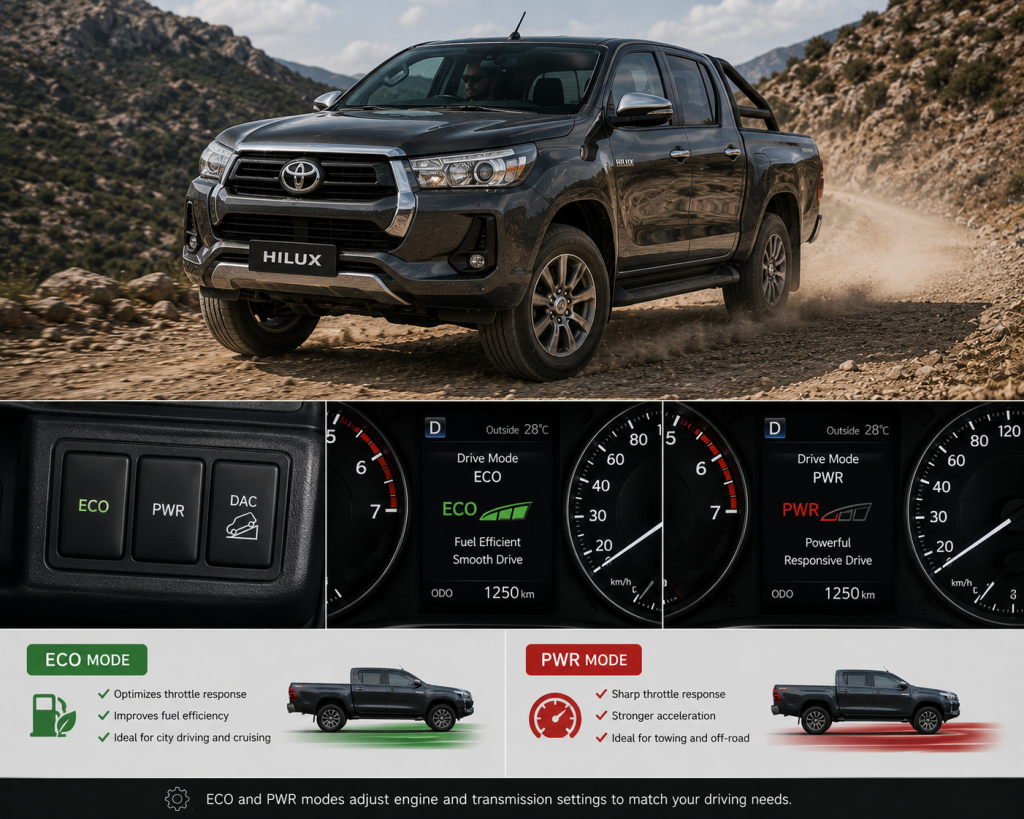
Toyota’s Hilux information confirms ECO and PWR mode availability in equipped versions. The feature gives the driver a simple way to change the pickup’s response without touching the engine, transmission, or aftermarket tuning.
That makes these drive-mode buttons more than dashboard decoration. They allow the same diesel Hilux to feel calmer or more responsive depending on where and how it is being driven.
5. Active Traction Control Can Brake a Spinning Wheel and Redirect Drive to a Tire With Grip
A rear differential lock is a powerful tool, but the Toyota Hilux also has a more automatic way of dealing with wheelspin on equipped four-wheel-drive models. Toyota calls the system Active Traction Control, or A-TRC, and its operation is more sophisticated than simply reducing engine power whenever a tire begins to slip.
Toyota’s official Hilux information identifies A-TRC as part of the pickup’s off-road equipment. The system monitors the wheels while four-wheel drive is selected. If it detects wheelspin that could reduce traction, A-TRC uses the anti-lock braking hardware to apply braking force to the slipping wheel.
The useful part happens next. By controlling the wheel that is spinning freely, the system helps transfer usable drive to a wheel with better traction. A driver climbing over uneven ground may therefore feel the Hilux continue moving even after one wheel begins to lose contact or spin on a slippery surface.
This makes A-TRC different from the manually selected rear differential lock discussed earlier. The driver does not have to judge every individual instance of wheelspin and lock the rear axle each time. Electronic control can react to changing traction while the vehicle moves through difficult terrain.
Toyota specifically developed the eighth-generation Hilux with A-TRC as part of a group of off-road systems intended to raise its four-wheel-drive capability. The feature is easy to miss because much of its work occurs through existing braking hardware rather than a dramatic mechanical action the driver can see.
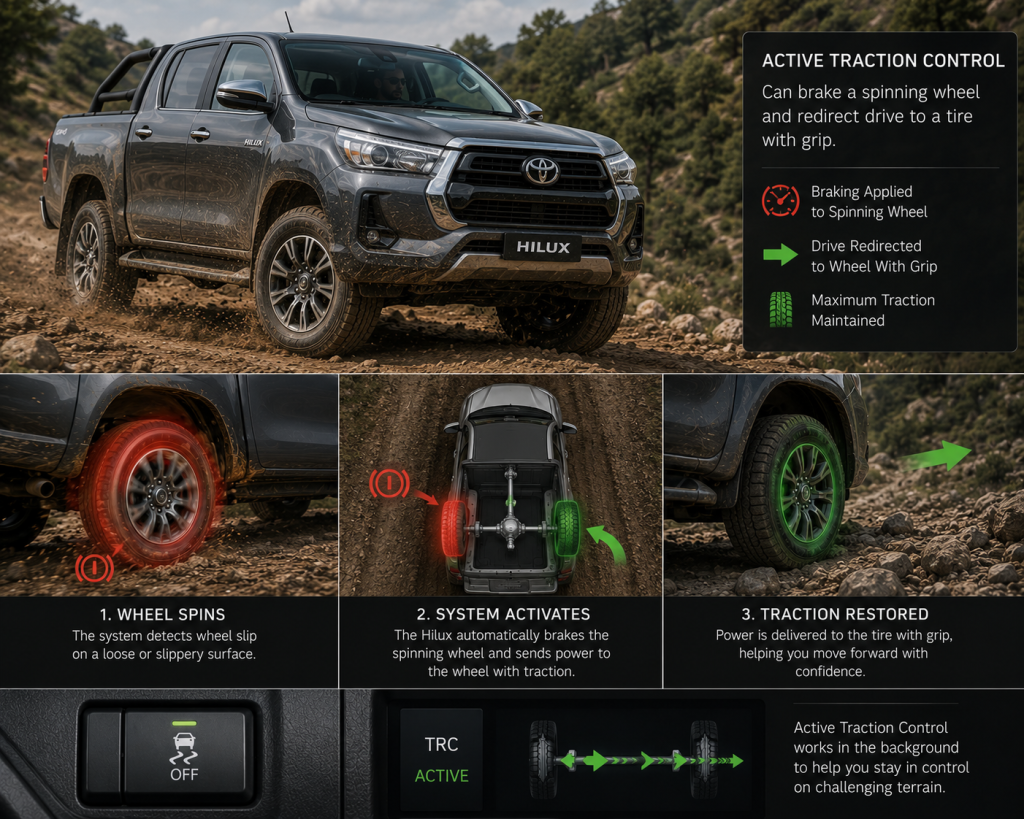
On loose dirt, mud, or uneven terrain, however, the intervention may be the difference between a wheel spinning uselessly and the truck continuing forward. A-TRC quietly turns the Hilux’s anti-lock braking system into a traction-management tool.
6. The Cooled Upper Glovebox Can Help Keep Drinks and Small Items Chilled
Not every overlooked Hilux feature is designed for mud, rocks, or steep slopes. Inside selected versions of the pickup is a much simpler convenience item that some owners may initially mistake for an ordinary storage compartment. Toyota’s official Hilux brochure lists a cooled upper glovebox among the truck’s cabin features.
The wording is important. This is not a miniature refrigerator with its own electric compressor. Instead, the storage compartment uses cooled air associated with the vehicle’s climate-control system. When operating under suitable conditions, that airflow can help keep items inside cooler than they would be in a conventional closed dashboard compartment.
For a pickup frequently used on long drives or in hot climates, the feature has an obvious practical role. A small drink or other suitable item can be placed in the upper glovebox while the air conditioning is running. The compartment’s location also keeps smaller objects away from the main cabin storage areas.
Many owners may overlook the cooling function because the upper glovebox does not visually resemble a refrigerator. Without checking the vehicle’s feature list or noticing the cooling arrangement, it is easy to use the space only for paperwork and miscellaneous cabin items.
Expectations still need to remain realistic. Toyota identifies the feature as a cooled upper glovebox, not a freezer. Its effectiveness is connected to climate-control operation and cabin conditions, so it should not be treated as temperature-controlled storage for medicine or other products requiring precise refrigeration.
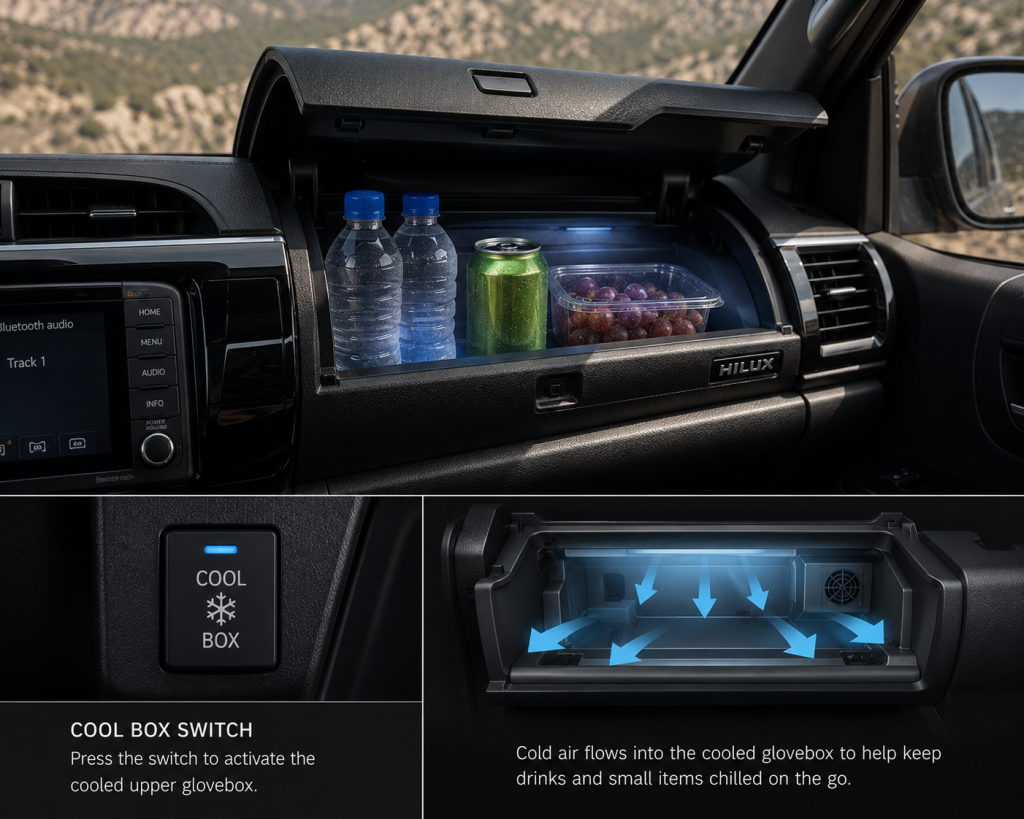
The feature reveals a different side of Hilux design. Toyota is known for emphasizing durability and off-road hardware in the pickup, yet the cabin includes small convenience solutions aimed at long periods behind the wheel.
A driver who has spent years thinking the upper compartment is simply another glovebox may be surprised to discover that Toyota specifically designed it to receive cooling. It is a modest feature, but one that can become surprisingly useful during a hot road trip or a long working day.
7. Trailer Sway Control Can Automatically Stabilize a Moving Trailer
Trailer movement can become dangerous when crosswinds, sudden steering inputs, or passing vehicles cause a trailer to swing from side to side. Selected Toyota Hilux models include trailer sway control, a system designed to detect excessive trailer movement and help stabilize the truck and trailer combination.
Toyota integrates Trailer Sway Control with the Hilux’s Vehicle Stability Control system. Sensors monitor vehicle movement while driving. When excessive sway is detected, the system can automatically reduce engine torque and selectively apply braking force to individual wheels.
These actions are intended to suppress the side-to-side movement and help return the truck and trailer to a more stable path.
The intervention happens automatically. Drivers do not need to search for a special control while a trailer is already moving unpredictably. A flashing slip indicator can alert the driver when the stability system is actively intervening.
Trailer sway control does not replace correct towing practices. Toyota’s operating guidance makes clear that the system cannot prevent every instance of trailer instability. Proper cargo distribution, correct tire pressures, suitable trailer loading, and driving at an appropriate speed remain essential.
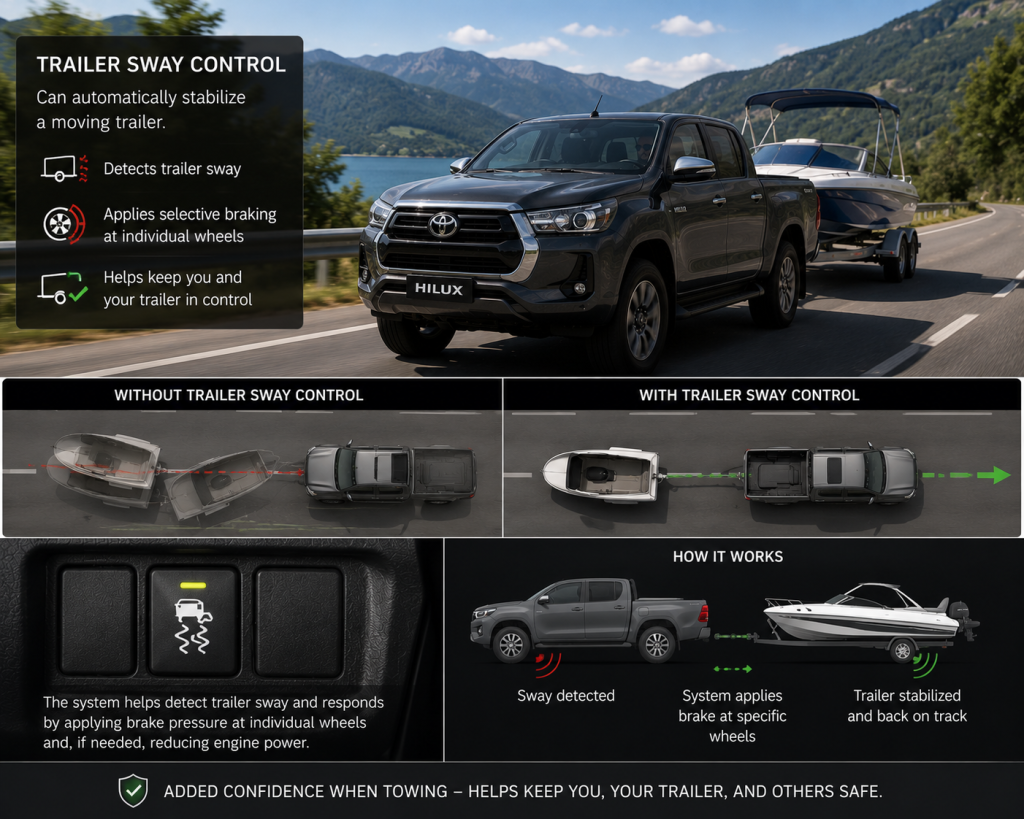
Many Hilux owners may never notice this technology during normal driving because it remains in the background until sensors identify excessive movement. For drivers who regularly tow equipment or recreational trailers, however, the system provides an additional electronic layer of assistance during an unstable situation.
8. The Hilux Can Switch From H₂ to H₄ While Moving at Up to 62 MPH
Some four-wheel-drive pickups require drivers to stop before changing drivetrain settings, but the Toyota Hilux offers more flexibility.
Toyota’s official operating guidance states that equipped Hilux models can shift from H2 high-speed two-wheel drive into H4 high-speed four-wheel drive while traveling at speeds of up to 62 mph.
The feature becomes useful when driving conditions change unexpectedly. H2 is the normal setting for dry paved roads and supports better fuel efficiency.
If the Hilux reaches an appropriate slippery or loose surface, the driver can select H4 without automatically bringing the truck to a complete stop, provided Toyota’s operating requirements are followed.
After the four-wheel-drive control is moved to H4, the 4WD indicator flashes while engagement takes place. The light remains illuminated once the drivetrain has completed the change. Drivers should check the indicator rather than assuming four-wheel drive is engaged instantly.
There is an important difference between H4 and L4. Low-range four-wheel drive requires the Hilux to be stationary. Automatic-transmission models must be placed in neutral before low range is selected. Manual-transmission versions require the clutch pedal to be depressed.
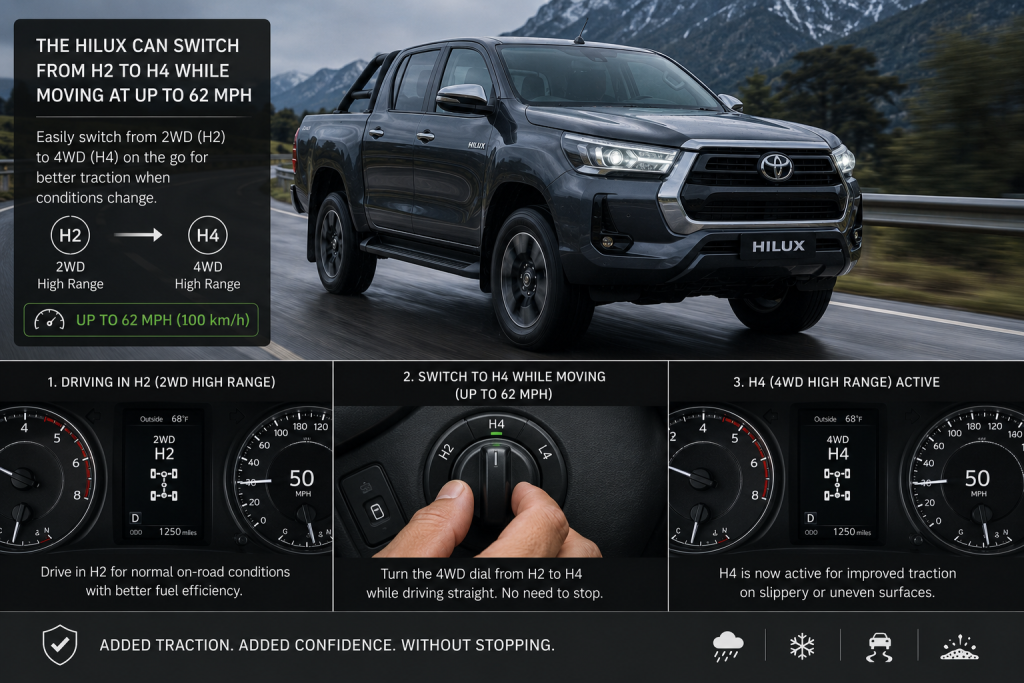
That distinction is easy to miss. H4 supports higher-speed driving on suitable low-traction surfaces, while L4 provides lower gearing for demanding terrain. For owners who stop before every 2WD-to-4WD change, the Hilux’s ability to enter H4 at speeds up to 62 mph may be one of its most useful, overlooked capabilities.
9. All Four Power Windows Can Have One-Touch Operation and Jam Protection
Power windows sound like ordinary equipment until the Toyota Hilux’s available system is examined more closely. In selected markets and grades, Toyota equips the pickup with automatic up and down operation for all four windows rather than limiting the one-touch function to the driver’s door.
The system allows an occupant to fully press or pull the appropriate window switch and then release it. The glass continues moving automatically without requiring the switch to remain held throughout the entire opening or closing process. This becomes convenient when several windows need to be adjusted quickly.
A more important feature is the available jam-protection function. During automatic closing, the system is designed to detect resistance affecting the movement of the window. If an obstruction is detected under applicable operating conditions, the protective function can interrupt the normal closing action.
Drivers should never intentionally test jam protection using fingers, hands, or other body parts. It is an assistance feature rather than a guarantee against every possible injury.
The feature is easy to overlook because owners may simply use the window switches normally without investigating their full operation. Toyota’s Hilux equipment information in markets such as India specifically identifies all-window auto up-and-down functionality with jam protection.
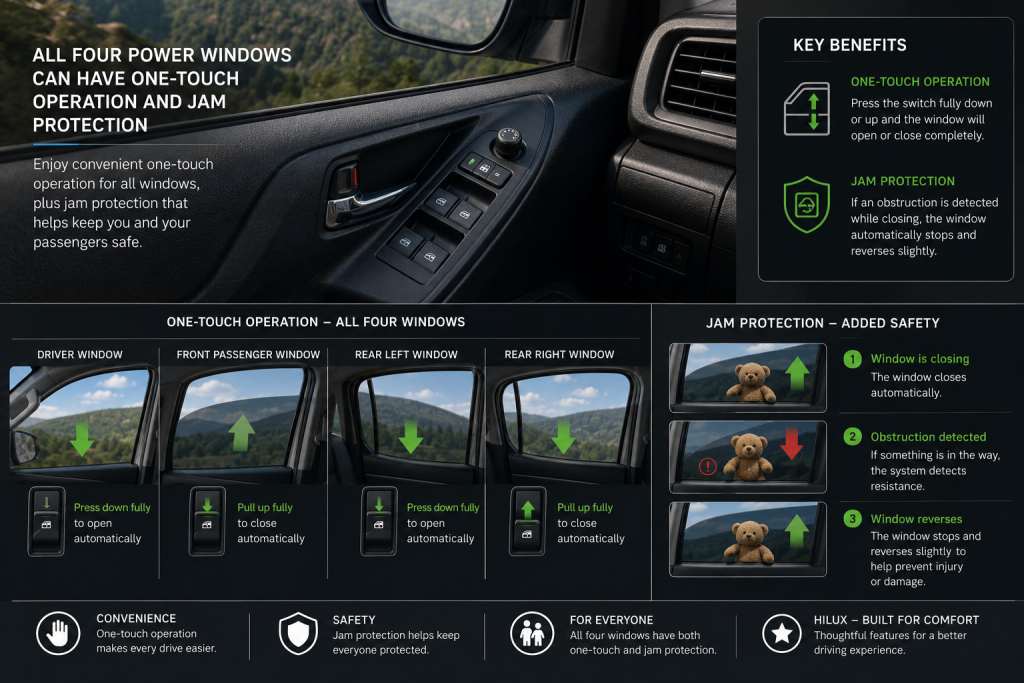
Availability depends on the exact Hilux grade and country. Still, on trucks fitted with the system, Toyota provides a more sophisticated power-window arrangement than many drivers expect from a work-focused pickup.
10. Smart Entry Lets You Unlock and Start the Hilux Without Removing the Key
Reaching into a pocket or bag for the vehicle key is unnecessary on Toyota Hilux grades equipped with Smart Entry and Start. When the authorized smart key is within the required detection area, the system allows the driver to access and start the pickup without manually using a conventional key.
Toyota’s Hilux equipment information confirms Smart Entry and Start availability on selected grades. The driver can approach the vehicle with the smart key nearby and use the door’s entry hardware to unlock the truck. Once inside, the engine can be started using the push-button ignition system.
The technology is easy to overlook because it quickly becomes part of the owner’s normal routine. There is no complicated activation process during everyday use. The vehicle detects the compatible key and allows the appropriate entry or starting function when the system’s conditions are satisfied.
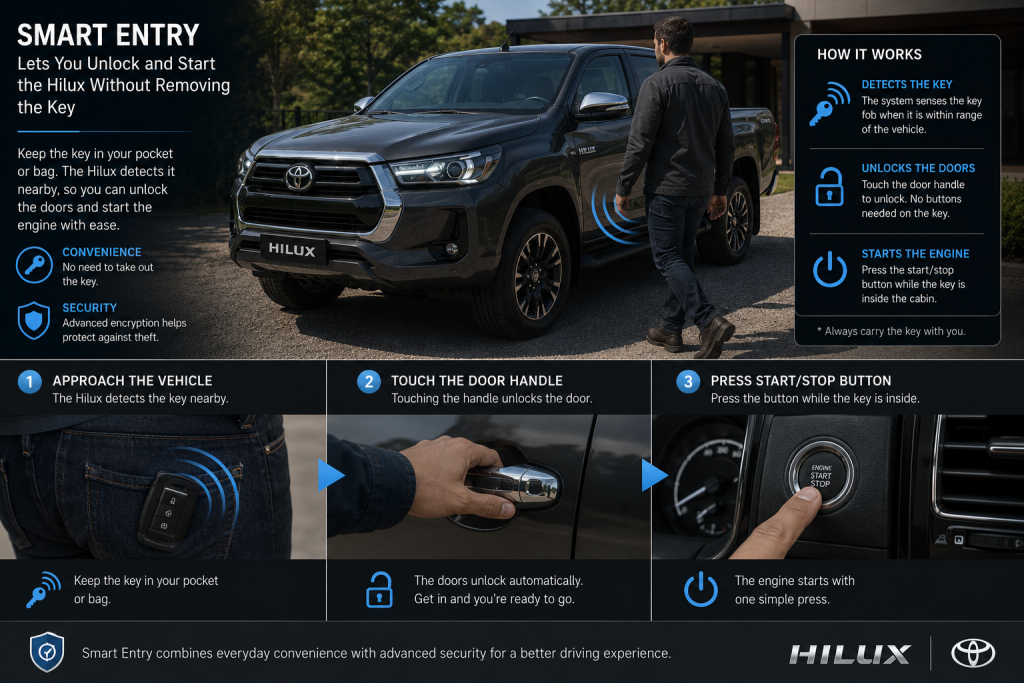
Some market-specific Hilux smart keys also include a panic function. Toyota Australia states that holding the appropriate key control can activate the vehicle’s horn and indicators to attract attention. Availability varies by grade and specification.
Smart Entry should not be assumed to exist on every Hilux. Toyota has offered the feature on selected versions, and equipment varies significantly between countries and model years.
Its usefulness comes from removing small steps from daily driving. An owner carrying tools, bags, or other items does not have to search for the key before entering the truck. The Hilux can recognize the authorized smart key, provide access, and allow push-button starting with the key still stored in a pocket or bag.
Also Read: 8 Hidden Features in the Acura MDX
