

In the early 1970s, General Motors wanted to prove that American automakers could embrace advanced engineering without sacrificing affordability. The result was the Chevrolet Vega, a compact car designed to compete with growing imports from Japan and Europe.
At the heart of the Vega sat one of the most ambitious engines ever developed by Chevrolet: the 2.3-liter aluminum inline-four, commonly known as the Vega 2300.
On paper, it was years ahead of its competition. Instead of a traditional cast-iron block, Chevrolet built the engine almost entirely from aluminum, reducing weight and improving fuel efficiency.
The biggest gamble, however, was eliminating conventional cast-iron cylinder liners. Engineers believed they had developed an innovative aluminum alloy that would allow piston rings to run directly against the cylinder walls. It was a bold idea that promised lower manufacturing costs, reduced weight, and improved heat transfer.
Unfortunately, real-world conditions exposed flaws that laboratory testing had not fully revealed. The Vega engine quickly became infamous for excessive oil consumption, cylinder wear, overheating, and catastrophic engine failures.
Decades later, automotive historians still cite it as one of General Motors’ most costly engineering missteps. According to GM Heritage Center documents, the Vega represented one of the company’s largest investments in small-car engineering, making its eventual reputation even more damaging.
Also Read: 10 States With the Most Miles Driven Per Driver (FHWA)
A Revolutionary Engine That Ignored Conventional Wisdom
During the late 1960s, aluminum engine technology was still relatively uncommon in mass-market American vehicles. Most manufacturers relied on cast-iron blocks because they were inexpensive, durable, and well understood. Chevrolet engineers wanted something different.
The Vega’s 2,287 cc single overhead camshaft engine featured an aluminum block manufactured using a high-silicon alloy known as Reynolds 390 aluminum. Instead of inserting steel or cast-iron cylinder sleeves, the cylinder bores were chemically etched after machining.
This process removed some of the softer aluminum while exposing hard silicon crystals embedded throughout the alloy. According to SAE technical papers published during the engine’s development, these exposed silicon particles were intended to provide a durable running surface for the piston rings without requiring separate liners.
The concept offered several theoretical advantages. Eliminating cylinder liners reduced weight, simplified manufacturing, and improved heat transfer because aluminum conducts heat significantly better than cast iron. Engineers believed faster heat dissipation would improve efficiency while allowing tighter engine packaging.
General Motors also designed the Vega engine with an overhead camshaft at a time when most American compact cars still relied on simpler pushrod designs. Automotive historians have noted that the engine’s architecture was genuinely advanced for a domestic economy car introduced in 1970.
When new and properly maintained, the Vega’s 110-horsepower engine delivered respectable performance for its class while helping the lightweight car achieve competitive fuel economy during an era increasingly concerned about rising fuel prices.
Unfortunately, many of the engine’s innovations depended on operating conditions that real owners often struggled to maintain.
Why the Engine Started Destroying Itself
The Vega engine did not fail because aluminum was inherently a poor material. Modern vehicles from nearly every manufacturer successfully use aluminum engine blocks today. The problem lay in how Chevrolet combined material selection, cooling system design, manufacturing tolerances, and customer maintenance expectations.
The most significant weakness involved heat management. Although aluminum transfers heat efficiently, the Vega’s cooling system proved vulnerable to neglect.
If coolant levels dropped or overheating occurred, the aluminum block expanded much more rapidly than a comparable cast-iron engine. Repeated overheating damaged the carefully prepared silicon cylinder surfaces, allowing piston rings to wear directly against softer aluminum underneath.

Once this protective surface deteriorated, cylinder wear accelerated dramatically. Oil began slipping past worn piston rings into the combustion chambers, producing the excessive oil consumption that soon became one of the Vega’s defining problems.
According to contemporary reports published by Consumer Reports, many owners experienced unusually high oil consumption long before engines reached 50,000 miles. Some vehicles required frequent oil top-offs between scheduled maintenance intervals, while others suffered noticeable compression loss and declining performance.
The situation became worse because early Vega engines used relatively small cooling systems that left little margin for abuse. Radiators could become clogged, coolant levels could fall unnoticed, and overheating often occurred before drivers realized something was wrong.
Unlike modern vehicles equipped with sophisticated engine protection software, the Vega depended almost entirely on driver attention.
Road & Track and Car and Driver, which initially praised the Vega’s engineering when it debuted, later documented increasing reliability concerns as higher-mileage examples began appearing.
Their long-term testing found that many mechanical issues emerged only after extended ownership, suggesting durability had not matched Chevrolet’s ambitious engineering goals.
The engine’s valve stem seals also contributed to oil consumption, while timing-related wear occasionally compounded maintenance costs. None of these problems alone doomed the Vega, but together they created a reputation that became increasingly difficult for Chevrolet to overcome.
General Motors attempted several improvements throughout the production run. Cooling systems were revised, engine components were strengthened, manufacturing quality improved, and warranty repairs became increasingly common. However, by then public perception had already shifted.
The Lasting Impact on Chevrolet’s Reputation
The Vega debuted to considerable acclaim. It won Motor Trend’s 1971 Car of the Year award, and initial sales were exceptionally strong. Chevrolet sold hundreds of thousands of Vegas during its early years, proving there was substantial demand for an American-built compact car.
Yet customer satisfaction gradually declined as durability issues became more widely known. Rust problems affecting the Vega’s body further compounded owner frustration, meaning many buyers experienced both mechanical and corrosion concerns within just a few years of ownership.
According to historical sales analyses compiled by automotive historians and GM Heritage archives, Vega sales steadily declined during the mid-1970s as its reputation deteriorated.
Chevrolet eventually introduced numerous engineering updates, including revised cooling components, improved engines, and better corrosion protection, but these changes arrived after much of the damage had already been done.
Ironically, the underlying engineering philosophy survived. Modern aluminum engine blocks found in vehicles from Chevrolet, Ford, Toyota, BMW, Mercedes-Benz, Honda, and virtually every major manufacturer no longer rely on the Vega’s exposed-silicon cylinder approach alone.
Instead, manufacturers typically use cast-in iron liners, plasma-transferred wire arc coatings, Nikasil, Alusil, or other advanced cylinder technologies developed through decades of additional research. These systems combine aluminum’s weight savings with significantly improved durability.
Many engineers now view the Vega not as proof that aluminum engines were a bad idea, but as evidence that promising technology requires equally mature manufacturing processes, effective cooling systems, and realistic durability testing before reaching mass production.
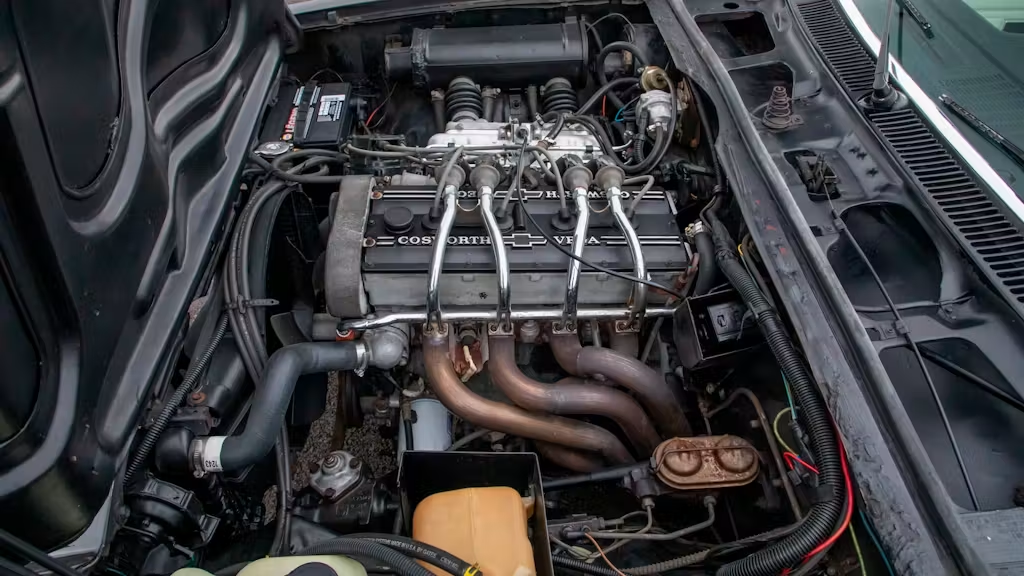
The Vega’s aluminum block itself was not inherently flawed. In fact, similar high-silicon aluminum concepts eventually evolved into successful production technologies used by manufacturers including Porsche, Mercedes-Benz, Audi, and BMW.
The difference was that later generations benefited from improved metallurgy, tighter machining tolerances, better piston coatings, superior engine management systems, and far more sophisticated cooling designs.
Looking back more than 50 years later, the Chevrolet Vega 2300 remains one of the automotive industry’s most fascinating engineering stories. It demonstrated remarkable innovation and genuine technical ambition, introducing concepts that were well ahead of mainstream American engine design.
However, it also illustrated the risks of bringing cutting-edge technology to market before every supporting system had reached the same level of refinement.
Rather than becoming the lightweight engine that transformed Chevrolet’s future, the Vega 2300 became a cautionary tale taught in automotive engineering circles.
It serves as a reminder that innovation alone is never enough. Reliability ultimately determines whether a groundbreaking design becomes a lasting success or an expensive lesson in engineering history.
Also Read: 10 Upcoming EVs With Over 400 Miles of Range
