
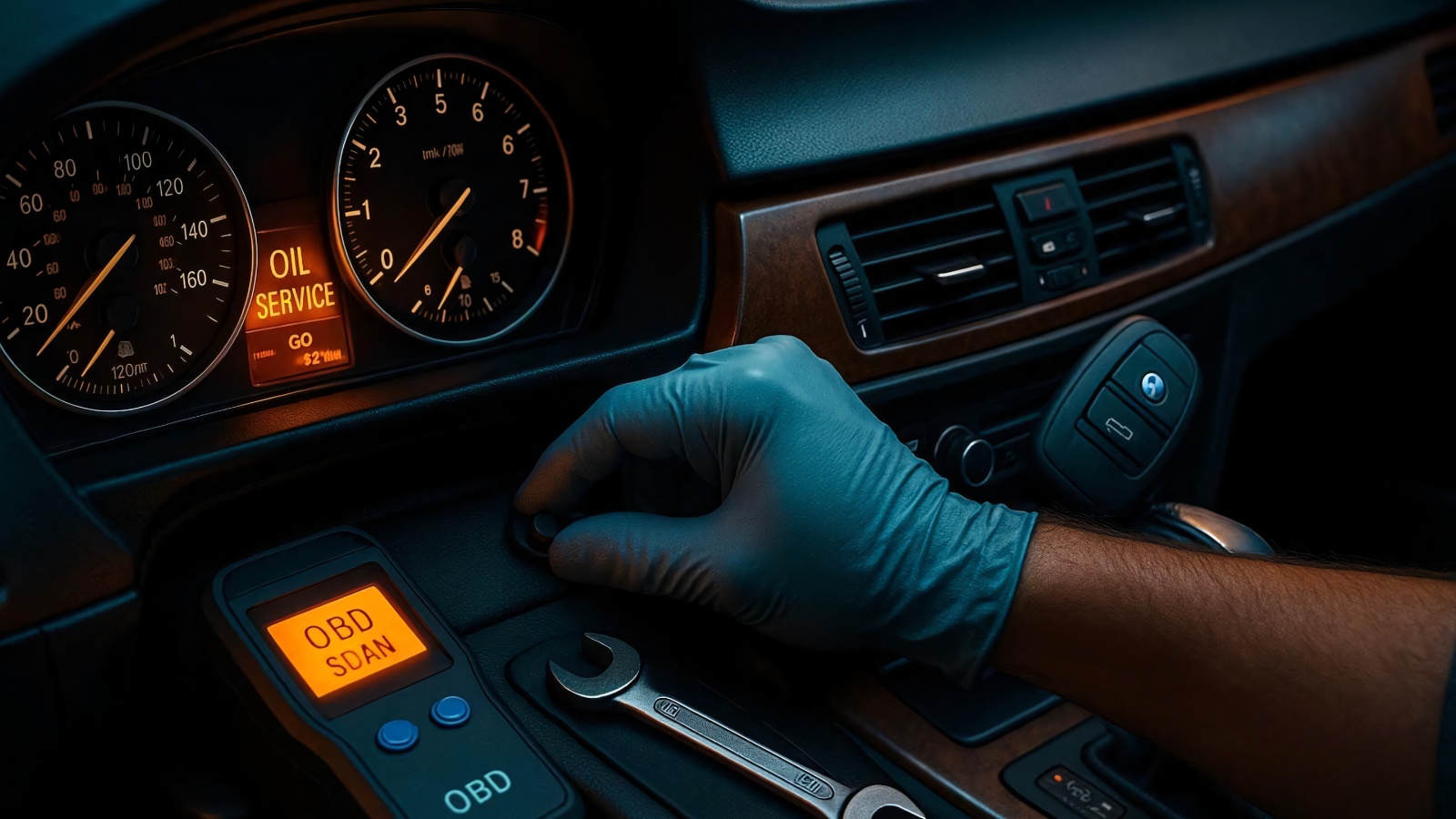
Not every oil change ends the same way. On most mainstream cars, a quick button sequence on the dash clears the service light in seconds. On a growing list of premium and near-luxury models, that same task requires factory-level diagnostic software.
This isn’t always about the oil light itself. Many of these vehicles use condition-based service systems. They calculate wear from oil quality sensors, driving style, and mileage together.
Resetting that logic properly often means writing back to a control module. Cheap OBD2 scanners frequently cannot do this correctly, or at all.
That gap pushes independent shops and DIY owners back toward the dealership. Some brands lock the process behind proprietary software like BMW’s ISTA, Mercedes’ XENTRY, or Porsche’s PIWIS.
Others use encrypted security gateways that block aftermarket tools from writing any data. The result is the same: a routine oil change becomes a service-lock-in moment.
Below are ten vehicles where this pattern shows up clearly. Each one is a genuinely capable, well-engineered car. But each also illustrates how modern software architecture can quietly extend a dealer’s grip on maintenance.
We cover the specific system involved, the tools that typically work, and the core specifications of a representative trim for each model. This is useful information whether you’re shopping for one of these cars or already own one and want to understand why that service light won’t clear with a $20 scanner.
1. BMW 5 Series (G60)
BMW’s Condition-Based Service system is the company’s long-standing answer to fixed maintenance intervals. It tracks oil quality, mileage, and even ambient temperature history.
The G60-generation 5 Series ties this data into the car’s central body module. A simple iDrive menu reset only clears the dashboard warning.
It does not fully synchronize the underlying CBS counter that the car’s service history relies on. For a complete reset that dealers and CPO inspections recognize, BMW’s ISTA software is typically required.
Independent shops get close with tools like Autel or Foxwell units carrying BMW-specific licenses. But full bidirectional writes to the CBS module still favor factory-level access.

This pushes many owners back to the dealer network for something as routine as an oil change reset. It’s a deliberate byproduct of how deeply BMW integrates service data into the car’s electrical architecture.
The complexity grows further on hybrid and M performance variants. Cars like the 550e xDrive and the M5 carry additional battery and high-voltage service checkpoints inside the same CBS logic tree.
A partial reset can leave stray warnings active in the driver display. Some owners report messages that persist for weeks after a DIY oil change, even though the physical work was done correctly. That inconsistency erodes trust in aftermarket tools, even good ones. Dealers know this, and price their reset labor accordingly.
BMW has also tightened its security gateway module in recent model years. This module sits between the OBD port and the car’s internal networks, filtering which commands third-party tools can send.
Older G30-generation 5 Series cars were noticeably easier to reset with aftermarket hardware. The newer G60 platform closes many of those gaps, making genuine ISTA access more valuable than ever for a complete, dealer-recognized service reset.
Specifications:
- Engine: 2.0L B48 turbocharged inline-4, mild-hybrid assist
- Horsepower: 255 hp
- Torque: 295 lb-ft
- Length: 199.2 in (5,060 mm)
- Width: 74.8 in (1,900 mm)
2. Mercedes-Benz E-Class (W214)
Mercedes uses its ASSYST PLUS system to calculate service intervals dynamically. It’s based on oil condition, mileage, and even brake pad wear. The W214-generation E-Class centralizes this logic inside a module that communicates over the car’s secured CAN network. Mercedes has increasingly hardened this network against aftermarket write access.
The company’s own dealer tool, XENTRY, remains the most reliable way to fully reset ASSYST PLUS. It’s especially true for hybrid variants that also track battery and motor service points.
Some newer scan tools claim partial ASSYST reset support. Forum reports suggest inconsistent results, particularly on E 450 4MATIC and E 53 Hybrid+ models.

Owners doing their own oil changes often find the light returns within days. It happens because the underlying counter was never truly zeroed. That inconsistency is a direct result of Mercedes tightening gateway security.
The E-Class shares its MRA2 platform architecture with the C-Class and S-Class. That means its diagnostic gateway inherits the same protections Mercedes uses across its higher-end lineup.
This is a notable shift from older E-Class generations, where basic service resets were more forgiving. Mercedes has steadily consolidated its service software under the XENTRY umbrella, retiring older standalone tools that once offered workarounds.
Independent shops that once relied on used dealer-grade equipment now find themselves needing active subscriptions and updated licenses just to keep pace. For owners, the practical result is straightforward.
A DIY oil change on the E 450 4MATIC or the six-cylinder E-Class variants can still be done in a driveway. But clearing the reminder light in a way that survives a subsequent dealer visit, or shows correctly during a trade-in inspection, often means either paying for shop time or investing in serious diagnostic hardware most casual owners will never fully use.
Specifications:
- Engine: 2.0L M254 turbocharged inline-4, mild-hybrid ISG
- Horsepower: 255 hp (plus up to 23 hp electric boost)
- Torque: 295 lb-ft combined
- Length: 194.8 in (4,949 mm)
- Width: 74.0 in (1,880 mm)
3. Land Rover Range Rover Sport
Range Rover Sport owners have long known the frustration of Land Rover’s service ecosystem. The Sport uses JLR’s proprietary diagnostic architecture, historically accessed through the Symptom Driven Diagnostics tool.
Newer models route through JLR Pathfinder, a cloud-connected dealer platform. Basic trip computer resets can clear the dashboard message temporarily.
But the vehicle’s actual service history record, tied to warranty and CPO status, is stored in a module that resists aftermarket writes. Forum threads from Range Rover CPO owners confirm dealers insist on annual or 10,000-mile dealer visits to preserve certified status.
This is true even when owners perform their own oil changes in between. The software lock effectively ties ongoing maintenance credibility to the dealer network, regardless of who actually changes the oil.

The Range Rover Sport’s growing electrification only deepens this dynamic. The P460e and P550e plug-in hybrid variants add battery management and charging system checkpoints to the same service record.
That record already tracks engine oil, transmission fluid, and brake wear together. A partial reset through the infotainment system might clear the visible warning icon.
But it rarely touches the underlying data JLR’s Pathfinder platform logs remotely for warranty purposes. This remote logging is a relatively recent addition to JLR’s ecosystem.
It means the brand can often see a vehicle’s actual service history even without a physical dealer visit. That capability makes it harder for owners to quietly perform their own maintenance without it eventually surfacing in the car’s official record, reinforcing the incentive to keep dealer relationships current.
Specifications:
- Engine: 3.0L twin-turbocharged inline-6, mild-hybrid
- Horsepower: 395 hp
- Torque: 406 lb-ft
- Length: 194.7 in (4,946 mm)
- Width: 80.6 in (2,047 mm)
4. Porsche Cayenne
The Cayenne’s oil service reset sits at the center of one of the most-discussed service lock-in debates among Porsche owners. Forum threads on Rennlist and the Cayenne Forums are full of stories about $150–$400 dealer oil change bills.
That’s simply for the labor of resetting a light after a DIY oil change. Porsche’s PIWIS diagnostic system remains the gold standard for a full, accurate reset.
It’s especially true because Cayenne service intervals also factor in an oil level sensor reading that requires a proper drive cycle to calibrate. Aftermarket tools like iCarsoft and Foxwell’s NT530 have improved significantly.
Many owners report success resetting basic service reminders with them. But newer Cayenne generations, including 2024-plus models, have outpaced older aftermarket tool compatibility.

Owners on enthusiast forums note that even Porsche-specific scan tool makers were still catching up on service-interval writes for the newest cars as recently as this year.
Porsche’s Cayenne CPO program adds another layer of pressure. Dealers frequently tell buyers that maintaining certified status requires a dealer visit at least once a year, or every 10,000 miles, regardless of how meticulously an owner services the car independently.
Rennlist forum threads describe this as less about the actual mechanical work and more about maintaining the digital service trail the dealer network controls. Many enthusiasts still buy a PIWIS-adjacent tool anyway.
The reasoning is simple: the cost of a diagnostic tool is often recovered after just one or two avoided dealer oil changes, especially on Cayenne S and GTS trims where dealer labor rates run high.
Beyond the oil reset itself, these tools also handle related tasks like coding new keys and reading precise oil level sensor data, making the investment worthwhile for owners who plan to keep their Cayenne long-term.
Specifications:
- Engine: 3.0L single-turbo V6
- Horsepower: 348 hp
- Torque: 368 lb-ft
- Length: 193.7 in (4,920 mm)
- Width: 86.4 in (with mirrors) / 78.0 in (body)
Also Read: 10 Cars With Microphones That Never Fully Switch Off
5. Volvo XC90
Volvo’s service reminder system runs through the car’s central electronic module. It’s tied to the brand’s VIDA diagnostic platform used at dealerships.
The XC90’s mild-hybrid and plug-in hybrid variants add another layer. Battery and electric motor service points must also be acknowledged and cleared alongside the oil reminder.
Dashboard-level resets through the instrument cluster menu often only mask the warning temporarily. It happens without updating the deeper service record Volvo dealers reference during warranty visits.
Independent techs report that VIDA access, normally restricted to authorized shops, produces the most reliable full reset. This is particularly true on B6 and T8 Plug-In Hybrid trims.

These trims Volvo has increasingly positioned as its performance-focused, tech-heavy flagships. The complexity of Volvo’s electrified service logic makes generic OBD2 tools a hit-or-miss proposition for anything beyond a basic oil light clear.
Volvo has also leaned heavily into over-the-air software updates across the XC90 range. This creates a moving target for aftermarket tool developers.
A reset procedure that works on one software version may fail after the next update pushes new logic to the car’s modules. Owners who successfully reset the light one year sometimes find the same method no longer works after a subsequent update cycle.
This is a distinctly modern wrinkle in the service lock-in story. It’s not just about hardware access anymore, but about keeping pace with a constantly evolving software environment.
For most XC90 owners, this uncertainty pushes routine maintenance back toward authorized service centers. That’s true even when the actual oil change itself was performed correctly and affordably elsewhere.
Specifications:
- Engine: 2.0L turbocharged and supercharged inline-4, mild-hybrid
- Horsepower: 295 hp
- Torque: 310 lb-ft
- Length: 194.8 in (4,953 mm)
- Width: 79.1 in (2,008 mm)
6. MINI Cooper (4 Door)
MINI shares BMW’s underlying electrical architecture, and that includes the Condition Based Service logic. Since MINI is a BMW subsidiary, the same ISTA software dealers use for BMW models applies here too.
Owners frequently discover that basic reset attempts through the car’s menu system, or through generic OBD2 tools, don’t fully clear the CBS counter. The service history the car reports to a MINI dealer, and by extension to warranty and CPO evaluations, stays inconsistent with actual maintenance performed.
Enthusiast guides consistently note that DIY reset methods “rarely work” on BMW and MINI products. Owners need a scanner that specifically supports the Condition Based Service protocol rather than a basic oil light clear function.
This makes MINI something of a surprise entry on a service lock-in list. Its go-kart image suggests a simple, accessible car, but its underlying software behaves exactly like its German parent company’s more expensive models.

Many first-time MINI owners are caught off guard by this. They expect a smaller, simpler car to come with simpler maintenance requirements, similar to a compact from a mainstream brand.
Instead, they find themselves shopping for the same BMW-compatible diagnostic tools that owners of much pricier 5 Series and X5 models rely on. The good news is that because MINI shares BMW’s platform, the aftermarket tool ecosystem built around BMW’s CBS system generally transfers over with minimal extra cost.
A scanner with proper BMW and MINI licensing can typically handle both brands equally well. Still, the requirement itself surprises a segment of buyers who chose MINI specifically for its compact, low-hassle reputation, only to discover its service software tells a very different story.
Specifications:
- Engine: 2.0L turbocharged inline-4
- Horsepower: 201 hp
- Torque: 221 lb-ft
- Length: 158.9 in (4,036 mm)
- Width: 77.6 in (1,971 mm, including mirrors)
7. Audi Q7
Audi’s service reminder system runs through the Online Diagnostic Information System, ODIS, the same platform used across the Volkswagen Group. The Q7’s mild-hybrid six-cylinder and plug-in variants track multiple service points simultaneously.
That includes oil life, brake wear, and battery conditioning on hybrid models. While VCDS, a well-known aftermarket tool for VW Group vehicles, can handle basic service interval resets on many Audi models.
Newer Q7 generations with more integrated security gateways have made full functionality less consistent. Owners researching Q7 maintenance routinely encounter guidance steering them toward dealer service departments.
That’s true even for questions as simple as oil type and reset procedures. It’s a sign of how tightly Audi has bundled diagnostic access with dealer relationships.

The Q7’s flagship positioning within Audi’s SUV lineup, competing directly with the X5 and GLE, means its service software mirrors the complexity of its rivals rather than a simpler mainstream SUV.
Volkswagen Group’s shared platform strategy cuts both ways here. On one hand, tools built for VW and Audi products tend to have broader compatibility across the brand family, from a Golf to a Q7.
On the other, the group’s newer security gateway implementations have been rolled out across nearly every model simultaneously. That leaves fewer easy workarounds than in years past.
Owners researching Q7 maintenance today are often steered toward dealer service departments for questions as basic as oil type and reset procedure, a sign that Audi has intentionally centralized this information and access rather than leaving it to owner’s manuals and generic aftermarket guidance.
For a vehicle marketed on refinement and technology, that centralization fits the brand’s broader positioning, even as it frustrates cost-conscious owners.
Specifications:
- Engine: 3.0L turbocharged V6, mild-hybrid
- Horsepower: 335 hp
- Torque: 369 lb-ft
- Length: 199.6 in (5,070 mm)
- Width: 77.5 in (1,969 mm, without mirrors)
8. Cadillac Escalade
The Escalade uses GM’s Global Diagnostic System, commonly referred to as GDS2 by technicians, alongside the older Tech2 platform for legacy functions. GM vehicles are generally more DIY-friendly than European luxury brands.
But the Escalade’s Driver Information Center reset is often only a surface-level fix. Full synchronization with the Oil Life Monitor system that GM’s onboard computer uses to actually calculate remaining oil life percentage requires the proper software sequence.
This becomes more relevant on Escalade V-Series models, where the supercharged V8’s more demanding oil specification and shorter effective service intervals make accurate tracking important.
Because the Escalade sits at the top of Cadillac’s lineup with its 6.2-liter V8, its service software complexity has grown alongside its price point. It increasingly resembles the diagnostic depth of European rivals rather than a typical domestic SUV.
Independent GM specialists can generally handle this with proper bidirectional tools, but casual DIY owners relying on basic code readers often can’t complete a true reset.
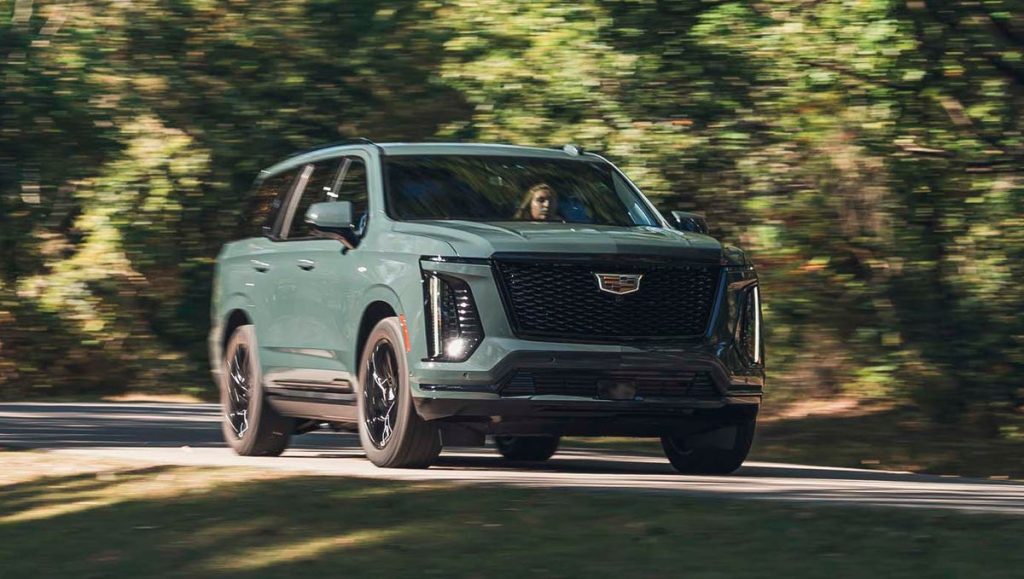
The Escalade’s Super Cruise hands-free driving system adds an unexpected wrinkle too. Its sensors and cameras require periodic calibration checks that sometimes get bundled into the same service visit as an oil change.
While this isn’t strictly tied to the oil reset itself, it reinforces a broader pattern. Cadillac increasingly bundles software-dependent features into routine maintenance visits, making a simple trip to swap oil and a filter feel more like a full diagnostic checkup.
For an SUV that competes with the Range Rover and the Escalade’s German rivals on luxury and technology, this growing service complexity tracks with where the segment as a whole is heading.
Buyers accustomed to simpler domestic trucks may find the shift toward software-gated maintenance the most surprising part of Escalade ownership.
Specifications:
- Engine: 6.2L V8, Dynamic Fuel Management
- Horsepower: 420 hp
- Torque: 460 lb-ft
- Length: 211.9 in (5,382 mm)
- Width: 93.7 in (with mirrors extended)
9. Jeep Grand Cherokee
The Grand Cherokee’s diagnostic ecosystem runs through Stellantis’s wiTech platform, the successor to Chrysler’s older diagnostic tools. Basic oil life resets can often be performed through the vehicle’s Uconnect menu without special equipment.
But that changes on more heavily optioned trims and hybrid variants where the reset logic ties into broader powertrain modules. The newly introduced Hurricane 4 Turbo engine option for the current model year adds complexity.
It has different oil specifications and service intervals compared to the long-running Pentastar V6. Guidance quoted by an FCA-focused vdiagtool source specifically flags FCA models as sometimes needing a scanner with special authorization.
That’s a nod to the encrypted access some newer Stellantis vehicles require. This makes the Grand Cherokee a middle-ground case. Simple resets are usually accessible, but full service record synchronization, especially on turbocharged and off-road Trailhawk variants, increasingly leans on dealer-grade tools.

Stellantis has been rolling out enhanced security gateways across its Jeep, Ram, and Dodge lineups in stages. Some model years and trims are affected before others.
This creates an inconsistent experience even within the Grand Cherokee’s own lineup. A Laredo X with the older Pentastar V6 might reset cleanly with a basic scanner.
A Summit trim running the newer Hurricane engine and additional driver-assist hardware might not. This staggered rollout mirrors what other manufacturers have done, tightening access gradually rather than all at once.
For owners, the practical advice is to check compatibility for the specific model year and trim before assuming a generic Jeep-branded scan tool will fully handle the job. What worked on a 2022 model may not carry over cleanly to a 2026 Grand Cherokee with the new engine option.
Specifications:
- Engine: 2.0L Hurricane turbocharged inline-4
- Horsepower: 324 hp
- Torque: 332 lb-ft
- Length: 193.5 in (4,915 mm)
- Width: 77.6 in (1,971 mm)
10. Jaguar F-Pace
Like its Range Rover Sport cousin, the F-Pace runs on Jaguar Land Rover’s shared diagnostic backbone, now centered on the JLR Pathfinder platform. The F-Pace’s service reset covers oil condition, brake wear, and, on six-cylinder mild-hybrid models, battery system checks.
Dashboard-level clears exist, but as with other JLR products. They frequently fail to fully update the deeper service record that dealers and Jaguar’s approved-used program reference.
This matters more on the F-Pace than it might on a simpler crossover. Jaguar has positioned the SVR variant with its supercharged V8 as a genuine performance flagship.
That means its service tracking, and the software gatekeeping around it, mirrors the complexity of a genuine sports SUV rather than a basic family crossover. Owners of six-cylinder and SVR trims in particular report the most friction when trying to avoid dealer visits for routine maintenance resets.

Jaguar’s smaller dealer network compared to mainstream brands compounds this issue. Fewer independent shops specialize in Jaguar-specific diagnostic work.
That’s simply because the customer base is smaller and the required software licensing is expensive relative to the volume of cars serviced. This scarcity pushes even routine oil resets toward official dealers more than it might for a higher-volume brand with a broader independent repair ecosystem.
Combined with JLR’s shared Pathfinder platform architecture, already noted in the Range Rover Sport section above, the F-Pace represents one of the clearer examples on this list.
Genuine service lock-in stems as much from limited market infrastructure as from the software itself, a reminder that scale and dealer network size matter just as much as the diagnostic technology in determining how easy or difficult independent maintenance really is.
Specifications:
- Engine: 3.0L turbocharged inline-6, mild-hybrid
- Horsepower: 395 hp
- Torque: 406 lb-ft
- Length: 186.8 in (4,745 mm)
- Width: 85.6 in (with mirrors) / 76.2 in (body)
