
Modern cars feel more secure than ever. Keyless entry, push-button start, and factory immobilizers all sound like serious protection. But there’s a gap most owners never hear about. That gap is the relay attack.
A relay attack doesn’t break your car’s security. It simply borrows it. Thieves use two small devices to stretch the invisible signal between your key fob and your car. One sits near your key, often just outside your front door.
The other sits next to your car. The car thinks the key is close. The key thinks the car is close. Neither one is telling the truth. Your factory immobilizer was built to stop a specific problem: starting a car without any key at all.
It was never built to question whether the key it detects is actually nearby. That’s the core issue. It’s why factory immobilizers, however advanced they sound, keep failing against this one attack. Insurance data and police reports across multiple countries keep pointing to the same trend.
Keyless theft, largely driven by relay attacks, has climbed sharply over the last several years. Owners often discover their car is gone with no broken glass and no forced entry.
That absence of damage confuses a lot of people at first. It shouldn’t, because nothing was actually broken into. The car simply did what it was designed to do. It let in a signal it believed was genuine.
Below are seven reasons why factory immobilizers keep failing against this one specific attack. Each one exposes a different blind spot baked into the design.
None of these reasons point to a single mistake by one manufacturer. Together, they describe an industry-wide pattern that’s taken years to fully surface.
Understanding each one helps explain why the problem hasn’t simply been fixed already. It also helps owners decide what extra protection is genuinely worth adding.
1. It Checks for a Valid Signal, Not a Valid Distance
The immobilizer’s job is simple. It wants to know if the correct key is present, nothing more. It sends a low-frequency signal from the car. This signal has a short natural range, usually just a few feet.
Your key fob hears it and responds automatically. It sends back an encrypted code proving it’s the right key. The immobilizer checks that code. If it matches, the car unlocks and starts.
Nowhere in that process does the system measure how far away the key really is. It just assumes short signal range makes distance irrelevant. That assumption used to be safe. A relay attack breaks it completely.
Thieves capture the signal and relay it over long distances. The car’s challenge gets carried out wherever the key is sitting, and the key’s response gets carried right back.
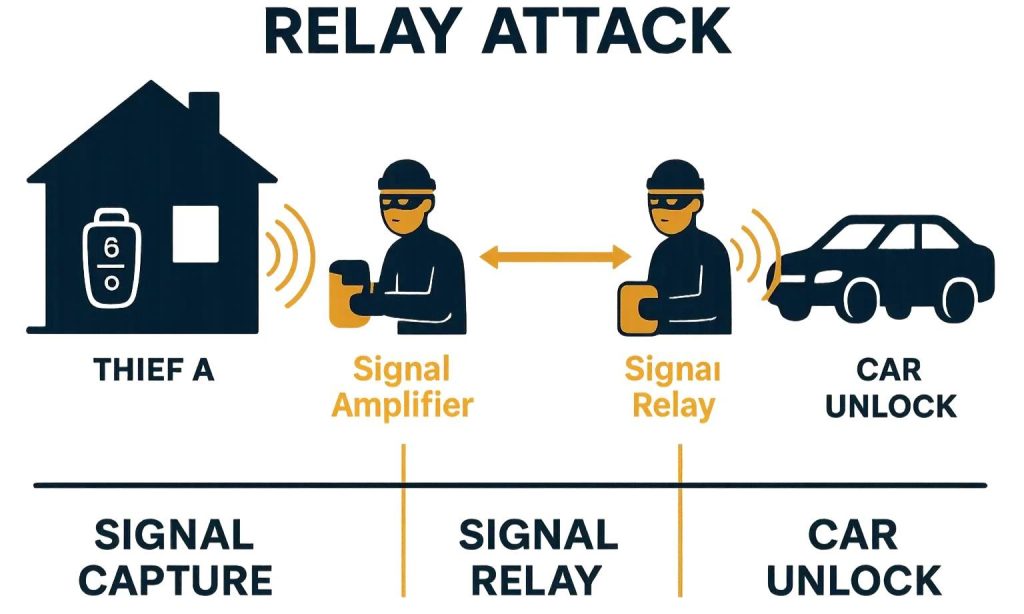
Distance becomes meaningless once you’re relaying electronically. The immobilizer has no way to detect this manipulation. It was designed around one false assumption: short range equals a nearby key. That assumption is exactly what relay attacks exploit.
Thieves are not necessarily defeating the vehicle’s security system. They are finding ways to extend its reach. That distinction explains why security experts increasingly view immobilizers as only part of the solution. An immobilizer can confirm that a valid key or signal is present, but effective anti-theft protection also needs to determine whether that authorized signal is actually nearby.
Factory systems only handle the first part. The second is where relay attacks slip through completely undetected. Think about how a bouncer checks IDs at a door. They confirm the ID is real, but they rarely confirm the person standing there is the one pictured from a distance.
An immobilizer works the same way. It checks the credential, not the context around it. That gap might sound small. In practice, it’s the entire opening thieves need. Once the credential checks out, the car has no further questions. It simply proceeds.
This is precisely why relay attacks feel almost invisible to victims. Nothing looks broken, nothing looks forced, and no alarm ever sounds. The car isn’t malfunctioning during the theft. It’s behaving exactly as its engineers intended, just against the wrong audience.
2. The Encryption Is Strong, But It Answers the Wrong Question
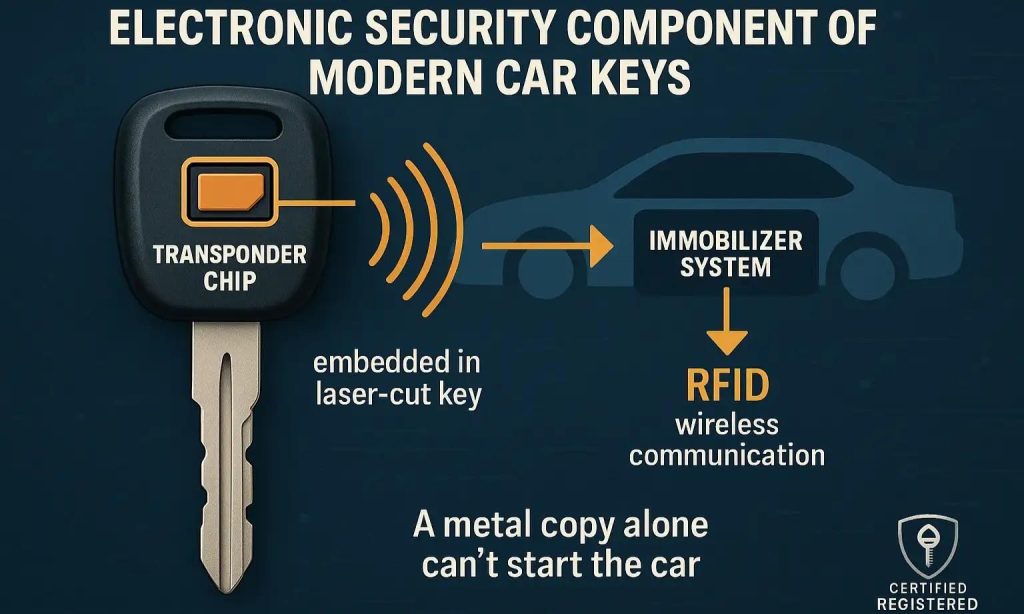
People assume strong encryption means strong security. With relay attacks, that logic falls apart. Modern immobilizer chips use serious cryptography. Rolling codes and challenge-response systems make key cloning extremely difficult.
You genuinely cannot fake a valid response without the real key. But relay attacks don’t fake anything. They pass the real response through, unchanged.
Think of it as a locked door with an excellent lock. Nobody can pick it. A relay attack doesn’t pick the lock. It hands you the real key through a very long tube. The encryption authenticates the message perfectly. It just never checks where that message originated.
Cryptographic security answers “is this the correct key.” It never answers “is this key actually near the car.” Those are two separate questions entirely. Factory immobilizers were engineered to solve only the first one.
Engineers built these systems before relay hardware was cheap and accessible. Physical proximity was assumed to be guaranteed by radio range alone.
Nobody predicted a market of affordable signal amplifiers. Nobody planned for relay kits sold openly for research purposes. The math behind the encryption hasn’t failed. The physical assumption underneath it has.
This explains why manufacturers can’t just patch this with better encryption. Better encryption solves cloning, not relaying. Until the system verifies real-world distance, even the strongest encryption stays fully exploitable. Relay attacks don’t argue with your locks, they just make the lock think you’re standing right there.
It helps to separate two ideas that often get blurred together. Confidentiality means nobody else can read the message. Authenticity means the message really came from your key. Proximity means the key is physically close right now.
Factory immobilizers nail the first two ideas almost perfectly. The third one, proximity, was simply never part of the original design brief. That missing piece is exactly what a relay device is built to exploit.
3. Passive Keyless Systems Were Designed for Convenience First
Passive keyless entry exists for one reason: convenience. Manufacturers wanted owners to unlock and start cars without touching a button. Keep the fob in your pocket, walk up, and go. This is genuinely great for everyday driving.
But convenience-first design comes with tradeoffs. Security researchers have flagged this repeatedly over the years. Every added security step reduces convenience slightly. Distance checks and extra authentication steps slow the process down.
Manufacturers were reluctant to add friction to a feature built entirely around removing it. So systems were tuned to respond quickly and automatically. Speed was prioritized over verifying real proximity. That tradeoff made sense two decades ago, when relay hardware barely existed.
Today, that same tradeoff is a liability. Relay attack kits are cheap and simple to build now. Passive entry keeps working exactly as designed. It responds instantly to any valid signal, real or relayed.
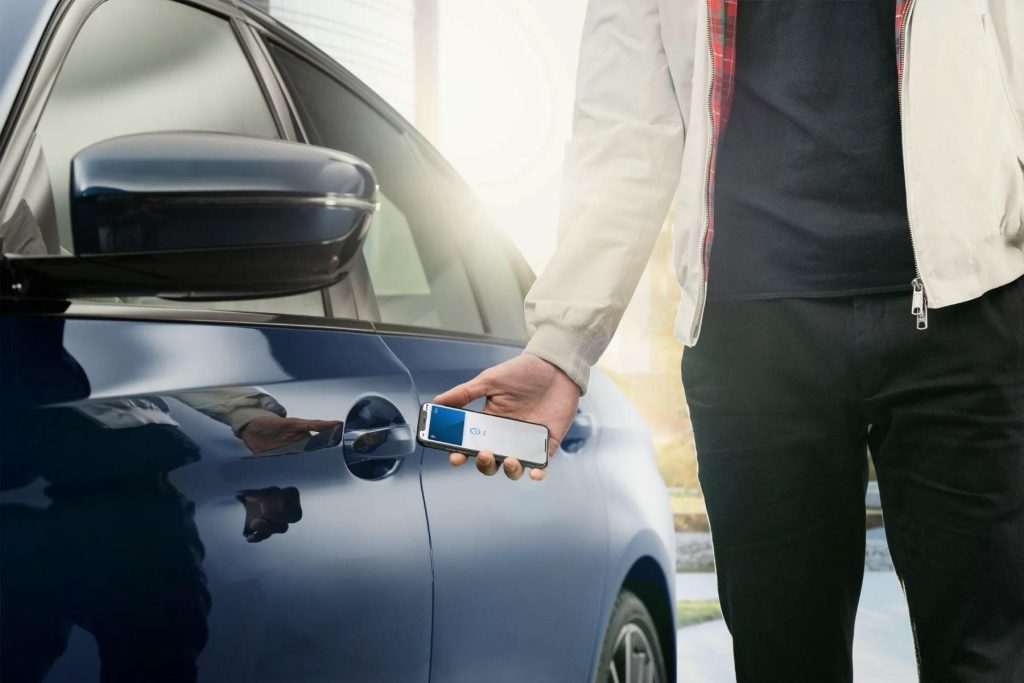
The system cannot tell the difference between a key sitting in your pocket and its signal reaching the vehicle from 30 meters away through a wall. The problem is not simply how the system was implemented. The vulnerability stems from the way its security priorities were originally designed.
Car makers built for a threat model from decades past. That threat model has clearly moved on. Passive convenience and relay resistance sit in direct tension. Most factory systems still lean firmly toward convenience.
That’s a business decision as much as a technical one. It’s exactly why relay theft remains common across nearly every keyless-equipped brand. Owner surveys consistently show people love the feature once they have it. Very few would willingly trade it back for a traditional metal key.
That popularity gives manufacturers little incentive to slow the system down. Adding friction risks upsetting the exact feature customers rate most highly. So the underlying tradeoff quietly persists, model year after model year. Convenience keeps winning, and the security gap keeps riding along with it.
4. There’s No Distance-Bounding Protocol in Most Factory Systems
Distance bounding is the real fix for relay attacks. Almost no factory immobilizer uses it properly yet. Here’s the idea in simple terms. The car measures how long a signal takes to travel to the key and back.
Radio signals move at a known, fixed speed. That timing can reveal real physical distance with precision. If the round-trip time is too long, the system can flag it. A relay attack always adds extra delay, even if it’s small.
Some newer vehicles have started implementing versions of this. Ultra-wideband technology offers a promising path toward accurate distance measurement.
But adoption has been slow and inconsistent. Many manufacturers still rely on older, simpler proximity assumptions. Even brands with newer hardware haven’t always activated full protection. Some vehicles with capable chips still default to older, more vulnerable communication methods for actual unlocking.
The hardware exists in some cases. Full protection doesn’t always follow it. This gap between “capable” and “actually protected” matters. Owners often assume newer means safer, but that isn’t always accurate.
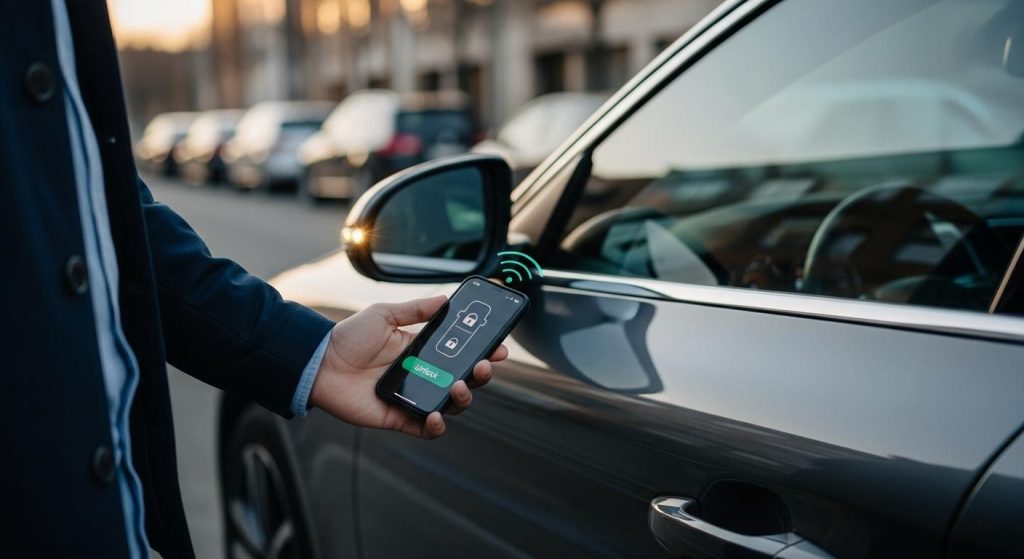
A car can have modern components while still running vulnerable logic underneath. Distance bounding requires precise timing and rigorous testing. It’s genuinely harder to implement than simple signal detection. That difficulty explains why manufacturers have been slow to roll it out widely.
Retrofitting existing platforms is expensive and complicated. Until distance bounding becomes standard industry-wide, this gap stays open, and relay attacks keep working exactly as they do now.
Standards bodies have started publishing guidance on this exact topic. Recommendations exist, but recommendations aren’t the same as requirements.
Without a firm mandate, adoption timelines stay flexible for manufacturers. Some will move quickly, while others wait for competitors to absorb the cost first. That hesitation leaves a wide window open for thieves. Every year without a mandate is another year of vehicles rolling off the line unprotected.
Also Read: 11 Cars With Ultra Wideband Keys That Refuse a Relay
5. The System Trusts the CAN Bus Once Authentication Passes
Once your immobilizer accepts the key’s response, something important happens. The system essentially stops questioning anything further. The vehicle’s internal network, the CAN bus, receives a “valid key” signal. From that point, doors unlock, and the engine can start.
This is a trust-based design. Authentication happens once, right at the beginning. There’s no continuous re-checking during unlock and start. The car never asks “are you still really there” a second time.
Relay attacks exploit this single-checkpoint structure perfectly. They only need to fool the system once, at that first moment. After the initial handshake succeeds, the car behaves normally. Doors open, the ignition engages, and the thief drives away.
This differs from how banking authentication often works. Multiple checkpoints and re-verifications are common in financial systems. Vehicle immobilizers weren’t built with that layered mindset. One successful handshake grants full access.
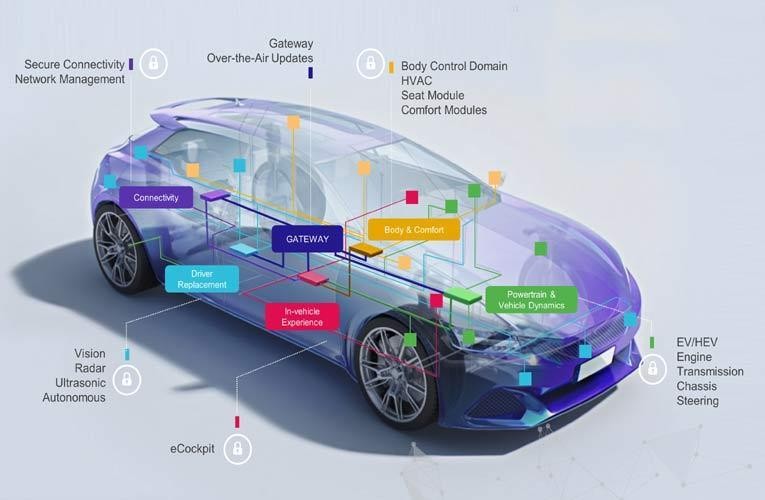
Some newer systems have added partial mitigations, like motion sensors inside the fob. If the key hasn’t moved recently, some cars will refuse to respond. But this is a partial fix, not a complete solution. Not all keys include motion sensors, and adoption remains inconsistent.
The core architecture stays the same across most vehicles. Authenticate once, then trust completely afterward. Relay attacks don’t need to defeat ongoing security. They just need one clean handshake at the very start, and that single point of failure is baked deeply into the design.
Redesigning this into a continuous-verification model isn’t trivial either. It would require constant communication between key and car throughout the entire drive. That level of chatter drains battery life in the fob much faster.
Engineers have to balance security against practical things like battery longevity too. So the industry has largely stuck with the one-time handshake model. It’s simpler, cheaper, and easier on the hardware, even though it’s also easier to exploit.
6. There’s No Secondary Authentication Factor by Default
Think about logging into your bank account online. Password first, then often a text code or app confirmation. That’s two-factor authentication. It exists because a single factor can be stolen or faked.
Most factory car immobilizers still rely on a single factor. Possession of the key fob signal, nothing more. There’s no PIN entry required. No button sequence, no secondary confirmation, nothing beyond that one radio signal.
This matches how these systems were designed decades ago. Single-factor authentication felt sufficient when spoofing hardware was inaccessible. Relay attacks essentially steal that single factor temporarily. There’s no PIN to steal because there isn’t one to begin with.
Some aftermarket security systems have filled this gap. Devices requiring a hidden button sequence before the car will drive add exactly this missing second factor.
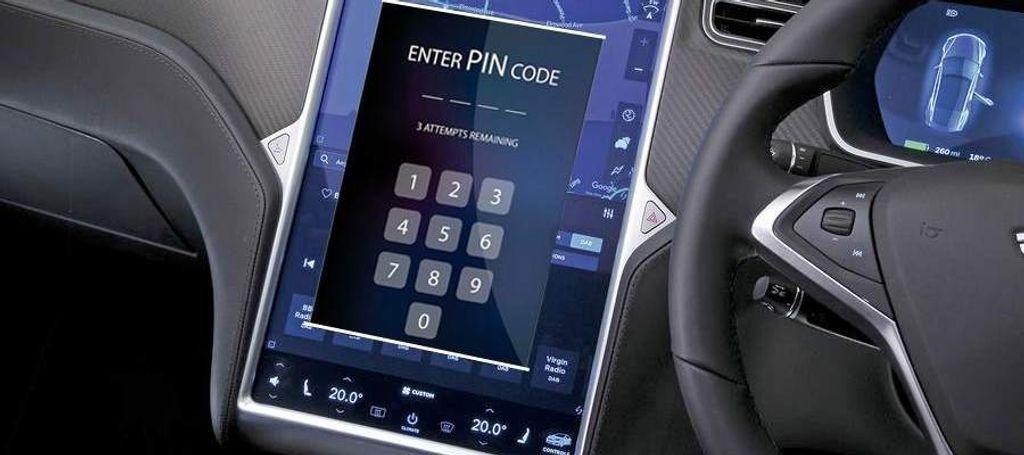
A few manufacturers have taken a similar approach with features that require a PIN before driving. It’s a meaningful extra layer many owners never enable. These solutions remain optional add-ons though. They’re rarely built into factory immobilizer systems by default.
The absence of a required second factor is arguably the biggest structural weakness here. Everything else stems from this one decision. If a car required something the driver knows, not just something the key broadcasts, relay attacks would stop working. The stolen signal alone wouldn’t be enough anymore.
Until this becomes a factory standard rather than an aftermarket option, this gap stays wide open. Owners are left to add this protection themselves. It’s worth noting why manufacturers hesitate here too. A required PIN adds a visible step every single owner will notice immediately.
That kind of friction tends to generate complaints fast. Car buyers rarely enjoy extra steps between them and driving away. Balancing that friction against theft prevention is a genuine design challenge. So far, most manufacturers have chosen to leave the choice with the customer instead.
7. Manufacturers Prioritize Backward Compatibility Over Redesign
This last reason is less technical and more structural. It’s about how the auto industry actually operates. Car platforms are expensive to design. Manufacturers reuse core electronic architectures across many models and years.
A security redesign at the immobilizer level isn’t a small patch. It touches key fobs, onboard chips, software, and manufacturing all at once. Changing this system means redesigning components across an entire lineup. That’s a massive, costly undertaking.
Manufacturers also have to consider existing customers. Millions of cars already on the road can’t easily receive a hardware-level upgrade. Software updates help at the margins sometimes. But the fundamental radio-based trust model is baked into physical components, not just code.
This creates a slow-moving industry problem. Everyone acknowledges the vulnerability, yet redesigns take years to reach the market. Regulatory pressure has also been limited in many regions. Without strong mandates, upgrading security isn’t always treated as urgent.
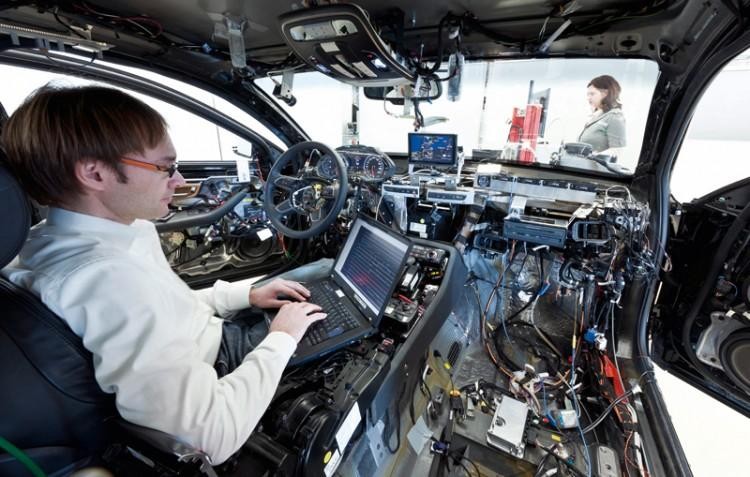
Meanwhile, relay attack hardware keeps getting cheaper and more available. The gap between attacker capability and factory defense keeps widening.
Some premium brands have moved faster than others. Ultra-wideband adoption and PIN-to-drive features are appearing, but unevenly across the market.
Budget and mid-range vehicles often lag furthest behind. These cars remain the most exposed to this specific theft method. Until distance-bounding and secondary authentication become baseline standards, this issue will persist. Not a flaw in one brand, but a pattern across the whole industry.
That’s the uncomfortable truth behind relay theft. It isn’t a defect so much as a two-decade-old design choice the industry hasn’t fully outgrown yet.
For owners, understanding this matters more than waiting on manufacturers. Faraday pouches, steering locks, and aftermarket immobilizers all help close the gap today.
None of them require a factory redesign to work. They simply add the layer of proximity and intent verification that factory systems still lack. Until the industry catches up, that extra layer remains the most reliable protection available. It’s a practical answer to a problem that’s been known for years.
Also Read: 8 Car Brands Blocked From US Showrooms by One Federal Rule
