
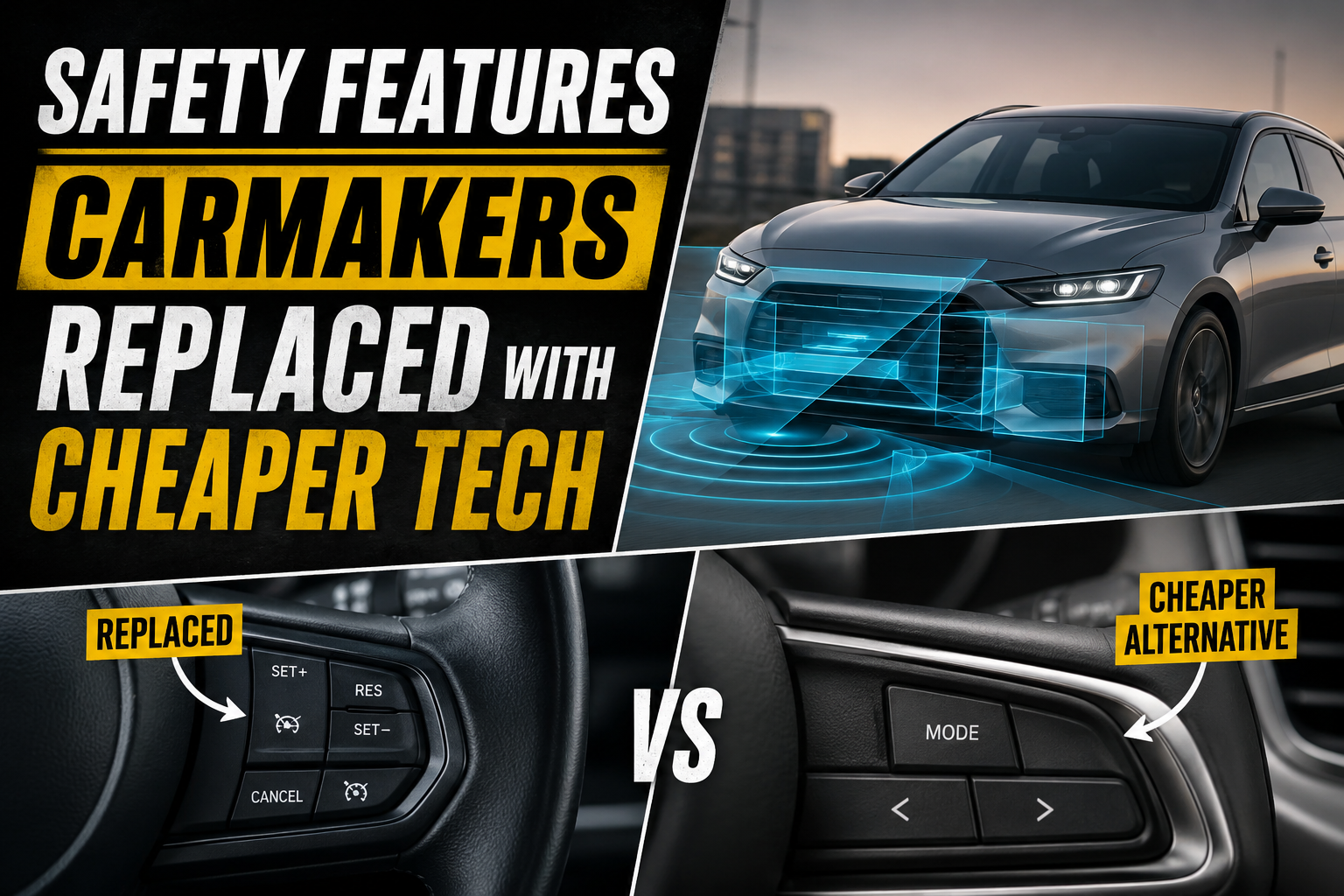
Safety technology has become a major selling point in modern vehicles, with manufacturers equipping their models with a wide range of advanced driver-assistance features. Systems such as automatic emergency braking, lane-keeping assist, blind-spot monitoring, and driver attention monitoring are now commonly promoted in marketing campaigns and dealership materials as tools designed to enhance safety on the road.
On the surface, it appears that automotive safety is advancing at a remarkable pace. Yet beneath the marketing language, many long-standing safety technologies have quietly disappeared from newer vehicles, replaced by alternatives that often cost manufacturers less to install and maintain.
For decades, automakers invested heavily in mechanical and hardware-based safety solutions. These systems were typically expensive to engineer but offered dependable performance under a wide range of conditions.
As vehicles became increasingly digital, manufacturers discovered that cameras, software algorithms, and centralized computing systems could perform many of the same functions while reducing production costs.
The result has been a gradual shift away from certain proven technologies toward cheaper electronic substitutes.
This transition is not always negative. In many situations, modern systems provide benefits that older technologies could never match. Cameras can monitor multiple areas around a vehicle simultaneously, while software updates can improve performance without replacing physical components.
However, cost reduction often plays a significant role in these decisions. When a camera can replace several sensors or a software feature can eliminate a dedicated piece of hardware, manufacturers frequently choose the less expensive route.
Consumers may not notice these changes immediately because the replacement technologies are usually marketed as upgrades rather than cost-saving measures.
Yet some drivers have discovered that newer systems can be more sensitive to weather conditions, dirt, glare, or software limitations than the hardware they replaced.
The following examples highlight safety features that were once common in many vehicles but have increasingly been substituted with lower-cost technologies.
While these replacements often bring new capabilities, they also reveal how the pursuit of efficiency and lower manufacturing expenses continues to shape the modern automobile.
Also Read: 10 Cars Easiest to Parallel Park in New York City
1. Hydraulic Power Steering Replaced by Electric Power Steering
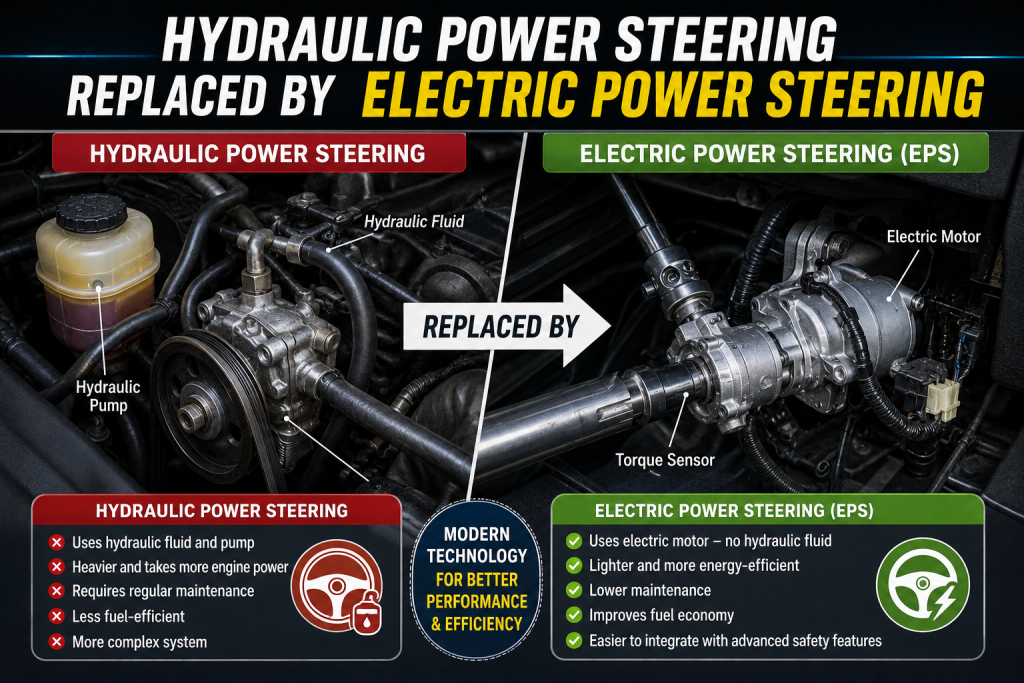
For much of automotive history, hydraulic power steering was considered the benchmark for steering precision and reliability. The system relied on a hydraulic pump driven by the engine, pressurized fluid, hoses, and valves that assisted the driver when turning the wheel. It was robust, predictable, and provided natural feedback from the road surface.
As fuel economy regulations became stricter, automakers searched for ways to reduce mechanical drag on engines. Hydraulic steering systems continuously consumed energy because the pump operates whenever the engine is running.
Electric power steering emerged as a solution. Instead of hydraulic pressure, an electric motor provides steering assistance only when needed.
The benefits for manufacturers were significant. Electric systems require fewer components, reduce assembly complexity, eliminate hydraulic fluid, and lower maintenance requirements. They also make it easier to integrate advanced driver assistance features such as lane-centering and automated parking systems.
Drivers, however, noticed a tradeoff. Early electric steering systems often lacked the detailed road feel that enthusiasts appreciated in hydraulic setups. While modern versions have improved considerably, many still feel more artificial than their hydraulic predecessors.
Another consideration is durability under demanding conditions. Hydraulic systems could often tolerate extreme temperatures and heavy use for long periods. Electric steering systems depend heavily on sensors, control modules, and software. When failures occur, diagnosis and repair can become more complicated.
From a manufacturing perspective, the move was logical. Electric steering reduces costs, improves fuel efficiency, and supports modern safety technologies. Yet it remains one of the clearest examples of a traditional hardware-based system being replaced by a cheaper electronic alternative.
2. Radar-Based Blind Spot Detection Replaced by Camera-Dependent Systems
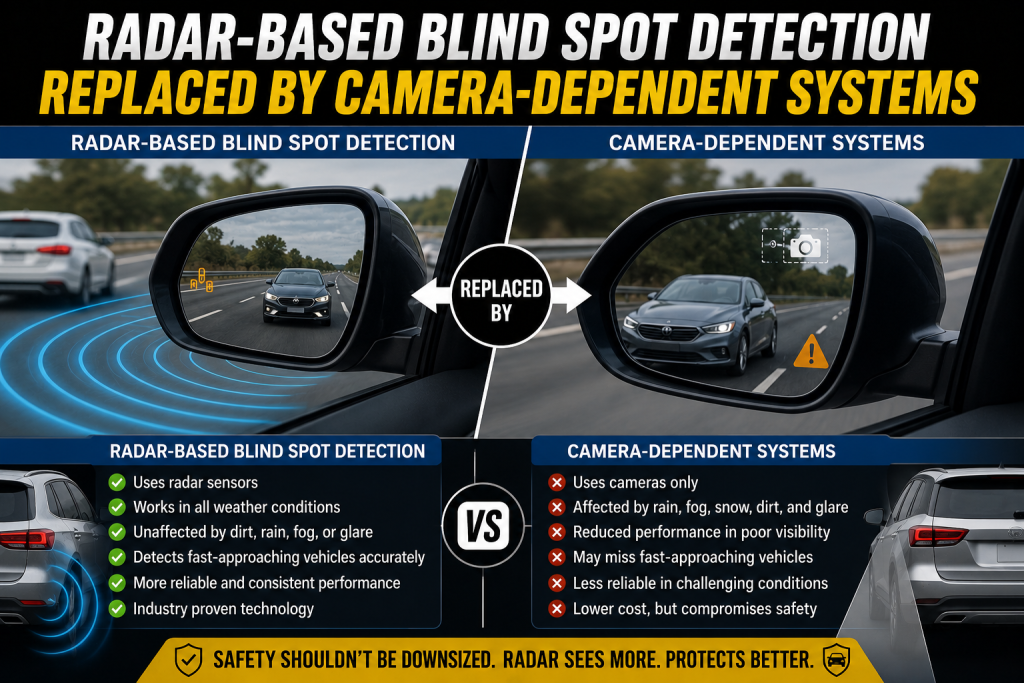
Blind spot monitoring became one of the most appreciated safety innovations of the last two decades. Early systems often relied on dedicated radar sensors mounted in the rear corners of a vehicle. These sensors continuously scanned adjacent lanes and could detect approaching vehicles even in darkness, rain, or fog.
Radar technology offered excellent reliability because it was less affected by lighting conditions. Vehicles approaching from behind could be identified quickly, providing drivers with consistent warnings before lane changes.
As cameras became cheaper and computing power increased, some manufacturers began reducing their reliance on radar hardware. Instead, they integrated blind-spot functionality into camera-based monitoring systems. A single camera can support multiple driver assistance features, reducing the number of separate components required.
The financial appeal is obvious. Cameras cost less than multiple radar modules and can perform several functions simultaneously. A manufacturer can use the same hardware for lane assistance, traffic sign recognition, pedestrian detection, and blind-spot monitoring.
The downside emerges in difficult environments. Cameras can struggle when lenses become dirty or when sunlight creates glare. Heavy rain, snow, and dense fog can also affect performance. Radar systems generally maintain effectiveness in conditions that challenge optical sensors.
Many newer vehicles still combine radar and cameras for maximum effectiveness, but the industry trend toward camera-heavy solutions reflects a broader effort to reduce hardware expenses while maintaining feature lists that appeal to buyers.
Consumers rarely see the engineering decisions behind these systems. They simply see a familiar safety feature on the window sticker. Yet the technology supporting that feature may be substantially different from what was used a decade ago.
3. Dedicated Parking Sensors Replaced by Wide-Angle Camera Software
Not long ago, parking assistance relied heavily on ultrasonic sensors embedded in the front and rear bumpers. These sensors emitted sound waves that bounced off nearby objects, allowing the vehicle to calculate distance accurately.
Drivers became familiar with the increasingly rapid warning beeps that indicated how close they were to another vehicle, a wall, or a curb.
The technology earned a strong reputation because it performed a single task exceptionally well. Ultrasonic sensors could detect obstacles regardless of lighting conditions and often worked effectively in spaces where visibility was limited. Whether parking in a dark garage or maneuvering through a crowded lot at night, the system provided consistent feedback.
As camera technology improved, manufacturers began shifting toward software-driven parking assistance. A single wide-angle camera can now provide a detailed image of the vehicle’s surroundings, while computer algorithms estimate distances and identify potential hazards.
Since many vehicles already require cameras for backup visibility and driver-assistance systems, adding parking functionality through software is considerably cheaper than installing multiple dedicated sensors.
From a manufacturing standpoint, this approach reduces component counts, wiring complexity, and assembly costs. It also allows automakers to advertise advanced features such as 360-degree views and automated parking aids without adding as much hardware.
Yet there are situations where software-based systems reveal their limitations. Camera lenses can become obscured by mud, snow, rain, or dust. Bright sunlight can create glare, while darkness can reduce image clarity despite modern enhancements. Ultrasonic sensors, although not perfect, were often less affected by these visual challenges.
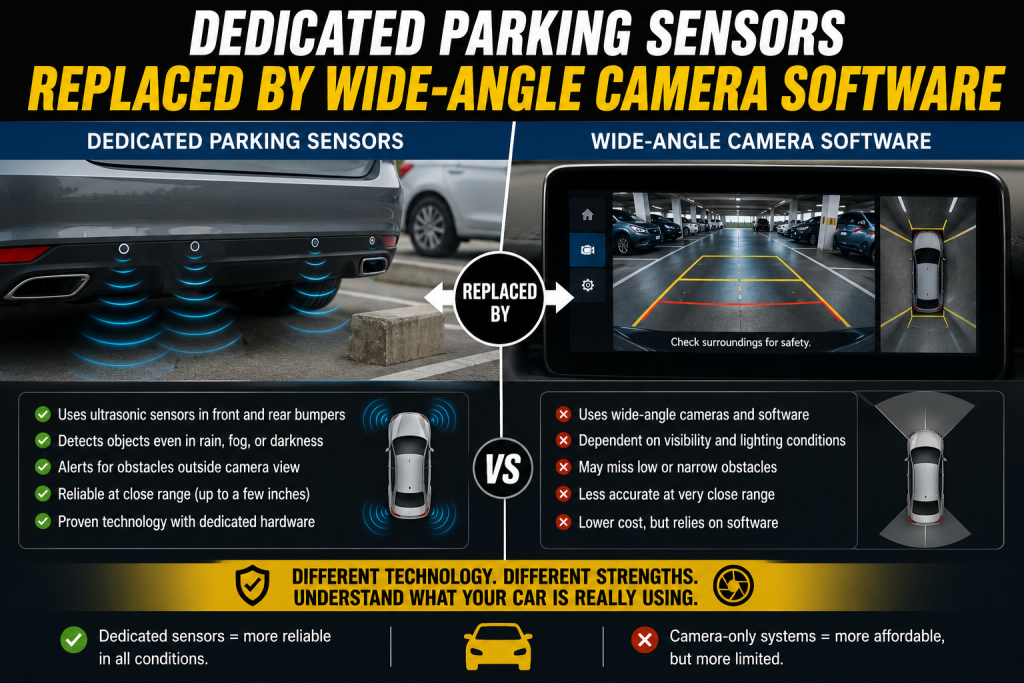
Another concern involves the accuracy of distance estimation. Dedicated sensors directly measure proximity, whereas camera systems rely heavily on image processing. Improvements in computing power have narrowed the gap, but some drivers still find traditional sensor alerts more reassuring in tight spaces.
The change illustrates a growing industry philosophy: use one piece of hardware for as many functions as possible. Cameras now serve multiple roles that once required separate components.
While that strategy lowers costs and simplifies manufacturing, it also demonstrates how specialized safety equipment is increasingly being replaced by software-driven alternatives.
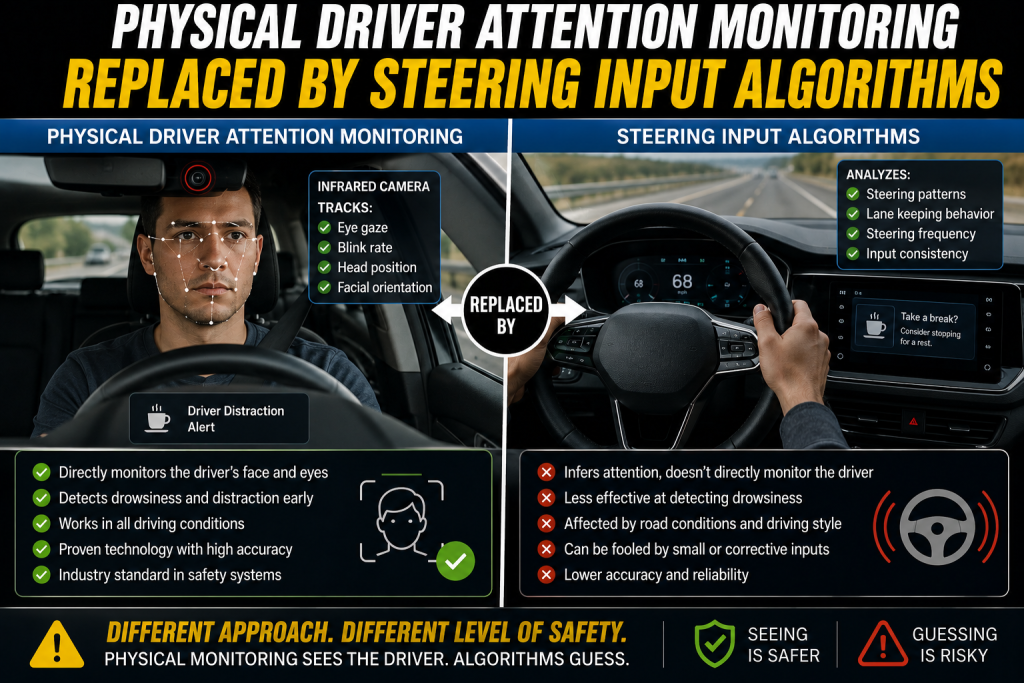
4. Physical Driver Attention Monitoring Replaced by Steering Input Algorithms
Fatigue has long been recognized as a major contributor to traffic accidents. To address this issue, some premium vehicles introduced sophisticated driver-monitoring systems that used infrared cameras to track eye movement, blinking frequency, head position, and full attentiveness.
These systems could determine with remarkable accuracy whether a driver was becoming distracted or drowsy. Although highly effective, such hardware was expensive. Infrared cameras, dedicated processors, and supporting electronics added cost to every vehicle equipped with the technology.
As manufacturers looked for ways to offer driver-attention features across larger portions of their lineups, many adopted a less costly alternative.
Instead of directly observing the driver, the software analyzes steering behavior. The system monitors subtle corrections, lane positioning, and driving patterns. If it detects irregular movements associated with fatigue, it issues a warning suggesting a break.
This approach requires little additional hardware because it relies largely on sensors already present in vehicles equipped with electronic steering and lane-assistance systems. For manufacturers, the savings can be substantial.
A software-based solution can be deployed across multiple models with minimal investment compared to installing dedicated monitoring equipment.
The distinction becomes apparent when comparing capability. A camera-based system can identify a driver looking away from the road, closing their eyes, or becoming distracted by a phone. Steering-based systems infer behavior indirectly. If a driver maintains steady steering despite being inattentive, the software may have less information available to assess risk.
There are also differences in response time. Direct observation can identify distraction almost immediately, while steering-analysis systems often require a pattern to develop before issuing a warning.
The growing reliance on software analytics reflects a larger shift within the automotive industry. Rather than adding expensive hardware, manufacturers increasingly seek ways to repurpose existing sensors for multiple safety functions.
The result is broader feature availability, though sometimes with reduced precision compared to the technologies that came before.
5. Mechanical Rearview Mirrors Enhanced by Optical Systems Replaced With Camera Displays
For generations, the rearview mirror represented one of the simplest and most dependable safety devices in any automobile. A driver only needed a glance to understand what was happening behind the vehicle.
Over time, automakers refined the design with auto-dimming technology, wider fields of view, and improved glass quality, but the basic concept remained unchanged because it worked exceptionally well.
In recent years, however, a growing number of manufacturers have begun replacing or supplementing traditional mirrors with camera-based rear vision systems. Instead of relying entirely on reflected light through the rear window, a camera mounted outside the vehicle sends a live video feed to a display integrated into the mirror housing.
The transition has been promoted as a safety improvement. Camera systems can provide a broader field of vision, eliminating some blind spots that conventional mirrors cannot cover.
They can also remain effective when passengers, cargo, or large headrests obstruct the driver’s rearward view. For families carrying luggage during vacations or owners using their vehicles for work, this capability can be genuinely beneficial.
There is another motivation behind the change that receives less attention. Camera systems can be integrated into a vehicle’s existing electronics architecture, allowing one piece of hardware to support several functions.
The same cameras used for parking assistance, surround-view displays, and driver-assistance features can contribute data to rear visibility systems. This consolidation reduces the need for multiple dedicated components.
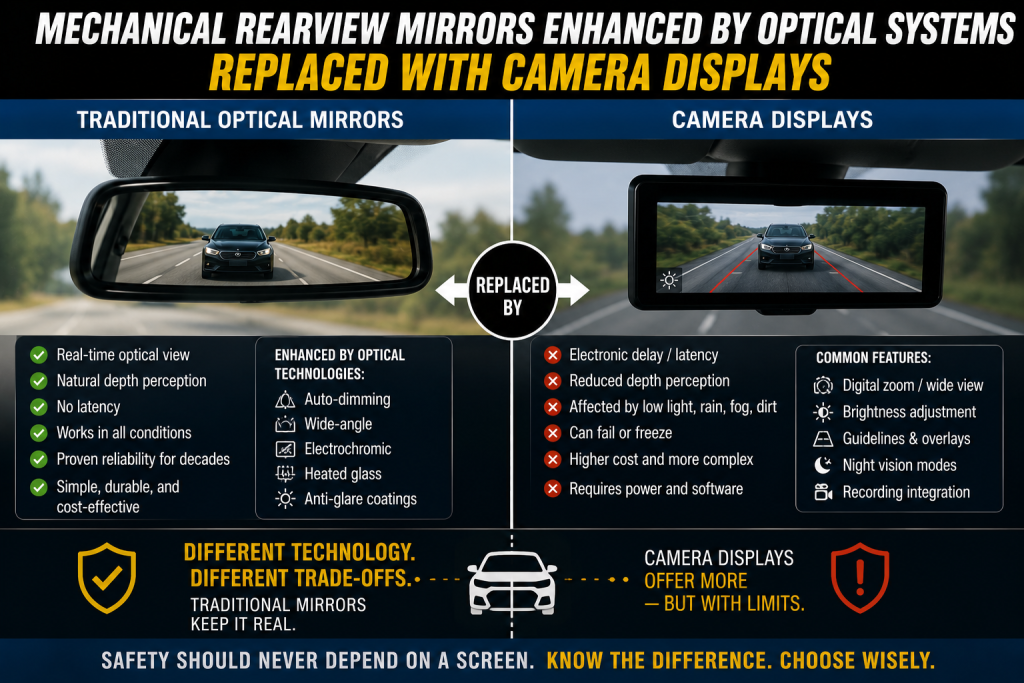
Yet the shift introduces challenges that traditional mirrors never faced. A conventional mirror functions without software, processors, image rendering, or electronic displays. Camera systems depend on all of those elements working correctly.
If a lens becomes dirty, covered with snow, or obscured by water droplets, image quality can deteriorate rapidly.
Some drivers also report difficulty adapting to digital displays because depth perception differs from what they experience with a reflective mirror. Human eyes have spent decades learning how to judge distance through mirrors, while screens present information differently.
Low-light performance can vary as well. Modern sensors have become remarkably capable, but glare from headlights or sudden changes in lighting can occasionally affect image clarity.
The evolution of rear visibility technology highlights a recurring trend throughout the automotive industry. Dedicated mechanical solutions are gradually giving way to multifunction electronic systems that reduce manufacturing complexity while supporting a wider range of features.
Whether that tradeoff represents progress or compromise often depends on the conditions in which the vehicle is driven.
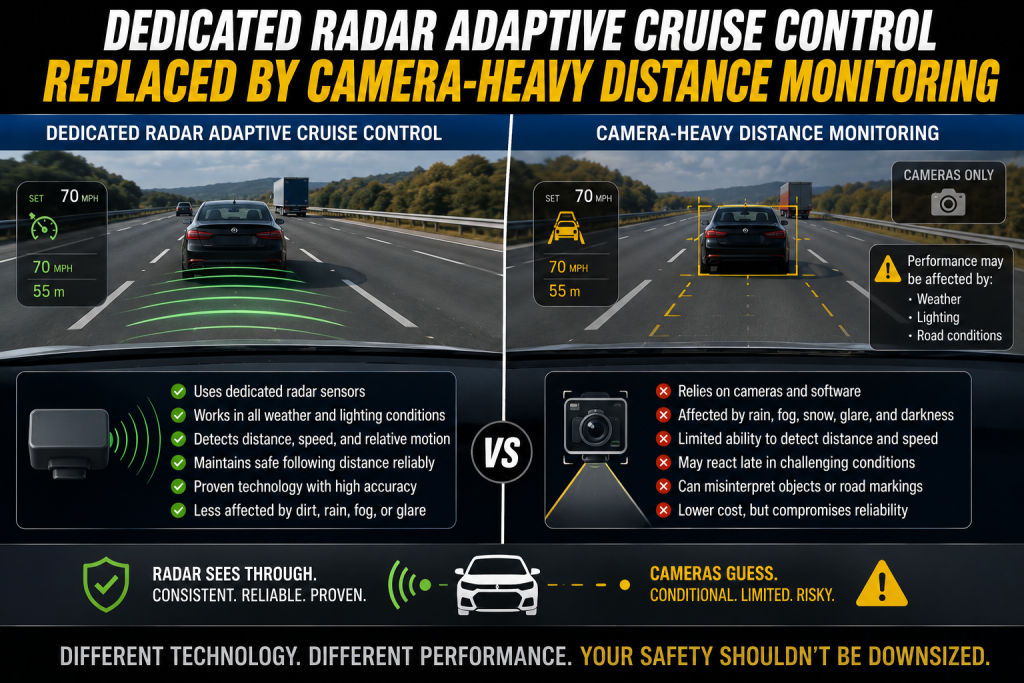
6. Dedicated Radar Adaptive Cruise Control Replaced by Camera-Heavy Distance Monitoring
Adaptive cruise control was once regarded as a premium technology reserved for luxury vehicles. Early systems relied heavily on radar units mounted behind the grille or front fascia. These sensors continuously measured the speed and distance of vehicles ahead, automatically adjusting throttle and braking inputs to maintain a safe following distance.
The strength of radar-based systems lies in their consistency. Radar waves are largely unaffected by darkness and perform well in weather conditions that challenge human vision.
A vehicle traveling on a foggy highway at night could still benefit from accurate distance measurements because radar detects objects based on reflected radio waves rather than visible light.
As driver-assistance technology spread into mainstream vehicles, manufacturers searched for ways to reduce the cost of deploying adaptive cruise control across entire model ranges. Cameras provided an attractive solution.
Since many vehicles already required forward-facing cameras for lane departure warnings, traffic sign recognition, and emergency braking systems, adding adaptive cruise capabilities through software became financially appealing.
A camera-centric setup can identify lane markings, vehicles, pedestrians, and road signs using a single hardware package. Instead of installing expensive dedicated radar modules on every model, manufacturers can leverage existing equipment and rely more heavily on image processing.
The advantages are significant from a production perspective. Fewer specialized sensors mean lower hardware expenses, simplified supply chains, and reduced assembly complexity. Software updates can also improve performance over time without requiring physical modifications.
The replacement introduces compromises that engineers must carefully manage. Cameras depend on visibility. Heavy rain, snow accumulation, direct sunlight, and dense fog can interfere with image recognition. Radar systems typically retain effectiveness in many of these conditions.
Another distinction involves object detection range. Radar can often track vehicles at substantial distances with impressive accuracy. Camera systems rely on interpreting visual information, which can become more difficult as distances increase or environmental conditions deteriorate.
Many modern vehicles address these concerns by combining radar and cameras, creating sensor-fusion systems that capitalize on the strengths of both technologies. However, cost pressures continue to encourage greater reliance on cameras wherever possible.
The move toward camera-based adaptive cruise control reflects a broader philosophy shaping vehicle development today. Manufacturers increasingly favor technologies that perform multiple functions simultaneously.
A single camera can support numerous safety systems, reducing the need for dedicated hardware. While that strategy improves affordability and expands feature availability, it also demonstrates how cost efficiency continues influencing the design of modern automotive safety systems.
7. Physical Tire Pressure Monitoring Hardware Replaced by ABS-Based Indirect Monitoring
Few safety technologies operate as quietly in the background as a tire pressure monitoring system. Drivers rarely think about it until a warning light appears on the dashboard, yet maintaining proper tire pressure plays a critical role in vehicle stability, braking performance, fuel economy, and tire longevity.
Because underinflated tires can contribute to accidents, tire pressure monitoring became mandatory in many markets and quickly evolved into a common feature across the industry.
The earliest and most accurate systems used what is known as direct monitoring. Each wheel contained a dedicated pressure sensor mounted inside the tire.
These sensors measured actual air pressure and transmitted the information wirelessly to the vehicle. Drivers could often view precise pressure readings for every tire, making it easy to identify problems before they became serious.
Direct monitoring provided dependable and highly detailed information, but it also increased manufacturing costs. Every wheel required its own sensor, battery, transmitter, and supporting electronics. Over time, those sensors could fail, batteries could expire, and replacement costs could be added to ownership expenses.
Seeking a less expensive alternative, some manufacturers adopted indirect tire pressure monitoring systems. Rather than measuring pressure directly, these systems use the wheel-speed sensors already installed for anti-lock braking and stability control functions.
When a tire loses pressure, its rolling diameter changes slightly. The system detects differences in wheel rotation speeds and concludes that one or more tires may be underinflated.
From a production standpoint, the savings are substantial. Since wheel-speed sensors already exist for other safety systems, little additional hardware is required. Software performs most of the work, reducing component costs while simplifying maintenance.
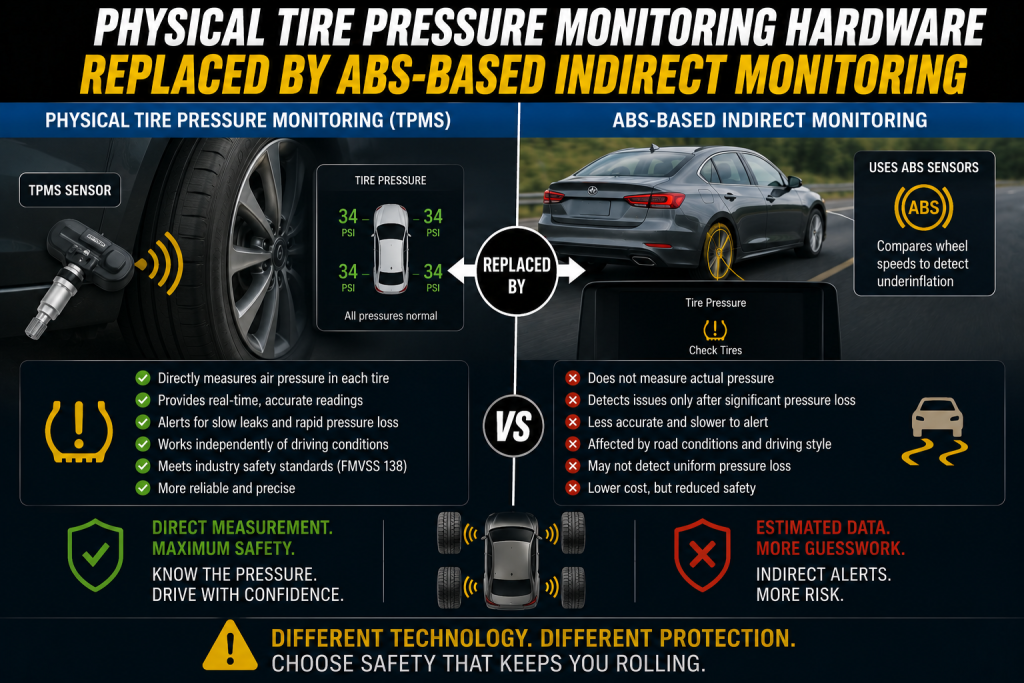
The compromise becomes apparent in accuracy and responsiveness. Direct systems provide exact pressure readings and can alert drivers to gradual losses before they become severe.
Indirect systems generally identify pressure changes only after a noticeable difference develops between wheel speeds. They often cannot indicate which tire is affected or display actual pressure values.
Another limitation appears when all four tires lose pressure at similar rates. Since the system compares one wheel to another, uniform pressure loss may be harder to detect immediately. Direct systems do not face this challenge because they monitor each tire independently.
The shift from dedicated pressure sensors to software-driven monitoring perfectly illustrates the industry’s broader movement toward multifunction technology. Existing hardware is increasingly leveraged to perform tasks that once required specialized components.
While indirect monitoring fulfills regulatory requirements and reduces costs, many drivers and technicians still regard direct monitoring as the more precise and informative solution.
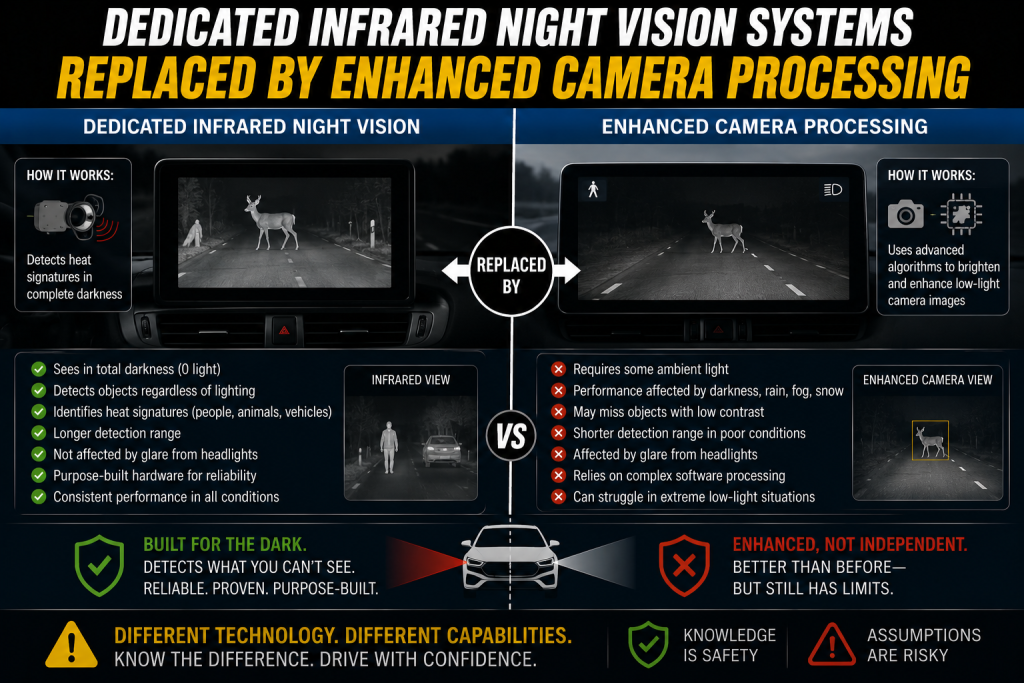
8. Dedicated Infrared Night Vision Systems Replaced by Enhanced Camera Processing
Driving after dark presents challenges that remain difficult to eliminate. Even with advanced headlights, drivers can struggle to identify pedestrians, animals, cyclists, or obstacles beyond the reach of the vehicle’s lighting.
To address this problem, several manufacturers introduced infrared night vision systems during the past two decades.
These systems relied on specialized infrared cameras capable of detecting heat signatures. On a display within the vehicle, warm objects such as people and animals appeared clearly even when they were invisible to the naked eye.
The technology provided valuable extra reaction time, particularly on rural roads where lighting was limited and unexpected hazards could emerge suddenly.
Infrared night vision represented a remarkable engineering achievement, but it was also expensive. Specialized sensors, dedicated processors, and display systems added high cost to a vehicle. As a result, the feature remained largely confined to luxury models where buyers were more willing to pay for advanced technology.
As camera technology improved, automakers began pursuing less expensive alternatives. High-resolution visible-light cameras combined with sophisticated image-processing software now perform many tasks that once required dedicated infrared hardware.
Advanced algorithms can brighten dark scenes, identify pedestrians, recognize animals, and highlight potential hazards using standard camera equipment already installed for driver-assistance systems.
For manufacturers, the appeal is obvious. A forward-facing camera used for lane-keeping assistance, traffic sign recognition, and automatic emergency braking can also contribute to nighttime safety features. This reduces hardware requirements while allowing automakers to advertise enhanced visibility technologies across a broader range of vehicles.
The tradeoff lies in capability. Infrared systems detect heat directly, giving them a unique advantage when identifying living objects in complete darkness.
Enhanced visible-light cameras still depend on available light sources and sophisticated software interpretation. Although modern image processing has become remarkably effective, it cannot always match the raw detection capability of dedicated thermal imaging equipment.
Weather can also influence performance. Rain, fog, snow, and glare from oncoming headlights may affect camera-based systems more than thermal imaging solutions. Dedicated infrared sensors were designed specifically to overcome many of these challenges.
Despite those differences, cost considerations have pushed the industry toward software-enhanced camera systems.
Consumers gain access to features that would otherwise remain limited to high-end luxury vehicles, while manufacturers benefit from lower production expenses and reduced hardware complexity.
The decline of dedicated night vision technology demonstrates how the automotive world increasingly prioritizes versatile electronics over specialized equipment. The result is broader feature availability, but it also serves as another example of a premium safety technology gradually being replaced by a more affordable alternative.
Automotive safety has advanced dramatically during the past several decades, but progress does not always follow a straight path.
Many traditional safety technologies that relied on dedicated hardware have gradually been replaced by software-driven solutions, camera systems, and multifunction electronic components.
These newer approaches often reduce manufacturing costs while allowing automakers to deliver a wider range of features across more vehicles.
In many cases, the replacements perform impressively and bring capabilities that older systems could never offer. Yet they also reveal an important reality of modern vehicle development: cost efficiency frequently influences engineering decisions just as much as technological advancement.
As buyers continue comparing new vehicles, recognizing the difference between purpose-built hardware and software-driven alternatives offers valuable insight into modern safety design. It also helps explain why many long-standing automotive technologies have gradually disappeared from today’s vehicles while newer digital systems have taken their place.
Also Read: 10 Best Cars for San Francisco’s Steep Hills
