
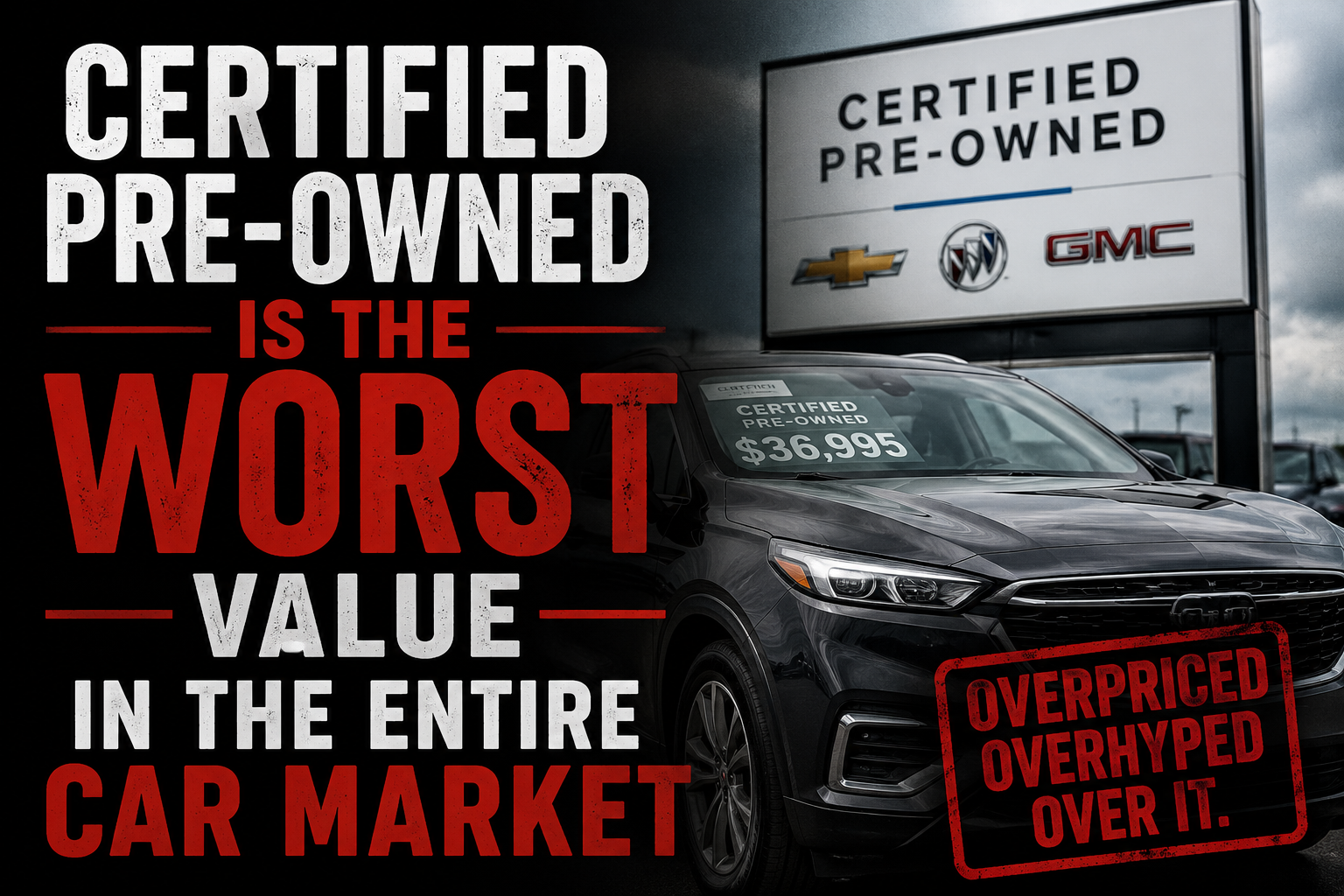
For years, certified pre-owned vehicles have been marketed as the perfect middle ground between buying new and buying used.
Automakers promote them as safer alternatives to ordinary used cars, dealerships highlight extended warranties and inspection programs, and many shoppers assume the certification badge automatically makes a vehicle a smarter purchase.
The reality is often far less appealing. While certified pre-owned (CPO) programs can provide peace of mind in certain situations, they frequently represent some of the poorest value propositions in today’s automotive market.
Buyers are often paying thousands of dollars extra for benefits that may be less valuable than they appear, while overlooking better alternatives available elsewhere.
The popularity of CPO vehicles has grown significantly during the past decade as new vehicle prices climbed and consumers searched for ways to save money. Yet the financial math behind many certified programs reveals a troubling pattern.
In numerous cases, buyers end up spending nearly new-car money for vehicles that are already several years old and have accumulated thousands of miles.
The result is a market segment that often benefits dealerships and manufacturers more than consumers.
That does not mean every certified vehicle is a bad purchase. Some genuinely offer attractive value. The problem is that many shoppers assume certification automatically equals a smart deal, when the opposite is frequently true.
Also Read: 10 Analog-Era Super Cars
The Certification Premium Is Often Excessive
The biggest issue with certified pre-owned vehicles is the price. Dealerships typically charge a significant premium for certification. Depending on the vehicle, that premium can range from several hundred dollars to several thousand dollars compared with a similar non-certified example.
Buyers are told the additional cost covers inspections, warranty protection, and reconditioning work. In practice, the numbers often fail to justify the increase.
Consider two nearly identical vehicles sitting on different lots. One may carry a certification badge, and cost $3,000 more than a comparable used model with similar mileage and maintenance history. The added warranty benefits rarely equal the entire price difference.
Many consumers focus on the monthly payment rather than the total cost, making it easier for dealerships to absorb certification premiums into financing packages.
The result is a transaction where buyers spend substantially more while receiving relatively limited additional value.
The certification label creates a perception of security that often exceeds its actual financial worth.
You’re Paying New-Car Prices for Used Vehicles
One of the strangest developments in today’s market is how close some certified vehicles are priced to brand-new models.
This becomes especially noticeable when manufacturers offer incentives, low-interest financing, or promotional discounts on new inventory.
A certified vehicle that is two or three years old may cost only a few thousand dollars less than a brand-new version of the same model. Yet the new vehicle includes a full factory warranty, zero miles, no prior ownership history, and the latest technology.
In those situations, the value proposition becomes difficult to defend. Spending nearly new-car money for a vehicle that has already experienced depreciation makes little financial sense. Buyers are essentially paying a premium for a used vehicle while giving up many of the advantages associated with buying new.
The gap becomes even smaller when promotional financing enters the equation. Many manufacturers offer interest rates on new vehicles that are substantially lower than those available on used cars. The resulting monthly payments can end up surprisingly similar.
That reality undermines one of the primary arguments supporting certified purchases.
The Warranty Is Often Overrated
Dealerships frequently present the warranty as the centerpiece of the certified ownership experience.
The implication is that buyers are receiving protection comparable to a new vehicle. While some programs do offer meaningful coverage, many warranties are less comprehensive than consumers assume.
In numerous cases, a significant portion of the original factory warranty remains active anyway.
The certification program may simply extend coverage by a relatively small amount. Buyers, therefore, pay a premium for protection that overlaps substantially with benefits they would already receive.
Additionally, warranty terms often contain limitations that receive less attention during the sales process.
Coverage periods, deductible requirements, component exclusions, and claim procedures vary considerably between programs. Many consumers never use the warranty at all.
When that happens, the certification premium effectively becomes an extra expense that provides no tangible benefit. The peace of mind may feel valuable, but financially, it can be a poor investment.
Inspections Sound Better Than They Really Are
One of the most heavily promoted aspects of certified programs is the inspection process. Manufacturers advertise multi-point inspections featuring hundreds of individual checks designed to ensure quality and reliability.
At first glance, these inspections sound impressive. The reality is more complicated. Many inspection items involve basic evaluations rather than major repairs or component replacements.
Verifying that lights function properly or checking fluid levels may count toward the total inspection number, but those steps do not necessarily transform the condition of the vehicle.
The large inspection figures often create a perception of exceptional scrutiny. In reality, certification standards vary significantly among manufacturers and dealerships.
A vehicle can pass inspection while still exhibiting normal wear, minor cosmetic flaws, aging components, or maintenance needs that emerge shortly after purchase. The certification badge should not be mistaken for a guarantee of perfection.
Consumers sometimes overestimate how much additional protection the inspection process actually provides.
Depreciation Still Hits Hard
Many buyers choose certified vehicles because they hope to avoid the steep depreciation associated with new cars.
While that logic has merit, certified vehicles are not immune to depreciation themselves. In fact, the certification premium often evaporates surprisingly quickly.
When it comes time to sell or trade in the vehicle, future buyers rarely place substantial value on the certification status it once carried. The market evaluates the vehicle based primarily on age, mileage, condition, and demand.
The thousands of dollars originally spent on certification often disappear entirely. This creates a hidden cost that many consumers overlook.
They pay extra at purchase but recover little or none of that premium later. From a long-term ownership perspective, this can significantly reduce the financial advantage of choosing a certified vehicle.
The certification may feel valuable during the purchase process, but its resale impact is often minimal.
Better Alternatives Frequently Exist
One of the strongest arguments against many certified purchases is the existence of better options.
Shoppers often become so focused on the certification badge that they ignore alternatives offering superior value.
A well-maintained private-party vehicle with documented service records may cost thousands less than a certified equivalent.
Similarly, a standard used vehicle purchased from a reputable dealer can often provide essentially the same ownership experience without the certification markup.
In some cases, buyers would be better served by purchasing a less expensive vehicle and setting aside money for future repairs.
Even a dedicated repair fund of several thousand dollars may cost less than the premium attached to many certified models.
The key point is that certification should not automatically outweigh other factors. Vehicle condition, maintenance history, reliability ratings, and pricing often matter far more.
Dealerships Love CPO Programs for a Reason
Certified pre-owned vehicles have become extremely popular among dealerships because they are highly profitable.
The certification badge allows dealers to differentiate inventory and justify higher asking prices. It also helps manufacturers maintain stronger residual values and improve brand perception.
From a business perspective, the model works exceptionally well. Consumers gain confidence from manufacturer-backed programs, while dealerships benefit from increased profit margins.
There is nothing inherently wrong with that arrangement. The problem arises when buyers assume the interests of the dealership and the consumer are perfectly aligned.
They are not. The certification process is designed partly to increase buyer confidence, but it is also designed to maximize revenue.
Understanding that distinction is important when evaluating whether the premium is truly justified.
The Smartest Buyers Focus on the Numbers
The best vehicle shoppers tend to approach certified vehicles differently. Rather than assuming certification automatically adds value, they compare pricing carefully, evaluate warranty details, review maintenance records, and calculate ownership costs objectively.

Sometimes a certified vehicle emerges as the best choice. Many times it does not. The smartest approach is to treat certification as one factor among many rather than the deciding factor.
A great vehicle remains a great vehicle whether it carries a certification badge or not. Likewise, an overpriced vehicle remains overpriced even if it has undergone a manufacturer-backed inspection. The numbers matter more than the marketing.
Why Certified Pre-Owned Often Falls Short
Certified pre-owned vehicles occupy an unusual place in the automotive market. They promise many of the benefits of new-car ownership while delivering the savings associated with used vehicles. Unfortunately, they frequently fail to provide the best of either world.
Buyers often pay substantial premiums for inspections, warranties, and branding advantages that offer less real-world value than advertised. In many cases, similarly equipped non-certified vehicles represent better financial decisions, while some certified models cost so much that purchasing new becomes the smarter option.
That does not mean certified vehicles should always be avoided. Certain programs provide meaningful benefits, particularly for luxury models with expensive repair costs or vehicles that offer unusually strong warranty coverage.
However, the assumption that certification automatically equals value is one of the biggest misconceptions in the automotive marketplace.
For consumers focused on maximizing every dollar, the certification badge should never be the reason to buy a vehicle. The actual condition, pricing, reliability, and ownership costs should always matter more.
When those factors are analyzed honestly, certified pre-owned vehicles often reveal themselves as one of the most overpriced segments in the entire car market.
Also Read: 10 Commuter Cars Ranked By Cost Per Mile
