
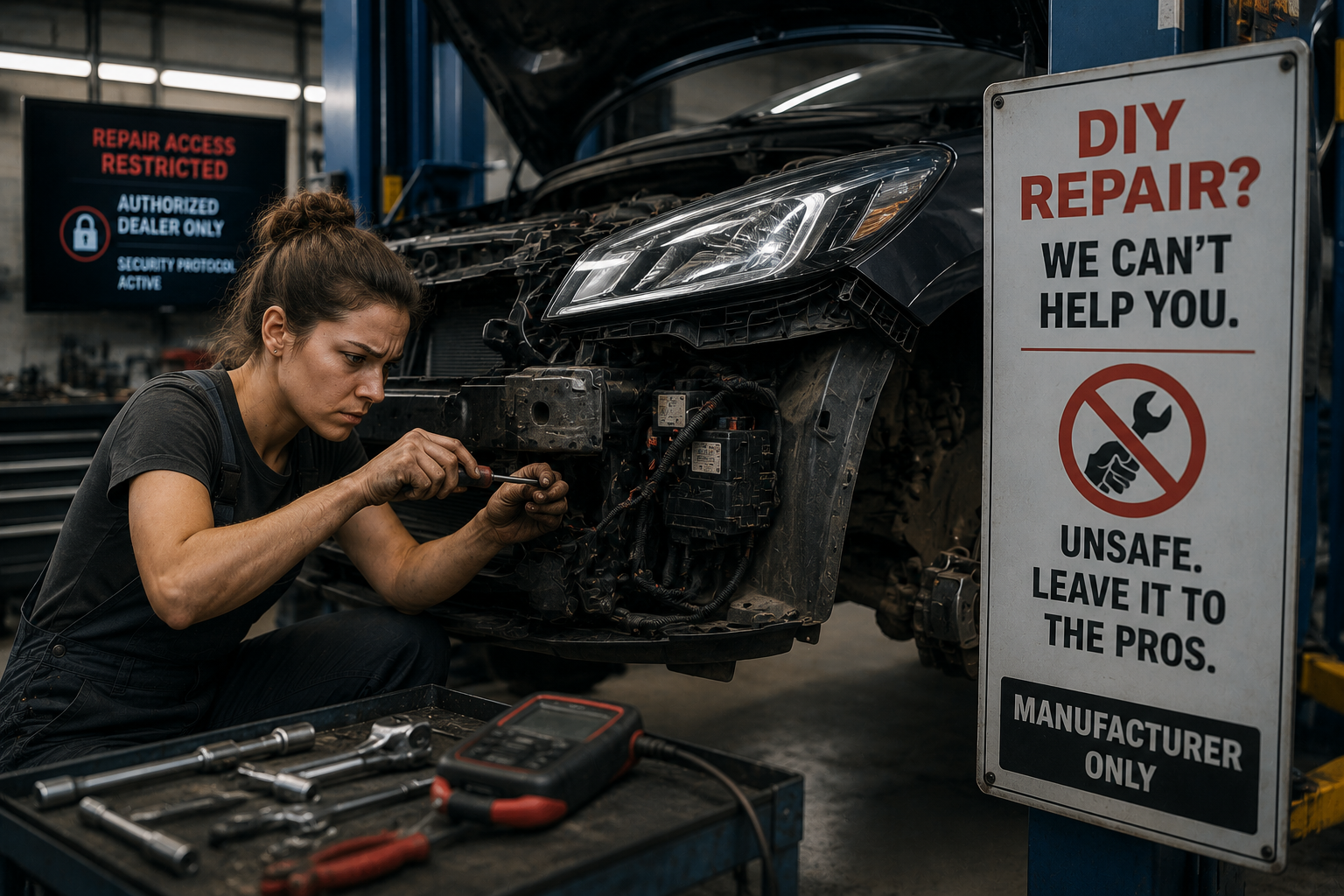
The modern automobile is more technologically advanced than ever before. Today’s vehicles contain sophisticated software, dozens of electronic control modules, advanced safety systems, and, in the case of electric vehicles, high-voltage battery packs that require specialized knowledge to service properly.
Automakers often point to this growing complexity when arguing against broader right-to-repair legislation, claiming that unrestricted repair access could create safety risks for consumers and technicians alike.
On the surface, that argument sounds reasonable. Nobody wants improperly repaired brakes, malfunctioning airbags, or compromised battery systems creating dangerous situations on public roads. Safety should always remain a priority when discussing vehicle repairs.
Yet many consumer advocates, independent repair organizations, and industry observers believe the safety argument only tells part of the story.
They point out that manufacturers have a significant financial interest in controlling how vehicles are repaired, who performs those repairs, and where consumers spend their maintenance dollars.
Dealership service departments generate billions in annual revenue, and every repair completed outside that network represents lost business.
The debate has become increasingly heated as vehicles rely more heavily on software. What was once a discussion about access to replacement parts has evolved into a battle over diagnostic information, software tools, digital locks, and vehicle-generated data.
At its core, the right-to-repair movement asks a simple question: if consumers own their vehicles, should they have the right to repair them wherever they choose?
For many critics of current manufacturer policies, the answer is obvious. They believe safety concerns are often being used to justify restrictions that primarily protect profits rather than consumers.
Also Read: 10 Hidden Features In The Toyota RAV4
Why Right-To-Repair Has Become A Major Issue
The right-to-repair movement has gained momentum because modern vehicles are increasingly difficult to service without manufacturer approval.
Decades ago, many repairs could be performed using basic tools and widely available service manuals. Independent repair shops thrived because they had access to the information and components needed to compete with dealership service centers. Consumers benefited from greater choice and competitive pricing. Today, however, the repair industry looks very different.
Modern vehicles often require proprietary diagnostic software to identify problems and complete repairs. Even replacing certain components may require electronic calibration or software authorization before the vehicle will function properly.
Independent shops frequently report challenges accessing the same information available to franchised dealerships.
Organizations such as the Auto Care Association have argued that these restrictions reduce competition and increase repair costs. According to industry estimates, independent repair facilities perform a substantial percentage of post-warranty vehicle repairs in the United States, making access to repair information critical for both businesses and consumers.
Manufacturers maintain that they support repair access while protecting vehicle integrity. Critics, however, argue that if safety were the primary concern, companies could provide secure access systems rather than limiting information altogether.
The growing complexity of vehicles has made repair access more valuable than ever, which is precisely why the debate has intensified.
Service Departments Are Extremely Profitable
One reason critics question manufacturers’ motives is the enormous financial value of automotive service operations.
While vehicle sales attract most public attention, dealership service departments often represent one of the most reliable sources of profitability within the automotive business. New vehicle sales can fluctuate with economic conditions, interest rates, and inventory levels. Repairs and maintenance continue regardless of market conditions.
According to data from the National Automobile Dealers Association, service and parts operations account for a significant portion of dealership earnings. Routine maintenance, diagnostics, software updates, warranty work, and repairs generate steady revenue throughout a vehicle’s life cycle.
This creates a strong incentive to keep customers within dealership networks. If consumers can choose independent shops that offer lower prices or more convenient service, dealerships face greater competition. From a business perspective, restricting repair access helps preserve a valuable revenue stream.
That does not automatically mean manufacturers are acting in bad faith. Businesses naturally seek to protect profitable operations. However, it does complicate claims that repair restrictions are motivated solely by safety concerns.
Critics often point to this economic reality when evaluating manufacturers’ arguments. They contend that the financial benefits of controlling repairs are too significant to ignore. When billions of dollars are at stake, profit becomes an unavoidable part of the conversation.
Safety Concerns Are Real But Often Overstated
There is no question that some vehicle repairs require specialized expertise. Electric vehicle battery systems can involve dangerous voltage levels. Advanced driver-assistance systems rely on precise calibration. Improper repairs to braking or steering components can create serious safety hazards.
Manufacturers are correct when they emphasize the importance of proper procedures. However, opponents of repair restrictions argue that safety and repair access are not mutually exclusive.
Independent technicians regularly receive specialized training and invest heavily in advanced equipment. Many shops employ technicians with certifications demonstrating expertise in modern vehicle systems.
The automotive industry has successfully navigated technological transitions before. Anti-lock brakes, electronic fuel injection, hybrid powertrains, and computerized engine controls were all once considered highly specialized technologies. Independent repair facilities adapted to each of these developments over time.
Consumer Reports and other industry observers have noted that competition among repair providers often benefits consumers without compromising safety. The existence of independent shops has never automatically meant lower repair standards.
The real question is whether manufacturers could provide broader access while maintaining appropriate safeguards.
Many experts believe they could. Secure diagnostic systems, technician certification programs, and controlled software access models already exist in other industries. Critics argue that automakers frequently present the issue as a choice between safety and access when more balanced solutions are available.
Independent Shops Already Handle Complex Repairs
One of the strongest counterarguments to manufacturer restrictions comes from the independent repair industry itself.
Independent shops are not small garages working exclusively on decades-old vehicles. Many operate sophisticated facilities equipped with advanced diagnostic tools, manufacturer-level scanners, and highly trained technicians capable of handling modern automotive technology.
Research from the automotive aftermarket industry consistently shows that independent repair providers invest heavily in training and equipment. They have adapted to increasingly complex vehicles because customer demand requires it.
In many cases, independent technicians perform repairs on systems directly related to safety. Brake replacements, suspension work, steering repairs, transmission service, and electrical diagnostics are routine tasks for qualified shops.
If these businesses can safely perform such repairs, critics ask why access to software and service information should be restricted.
The argument becomes even more compelling when considering rural communities. Many consumers live significant distances from franchised dealerships. Independent repair facilities often provide the most practical and affordable service option. Restricting access can create inconvenience as well as higher costs.
For supporters of right-to-repair legislation, the success of independent repair businesses demonstrates that the issue is not capability. Rather, it is access to information controlled by manufacturers.
Consumers Pay The Price For Repair Restrictions
The consequences of limited repair access ultimately fall on vehicle owners. When fewer businesses can perform certain repairs, competition decreases. Basic economic principles suggest that reduced competition often leads to higher prices and fewer choices for consumers.
Studies examining repair markets have found that competition helps control service costs while encouraging innovation and customer service improvements. Independent shops frequently compete by offering lower labor rates, flexible scheduling, and personalized service.
Consumers benefit when multiple repair options are available. Restrictions can also affect vehicle longevity. Older vehicles often become less economical to maintain if repair costs rise significantly. This can encourage premature vehicle replacement, increasing ownership expenses for consumers who might otherwise keep vehicles longer.
The issue becomes particularly important as vehicle prices continue rising. According to Kelley Blue Book data, average new vehicle transaction prices remain substantially higher than they were a decade ago. Repair affordability plays a critical role in helping consumers maximize the value of their investments.
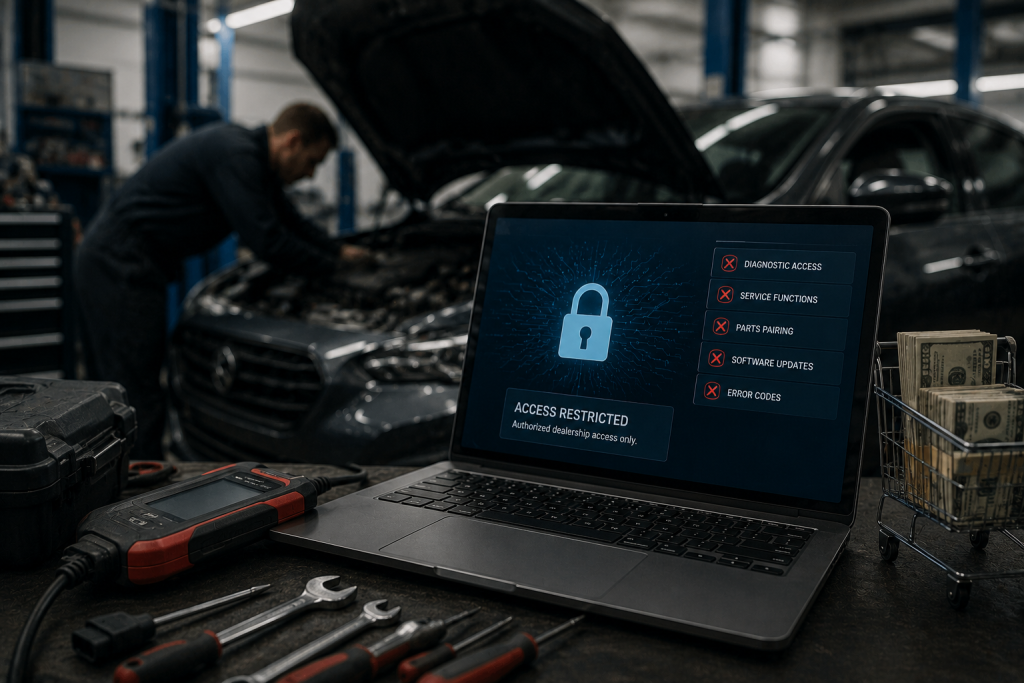
For many right-to-repair advocates, the debate extends beyond convenience. They view repair access as a fundamental ownership issue.
If consumers purchase a vehicle, they argue, they should have the freedom to choose who repairs it and how those repairs are performed, provided safety standards are met.
The Real Debate Is About Control
The right-to-repair discussion is often framed as a battle between safety and access. In reality, it is more accurately a control debate.
Manufacturers understandably want to protect their products, maintain quality standards, and secure valuable service revenue. Consumers and independent repair providers want access to the information necessary to maintain vehicles without unnecessary restrictions.
Both sides raise legitimate concerns. Yet the financial incentives involved make it difficult to accept claims that safety alone drives manufacturer opposition to broader repair access. Dealership service departments generate enormous revenue, and maintaining influence over repairs provides clear business advantages.
That does not mean safety concerns should be dismissed. Modern vehicles are complex, and proper repair procedures matter. However, independent repair professionals have repeatedly demonstrated their ability to adapt to new technologies and maintain high standards.
The challenge moving forward is finding a balance that protects consumers without limiting competition. Secure access systems, technician certification requirements, and transparent repair standards could help address legitimate safety concerns while preserving consumer choice.
For many observers, the evidence suggests that profit plays a far larger role in the right-to-repair debate than manufacturers are willing to acknowledge. As vehicles become more software-dependent and connected, that debate will only become more important.
The outcome will help determine not only where consumers repair their vehicles but also what ownership truly means in the modern automotive era.
Also Read: First 1,000-Volt EVs Arrive as Sub-10-Minute Charging Claims Continue
