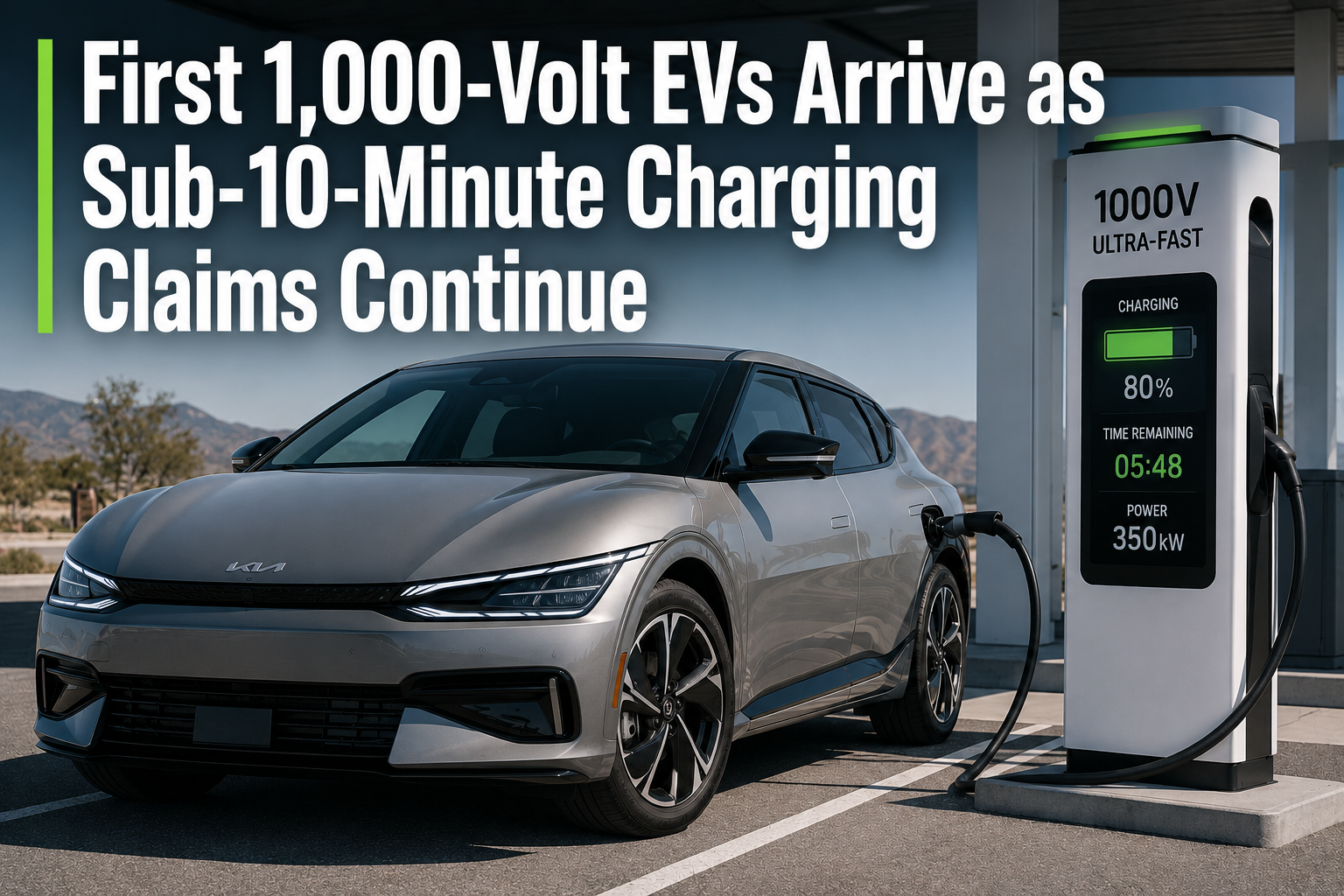
The electric vehicle industry has spent the better part of the last decade trying to solve one problem that continues to shape consumer perceptions: charging time.
While battery range has improved dramatically and public charging networks have expanded across major markets, many drivers still compare the experience of recharging an EV with the convenience of filling a gasoline vehicle.
Automakers and battery manufacturers have long argued that the gap would eventually shrink, and developments over the past year suggest the industry is moving closer to that goal.
The arrival of the first production vehicles built around 1,000-volt electrical architectures represents one of the most significant technological milestones in recent EV history.
At the same time, automakers and battery suppliers have continued announcing charging capabilities that promise to replenish batteries in less than 10 minutes under certain conditions.
These advances are being driven by improvements in power electronics, battery chemistry, thermal management systems, and charging infrastructure.
Industry experts believe the progress could have implications far beyond faster charging sessions. As electric vehicles move into the mainstream market, convenience is becoming a critical competitive factor.
Consumers increasingly expect charging experiences that fit seamlessly into their daily routines, and manufacturers are investing heavily in technologies designed to make that possible.
The developments seen throughout 2025 and into 2026 suggest that the next stage of EV competition may be defined less by battery size and more by how quickly those batteries can be replenished.
Also Read: Stellantis Recalls 419,035 Jeep Grand Cherokees Over A Side-Airbag Software Fault
The Move Beyond Traditional EV Architectures
For many years, most electric vehicles operated on electrical systems ranging from 300 to 400 volts. Those configurations proved effective for early EV adoption, offering adequate performance and charging capabilities for a market that was still developing.
As demand for faster charging increased, manufacturers began looking for ways to improve efficiency and reduce charging times. One solution involved raising the system voltage.
Higher-voltage architectures allow vehicles to accept more charging power while reducing the amount of electrical current flowing through cables and components. Lower current means less heat generation, improved efficiency, and the potential for substantially faster charging speeds.
The transition first became noticeable with the introduction of 800-volt platforms. Automakers, including Hyundai, Kia, Porsche, and several luxury manufacturers, demonstrated that higher-voltage systems could significantly improve charging performance while also enhancing full vehicle efficiency.
Now the industry is taking another step forward. The first 1,000-volt production vehicles began appearing during 2025, marking a new phase in EV development. These architectures are designed to support even higher charging rates and provide the technical foundation necessary for future ultra-fast charging systems.
Manufacturers view the technology as a key component of their long-term electrification strategies, particularly as consumer expectations continue to evolve.
Charging Speed Becomes the New Battleground
A few years ago, range dominated nearly every discussion surrounding electric vehicles. Manufacturers competed aggressively to advertise the highest possible mileage figures, believing that range anxiety represented the biggest obstacle to EV adoption.
That narrative is beginning to change. As battery technology has improved, many modern EVs now offer enough range to satisfy the needs of most drivers. Consequently, attention has shifted toward charging speed and convenience.
Automakers increasingly recognize that consumers may place greater value on a vehicle that can recharge quickly than on one carrying an extremely large battery pack. A short charging stop can often be more practical than carrying additional battery capacity that adds cost and weight.
This shift has intensified competition among manufacturers. Throughout 2025 and the first half of 2026, several companies announced charging systems capable of adding hundreds of miles of range in remarkably short periods.
Some manufacturers claimed charging times below ten minutes under ideal conditions, while others revealed battery technologies specifically engineered to support ultra-fast energy transfer.
Although real-world performance varies depending on charger capability, battery temperature, and environmental conditions, the industry’s direction is clear.
Faster charging has become one of the most important benchmarks for future EV development.
Battery Technology Makes Rapid Progress Possible
The emergence of sub-10-minute charging claims is not solely the result of higher-voltage architectures. Significant advances in battery technology have played an equally important role.
Traditional lithium-ion batteries face limitations when exposed to extremely high charging rates. Excessive heat can affect performance, reduce longevity, and create engineering challenges that manufacturers must address carefully.
To overcome these issues, battery developers have introduced a range of innovations. New cell designs, improved electrode materials, advanced electrolytes, and more sophisticated battery management software have collectively improved charging performance.
Researchers have focused on increasing the speed at which batteries can safely accept energy without sacrificing durability. Thermal management systems have also evolved.
Modern EV battery packs incorporate increasingly advanced cooling technologies designed to maintain optimal temperatures during high-power charging sessions. Effective temperature control is critical because batteries perform best within specific operating ranges.
Industry analysts note that these improvements often work together. Faster charging is rarely the result of a single breakthrough. Instead, it reflects progress across multiple areas of vehicle engineering.
That combination of innovations is helping manufacturers push charging performance closer to levels that many consumers once considered unrealistic.
Infrastructure Must Keep Pace With Vehicle Development
While automakers continue making impressive advances, vehicle technology represents only part of the equation. Charging infrastructure must evolve alongside the vehicles it serves.
Many existing fast-charging stations were designed before ultra-high-voltage architectures became a major industry focus. Supporting the latest generation of EVs requires charging equipment capable of delivering significantly greater amounts of power while maintaining reliability and safety.
Network operators have responded by investing in upgraded hardware and expanding high-power charging capabilities.
New charging stations increasingly feature improved cooling systems, advanced power electronics, and enhanced communication technologies. These upgrades are intended to support the next wave of electric vehicles entering the market.
The transition presents challenges, particularly because infrastructure deployment often moves more slowly than vehicle development. Building and upgrading charging networks requires substantial investment, coordination with utilities, and long-term planning.
Nevertheless, charging providers understand the importance of keeping pace. Without compatible infrastructure, even the most advanced EVs cannot fully utilize their charging capabilities.
Why Faster Charging Matters to Consumers
For many consumers, charging speed has become a practical issue rather than a technical one.
Drivers want confidence that electric vehicles can handle both daily commuting and longer journeys without creating significant inconvenience.
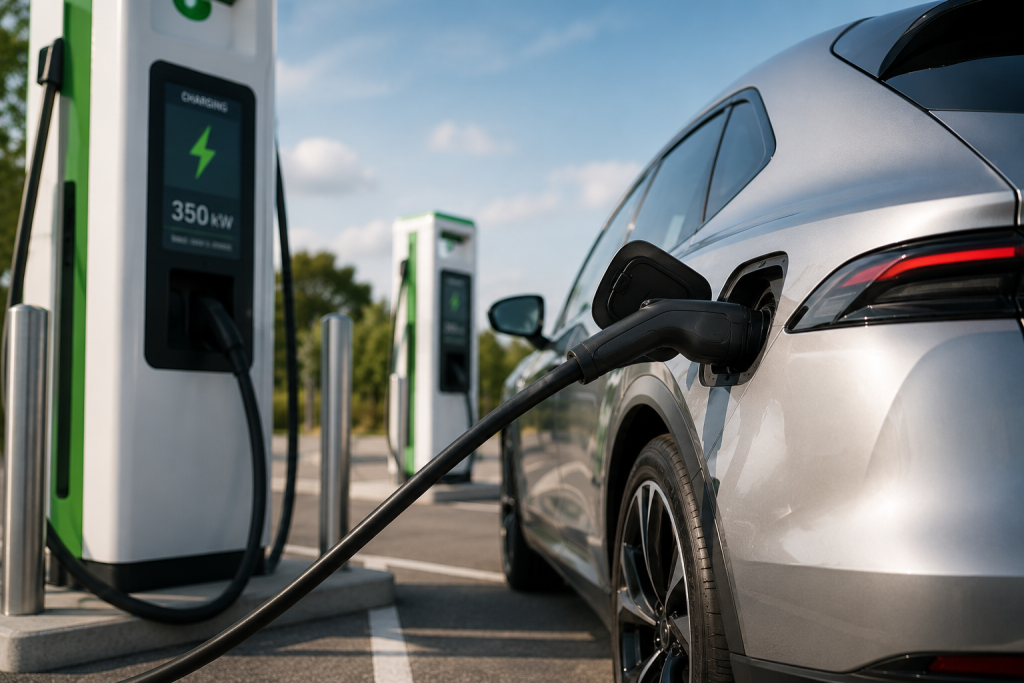
While home charging remains the primary method of replenishing batteries for many owners, public charging is essential for road trips and situations where home charging is unavailable.
Faster charging directly addresses those concerns. A vehicle capable of recovering a substantial range during a brief stop can make long-distance travel significantly easier. It can also reduce waiting times at busy charging stations, improving the ownership experience for a larger number of drivers.
Industry surveys consistently show that charging convenience remains one of the most important factors influencing EV purchasing decisions. Manufacturers are therefore treating charging performance as a critical selling point rather than simply a technical specification.
The growing emphasis on charging speed reflects the industry’s broader effort to make electric vehicles more appealing to mainstream consumers.
The Road Ahead
The arrival of the first 1,000-volt electric vehicles and the continued emergence of sub-10-minute charging claims represent important milestones in the evolution of electric transportation.
Only a few years ago, charging times measured in hours were common. Today, manufacturers are discussing charging sessions that can potentially add meaningful driving range in less time than many drivers spend ordering coffee or visiting a convenience store.
Challenges remain. Infrastructure expansion must continue, costs need to decline, and manufacturers must ensure that ultra-fast charging does not compromise long-term battery durability. Yet the pace of development suggests the industry is making substantial progress.
The significance of these advancements extends beyond technical achievements. Faster charging addresses one of the most persistent concerns associated with EV ownership and could help accelerate adoption among consumers who remain hesitant about making the transition from gasoline-powered vehicles.
As automakers, battery suppliers, and charging providers continue investing in next-generation technologies, the distinction between refueling and recharging may become increasingly less important.
The first 1,000-volt vehicles represent an early glimpse of that future, one in which charging speed is no longer viewed as a limitation but as a competitive advantage capable of reshaping the entire electric vehicle market.
Also Read: Stellantis Confirms Second Range-Extender SUV for Michigan Plant