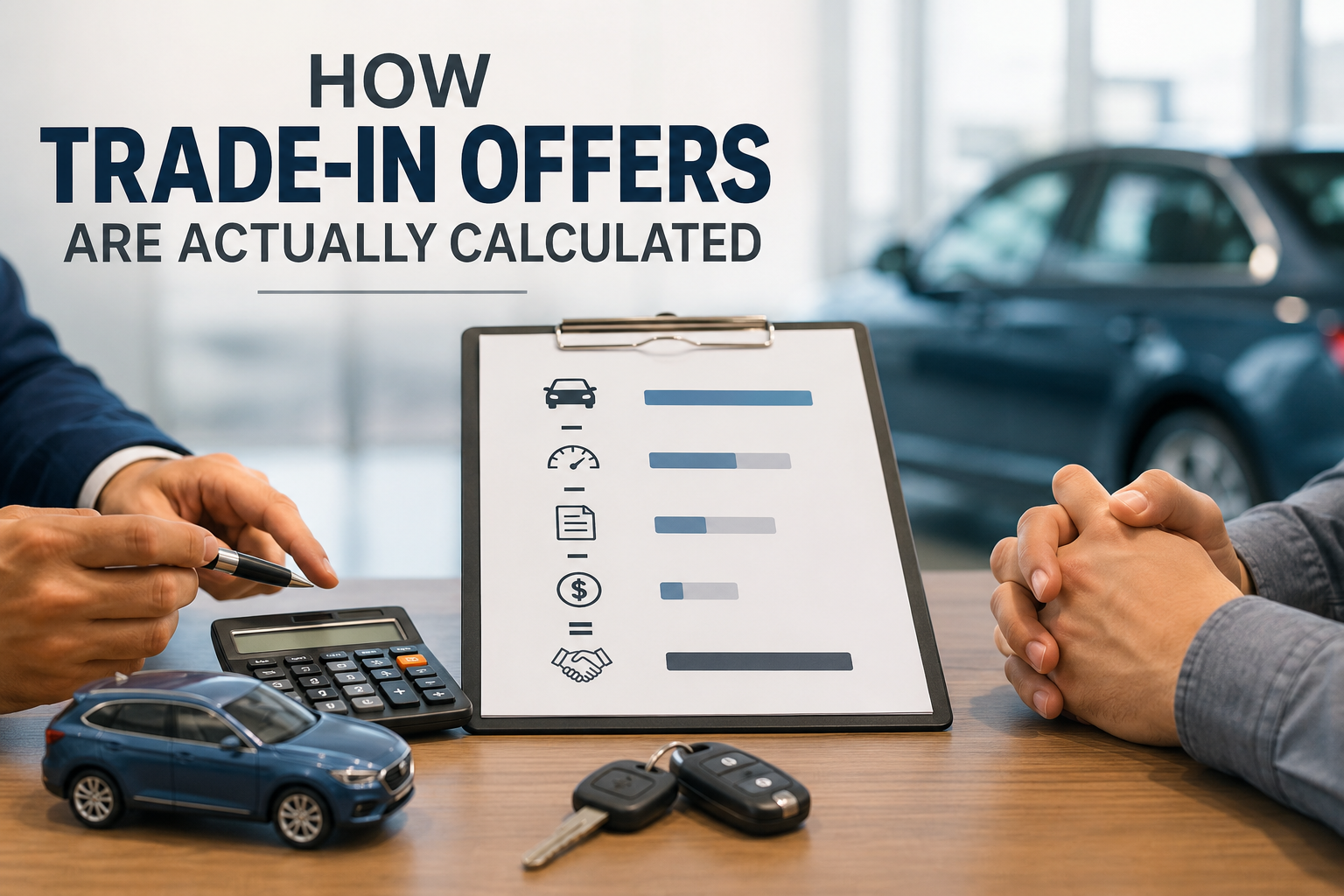
Trading in a car can feel strangely secretive. A dealer may spend 15 minutes examining a vehicle, disappear into an office, and return with a number thousands of dollars below the prices the owner saw online. Another dealership might inspect the same car the following day and offer considerably more.
The difference is not necessarily random. A trade-in offer is a business calculation based on what the vehicle is worth to that specific dealer at that moment. Dealers consider wholesale market data, local demand, mileage, condition, vehicle history, reconditioning costs, and the likely resale path.
Kelley Blue Book says mileage, condition, and demand for a specific make and model can affect trade-in value. J.D. Power also uses large volumes of transaction and market information to estimate vehicle values.
The important point is that a $28,000 asking price on a dealer website does not mean another dealer should pay $28,000 for your trade. Retail price and trade-in value represent two different stages of the used-car business.
Also Read: 8 Vehicles With the Lowest Step-In Height in 2026
Dealers Start With Market Value and Work Backward
A trade appraisal usually begins by identifying the exact vehicle. The dealer needs the VIN, year, make, model, trim, engine, mileage, and major factory equipment.
Small differences can change value. A four-wheel-drive pickup may have stronger demand than an equivalent two-wheel-drive version. A desirable trim or factory option package may make a vehicle easier to sell. Kelley Blue Book lists age, mileage, condition, and market trends among the major factors affecting vehicle value.
The appraiser then examines current market information. Wholesale value is one important reference. Dealers regularly acquire and dispose of vehicles through wholesale channels and auctions. J.D. Power explains that vehicle valuation companies use wholesale and retail transaction information when estimating values.
For the dealership, the basic question is simple: If we do not buy this customer’s vehicle, what would it cost us to obtain a similar one elsewhere?
Imagine a customer trades in a three-year-old SUV. Similar vehicles may be advertised locally for $30,000. That does not make the trade worth $30,000 to the dealer.
The dealership may believe it can realistically sell the SUV for $29,000 after negotiating with a future buyer. Before the vehicle reaches the lot, however, it may need tires, brake work, an oil change, paint correction, and professional detailing.
The dealership must inspect the car, complete paperwork, photograph it, advertise it, and carry it in inventory until someone buys it. There also needs to be room for potential profit and unexpected expenses.
If the store estimates substantial reconditioning and selling costs, its trade offer may be several thousand dollars below the retail prices the owner found online.
This is the trade-in equation many owners misunderstand. The dealer is not calculating what the car is worth to the next retail customer. It is determining what it can pay today and still resell the vehicle economically. The condition can quickly change the number.
An appraiser may inspect dents, scratches, cracked lights, windshield damage, and evidence of previous body repairs. Tires are checked for tread depth and condition. The interior may be examined for stains, odors, damaged upholstery, and malfunctioning equipment.
Warning lights, transmission problems, engine noises, and electronic faults can also affect the offer. A dealer expecting to spend $2,000 preparing a vehicle for sale may adjust the appraisal accordingly.
Mileage is considered in context. A five-year-old car with 35,000 miles will generally not receive the same offer as an identical example with 100,000 miles. Higher mileage can mean more wear and may make the vehicle less attractive to future retail customers.
CarMax says its offers consider vehicle-specific information and current market conditions. Its valuation systems can also consider projected mileage, condition, and vehicle history.
History reports matter because a previous accident can affect what the next buyer is willing to pay. A reported collision does not automatically make a car worthless, but serious structural damage, flood history, or a branded title can significantly reduce market value.
If shoppers are likely to pay less because of a vehicle’s history, the dealership will usually account for that during the appraisal.
Why the Same Car Can Receive Three Different Offers
One of the most confusing parts of trading in a car is receiving different offers from different dealerships. The reality is that a vehicle does not have one perfect universal trade-in value.
Suppose a Toyota dealership needs clean used RAV4s because its pre-owned inventory is low. A three-year-old RAV4 may be an excellent vehicle for that store. The dealership understands the model, has customers shopping for it, and may expect to sell it quickly.
Another dealer may already have eight similar RAV4s sitting on its lot. Buying another one is less valuable to that business.
The second dealership may still accept the trade, but it could calculate the offer closer to the expected wholesale value. The car itself has not changed. The dealer’s inventory situation has improved.
Local demand also matters. Kelley Blue Book specifically identifies demand for a particular make and model as a factor influencing trade-in value.
A four-wheel-drive truck may attract stronger interest in one region than another. Convertibles can face seasonal demand differences. Fuel prices, new-car incentives, and the supply of competing used vehicles may also affect what dealers are willing to pay.
This is why online valuation tools should be treated as useful benchmarks rather than guaranteed checks.
An owner may receive an online trade-in estimate of $22,000 and assume every dealer should pay exactly that amount. The estimate can provide a reasonable market range, but the physical vehicle and the dealer’s current business needs still affect the final appraisal.
Edmunds has recommended obtaining multiple offers because competing appraisals give sellers more leverage. The company also explains why trade-in value is normally lower than retail value: the dealer may need to recondition, market, and process the vehicle while leaving room for profit.
That is how the same car can receive offers of $19,500, $21,000, and $22,400 from three buyers. The highest bidder may simply have the best resale opportunity.
Dealers also consider whether a vehicle belongs on their retail lot. An older, high-mileage trade may be accepted during a new-car transaction but sent directly to wholesale.
If the appraiser expects the vehicle to go to auction, the offer will usually reflect expected wholesale value. The dealership does not want to pay a retail-like price for a car it expects to sell through a wholesale channel.
Cleaning a vehicle can improve presentation, but it rarely transforms its fundamental value. A detailed interior cannot erase 150,000 miles, a branded title, or major mechanical problems.
Minor preparation may still help. Cleaning the car, removing personal belongings, and addressing inexpensive, obvious problems can make the vehicle easier to inspect. Expensive repairs require more careful consideration.
Spending $3,000 on repairs does not guarantee the trade offer will increase by $3,000. A dealership may be able to perform the same work at a lower internal cost.
Trade Value and Your Loan Balance Are Separate Numbers
The final source of confusion is vehicle equity. A dealer may offer $25,000 for a trade, but the customer still owes $29,000 on the auto loan. The vehicle’s trade value remains $25,000. The additional $4,000 represents negative equity.
The Federal Trade Commission defines negative equity as owing more on a vehicle loan than the car is worth. The FTC warns buyers to understand how this difference is handled because a dealer may roll the unpaid balance into the financing for the next vehicle.
Consider a simple example. Your vehicle is appraised at $20,000, but the loan payoff is $25,000. You have $5,000 in negative equity. When the dealership pays the existing lender, that $5,000 does not disappear.
Depending on lender approval and the structure of the transaction, the difference may be paid in cash or included in the new financing. Rolling the amount into the next loan means the customer is financing old vehicle debt together with the replacement car.
Positive equity works in the opposite direction. If the dealer offers $25,000 and the loan payoff is $18,000, the customer has $7,000 in positive equity that can be applied to the new transaction.
This is why buyers should keep trade value and loan payoff separate. Another common source of confusion is an unusually high advertised trade allowance. A dealer may appear to give $3,000 more for the trade while providing a smaller discount on the new vehicle.
For example, Dealer A may offer $20,000 for the trade and sell the replacement vehicle for $45,000. Dealer B may advertise a $22,000 trade allowance but price the new car at $47,000.
The extra $2,000 trade allowance has not improved the customer’s financial position. The best approach is to compare the complete transaction while still examining each number separately. Know the new-car price, trade value, loan payoff, and financing terms.
Obtaining several real trade offers can also reveal what buyers are currently willing to pay. Kelley Blue Book can provide a valuation benchmark, while vehicle buyers such as CarMax can provide actual offers subject to inspection and offer terms.
Trade-in offers are not simply numbers selected by a salesperson after walking around a car. The calculation usually starts with market value and then adjusts for the exact model, mileage, condition, vehicle history, expected reconditioning, local demand, and the dealer’s likely resale plan.
The number can still be negotiated, and different dealers can produce substantially different appraisals. Yet the central business question remains the same: What can this dealership safely pay for the vehicle today based on what it expects to spend and what it realistically believes the car will be worth when sold?
Once buyers understand that calculation, the gap between an online retail listing and a trade-in offer becomes less mysterious. The dealership is buying the car at one stage of the used-vehicle market and attempting to sell it at another. Reconditioning expenses, inventory risk, and potential profit exist between those two stages.
For the owner, the smartest strategy is simple: research the approximate value, clean the vehicle, know the exact loan payoff, and obtain several competing offers before completing the trade. A single dealer’s appraisal is only one buyer’s opinion of the car’s value. Multiple real offers show what the market is actually prepared to pay.
Also Read: 8 Motorcycles Known to Pass 100,000 Miles