
For many vehicle owners, tire rotation is one of the easiest maintenance items to ignore. Unlike an oil change, there is no warning light reminding you to rotate your tires. The engine runs normally, the vehicle continues to move, and there are often no obvious symptoms in the early stages of uneven tire wear.
As a result, thousands of drivers postpone tire rotations for months or even years, believing they are saving time and money.
In reality, skipping tire rotations can become one of the most expensive maintenance mistakes a driver makes. Uneven tread wear shortens tire life, reduces traction, increases road noise, affects braking performance, and, in some cases, can even damage components of an all-wheel-drive system.
Just as importantly, failing to rotate your tires at the recommended intervals may void the mileage portion of your tire’s treadwear warranty, leaving you responsible for replacement costs that might otherwise have been covered.
According to Tire Rack, one of North America’s leading tire retailers and testing organizations, regular tire rotations are essential because every wheel position on a vehicle experiences different loads during acceleration, braking, cornering, and steering.
Tire Rack generally recommends rotating tires every 3,000 to 5,000 miles, or according to the vehicle manufacturer’s maintenance schedule, to promote even tread wear and maximize tire life.
While the procedure typically takes less than an hour, the long-term benefits can save drivers hundreds or even thousands of dollars over the life of their vehicle.
Also Read: 10 Longest Cars Ever Sold in America
Why Tires Wear Unevenly Without Regular Rotation
Many drivers assume all four tires wear at roughly the same rate. In reality, each tire performs a different job depending on the vehicle’s drivetrain, weight distribution, suspension design, and steering system.
On a front-wheel-drive vehicle, the front tires handle nearly everything. They transmit engine power to the road, steer the vehicle, and absorb the majority of braking forces. Because they perform multiple tasks simultaneously, front tires often wear significantly faster than the rear tires.
Rear-wheel-drive vehicles distribute engine power through the rear axle, placing greater acceleration loads on the rear tires. However, the front tires still manage steering and most braking duties, creating a different but equally uneven wear pattern.
Even all-wheel-drive vehicles, which distribute power to all four wheels, experience uneven wear because steering loads remain concentrated on the front axle while suspension geometry causes each tire to experience slightly different forces.
According to Tire Rack’s wear testing, moving tires between different positions at regular intervals allows each tire to share these varying workloads.
Over time, this helps the entire set wear more evenly, extending full tire life and preserving consistent handling characteristics. Instead of one pair reaching the wear bars while the other still has usable tread, all four tires approach replacement at roughly the same time.
Without rotation, uneven wear begins gradually but accelerates as tread depth differences increase.
The first signs are often subtle. Drivers may notice slightly increased road noise or mild steering changes that develop so slowly they become easy to overlook. As wear continues, tires can develop feathering, cupping, heel-and-toe wear, or excessive shoulder wear depending on the vehicle and driving conditions.
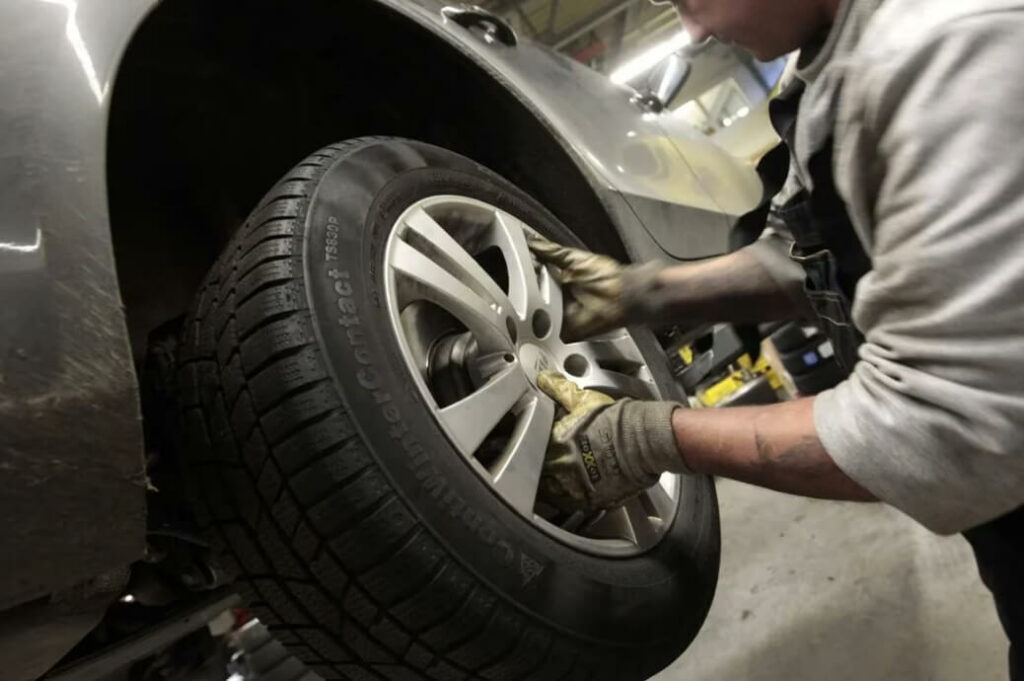
These irregular wear patterns cannot usually be corrected once they become severe. Even after rotating the tires later, the uneven tread remains, often producing permanent vibration or humming noises throughout the remaining life of the tire.
The Safety and Financial Costs Can Add Up Quickly
Uneven tire wear affects much more than appearance. As tread depth decreases unevenly, the tire’s ability to evacuate water during wet-weather driving also declines. The National Highway Traffic Safety Administration (NHTSA) has consistently emphasized that adequate tread depth is essential for maintaining traction and reducing hydroplaning risk on wet roads.
When one pair of tires becomes significantly more worn than the other, braking performance and vehicle stability can be compromised, particularly during emergency maneuvers.
Handling balance also changes. If the front tires lose substantially more tread than the rear tires, steering response may become less predictable while stopping distances increase. Conversely, heavily worn rear tires can make the vehicle more susceptible to oversteer on slippery roads, reducing full stability.
Fuel economy can also suffer. Unevenly worn tires often create higher rolling resistance, forcing the engine to work slightly harder. While the fuel economy difference may not be dramatic, it contributes to higher operating costs over thousands of miles.
Perhaps the biggest financial consequence appears when tire replacement becomes necessary.
Suppose a front-wheel-drive vehicle receives no tire rotations throughout its service life. The front tires may reach the legal minimum tread depth after 30,000 miles while the rear tires still retain half of their original tread.
Instead of replacing an entire matched set at the appropriate interval, the owner faces an awkward decision: replace only two tires, purchase four new tires early, or continue driving on mismatched tread depths. On vehicles equipped with all-wheel drive, the situation becomes even more expensive.
Many AWD systems require all four tires to remain within a very small tread-depth difference, often around 2/32 inch, although exact specifications vary by manufacturer. Larger differences force drivetrain components such as differentials, transfer cases, or electronically controlled clutch packs to compensate continuously for varying tire diameters.
Manufacturers including Subaru, Audi, BMW, and others warn that excessive tread-depth differences can place unnecessary stress on AWD components. As a result, replacing only two heavily worn tires may not be recommended. Instead, owners often need to replace all four tires, even if two still have usable tread remaining.
For premium SUVs or trucks equipped with high-quality tires, replacing an entire set can easily exceed $1,200 to $2,000, depending on tire size and brand.
A simple maintenance procedure that might cost little or nothing during routine service suddenly becomes a very expensive oversight.
Skipping Tire Rotations May Void Your Treadwear Warranty
Many drivers are unaware that tire warranties come with maintenance requirements. Premium replacement tires frequently include treadwear warranties ranging from 50,000 to 80,000 miles, and some touring tires advertise coverage exceeding 90,000 miles.
These warranties are designed to protect buyers if a tire wears out prematurely under normal driving conditions. However, they are not unconditional guarantees.
According to Tire Rack, nearly every major tire manufacturer requires owners to follow recommended maintenance procedures, including maintaining proper inflation, correcting wheel alignment issues when necessary, and rotating tires at specified mileage intervals.
Tire Rack also advises customers to retain service records because manufacturers may request documentation before honoring a treadwear claim.
Warranty documents from major manufacturers such as Michelin, Continental, Goodyear, Bridgestone, Yokohama, and others commonly specify maximum rotation intervals, often between 5,000 and 8,000 miles, depending on the tire model and vehicle application.
If an owner cannot demonstrate that these maintenance requirements were followed, manufacturers may deny the treadwear portion of the warranty, even if the tire wears out well before its advertised mileage.
This surprises many consumers. A driver expecting partial reimbursement for prematurely worn tires may instead discover that the warranty has been voided simply because regular rotations were never performed or documented.
Maintaining records becomes especially important for drivers who perform maintenance themselves. Keeping receipts, mileage logs, or service documentation can help establish that recommended maintenance occurred if a warranty claim becomes necessary later.
Fortunately, tire rotation itself remains one of the simplest maintenance procedures performed on any vehicle.
Most service centers complete the work in less than an hour, and many dealerships, tire retailers, and repair shops include complimentary rotations when tires are purchased through them. Some vehicle maintenance packages also bundle tire rotation with routine oil changes, making it easy to follow manufacturer recommendations without additional appointments.
Drivers should also remember that tire rotation is not a substitute for proper tire inflation or wheel alignment.
Incorrect tire pressure remains one of the leading causes of premature tire wear. Underinflated tires wear excessively along both shoulders, while overinflated tires wear more rapidly in the center of the tread.
Likewise, misaligned suspension components can destroy a new set of tires in just a few thousand miles regardless of how often they are rotated.
The best tire maintenance program combines regular pressure checks, scheduled rotations, periodic alignment inspections, and prompt repairs whenever abnormal wear appears.
Although tire rotation may seem like a minor maintenance task, its impact on vehicle safety, performance, and ownership costs is substantial. Regularly moving the tires between wheel positions helps distribute wear evenly, preserves predictable handling, maximizes tread life, and ensures that all four tires reach replacement at approximately the same time.
Just as importantly, following the recommended rotation schedule helps protect valuable treadwear warranty coverage that could save hundreds of dollars if tires wear out prematurely.
Skipping tire rotations may not produce immediate consequences, which is precisely why so many drivers ignore them. But over months and years, the effects become increasingly costly.
Whether it is replacing tires thousands of miles earlier than expected, dealing with excessive road noise, paying for a complete set of tires on an all-wheel-drive vehicle, or losing warranty protection altogether, the price of neglect often far exceeds the modest time and expense required for routine tire maintenance.
For most vehicle owners, rotating the tires every few thousand miles remains one of the simplest investments they can make in extending tire life, improving safety, and reducing long-term ownership costs.
Also Read: 10 SUVs That Hold Value Better Than a Land Cruiser
