
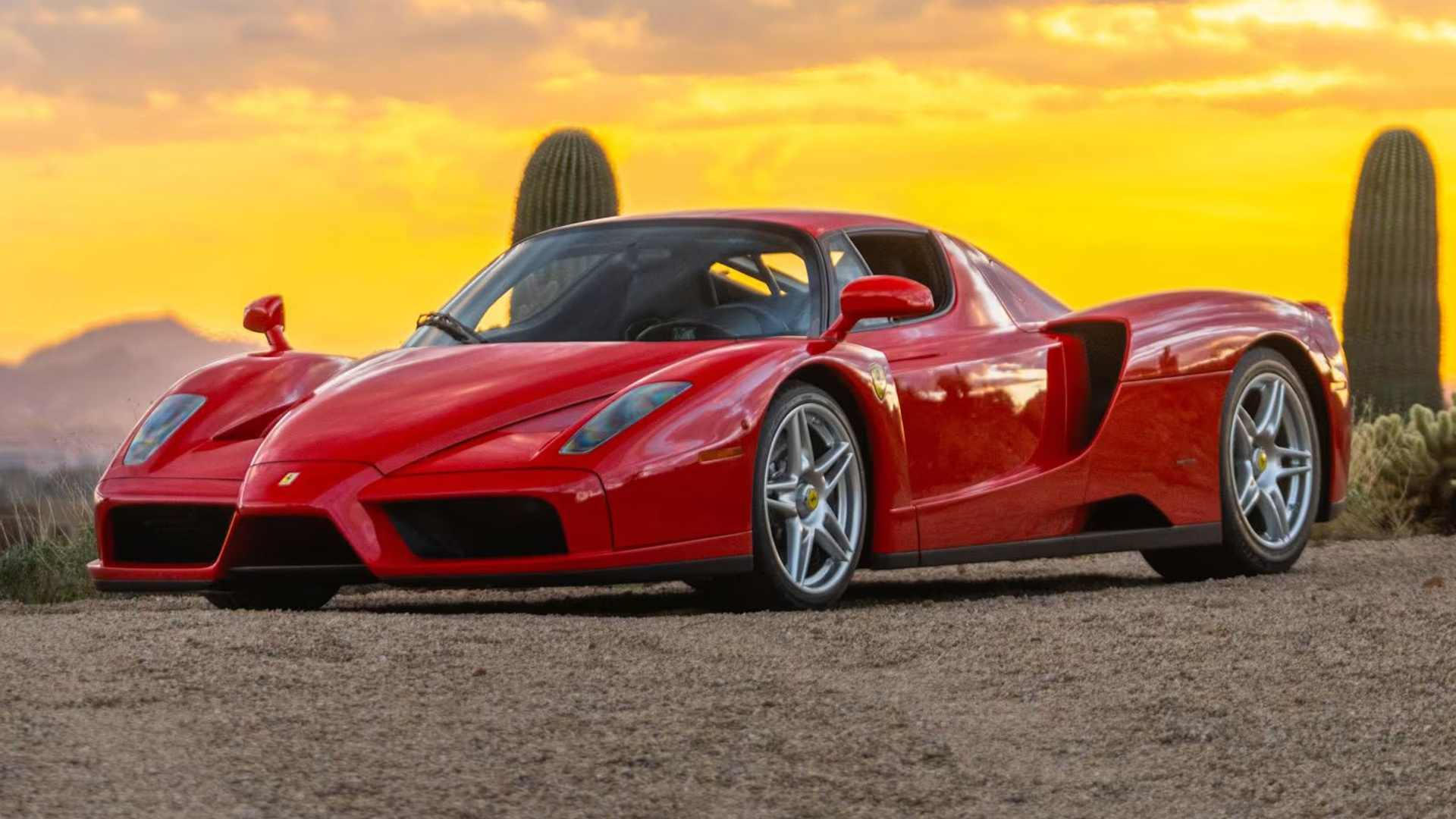
A one-of-one Ferrari Enzo finished in Rosso Dino has become the most expensive car ever sold through an online-only auction, reaching a hammer price of $12,399,000. With the buyer’s premium included, the final transaction totaled $13,018,950.
The result set a new high-water mark for digital collector-car sales and placed the car among the most valuable Ferrari Enzos ever sold publicly. It also delivered a major statement about how the market for rare, eight-figure automobiles is changing.
For decades, the largest collector-car transactions were closely associated with live auction rooms in Monterey, Scottsdale, Amelia Island, Goodwood, and Monaco. This sale showed that a carefully presented online auction can now attract the same level of international attention when the car is exceptional enough.
The Enzo was sold through duPont REGISTRY Live, which said the car was offered without reserve. That meant the highest bidder would take it home regardless of the final amount, a format that can create urgency when a rare car enters the market. The auction attracted hundreds of bids and drew attention from collectors around the world.
The final figure was remarkable, but the reason behind it was not difficult to understand. This was not simply another low-mileage Ferrari Enzo. It was the only Enzo built by Ferrari in Rosso Dino, a historic orange-red shade with deep ties to the company’s past.
Also Read: 10 Cars That Hold Their Value Better Than a Toyota
A New Benchmark for Online Collector-Car Sales
Before the Rosso Dino Enzo sale, the most expensive car sold through an online-only auction was a Ferrari LaFerrari Aperta that brought $5.36 million on Bring a Trailer in 2022.
The Enzo more than doubled that previous record. That difference matters because it shows how far online auctions have progressed. Digital platforms initially gained popularity by selling affordable classics, enthusiast cars, modified vehicles, and lower-priced sports cars. Over time, the market expanded.
Rare Porsche 911s, limited-production Ferraris, vintage SUVs, Japanese performance cars, and modern supercars began selling online for six-figure and seven-figure prices. However, eight-figure collector cars remained largely tied to traditional auction houses.
Buyers spending millions of dollars often wanted the experience of a physical auction. They wanted to inspect the car in person, speak with specialists, review paperwork, study the competition, and participate in the drama of live bidding.
Online auctions offer a different kind of experience. They allow bidders to examine detailed photographs, service records, videos, ownership history, and condition reports from anywhere in the world. They also give rare car access to a global audience without requiring every interested buyer to travel to a single event.
The Enzo sale proved that online platforms can now provide enough confidence for buyers at the highest level of the market.
The key remains trust. A bidder spending more than $13 million needs confidence in the vehicle’s condition, title, history, originality, maintenance, and seller representation. The Rosso Dino Enzo had the kind of documentation and factory provenance that made such confidence possible.
Rosso Dino Was More Than an Unusual Paint Color
Ferrari built 400 Enzos between 2002 and 2004. That production number makes every Enzo special, but collector values vary widely depending on color, mileage, condition, service history, ownership records, accident history, and original specification.
The Rosso Dino car stood apart because Ferrari built no other Enzo in the same color. Rosso Dino is a warm orange-red shade named after Alfredo “Dino” Ferrari, the eldest son of company founder Enzo Ferrari.
Dino Ferrari died in 1956 at only 24 years old, but his name became an important part of Ferrari history. The Dino name was later used on Ferrari’s V6-powered road cars and became associated with some of the company’s most memorable designs.
Rosso Dino appeared on Ferraris during the 1960s and was seen on significant models from that era. By the time the Enzo arrived in 2002, the color was no longer part of Ferrari’s normal paint catalog.
The original owner, Gerald Barnes, asked Ferrari to revive Rosso Dino for his Enzo. Barnes was a well-known collector with a particular interest in Ferraris finished in the shade. Ferrari approved the special request, and the Enzo left the factory with what its original documentation described as an out-of-range paint color.
The original paint option reportedly cost only $2,364. The Enzo itself carried an original U.S. sticker price of more than $662,000.
More than two decades later, that small special-order decision became central to the car’s value.
At the highest level of the collector market, factory originality can matter more than almost any later modification. A standard Enzo repainted in Rosso Dino would not carry the same significance. This car was valuable because Ferrari itself created it that way when it was new.
The Enzo Had the Condition, and Records Buyers Expect
The rare color alone would not have produced an eight-figure result without the right supporting details.
The Rosso Dino Enzo showed approximately 3,758 miles when it was sold. It was offered with original documentation, including its window sticker, service records, factory accessories, key, and luggage.
According to the auction information, the car received major maintenance at Ferrari of Newport Beach in late 2024. The work included replacement fuel pumps, new tires, fluid and filter service, a new battery, and repairs involving camshaft sensors. The reported bill exceeded $36,000.
That type of preparation is important because the Enzo is a highly complex early-2000s hypercar. It uses a naturally aspirated V12, a carbon-fiber chassis, carbon-ceramic brakes, advanced aerodynamics, and an F1-style automated manual transmission. These cars require specialist care, and deferred maintenance can become expensive quickly.
A buyer at this level is not simply purchasing a famous Ferrari. They are purchasing an asset whose value depends on its originality and history.
A missing service record, questionable mileage, incomplete accessories, undisclosed accident damage, or poorly documented restoration can significantly reduce a car’s value. The Rosso Dino Enzo had a strong story, and the paperwork supported it.
It was also one of 127 Enzos originally delivered to the United States. That fact did not make it rare globally, but it increased its appeal among American collectors who often prefer cars with known domestic history and easier access to service specialists.
Why the Ferrari Enzo Remains So Desirable
The Ferrari Enzo was introduced in 2002 as the company’s flagship road car and technological showcase.
It followed the F50 and arrived during Ferrari’s dominant Formula 1 period with Michael Schumacher. The company used that racing success to position the Enzo as a road-going expression of Formula 1 thinking.
The car used a 6.0-liter naturally aspirated V12 producing 651 horsepower. Power was sent to the rear wheels through a six-speed F1-style automated manual gearbox. Ferrari claimed a top speed above 217 mph and a 0 to 60 mph time of about 3.5 seconds.
Those figures were extraordinary when the car was new. Yet the Enzo’s importance comes from more than acceleration.
It featured a carbon-fiber monocoque, pushrod suspension, carbon-ceramic brakes, active aerodynamic systems, and bodywork influenced by Formula 1 design. The pointed nose, dramatic side intakes, exposed aerodynamic details, butterfly doors, and glass engine cover gave it a visual identity unlike any other Ferrari road car of its era.
Collectors now place the Enzo in Ferrari’s most important halo-car lineage, alongside the 288 GTO, F40, F50, LaFerrari, and newer F80.
Its naturally aspirated V12 has become especially appealing as the hypercar market moves toward turbocharged engines, hybrid powertrains, electric assistance, and increasingly complex software systems. The Enzo remains advanced, but it still offers a more mechanical and raw driving experience than many newer hypercars.
The Result Does Not Set a Normal Enzo Price
The Rosso Dino Enzo’s sale should not be interpreted as the standard market value for every Ferrari Enzo.
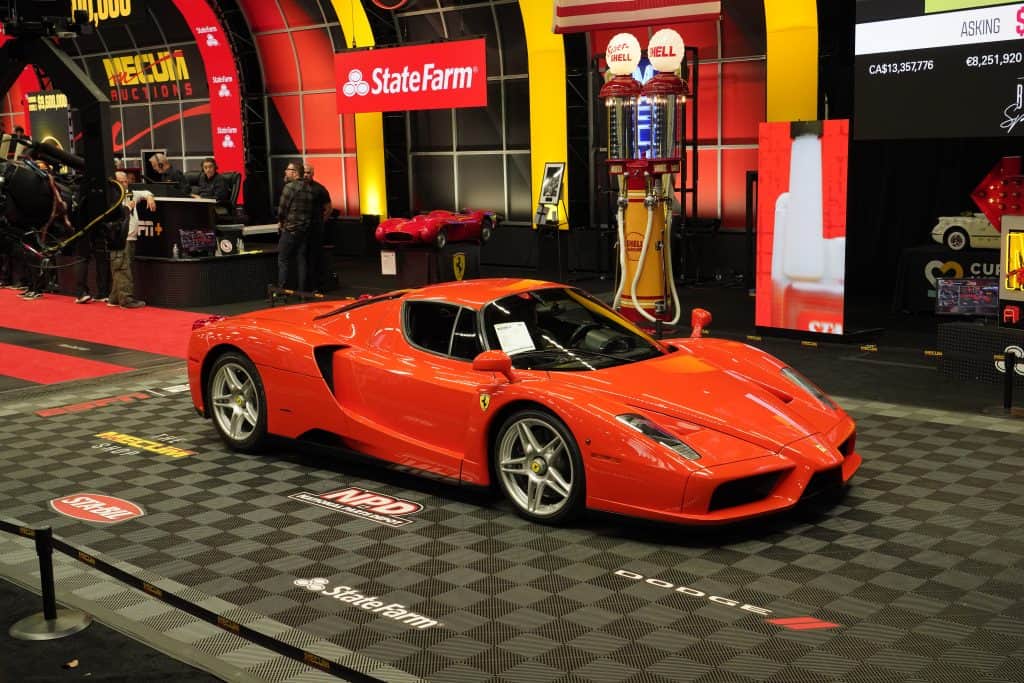
A conventional Enzo in a more common color, with higher mileage, incomplete records, or less desirable history, will not automatically sell for $13 million. The market still separates exceptional cars from ordinary examples.
However, the sale confirms that rare factory specifications can create an enormous premium when they are combined with a desirable model, low mileage, strong maintenance, and documented provenance.
Other unusual Enzos have also attracted attention. A 2004 Enzo finished in Argento Nürburgring, one of only nine in that color, sold through RM Sotheby’s in Monaco for €6.53 million. That result showed that rare factory colors can materially affect values.
The Rosso Dino car went much further because it was not one of nine. It was one of a kind.
Collectors were not simply bidding on orange paint. They were bidding on an unrepeatable factory story connected to Ferrari’s heritage.
A Turning Point for Digital Auctions
The sale may become a defining moment for online collector-car platforms. duPont REGISTRY Live launched in late 2025, and the Rosso Dino Enzo immediately gave the platform a record that established auction houses have spent decades building toward. The transaction showed that online sales are no longer limited to lower-priced collector vehicles.
For sellers, the digital format can offer a broader global audience and avoid the logistics of transporting a rare vehicle to a major live event. For buyers, it provides access to significant cars without requiring international travel.
The physical auction room will not disappear. Major events still create excitement, prestige, and direct access to specialists. But the Enzo sale demonstrated that the most important bidding battles can now happen on a screen.
The one-of-one Rosso Dino Ferrari Enzo sold for $12,399,000 before the buyer’s premium and $13,018,950 after fees because it combined the qualities elite collectors value most.
It was one of Ferrari’s defining modern hypercars. It had low mileage, documented maintenance, original accessories, and strong provenance. Most importantly, it was the only Enzo ever factory-finished in Rosso Dino.
The original owner spent only $2,364 on the special paint option. More than 20 years later, that decision helped create the most expensive car ever sold through an online-only auction.
Also Read: 10 Most Stolen Vehicles in 2025 Ranked
