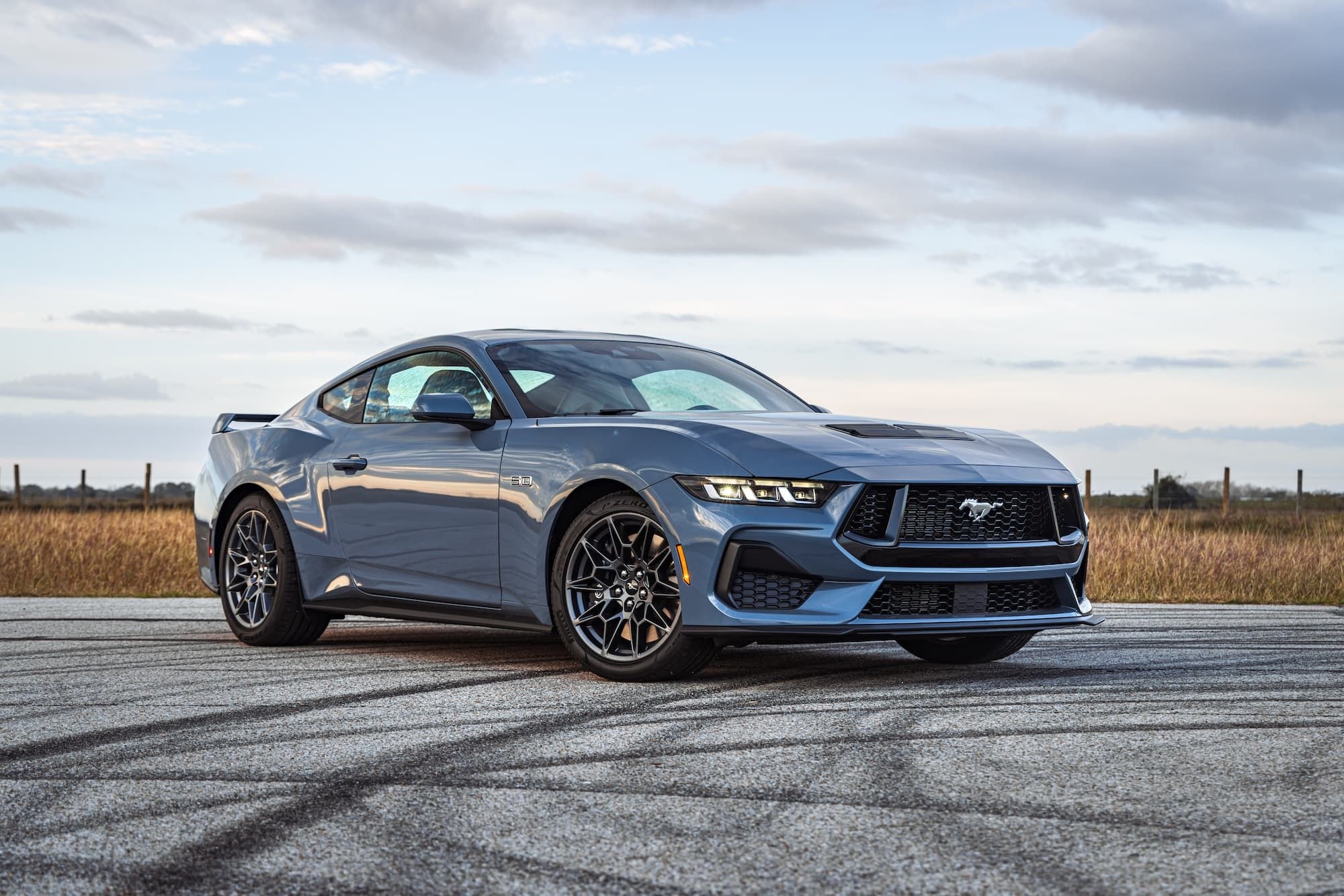
Hennessey Performance Engineering has introduced a new Super Venom package for the current Ford Mustang GT, turning the S650-generation pony car into an 850-horsepower performance machine.
The conversion is aimed at buyers who want substantially more power than Ford’s standard V8 Mustang provides but do not want to step into the rare and dramatically more expensive Mustang GTD.
The package starts with the 2024 and newer Mustang GT, which uses Ford’s 5.0-liter naturally aspirated Coyote V8. In stock form, the engine produces 480 horsepower, or 486 horsepower with the optional active exhaust system.
Hennessey’s Super Venom upgrade adds forced induction and supporting hardware to raise output to 850 horsepower.
That is an increase of more than 360 horsepower over a standard Mustang GT. It also puts the Super Venom above the output of Ford’s previous-generation Shelby GT500, which used a supercharged 5.2-liter V8 rated at 760 horsepower.
The result is a Mustang that remains based on a familiar production car but enters a much more serious category of performance. It is designed for enthusiasts who want the sound and character of Ford’s Coyote V8, combined with acceleration that can challenge much more expensive sports cars.
Hennessey has built its business around this formula for decades. The Texas company is known for transforming American trucks, muscle cars, SUVs, and supercars into higher-output versions through engine upgrades, suspension changes, aerodynamic parts, and limited-production packages.
The Super Venom follows that approach. It is not simply a bolt-on power kit. Hennessey is positioning it as a complete, documented conversion that adds visual distinction and warranty support alongside its headline horsepower figure.
Also Read: 10 Most Reliable Trucks Of The Last Decade & RANKED
The Coyote V8 Is a Strong Foundation
Ford’s 5.0-liter Coyote V8 has become one of the most respected modern American performance engines.
It is naturally aspirated, rev-happy, and capable of producing strong power without relying on turbochargers or hybrid assistance. The engine has been refined through several Mustang generations, with improvements to airflow, fuel delivery, cooling, valve control, and electronic calibration.
The current S650 Mustang GT gives Hennessey a strong starting point. The car uses a modern chassis, rear-wheel drive, independent rear suspension, and a choice between a six-speed manual transmission and Ford’s 10-speed automatic.
The standard Mustang GT is already quick enough for most drivers. But the Coyote engine has long been popular among tuners because it responds well to forced induction. A properly engineered supercharger system can add major horsepower while retaining the immediate throttle response that makes the V8 appealing.
The Super Venom package uses a high-output supercharger system to increase airflow into the engine. More air allows the engine to burn more fuel, producing far more power than it can in naturally aspirated form.
Unlike a turbocharger, which is powered by exhaust gases, a supercharger is driven mechanically by the engine. That generally delivers a boost more immediately when the driver presses the throttle. For a Mustang that can create strong acceleration from low engine speeds and maintain power through the rev range.
The supercharger is only one part of the upgrade. Hennessey also recalibrates the engine management system and adds supporting components to make the package work as a complete system.
That tuning is essential. An 850-horsepower conversion must manage air temperatures, fuel delivery, ignition timing, throttle behavior, transmission operation, and safety controls. A large dyno number means little if the car is difficult to drive, inconsistent in hot weather, or vulnerable to mechanical problems.
More Than a Straight-Line Upgrade
An 850-horsepower Mustang GT will be far quicker than the factory version, but real-world performance depends on more than engine output. The main issue is traction.
The Mustang remains a rear-wheel-drive coupe. Even with modern suspension design and wide tires, 850 horsepower can overwhelm the rear wheels easily. Cold pavement, wet roads, dusty surfaces, and aggressive throttle inputs can make the car difficult to control.
Hennessey’s package includes performance upgrades intended to help the Mustang handle the added power, but drivers should understand what this level of output means. The Super Venom is not a beginner-friendly sports car. It requires restraint and skill, particularly in a manual-transmission model.
The 10-speed automatic may offer more consistent acceleration because it shifts quickly and keeps the engine in its strongest power range. The manual transmission will appeal to drivers who want a more involved experience, but managing 850 horsepower through a clutch pedal requires careful throttle control.
Tires will also become a major ownership cost. High-performance rubber provides better grip, but it wears more quickly when subjected to repeated hard launches and aggressive driving. Brake wear, fuel consumption, and maintenance demands can also increase as the car is driven closer to its performance limits.
That is part of the trade-off. The Super Venom gives the Mustang supercar-level power, but it also demands more attention from its owner than a standard GT.
Hennessey Adds a Distinctive Exterior Package
The Super Venom is intended to look different from a regular Mustang GT. Hennessey has traditionally combined major engine upgrades with exterior changes that make its vehicles recognizable.
The Super Venom package includes carbon-fiber elements, revised aerodynamic pieces, unique badging, special wheels, and graphics designed to give the car a more aggressive identity.
The visual changes are important because customers paying for a high-output conversion often want more than hidden mechanical work. They want the vehicle to stand apart at a car meet, on a showroom floor, or beside a standard Mustang GT.
The S650 Mustang already has a more angular and technical appearance than the previous generation. Its upright front end, sharp headlights, broad grille openings, and sculpted bodywork give it a more modern stance.
Hennessey’s additions are designed to push that design further without changing the car into something unrecognizable.
The company also limits production of its special packages, which gives the Super Venom a level of exclusivity. A privately modified Mustang may have similar power, but it may not have the documentation, serial-number identity, or factory-style presentation of a Hennessey build.
For some buyers, that distinction matters when it comes time to sell. A documented conversion from an established performance company can be easier to explain to a future owner than a car assembled from parts by multiple shops.
Where It Fits in Ford’s Mustang Range
Ford’s Mustang lineup now covers a wide range of performance levels. The regular Mustang GT remains the core V8 model. The Mustang Dark Horse adds 500 horsepower, track-focused suspension tuning, upgraded cooling, and more serious performance hardware.
The Mustang GTD sits at the end of the range with a supercharged V8, advanced aerodynamics, and a price that places it closer to European exotic cars than traditional muscle cars. The Hennessey Super Venom uniquely fits between these models.
It starts with the regular Mustang GT rather than the Dark Horse. Its 850-horsepower rating gives it much more straight-line power than the Dark Horse, but it does not replace Ford’s factory-developed track package.
The Dark Horse remains a more integrated performance model from Ford, with suspension, braking, cooling, and chassis development aimed at track use.
The GTD is different again. It is a limited-production flagship designed to deliver extreme track performance and advanced engineering. Its price and availability place it beyond the reach of most Mustang buyers.
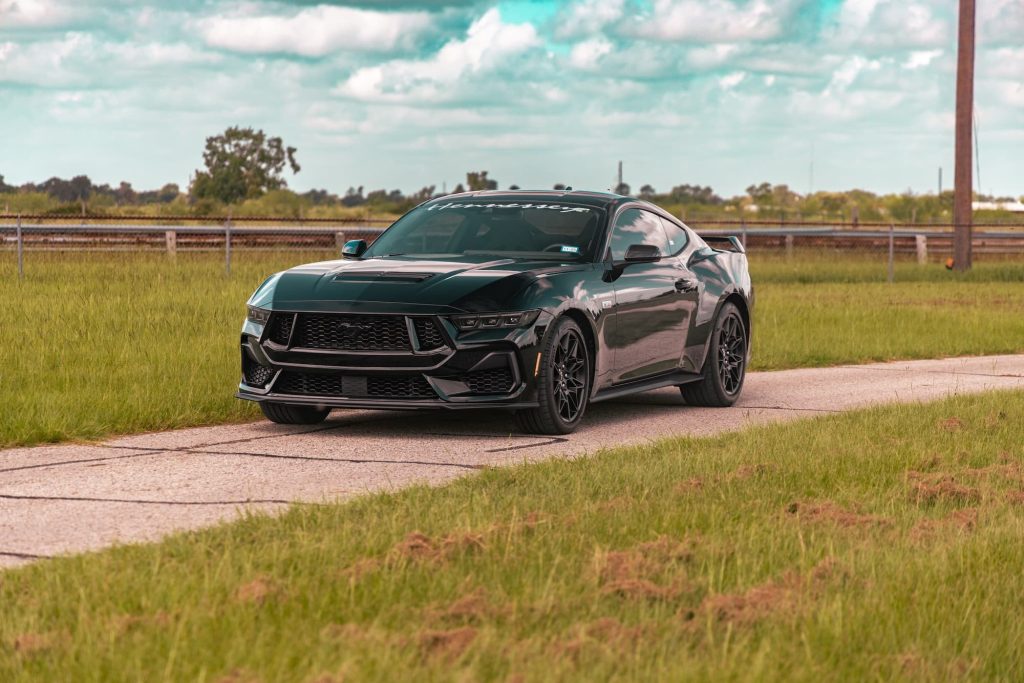
The Super Venom offers another path. It gives a customer the ability to own a modern Mustang with exotic-car power without needing a GTD allocation. It also allows buyers to begin with a Mustang GT they may already own, rather than purchasing an entirely different vehicle.
Warranty Support Helps Separate It From a Typical Build
High-horsepower modifications raise obvious questions about reliability. Adding more than 360 horsepower increases stress on the engine, transmission, driveshaft, differential, cooling system, tires, and brakes. Buyers who install aftermarket parts individually may face complicated warranty situations if a problem occurs.
Hennessey addresses this concern by offering warranty coverage with its performance packages. The company has long promoted its upgrades as engineered, dyno-tested, and supported by its own warranty terms.
That does not mean the original Ford warranty will remain unchanged. Major performance modifications can affect factory coverage, and buyers should carefully read the terms of both Ford’s warranty and Hennessey’s agreement before ordering.
Still, the presence of a dedicated warranty is important. It gives customers more confidence than they might have with a privately assembled modification package. Hennessey is not simply selling parts. It is selling a complete conversion and standing behind the work.
A Sign of Continued Demand for V8 Performance
The Super Venom arrives at a moment when the auto industry is moving toward electrification, hybrid powertrains, and smaller turbocharged engines. Yet demand remains strong for vehicles that deliver traditional V8 performance.
The Mustang is one of the few major American performance cars still available with a naturally aspirated V8 and a manual transmission. That combination has become increasingly rare.
Hennessey’s package speaks directly to buyers who want that old-school formula with modern power. The Super Venom retains the Mustang’s basic identity: a front-engine, rear-wheel-drive coupe with a V8 soundtrack and strong straight-line performance.
It simply takes the formula much further. The package will not be cheap, and it will not be practical for every driver. It will consume more fuel under hard use, require expensive tires, and demand serious respect behind the wheel.
But for enthusiasts who want an 850-horsepower American coupe with a documented performance pedigree, Hennessey’s Super Venom offers a dramatic alternative to the standard Mustang GT.
Also Read: 10 Cars That Hold Their Value Better Than a Toyota