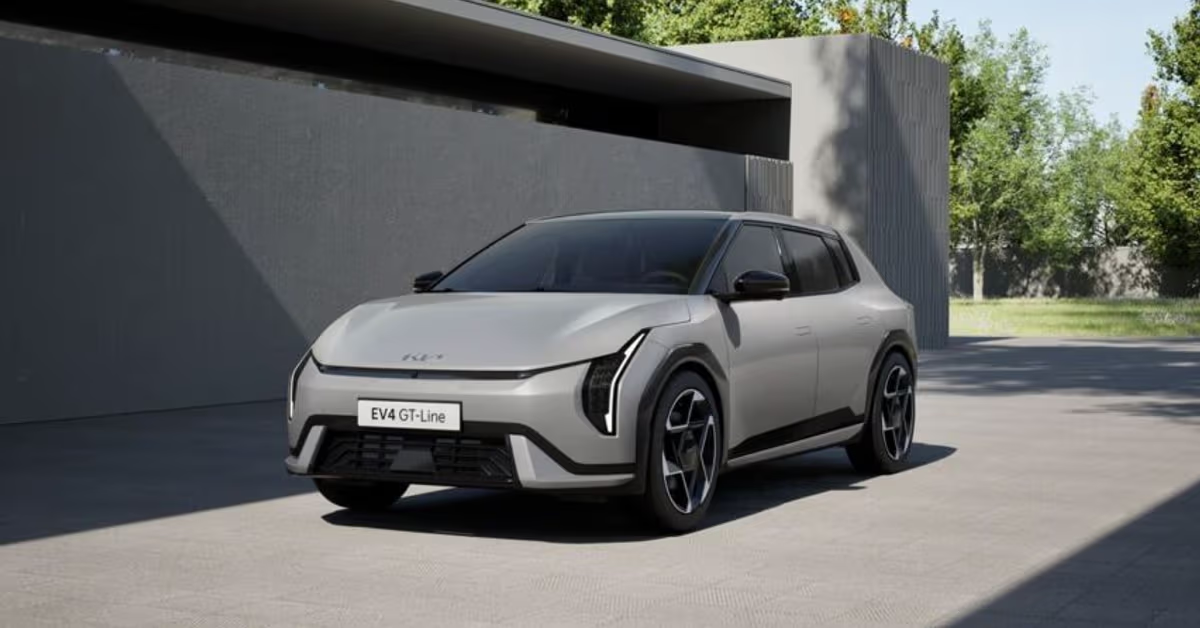
Kia has offered one of its clearest looks yet at the upcoming EV4 sedan, releasing new teaser images and additional technical details ahead of the model’s official global debut.
The preview provides further insight into the automaker’s latest electric vehicle strategy as it expands beyond SUVs and crossovers into the increasingly competitive electric sedan segment.
The EV4 represents another important step in Kia’s long-term electrification roadmap. While SUVs continue to dominate global EV sales, the company believes there remains strong demand for efficient, stylish electric sedans capable of combining long driving range with advanced technology and everyday practicality.
According to the Kia Newsroom, the EV4 has been designed with a strong emphasis on aerodynamic efficiency, digital connectivity, and next-generation electric architecture.
The sedan is expected to join Kia’s growing EV lineup alongside the EV3, EV5, EV6, and EV9, giving the company one of the broadest electric vehicle portfolios among mainstream automakers.
The preview also reinforces Kia’s commitment to launching multiple dedicated battery-electric vehicles before the end of the decade as it works toward becoming one of the world’s leading EV manufacturers.
Also Read: 8 Used Motorcycles Selling Above Original MSRP
A New Direction for Kia’s Electric Sedan Strategy
Unlike many manufacturers that adapted existing gasoline-powered sedans into electric vehicles, Kia has developed the EV4 as a purpose-built battery-electric model.
According to Kia, the EV4 follows the company’s “Opposites United” design philosophy, blending sharp body lines with smooth aerodynamic surfaces intended to maximize efficiency without sacrificing visual appeal.
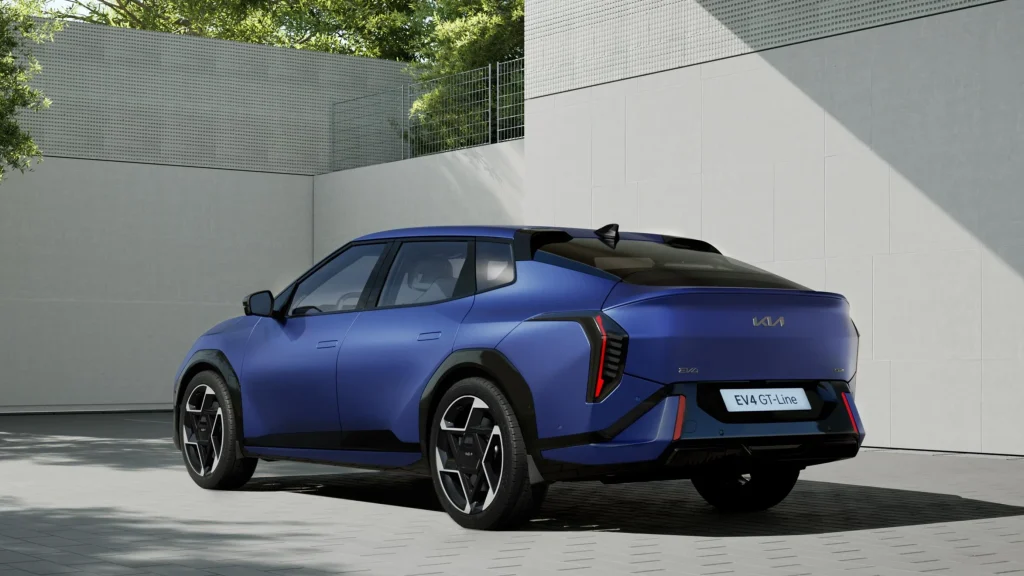
The newly released teaser images reveal a low-slung profile, an extended wheelbase, short overhangs, and a streamlined roofline that distinguishes the EV4 from traditional compact sedans.
The front fascia incorporates Kia’s latest interpretation of its signature “Digital Tiger Face,” complemented by vertically positioned LED lighting elements and an enclosed front grille designed to improve airflow around the vehicle.
At the rear, slim vertical taillights and an integrated decklid spoiler further emphasize the sedan’s aerodynamic character.
According to Kia, every major exterior element has been carefully shaped to reduce drag while maintaining a modern appearance suitable for global markets.
Efficiency has become one of the most important engineering priorities for modern electric vehicles.
Unlike gasoline-powered cars, where aerodynamic improvements primarily enhance fuel economy at highway speeds, aerodynamic efficiency directly influences EV driving range by reducing energy consumption.
According to Kia, the EV4’s body has been optimized to minimize airflow disruption across the hood, roof, underbody, and rear section.
Although the company has not yet announced an official drag coefficient, engineers indicate that extensive wind tunnel development played a central role throughout the vehicle’s design process.
Features such as flush door handles, carefully sculpted side panels, active airflow management, and specially designed wheels are expected to contribute to improved efficiency.
Industry analysts note that even small aerodynamic improvements can translate into meaningful increases in real-world driving range, particularly during sustained highway travel.
As manufacturers compete to maximize battery efficiency without dramatically increasing battery size, aerodynamic design has become one of the industry’s most valuable engineering tools.
Built on Kia’s Dedicated Electric Vehicle Platform
The EV4 will utilize Kia’s Electric Global Modular Platform (E-GMP), the same dedicated EV architecture that underpins several of the company’s current electric models.
According to Kia, the platform offers significant advantages over modified gasoline vehicle architectures, including a flat battery floor, longer wheelbase, improved interior packaging, and greater structural rigidity.
The E-GMP platform has already proven capable of supporting both single-motor and dual-motor configurations, rear-wheel drive and all-wheel drive layouts, and battery capacities designed to accommodate different driving range requirements.
Industry experts expect the EV4 to benefit from many of the same engineering advantages seen in the EV6 and EV9, including rapid charging capability, optimized weight distribution, and advanced battery management systems.
Although Kia has not confirmed final powertrain specifications, analysts anticipate multiple battery and drivetrain options to meet the needs of different global markets.
While Kia has not released official EPA or WLTP driving range estimates, the company has emphasized efficiency as one of the EV4’s primary engineering objectives.
Industry observers expect the sedan to offer driving range figures competitive with other compact and midsize electric sedans currently available.
Depending on battery configuration and regional specifications, estimates suggest the EV4 could comfortably exceed 300 miles of driving range in certain versions, although final certified figures will be announced closer to launch.
According to Kia, improvements in battery chemistry, thermal management, regenerative braking, and software optimization will contribute to maximizing real-world efficiency.
Longer driving range remains one of the most influential factors affecting EV purchasing decisions, making this area particularly important as Kia expands its electric portfolio.
Advanced Charging Technology Continues
The EV4 is also expected to inherit Kia’s advanced charging capabilities. The E-GMP platform currently supports high-voltage charging systems capable of significantly reducing charging times when connected to compatible DC fast chargers.
According to Kia, its latest electric vehicle architecture enables rapid charging that allows drivers to recover a substantial portion of battery capacity during relatively short charging stops.
Although the company has not yet disclosed official charging times for the EV4, industry analysts expect performance similar to Kia’s existing dedicated EV models.
The vehicle is also expected to support vehicle-to-load (V2L) functionality, allowing owners to power external electrical devices directly from the battery, a feature that has become increasingly popular among Kia’s electric vehicle customers.
Future software updates delivered through over-the-air technology are also expected to expand functionality throughout the vehicle’s ownership cycle.
While the latest teaser images primarily highlight the exterior design, Kia has confirmed that the EV4 will feature the company’s newest digital cockpit technology.
According to Kia, the cabin will emphasize simplicity, connectivity, and sustainable materials while providing a spacious interior made possible by the dedicated electric platform.
Industry observers expect the dashboard to incorporate dual panoramic displays combining digital instrumentation and infotainment within a single integrated interface.
Wireless Apple CarPlay, Android Auto, cloud-connected navigation, voice recognition, and over-the-air software updates are expected to be standard across much of the lineup.
Advanced driver assistance technologies are also likely to include adaptive cruise control, highway driving assistance, lane-centering technology, blind-spot monitoring, automatic emergency braking, and parking assistance systems.
As software becomes an increasingly important differentiator among electric vehicles, Kia continues investing heavily in digital user experiences alongside traditional automotive engineering.
Expanding Kia’s Global EV Portfolio
The EV4 forms part of Kia’s broader effort to establish one of the industry’s most comprehensive electric vehicle lineups.
The company has steadily introduced dedicated battery-electric models covering multiple vehicle categories, including compact crossovers, midsize SUVs, flagship three-row SUVs, and now an all-electric sedan.
According to Kia, the company plans to continue expanding its EV family as global demand for battery-electric vehicles grows throughout the remainder of the decade.
The EV4 also reflects Kia’s strategy of targeting customers seeking practical everyday transportation rather than focusing exclusively on premium luxury buyers.
By introducing vehicles across multiple price points and body styles, Kia aims to attract a broader customer base while strengthening its position in key global markets.
The company has repeatedly stated that electrification remains central to its long-term business strategy.
Competition in the Electric Sedan Segment
The EV4 will enter one of the fastest-evolving areas of the global EV market. Established competitors include the Tesla Model 3, Hyundai Ioniq 6, Polestar 2, BYD Seal, Volkswagen ID.7, BMW i4, Mercedes-Benz CLA EV, and several new Chinese electric sedans expanding into international markets.
Each manufacturer is competing through different combinations of driving range, charging speed, software capability, performance, and pricing.
For Kia, success will likely depend on balancing competitive technology with attractive pricing and strong full value.
The company’s reputation for reliability, lengthy warranty coverage in many markets, and growing expertise in dedicated EV development may provide important advantages as competition intensifies.
Industry analysts expect consumer demand for electric sedans to remain strong despite the continued popularity of SUVs, particularly in markets where efficiency and urban maneuverability are highly valued.
The EV4 also aligns with Kia’s broader environmental and business objectives. The company has committed to significantly expanding its battery-electric vehicle sales while reducing fleet emissions and investing in sustainable manufacturing practices.
According to Kia, future electric models will increasingly incorporate recycled materials, environmentally responsible production methods, and software-focused vehicle architectures capable of receiving continuous updates throughout their service life.
These investments support the company’s ambition to remain competitive as governments around the world introduce stricter emissions standards and consumers place greater emphasis on sustainability.
Rather than viewing the EV4 as an isolated product, Kia positions it as another building block within a much larger transformation of its global vehicle portfolio.
Although Kia has not yet revealed every technical specification, the latest preview confirms that the EV4 will play a major role in the company’s next phase of electric vehicle expansion.
With its aerodynamic design, dedicated E-GMP architecture, advanced charging capability, and modern digital technology, the sedan has been engineered to compete in one of the industry’s most dynamic market segments.
According to the Kia Newsroom, the EV4 demonstrates the company’s commitment to combining efficiency, innovation, and practical everyday usability in a dedicated electric sedan.
With the official global debut nearing, more information about the EV4’s battery choices, range, performance capabilities, pricing, and availability is expected to emerge. These details will help determine how the model compares with the growing number of electric vehicles competing in the market.
For Kia, the EV4 is more than simply another model launch. It represents the continued evolution of a brand that has rapidly established itself as one of the automotive industry’s leading innovators in electric mobility, offering customers an expanding range of vehicles designed to meet the changing demands of the global transportation landscape.
Also Read: 8 Limited-Run Vintage Cars That Sold Out and Never Came Back