
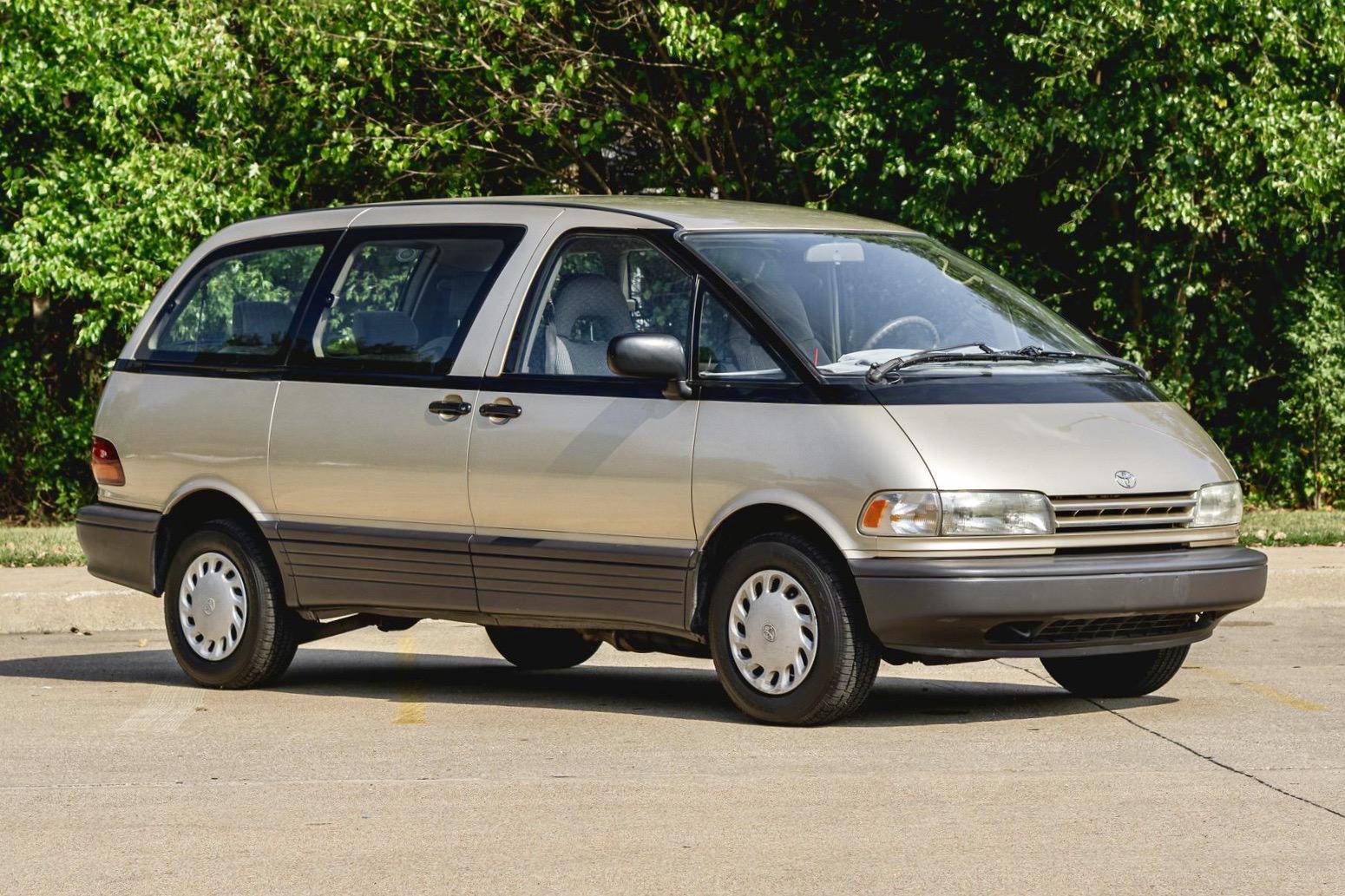
Minivans have always been designed with practicality in mind. Families buy them for spacious interiors, comfortable seating, excellent visibility, and generous cargo capacity rather than exciting engineering.
Most modern minivans follow a familiar formula: a front-mounted engine, front-wheel drive, and a layout optimized for passenger comfort. It is a design that has remained largely unchanged for decades because it works exceptionally well. During the early 1990s, however, Toyota took an entirely different approach.
Instead of placing the engine under the hood like virtually every other minivan, Toyota positioned it beneath the front seats, creating a unique mid-engine layout.
Even more surprising, Toyota later offered a supercharged version that transformed the practical Previa into one of the most mechanically unusual family vehicles ever sold in the United States. It wasn’t built to compete with sports cars, but its engineering made it unlike any other production minivan of its era.
Introduced to the U.S. market for the 1991 model year, the first-generation Toyota Previa combined futuristic styling, available all-wheel drive, and innovative packaging with an engine placement rarely seen outside exotic sports cars.
According to Toyota engineering documents and automotive historians, the Previa remains one of the most unconventional production vehicles ever developed, proving that even a family minivan could become an engineering showcase.
Also Read: 8 Car Seats That Get Painful After One Hour
Why Toyota Put the Engine Under the Front Seats
The first-generation Previa was designed from the ground up rather than adapted from an existing passenger car.
Toyota engineers wanted to maximize cabin space while improving ride quality and weight distribution. To accomplish this, they mounted the engine almost entirely behind the front axle, tucked beneath the driver and front passenger seats at roughly a 75-degree angle.
Although commonly referred to as a mid-engine layout because the engine sat behind the front wheels, it still drove the rear wheels in standard models through a driveshaft, with an optional all-wheel-drive system available for buyers needing additional traction.
Power came from Toyota’s 2.4-liter 2TZ-FE inline-four, producing approximately 138 horsepower and 145 lb-ft of torque. While these numbers were adequate for everyday family transportation, the engine had to move a vehicle weighing well over 3,700 pounds, making acceleration slower than many competing minivans.
The unusual engine placement created several advantages. By moving the engine rearward, Toyota shortened the front overhang, improved front-to-rear weight distribution, and created a remarkably low, flat floor throughout much of the cabin.
The design also contributed to the Previa’s distinctive egg-shaped body, which achieved an impressive aerodynamic drag coefficient for a vehicle of its size.
Service access, however, became considerably more complicated. Routine maintenance required technicians to remove interior access panels beneath the front seats, while larger repairs often involved accessing components from underneath the vehicle or through the engine compartment.
Although owners appreciated the vehicle’s reliability, mechanics often found the unconventional layout more time-consuming to service than traditional front-engine designs.
Toyota also equipped the Previa with independent suspension at all four corners, providing a smoother ride than many truck-based vans of the era. Combined with rear-wheel drive and balanced weight distribution, the Previa offered surprisingly composed handling for a family hauler.
The Supercharged Previa Was Unlike Any Other Minivan
By the mid-1990s, Toyota recognized that many buyers wanted stronger acceleration. Rather than replacing the engine with a larger V6, engineers chose a more unusual solution.
For the 1994 model year, Toyota introduced the 2TZ-FZE, a factory-supercharged version of the same 2.4-liter engine. Using an Eaton Roots-type supercharger combined with an air-to-air intercooler, output increased to approximately 161 horsepower and 210 lb-ft of torque.
The torque improvement proved especially important. Instead of dramatically increasing high-rpm horsepower, the supercharger produced substantially stronger low-end pulling power, making the heavy Previa feel more responsive during city driving, highway merging, and climbing steep grades with passengers or cargo onboard.
Unlike many factory supercharged vehicles marketed primarily for performance, Toyota designed the system to improve drivability and maintain reliability. Boost pressures remained relatively conservative, allowing the engine to retain Toyota’s reputation for long-term durability while providing noticeably improved acceleration.
Buyers could pair the supercharged engine with either rear-wheel drive or Toyota’s available all-wheel-drive system. At the time, this combination made the Previa one of the most technically advanced minivans available anywhere in the world.
The Previa’s driving characteristics also differed from competitors because of its rear-wheel-drive architecture. Steering remained light and predictable, while the independent suspension delivered impressive ride comfort.
Although few owners purchased the vehicle for spirited driving, many automotive journalists noted that it handled more confidently than expected for a minivan.
A Brilliant Design That Was Simply Too Complex
Despite its engineering brilliance, the first-generation Previa faced significant market challenges.
Competitors such as the Honda Odyssey, Dodge Caravan, and later the Toyota Sienna adopted more conventional front-engine, front-wheel-drive layouts that proved less expensive to manufacture, easier to service, and more spacious inside.
The under-seat engine consumed valuable packaging space that could otherwise have been used for lower floors or additional interior storage. Maintenance complexity also increased ownership costs for some repairs, even though Toyota’s full reliability remained excellent.
Recognizing changing market demands, Toyota replaced the original Previa in North America with the 1998 Toyota Sienna, which adopted the industry-standard front-engine, front-wheel-drive configuration. While the Sienna became a major commercial success, it abandoned nearly all of the engineering innovations that had made the Previa unique.
Today, the original Previa has developed a devoted following among enthusiasts who appreciate unusual automotive engineering. Supercharged models equipped with all-wheel drive are particularly desirable because they represent one of the rarest combinations ever offered in a production minivan.
Their distinctive layout, dependable Toyota mechanicals, and growing collector interest have steadily increased their appeal in recent years.
Looking back, the first-generation Toyota Previa was decades ahead of its time. A mid-engine layout, available factory supercharger, rear-wheel drive, optional all-wheel drive, and a spacious family-friendly interior were features no competitor combined in a single vehicle.
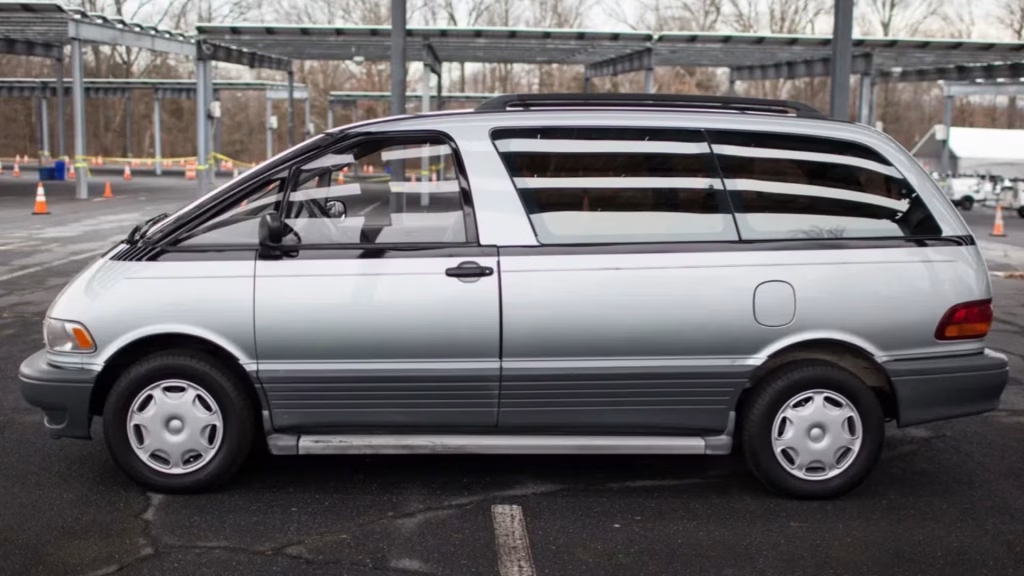
Although later minivans adopted simpler engineering to meet mainstream buyer expectations, the Previa remains one of the boldest family vehicles Toyota has ever produced.
Its commercial success never matched its technical ambition, but its legacy is secure. More than thirty years after its debut, the Toyota Previa continues to stand as one of the most unconventional and innovative minivans ever sold, proving that practical transportation could also be an extraordinary engineering achievement.
Why the Previa Has Become a Cult Classic Among Enthusiasts
The first-generation Toyota Previa is appreciated today not because it was the fastest or best-selling minivan of its era, but because it represented a level of engineering creativity that is rarely seen in modern family vehicles.
At a time when most manufacturers were focused on reducing costs through shared platforms and conventional layouts, Toyota invested heavily in designing an entirely new architecture specifically for the Previa.
The result was a vehicle that looked futuristic, drove differently from its competitors, and introduced engineering solutions that remain fascinating more than three decades later.
One of the reasons enthusiasts continue to seek out the Previa is its remarkable durability. Toyota’s 2TZ-series engine earned a reputation for longevity when properly maintained, with many examples exceeding 250,000 to 300,000 miles without major internal engine repairs.
Owners frequently praise the Previa for its dependable drivetrain, comfortable ride, and ability to handle years of family use while requiring relatively little unscheduled maintenance.
Although repairs could sometimes be labor-intensive because of the under-seat engine location, the vehicle’s full reliability helped offset those challenges.
The supercharged all-wheel-drive version has become especially desirable among collectors because relatively few were produced compared with standard rear-wheel-drive models. Finding one today in original condition is becoming increasingly difficult, leading to rising interest in the collector market.
Enthusiasts also appreciate that the supercharged Previa represents a unique combination unlikely to ever return: a factory-built, mid-engine, rear-wheel-drive or all-wheel-drive minivan with forced induction from one of the world’s most respected reliability-focused manufacturers.
Perhaps the Previa’s greatest legacy is that it demonstrated Toyota’s willingness to pursue unconventional engineering when it believed a better solution existed.
While later minivans adopted more traditional front-engine layouts to improve manufacturing efficiency and interior packaging, the original Previa remains a reminder of an era when automakers occasionally prioritized innovation over convention.
Today, it stands as one of the most distinctive family vehicles ever built and a fascinating chapter in Toyota’s engineering history, earning admiration from collectors and automotive historians who recognize just how bold its design truly was.
Also Read: Toyota RAV4 Trim Guide for Buyers Spending Under $38,000
