
Performance pickups are everywhere today. Ford has the F-150 Raptor, Ram builds the TRX, and Chevrolet offers increasingly powerful Silverado variants.
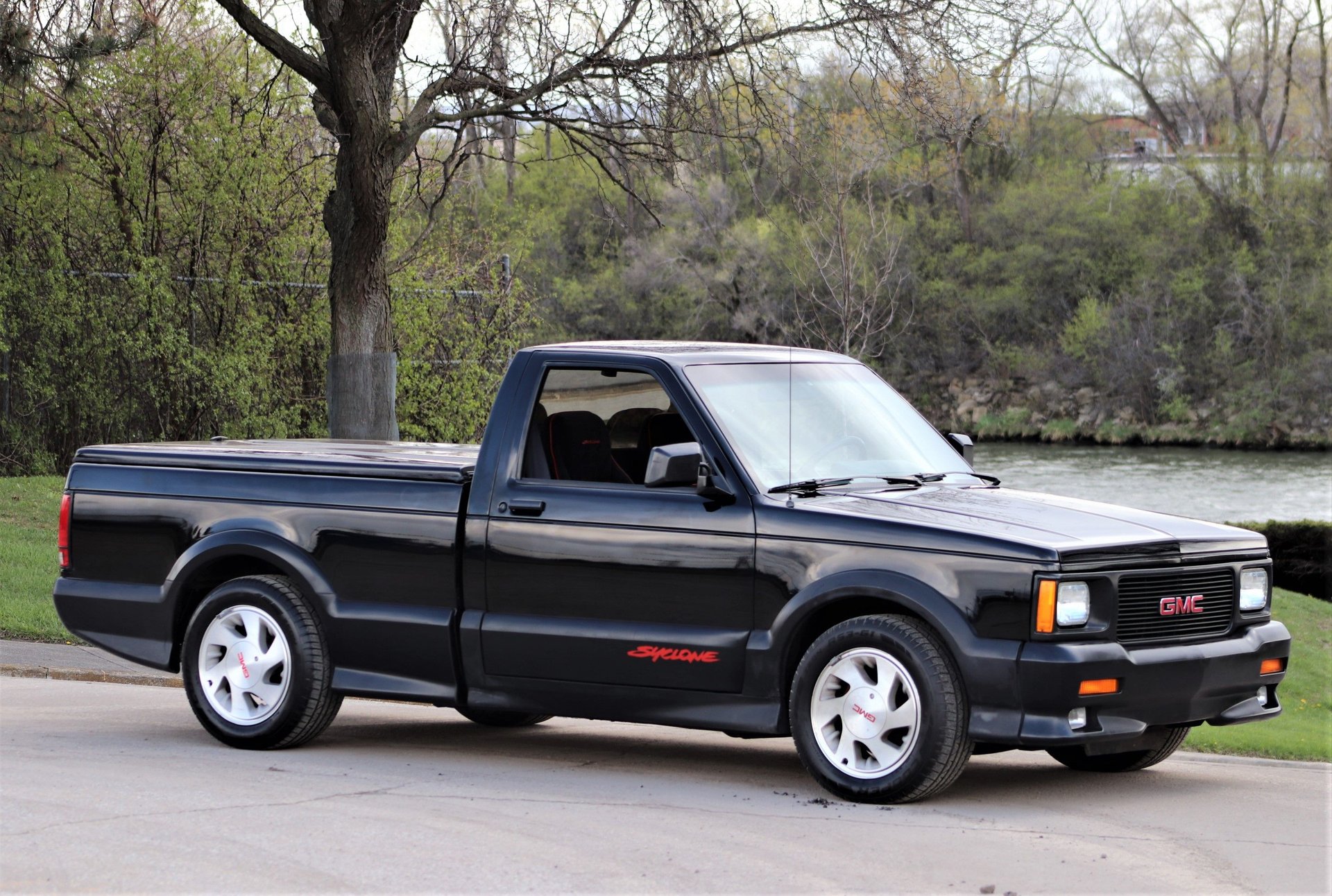
But in the early 1990s, the idea of a pickup truck embarrassing exotic sports cars seemed almost impossible. Pickups were built to haul lumber, tow trailers, and tackle job sites, not outrun Ferraris. Then General Motors shocked the automotive world with the 1991 GMC Syclone.
Based on the compact GMC Sonoma pickup, the Syclone combined a turbocharged V6 engine with an advanced all-wheel-drive system to create one of the quickest production vehicles America had ever built.
Its performance was so astonishing that Car and Driver’s instrumented testing recorded the Syclone reaching 60 mph quicker than Ferrari’s 348, one of Italy’s flagship sports cars at the time. It wasn’t simply fast for a truck. It was genuinely one of the quickest production vehicles on sale anywhere in the world.
Built for just one model year in 1991, with 2,995 units produced, the Syclone remains one of General Motors’ boldest engineering experiments. More than three decades later, it continues to be remembered as the pickup that rewrote expectations of what a truck could achieve.
Also Read: 10 Most Expensive Harley-Davidsons Ever Sold
How GMC Turned an Ordinary Pickup into a Supercar Slayer
The Syclone began life as a standard GMC Sonoma, but almost every important mechanical component was transformed. General Motors partnered with Production Automotive Services (PAS) to engineer a vehicle that prioritized acceleration over payload capacity, a radical concept at the time.
Under the hood sat a 4.3-liter LB4 V6, an engine closely related to Chevrolet’s famous small-block V8 family.
Rather than relying on naturally aspirated displacement, engineers fitted the V6 with a Mitsubishi TD06-17C turbocharger, an air-to-air intercooler, revised fuel injection, upgraded engine management software, and stronger internal components capable of handling substantially more boost pressure.
Officially, GMC rated the engine at 280 horsepower and 350 lb-ft of torque. Even by modern standards, those numbers remain respectable, but in 1991 they were extraordinary for a midsize pickup.
Many enthusiasts and historians believe the factory ratings were intentionally conservative, as dyno testing and real-world performance suggested the engine produced noticeably more power than advertised.
Power was routed through a strengthened 4L60 four-speed automatic transmission, sending approximately 35 percent of torque to the front wheels and 65 percent to the rear via a BorgWarner all-wheel-drive transfer case.
Rather than relying on a traditional rear-wheel-drive setup that often overwhelmed the tires under heavy acceleration, the Syclone’s all-wheel-drive system allowed it to put its turbocharged power to the ground with impressive efficiency. This advanced drivetrain was the key factor behind the truck’s remarkable launch performance.
According to Car and Driver’s famous 1991 instrumented test, the GMC Syclone accelerated from 0 to 60 mph in just 4.3 seconds, completing the quarter mile in 13.7 seconds at 96 mph.
During the same comparison, Ferrari’s 348ts required approximately 5.6 seconds to reach 60 mph. While the Ferrari remained superior in top speed and handling, there was no arguing with the stopwatch during straight-line acceleration.
Those figures placed the Syclone among the fastest production vehicles sold in America, regardless of body style or price.
The Syclone’s success came from more than engine output alone. Engineers lowered the suspension, installed performance-tuned springs and shocks, upgraded anti-roll bars, fitted quicker steering calibration, and specified 16-inch alloy wheels wrapped in high-performance tires.
The truck sacrificed much of the Sonoma’s payload capability because performance had become the primary objective.
The Syclone’s speed was not simply the result of a powerful engine. Its greatest advantage came from how effectively it transferred that power to the pavement. With all-wheel drive working alongside the turbocharged engine, the truck could launch with remarkable stability as boost arrived, minimizing wheelspin and delivering acceleration that surprised even many sports cars of the era.
Despite its performance credentials, the truck’s exterior design was remarkably restrained. Available only in black, the Syclone carried a clean monochrome look highlighted by matching bumpers, a sportier front end, subtle aerodynamic enhancements, and unique Syclone badges that set it apart from the standard pickup.
Without loud graphics or oversized wings, many people underestimated the truck until they watched it disappear down the road.
The interior received similar treatment. Bucket seats, a sporty instrument cluster, leather trim, air conditioning, and power accessories made the Syclone comfortable enough for daily use while maintaining a purposeful appearance.
The Ferrari Comparison Changed Automotive History
The comparison that made the Syclone famous came from Car and Driver, whose independent testing placed the truck ahead of one of Europe’s most prestigious sports cars in the sprint to 60 mph.
The Ferrari 348 represented everything enthusiasts associated with Italian performance. It carried a mid-mounted 3.4-liter V8, produced around 300 horsepower, featured a five-speed manual transmission, and wore styling influenced by the legendary Testarossa. It was exotic, expensive, and purpose-built for speed.
The GMC was none of those things. It was a compact pickup with a turbocharged V6, an automatic transmission, and a cargo bed.
Yet acceleration favored the truck. The result generated headlines across the automotive industry because it challenged long-held assumptions about vehicle performance. Until then, pickups were judged by towing capacity and payload ratings, not quarter-mile times.
While critics correctly pointed out that the Ferrari eventually surpassed the GMC in top speed and delivered significantly better handling on a road course, those arguments largely missed the point. The Syclone wasn’t intended to compete with Ferrari.
Its purpose was to demonstrate what clever engineering could accomplish when traction, turbocharging, and torque worked together. General Motors also benefited from excellent timing.
The early 1990s marked a period when turbocharging was becoming increasingly sophisticated, electronic engine management was improving rapidly, and all-wheel-drive systems were beginning to appear outside luxury sedans. The Syclone combined all three technologies into a package unlike anything else on the market.
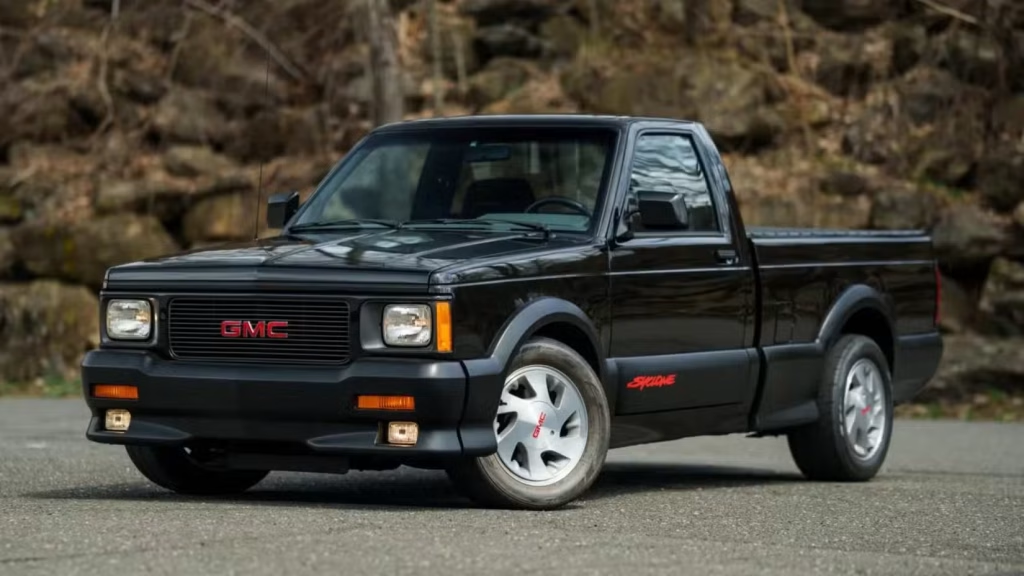
Its success paved the way for the 1992 GMC Typhoon, an SUV based on the Jimmy that used nearly the same drivetrain. Like the pickup, the Typhoon delivered astonishing acceleration and proved that high-performance utility vehicles could attract enthusiastic buyers long before performance SUVs became mainstream.
Why the Syclone Remains One of GM’s Greatest Performance Vehicles
Only 2,995 Syclones were produced during the 1991 model year, instantly making it one of General Motors’ rarest modern performance vehicles. Production remained intentionally limited because the truck served as a halo product rather than a high-volume model.
Its rarity has significantly increased collector interest. Original, low-mileage examples regularly command six-figure prices at major collector auctions, while well-preserved trucks continue appreciating as enthusiasts recognize their historical importance.
The Syclone also influenced the future of performance engineering. Today, nearly every high-performance truck relies on the same principles pioneered by GMC more than thirty years ago: forced induction, electronically controlled transmissions, sophisticated traction management, and maximizing low-end torque rather than focusing solely on peak horsepower.
Modern pickups such as the Ford F-150 Raptor R and Ram 1500 TRX produce far greater horsepower figures, but they owe part of their existence to the Syclone, proving there was genuine demand for trucks built primarily for speed.
Automotive historians also appreciate the truck because it represented a period when manufacturers were willing to experiment. Rather than following conventional market research, GMC created something no one had requested, but many enthusiasts immediately admired.
The Syclone wasn’t practical by pickup standards. Its lowered suspension reduced off-road ability, payload capacity was lower than a standard Sonoma, and towing capability took a back seat to performance. None of those compromises mattered because buyers weren’t purchasing it to haul building materials.
They were buying it because nothing else like it existed. Even today, the Syclone’s acceleration numbers remain impressive. A 0-to-60 mph time of 4.3 seconds would still make many modern performance sedans work hard, an incredible achievement for a vehicle engineered more than three decades ago.
More importantly, the truck fundamentally changed perceptions of what a pickup could be. Before the Syclone, speed belonged to Corvettes, Camaros, Mustangs, and Ferraris. After the Syclone, the idea that a pickup could outrun an exotic sports car no longer seemed impossible.
That single accomplishment secured the GMC Syclone’s place in automotive history. It wasn’t merely a fast truck. It became one of the most memorable performance vehicles General Motors has ever built, proving that innovation, turbocharging, and intelligent engineering could overcome expectations and leave even a Ferrari trailing behind at the first traffic light.
Also Read: 8 Cars That Cost the Most to Insure for a Teen Driver
