Audi’s next electric sports car has returned to public roads wearing what appears to be a Porsche 718 Boxster body. Still, the mule is widely understood to be testing hardware for Audi’s upcoming battery-electric coupe and roadster.
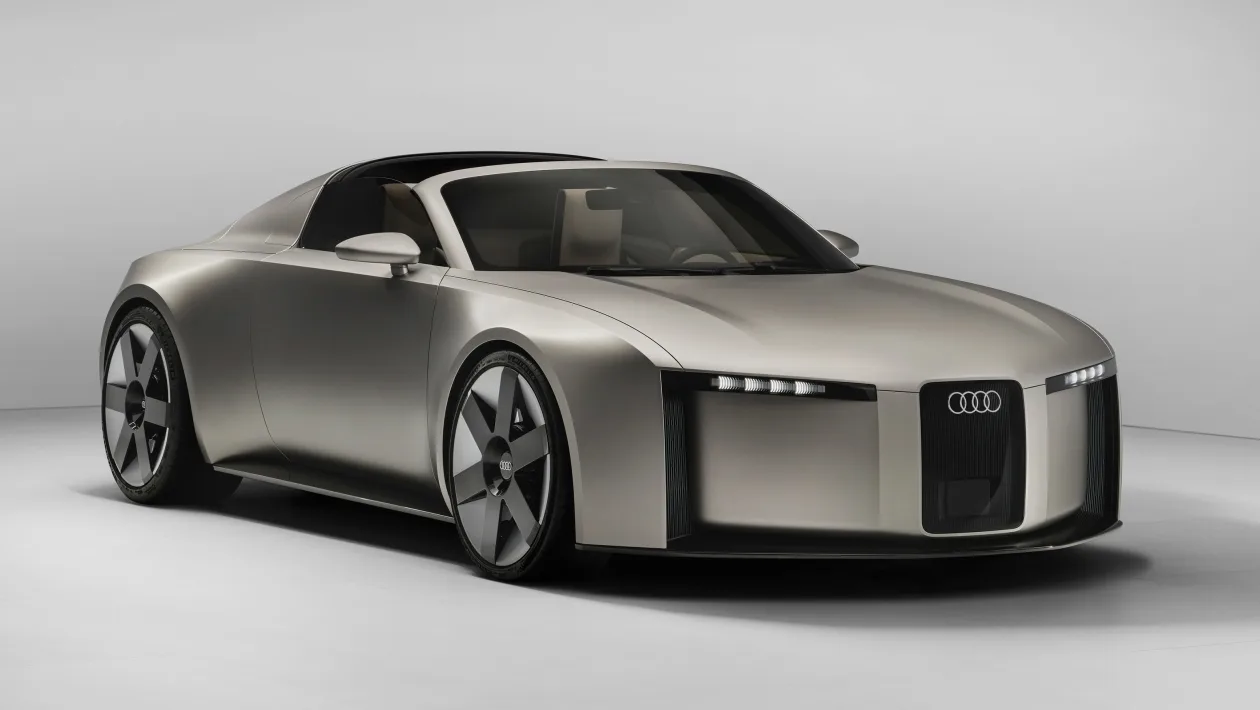
The vehicle is expected to become the production version of the Audi Concept C, a dramatic two-seat show car revealed in 2025 that signaled Audi’s intention to return to the compact sports-car segment after the original TT ended production in 2023.
The spy shots matter because they offer the clearest sign yet that Audi’s sports-car project is moving beyond design studies and toward production engineering.
The mule retains the broad shape of the upcoming electric Porsche 718, but it reportedly wears wider fender flares and modified bodywork, suggesting Audi is testing its own chassis, track width, cooling requirements, suspension tuning, and electric drivetrain calibration beneath the disguise.
Audi has not formally confirmed that the production car will use the TT name. Company executives have been careful to describe the Concept C as a vehicle positioned between the old TT and the R8, rather than a direct replacement for either model.
Yet the project is expected to fill much of the same emotional role once held by the TT: a compact, design-led Audi sports car with a more attainable position than a flagship supercar.
Also Read: 10 Best Jaguar Cars Ever Made & Ranked
Why Audi Is Using a Porsche Body
Using a Porsche-shaped mule is not unusual within the Volkswagen Group. Audi and Porsche already share major engineering resources on several projects. The Porsche Taycan and Audi E-Tron GT, for example, use related architecture but have distinct styling, suspension tuning, interiors, and brand identities.
The upcoming Audi sports car is expected to follow a similar pattern, sharing core engineering with Porsche’s next-generation electric 718 Boxster and Cayman while receiving its own body, interior, driving character, and market position.
Audi CEO Gernot Döllner has previously said the Concept C production car will sit between the former TT and R8. He also acknowledged that Audi and Porsche have successfully differentiated shared-platform vehicles in the past, while stopping short of confirming the exact architecture.
The current test mule supports that strategy. Porsche’s 718 body gives engineers a usable shell for road testing while keeping Audi’s final design hidden. It also allows Audi to validate mechanical components before production-ready prototype bodies are built.
The shared development route should help Audi reduce the cost of creating a low-volume electric sports car. That is important because two-seat coupes and roadsters are difficult to make profitable, particularly as automakers invest heavily in batteries, software, charging technology, and electric SUVs.
The Concept C Is the Key Design Clue
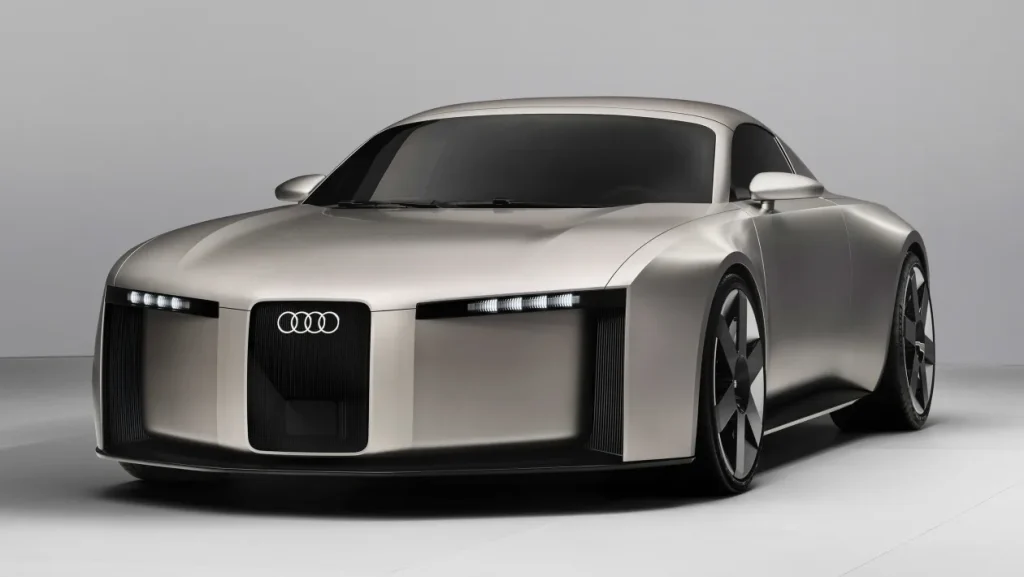
The Audi Concept C provides the strongest preview of the future production car. Revealed before the 2025 Munich auto show, the concept used a low-slung two-seat body, a retractable hardtop, sharp horizontal lighting, a new upright front design called the “vertical frame,” and a clean, minimal cabin.
Audi described the concept as the beginning of a new design direction built around “radical simplicity.”
The production car is unlikely to copy every show-car detail, but its central proportions should survive. The Concept C has a long, low body, a short rear deck, pronounced wheel arches, and a roofline that gives it a more dramatic appearance than the earlier TT.
It is also noticeably larger than the final-generation TT, suggesting Audi may be moving the new car slightly upmarket.
The concept measured about 178 inches long, making it longer than the previous TT and even slightly longer than the old R8. Concepts often exaggerate size and proportions, so the production car may be smaller, but the numbers show that Audi is not simply recreating the old TT formula.
Audi’s new vertical front frame is expected to become a broader brand signature, but the sports car will likely be the first production vehicle to use it in its most dramatic form. That gives the project an added role. It is not only a replacement for a discontinued coupe. It is also a design statement intended to influence future Audi models.
An EV Layout Could Preserve Sports-Car Proportions
One of the most interesting technical features of Concept C is its battery placement.
Most electric vehicles place the battery pack beneath the cabin floor. That arrangement is efficient for packaging, but it can create a taller seating position and a thicker floor, both of which are undesirable in a low sports car.
Audi indicated that the Concept C’s battery is mounted behind the passenger compartment instead. This could allow a lower seating position and a more traditional sports-car driving posture while helping the vehicle achieve a more balanced weight distribution.
Reports have also suggested that the production model may use rear-wheel drive in entry form, with higher-performance versions potentially adding a second motor and all-wheel drive.
That layout would align closely with Porsche’s electric 718 strategy. Porsche has said its future two-door electric sports car will retain a “mid-engine feel,” even though it will use battery power rather than a gasoline flat-six. The Audi is expected to benefit from the same underlying packaging philosophy.
Audi has not released battery capacity, charging speed, range, or performance figures. Reports estimating an 89-kWh battery, 350-kW charging, and more than 300 miles of range remain speculative rather than official production specifications.
Still, the target is clear. Audi needs to build an EV that feels like a sports car, not simply a heavy electric coupe with quick acceleration.
The Challenge Is Making an Electric TT Feel Emotional
The original Audi TT was never defined only by performance figures. Its appeal came from design, compact proportions, a low seating position, and a sense that it looked unlike anything else on the road.
The new electric model faces a harder task. Electric power delivers immediate torque and strong acceleration, but it does not naturally provide the engine sound, gear changes, vibration, or mechanical drama associated with earlier TT models, especially the five-cylinder TT RS.
Audi will need to create emotion through steering response, brake feel, chassis balance, seating position, material quality, sound design, and visual character.
The Concept C suggests the company understands that challenge. Its interior combined digital technology with physical controls, including tactile buttons and a retractable central screen that could be hidden when the driver wants fewer distractions.
Whether those details reach production remains uncertain. Automakers often simplify concept interiors to reduce cost and meet safety rules. But Audi’s emphasis on physical interaction is notable at a time when many manufacturers are replacing buttons with touchscreen menus.
The final car will also need to be lighter and more agile than most electric vehicles. Batteries add significant mass, and weight can reduce the delicacy that buyers expect from a small coupe or roadster.
Porsche’s development work on the electric 718 will be crucial because the German brand has more experience than most manufacturers in preserving sports-car handling across changing powertrain technologies.
Production Is Expected in 2027
Audi has confirmed that its new electric sports car will be built at the Böllinger Höfe facility in Germany, the low-volume production site previously associated with the R8 and now used for specialized Audi projects. Production is expected to begin in 2027.
That schedule leaves Audi with limited time to move from Porsche-bodied mules to final prototypes, production validation vehicles, and customer-ready cars. However, the company is not developing the project alone.
Porsche has been testing its electric 718 program for years, and shared engineering should allow Audi to accelerate the final stages of development.
The launch timing also depends on Porsche. The next electric Boxster and Cayman have faced delays as Porsche adjusts its wider electrification plans and continues to assess demand for combustion-powered sports cars.
Audi’s model is expected to be EV-only, which makes it more dependent on the electric platform reaching production readiness.
Audi’s decision to proceed with an electric sports car is still significant. Several manufacturers have stepped back from low-volume coupes and roadsters because of cost, emissions rules, and limited demand.
The BMW Z4 and Toyota GR Supra are nearing the end of their current runs, while the combustion Porsche 718 family is also approaching a transition.
Audi sees an opening to return with a car that offers distinctive styling, premium positioning, and electric performance without attempting to compete directly with the Porsche 911.
It May Not Be Called the TT
The “TT EV” label is convenient, but buyers should not assume Audi will revive the TT badge.
Döllner has described the Concept C production model as sitting between the TT and R8, suggesting a different name and a more premium position. That could mean a higher starting price than the old TT, which was one of Audi’s more accessible sports cars.
The Concept C is also larger and more ambitious than the original TT. Audi may want a new name to separate the vehicle from expectations tied to the earlier model, especially because the new car will be electric and could arrive as a targa-style roadster rather than a traditional coupe first.
What is more certain is the car’s purpose. Audi wants a compact halo model that can restore some of the emotional appeal the brand lost when it ended both the TT and R8. The new EV will have to prove that an electric Audi can still be desirable for reasons beyond range, screen size, or acceleration.
The Porsche-skinned test mule is a meaningful sign that Audi’s electric sports-car program is advancing toward its planned 2027 launch.
The final model is expected to borrow core engineering from Porsche’s next electric 718 while adopting the distinctive styling direction previewed by the Concept C. It may not wear the TT name, but it is likely to occupy the space the TT left behind, with a more premium position between the old coupe and the R8.
Audi still has major questions to answer about range, charging, power, weight, pricing, and final design. But the project has moved beyond speculation. The next Audi sports car is now being tested in the real world, even if it is wearing a Porsche disguise.
Also Read: 10 Best Porsche Cars Ever Made & Ranked