
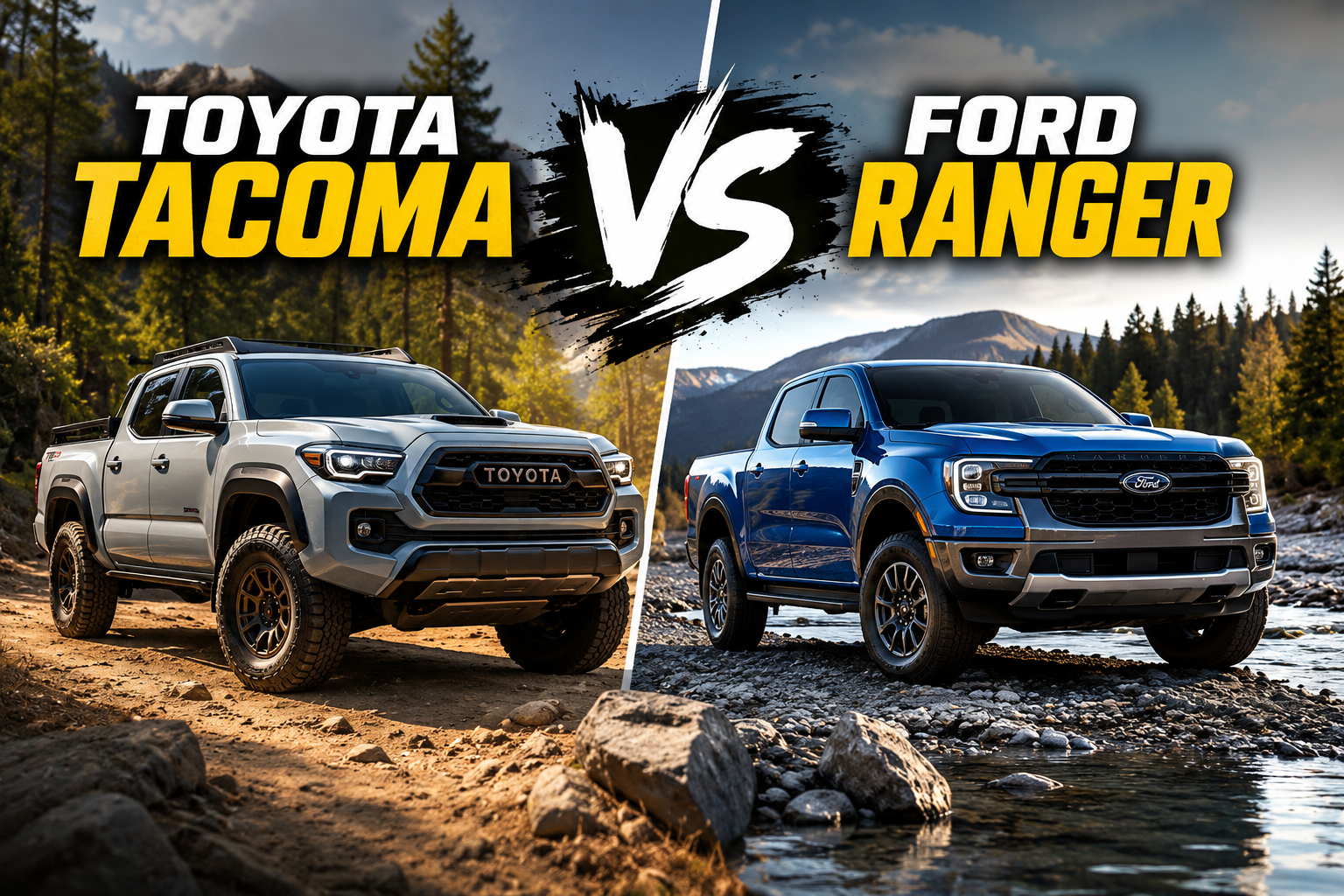
The midsize pickup truck segment has evolved dramatically over the last decade. What was once considered a niche category filled with basic work trucks has become one of the most competitive areas of the automotive market.
Buyers no longer view midsize pickups as simply smaller alternatives to full-size trucks. Instead, they have become lifestyle vehicles capable of serving as daily commuters, family transportation, weekend adventure machines, and serious work tools all at once. Two trucks sit near the center of that battle: the Toyota Tacoma and the Ford Ranger.
Both nameplates carry tremendous recognition among truck buyers. The Tacoma has spent years building a reputation for durability, resale value, and off-road capability, earning a loyal following that borders on cult status.
The Ranger, meanwhile, leverages Ford’s truck expertise and the success of the F-Series lineup to deliver a midsize pickup that emphasizes power, towing capability, and everyday usability.
Recent redesigns have transformed both trucks into significantly more sophisticated machines. Gone are the days when buyers had to accept outdated interiors, underpowered engines, and basic technology in exchange for pickup truck versatility.
Today’s Tacoma and Ranger offer advanced safety systems, modern infotainment technology, premium interior materials, and powertrains capable of impressive performance.
Yet despite their similarities on paper, these trucks appeal to slightly different audiences. Toyota’s approach focuses heavily on adventure, long-term ownership confidence, and off-road readiness.
Ford takes a more balanced route, emphasizing work capability, towing strength, and a driving experience that feels surprisingly refined for a truck.
Choosing between them is not as straightforward as comparing horsepower figures or towing numbers. The better truck depends heavily on how it will be used and what characteristics matter most to the buyer.
Some shoppers will immediately gravitate toward the Tacoma’s rugged personality and proven reputation. Others will appreciate the Ranger’s stronger utility credentials and polished on-road manners.
To determine which midsize truck comes out ahead, it is necessary to examine every major area, from styling and interior comfort to powertrains, towing capability, fuel economy, and long-term ownership considerations.
Also Read: 10 Vintage Honda Motorcycles Worth More Than $100,000
Exterior Design and Road Presence
Design has become increasingly important in the pickup truck world. Modern buyers want capability, but they also want a vehicle that makes a visual statement. Both Toyota and Ford understood this when redesigning their trucks, though they approached the challenge from different directions.
The Toyota Tacoma immediately projects toughness. Its broad stance, muscular wheel arches, high beltline, and aggressive front-end treatment create a truck that looks ready for off-road adventures even when parked in a suburban driveway. Toyota’s designers clearly wanted to emphasize ruggedness, and the result is one of the most distinctive trucks in the segment.
The Tacoma’s various trim levels further reinforce that image. Models such as the TRD Off-Road, Trailhunter, and TRD Pro feature unique grilles, specialized lighting elements, skid plates, and off-road-focused styling details that make them appear purpose-built for outdoor enthusiasts.
Even lower trims benefit from the truck’s aggressive design language, ensuring that no version feels bland or generic.
Ford took a somewhat different path with the Ranger. Rather than creating a truck that constantly advertises its off-road credentials, Ford designed a pickup that mirrors the styling cues of its larger F-Series siblings. The result is a cleaner and more mature appearance that emphasizes functionality and professionalism.
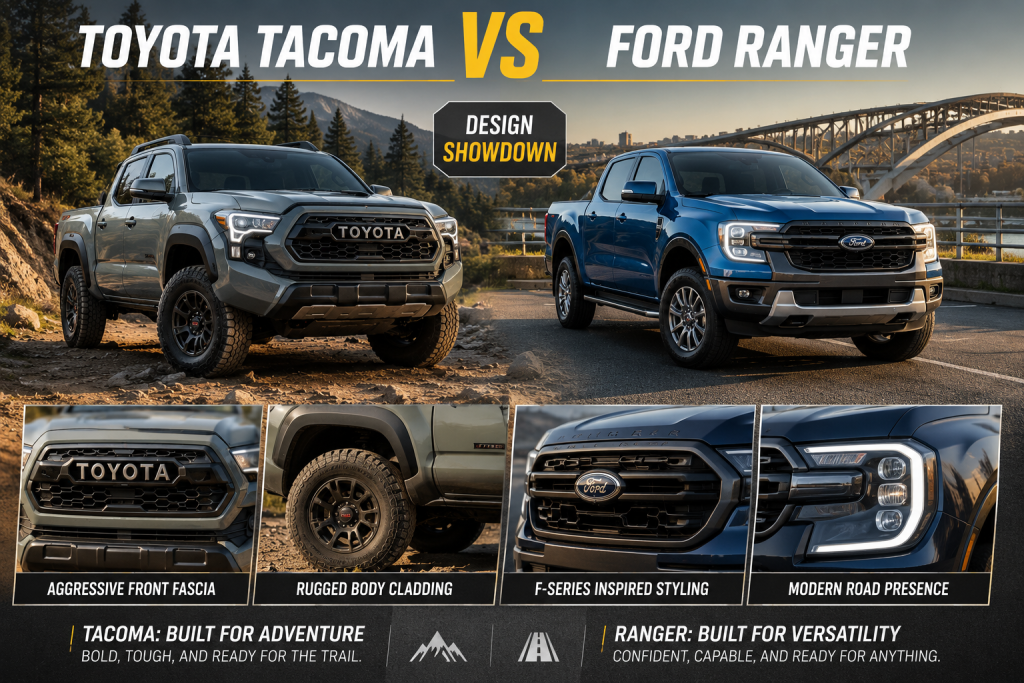
The Ranger’s front fascia is bold without being excessive, while its body lines are simpler and more restrained than those found on the Tacoma. This approach gives the truck broad appeal. It looks equally appropriate pulling into a corporate parking lot or arriving at a job site.
Both trucks are attractive in their own ways, but the Tacoma possesses a stronger visual identity. It stands out more easily and feels more distinctive in a crowded field of pickups and SUVs.
Buyers seeking a truck with maximum personality will likely prefer Toyota’s approach, while those favoring a cleaner and more understated appearance may lean toward Ford.
Winner: Toyota Tacoma
Interior Design and Technology
Previous generations of the Tacoma often faced criticism for outdated cabins and technology that lagged behind competitors. Toyota listened carefully to those complaints, and the latest Tacoma represents a dramatic improvement.
Stepping inside the new Tacoma reveals an interior that feels far more modern than before. Material quality has improved noticeably, and the dashboard layout strikes a good balance between ruggedness and sophistication.
The available 14-inch touchscreen dominates the center stack on higher trims, providing a premium appearance that helps justify the truck’s pricing.
Toyota also deserves credit for retaining physical controls for key functions. While touchscreen-heavy interiors have become common across the industry, many truck buyers still appreciate the simplicity and convenience of traditional knobs and buttons. The Tacoma manages to integrate modern technology without sacrificing usability.
The Ranger counters with an equally impressive interior. Ford’s design emphasizes functionality and spaciousness, creating a cabin that feels open and practical. The large vertical touchscreen serves as the centerpiece, offering access to Ford’s SYNC infotainment system and a wide range of connected features.
One area where the Ranger excels is full cabin comfort. Front-seat accommodations are excellent, and rear-seat passengers benefit from generous space. Visibility is also impressive thanks to the truck’s thoughtfully designed greenhouse and seating position.
Technology offerings are competitive in both trucks. Wireless smartphone integration, digital instrument clusters, advanced driver assistance systems, and multiple connectivity options are available across much of the lineup. Neither truck holds a decisive advantage here because both manufacturers have invested heavily in modernizing their interiors.
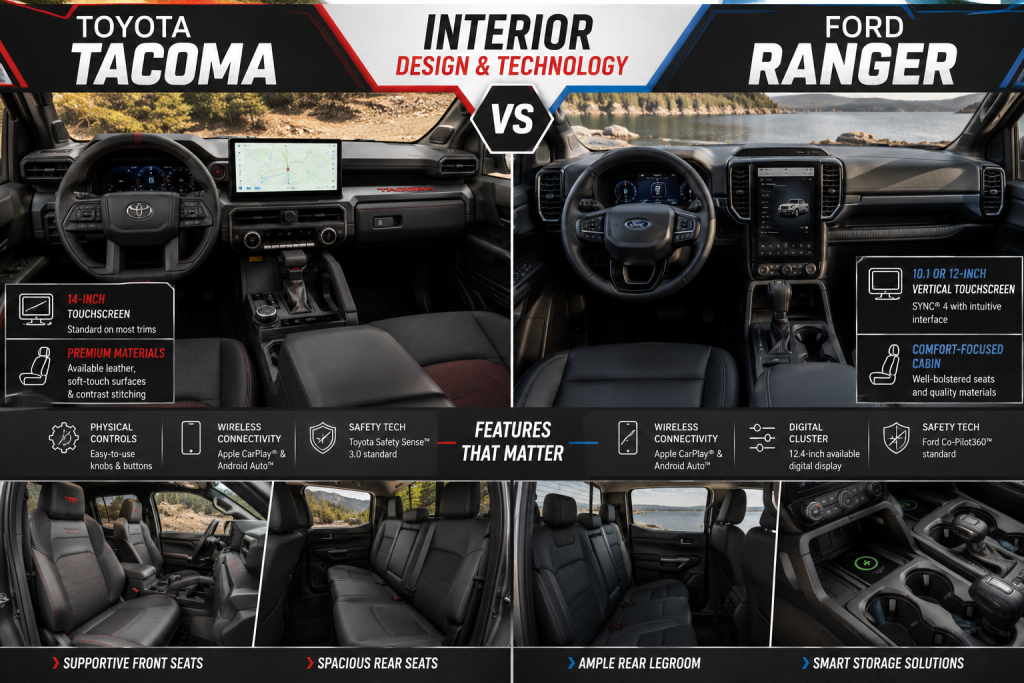
Buyers are likely to find themselves choosing based on preference rather than objective superiority. The Tacoma feels slightly more adventurous and stylish, while the Ranger emphasizes practicality and ease of use.
Both interiors represent major improvements over their predecessors and rank among the best in the midsize truck segment.
Result: Tie
Powertrains and Performance
Performance has become increasingly important in the midsize truck category, and both Toyota and Ford offer compelling engine choices.
Toyota replaced its traditional V6 with a turbocharged 2.4-liter four-cylinder engine that produces up to 278 horsepower and 317 lb-ft of torque. While some enthusiasts initially questioned the move away from a naturally aspirated six-cylinder, the new engine delivers stronger torque and improved responsiveness.
The real highlight of the Tacoma lineup, however, is the i-FORCE MAX hybrid system. Combining the turbocharged engine with an electric motor results in an impressive 326 horsepower and 465 lb-ft of torque.
Those numbers place the Tacoma among the most powerful trucks in its class while also delivering immediate low-end response that proves especially useful during towing and off-road driving.
Ford’s standard Ranger powertrain consists of a 2.3-liter EcoBoost turbocharged four-cylinder producing 270 horsepower and 310 lb-ft of torque. This engine has earned praise for its strong performance and broad torque curve, making the Ranger feel lively during everyday driving.
Buyers seeking additional power can step up to the available 2.7-liter twin-turbocharged V6. Producing 315 horsepower and 400 lb-ft of torque, this engine transforms the Ranger into one of the quickest trucks in the segment. Acceleration is strong, highway passing becomes effortless, and towing duties are handled with confidence.
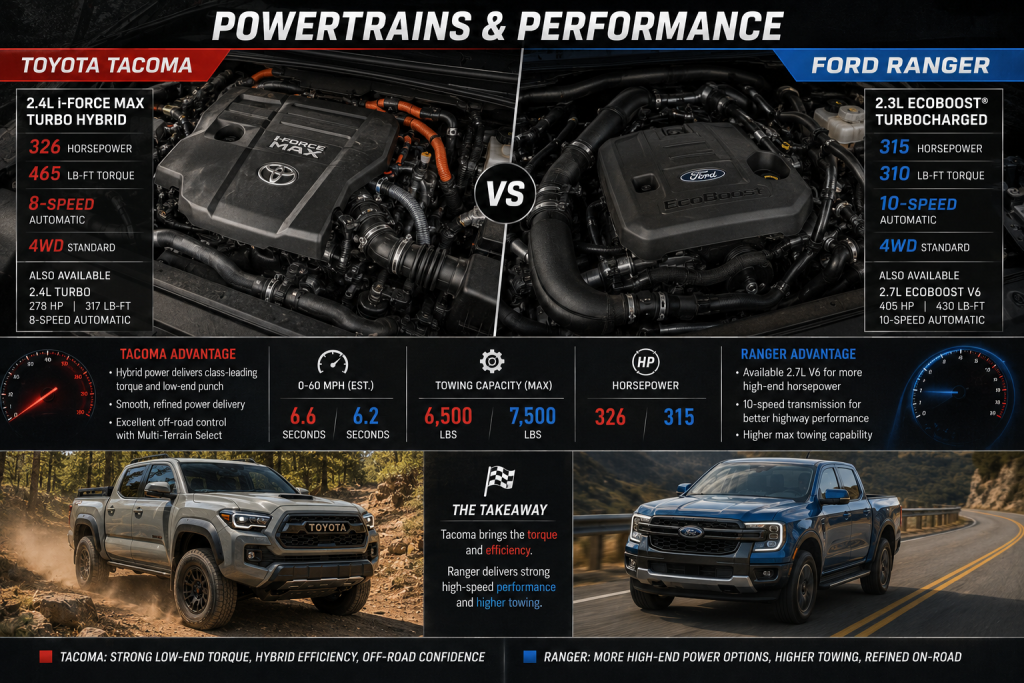
The performance hierarchy becomes even more impressive with the Ranger Raptor. Its twin-turbocharged V6 generates 405 horsepower, placing it in a category of its own among midsize pickups. While the Raptor serves a specialized audience, it demonstrates Ford’s commitment to offering serious performance throughout the Ranger lineup.
Comparing these powertrains reveals interesting differences. The Ranger’s V6 delivers exceptional acceleration and a more traditional truck feel. The Tacoma hybrid, meanwhile, impresses with its enormous torque output and seamless power delivery.
For buyers prioritizing efficiency and everyday drivability, Toyota’s hybrid system may prove more appealing. Those seeking maximum performance and towing strength may favor Ford’s V6 options.
Winner: Toyota Tacoma
Towing and Payload Capability
Truck buyers frequently place towing and hauling near the top of their priority list, and this is one area where the Ranger establishes a meaningful advantage.
When properly equipped, the Ranger can tow up to 7,500 pounds. That figure places it near the top of the midsize truck segment and allows owners to confidently tow larger campers, boats, utility trailers, and recreational equipment.
Ford’s engineering team clearly focused on creating a truck capable of handling serious work. The available V6 engines provide substantial torque, while the chassis and suspension systems contribute to stable towing behavior even under demanding conditions.
The Tacoma remains highly capable, offering a maximum towing capacity of approximately 6,500 pounds, depending on configuration.
For many buyers, that figure will be more than sufficient. Most midsize truck owners rarely approach their vehicle’s towing limits, meaning the Tacoma can easily handle common tasks such as towing small boats, utility trailers, or recreational vehicles.
Payload capacity follows a similar pattern. The Ranger generally offers slightly higher ratings, making it the stronger choice for buyers who frequently carry heavy loads in the bed.
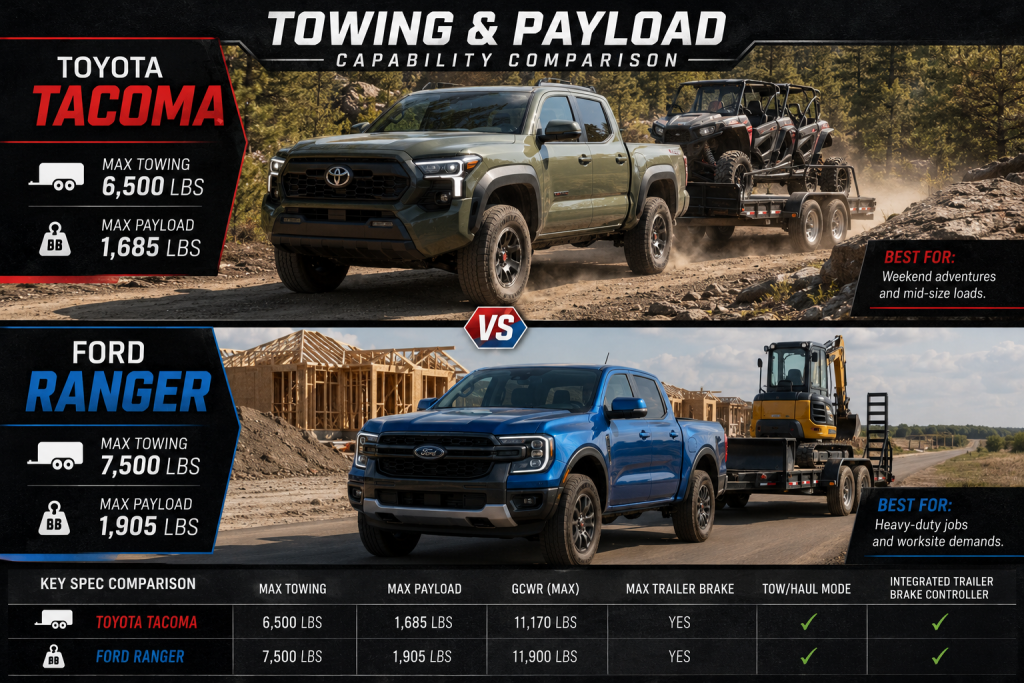
Toyota’s hybrid system does provide an advantage in terms of low-speed torque, helping the truck feel confident when launching with a trailer attached. However, raw capability still favors the Ranger.
Buyers who regularly tow near maximum capacity are likely to appreciate Ford’s advantage in this category. The Ranger feels purpose-built for demanding work situations and rewards owners who frequently push their truck’s capabilities.
Winner: Ford Ranger
Off-Road Capability
Few midsize trucks have built a reputation as strong as the Tacoma’s when it comes to off-road performance.
Toyota has spent decades cultivating an image centered around adventure, exploration, and trail capability. The latest Tacoma continues that tradition with a broad range of off-road-focused trims and technologies.
The TRD Off-Road model provides features such as locking differentials, terrain management systems, and specialized suspension tuning. Moving up to the Trailhunter introduces equipment specifically designed for overlanding enthusiasts, while the TRD Pro adds premium suspension components and enhanced trail performance.
Toyota’s off-road technology suite is among the most advanced in the segment. Features such as Crawl Control and Multi-Terrain Select help drivers navigate difficult terrain with confidence, even when experience levels vary.
The Ranger should not be overlooked, however. Ford offers the FX4 package for buyers seeking additional capability, while the Ranger Raptor stands as one of the most capable factory-built off-road trucks available today.
With long-travel suspension, locking differentials, upgraded shocks, and impressive ground clearance, the Ranger Raptor can tackle terrain that would challenge many larger trucks. Its performance at higher speeds over rough surfaces is particularly impressive.
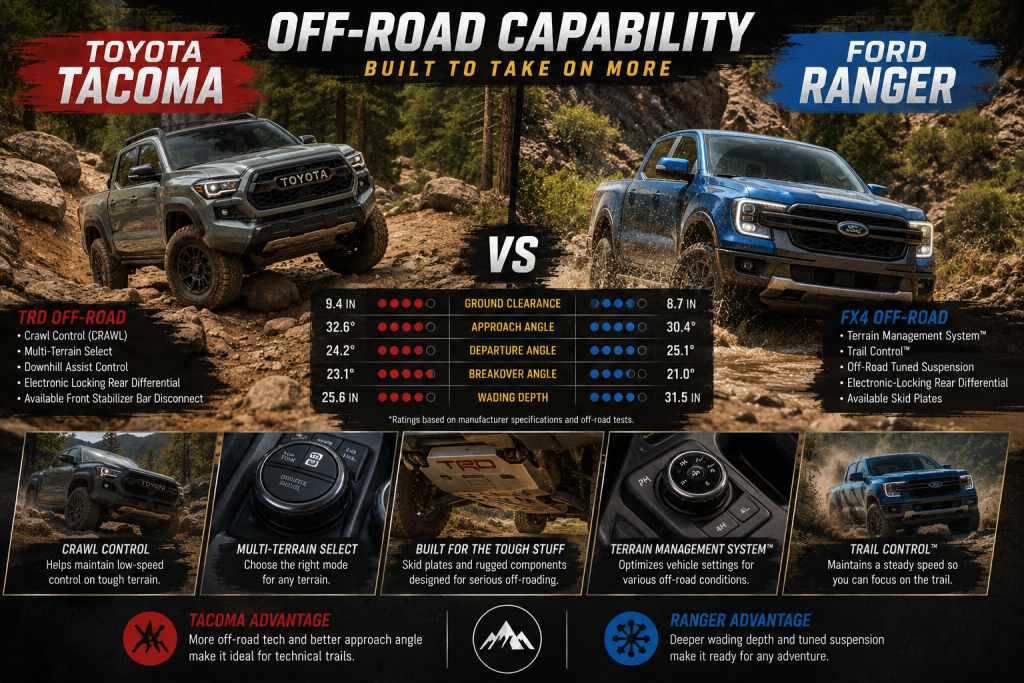
The difference lies in accessibility. Toyota offers meaningful off-road capability across a wider range of trim levels and price points. Buyers do not necessarily need to purchase the most expensive Tacoma to enjoy serious trail performance.
That flexibility, combined with Toyota’s extensive aftermarket support network, helps the Tacoma maintain its position as the benchmark for off-road-focused midsize trucks.
Winner: Toyota Tacoma
Ride Quality and Daily Driving
While capability matters, most owners spend far more time commuting than climbing rocky trails.
Ford clearly prioritized daily comfort when developing the Ranger. The suspension delivers a composed ride on pavement, absorbing bumps effectively while maintaining good body control. Highway travel is comfortable, and the truck feels refined during long-distance journeys.
Steering is predictable and well-weighted, contributing to a driving experience that feels surprisingly car-like at times. The Ranger’s balance between utility and comfort makes it particularly appealing to buyers who use their truck primarily as everyday transportation.
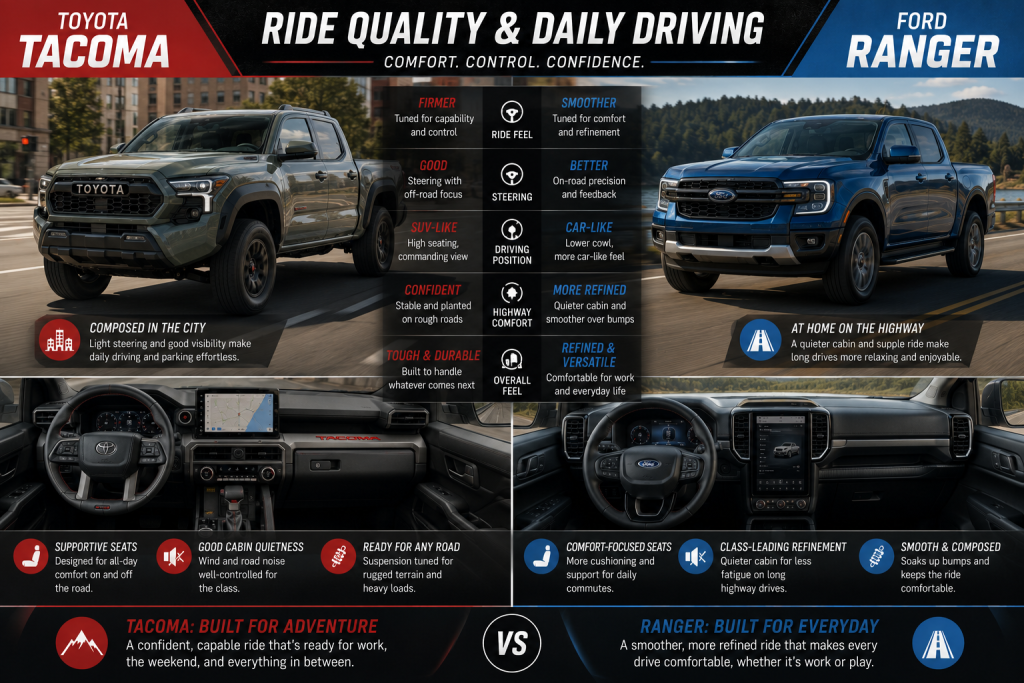
Toyota made significant improvements to the Tacoma’s ride quality as well. The adoption of rear coil springs on many models has transformed the truck’s behavior on pavement. Compared to previous generations, the new Tacoma feels more settled and comfortable.
Nevertheless, the Ranger retains a slight edge in full refinement. Ford’s truck simply feels more polished during routine driving situations, particularly on highways and urban roads.
Winner: Ford Ranger
Reliability, Resale Value, and Ownership Experience
Few brands enjoy a stronger reputation for long-term durability than Toyota. The Tacoma has consistently ranked among the most dependable trucks on the market, earning the trust of owners who plan to keep their vehicles for many years.
Stories of Tacomas surpassing 200,000 or even 300,000 miles are common, helping reinforce the truck’s legendary status.
Resale value represents another major strength. Historically, the Tacoma retains its value exceptionally well, often outperforming competitors by significant margins. This makes ownership costs lower over time and provides added peace of mind for buyers concerned about depreciation.
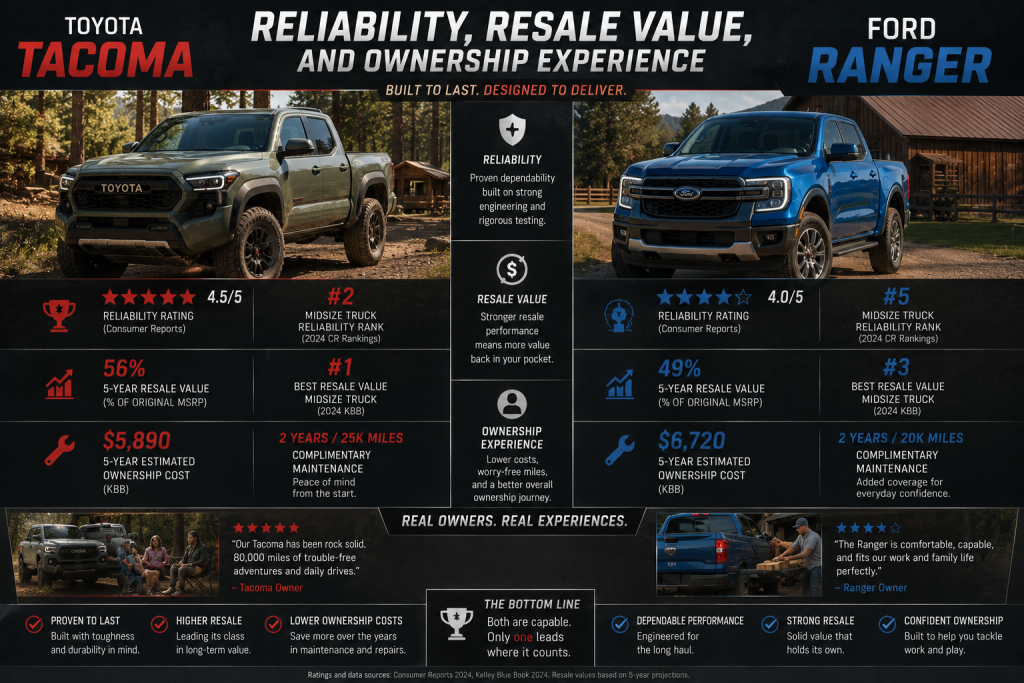
Ford has improved reliability considerably over the years, and the Ranger generally performs well in ownership studies. However, it does not carry the same reputation as the Tacoma when discussing long-term durability and resale value.
For buyers planning to keep their truck for a decade or longer, Toyota’s advantages become difficult to ignore.
Winner: Toyota Tacoma
Pricing and Value
Pricing often plays a major role in the midsize truck segment because buyers tend to use these vehicles for a wide variety of purposes. Some shoppers simply need a practical pickup for occasional hauling and commuting, while others are looking for highly capable off-road machines packed with premium technology.
Fortunately, both the Toyota Tacoma and Ford Ranger offer broad trim lineups that allow customers to spend as little or as much as they want.
The 2025 Toyota Tacoma starts at roughly $31,500 for entry-level models, while higher trims such as the TRD Off-Road, Limited, Trailhunter, and TRD Pro can push pricing well beyond $50,000 depending on equipment and options.
The addition of the i-FORCE MAX hybrid powertrain also increases pricing, although many buyers will likely consider the extra performance and torque worth the additional investment.
Ford positions the Ranger in a very similar space. Base XL models begin at around $33,000, placing them slightly above some Tacoma configurations.
Moving into XLT and Lariat trims quickly raises the price, while the high-performance Ranger Raptor enters a completely different category with pricing approaching $57,000. Buyers seeking maximum capability often find themselves spending considerably more than the base MSRP once popular packages and options are added.
When comparing similarly equipped models, the pricing gap between the two trucks is surprisingly small. In most cases, buyers will find that comparable Tacoma and Ranger trims differ by only a few thousand dollars. Because of this, the purchasing decision usually comes down to priorities rather than sticker price alone.
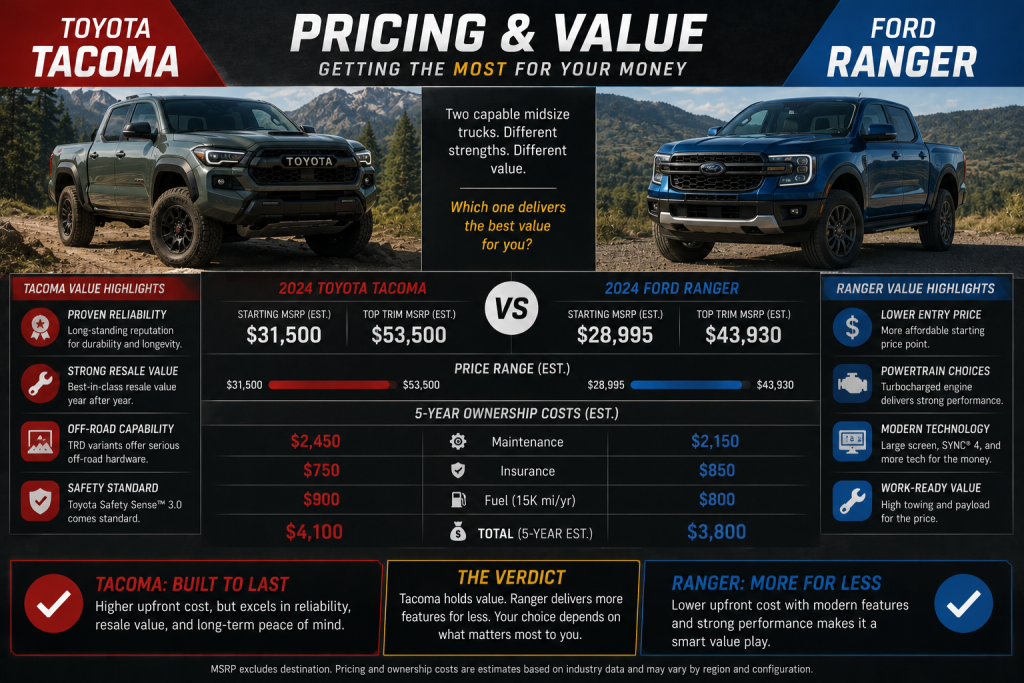
Value is where the discussion becomes more interesting. Toyota’s reputation for reliability and exceptional resale value has historically allowed Tacoma owners to recover a larger percentage of their investment when it comes time to sell or trade the truck.
Ford counters by offering stronger towing capability and impressive powertrain options for the money, giving work-focused buyers a compelling reason to consider the Ranger.
Neither truck can be described as a bargain in today’s market, but both justify their pricing through capability, technology, and versatility. The Tacoma tends to deliver stronger long-term value, while the Ranger often provides slightly more capability per dollar for buyers focused on towing and hauling.
Winner: Toyota Tacoma
Final Verdict
Choosing between the Toyota Tacoma and Ford Ranger comes down to priorities. The Ranger is an outstanding truck that excels in towing capability, payload capacity, daily comfort, and overall refinement. Buyers who need a truck primarily for work, highway travel, and frequent towing will find plenty to admire in Ford’s approach.
The Tacoma, however, offers a broader range of strengths. Its hybrid powertrain delivers impressive performance, its off-road capability remains among the best in the segment, and its reputation for reliability and resale value continues to set the standard. Toyota also benefits from a deeply loyal owner community and an unmatched aftermarket ecosystem.
Neither truck represents a poor choice. Both are among the strongest contenders in the midsize pickup market and offer capabilities that would have seemed remarkable only a few years ago.
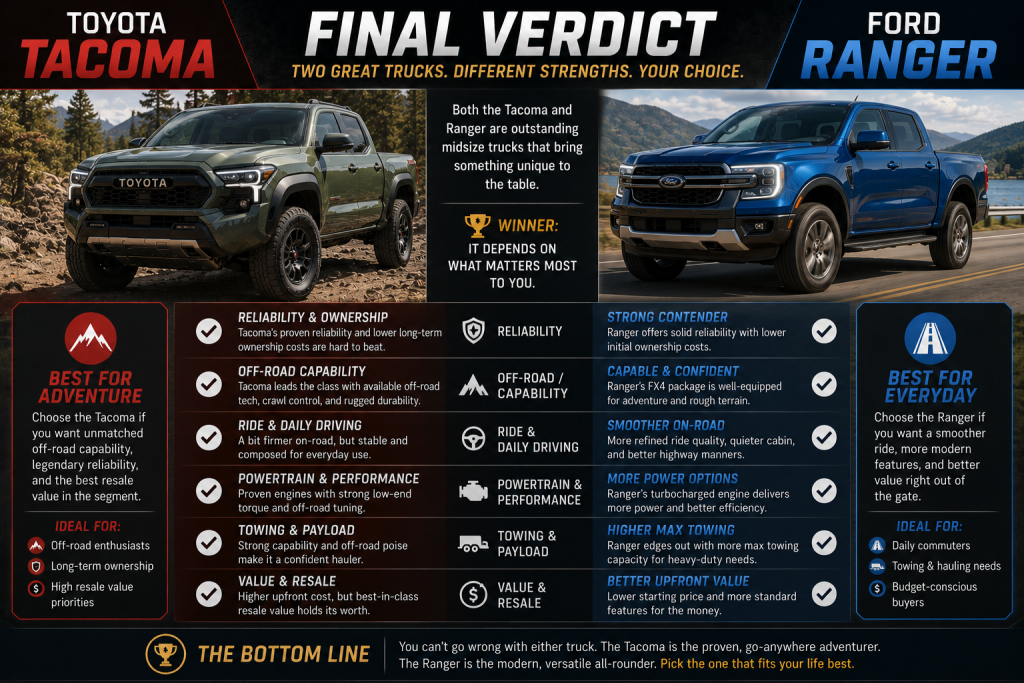
Yet when considering the complete ownership experience, the Tacoma emerges as the more compelling package for the average buyer. It combines modern technology, exceptional capability, strong efficiency, proven reliability, and outstanding long-term value in a way few competitors can match.
For those reasons, the Toyota Tacoma narrowly claims the crown in this midsize truck showdown. While the Ranger remains a formidable rival, Toyota’s combination of versatility, durability, and adventure-ready character gives it the edge in one of the automotive market’s most hotly contested segments.
Winner: Toyota Tacoma
| Category | Winner | The Edge |
|---|---|---|
| Exterior Design and Road Presence | Toyota Tacoma | More rugged styling and a stronger off-road-inspired visual identity. |
| Interior Design and Technology | Tie | Both offer modern cabins, strong technology, and excellent usability. |
| Powertrains and Performance | Toyota Tacoma | Hybrid delivers exceptional torque and impressive full drivability. |
| Towing and Payload Capability | Ford Ranger | Higher towing and payload ratings benefit work-focused truck owners. |
| Off-Road Capability | Toyota Tacoma | Wider range of off-road trims and stronger aftermarket support. |
| Ride Quality and Daily Driving | Ford Ranger | More refined ride quality and superior highway comfort. |
| Fuel Economy | Toyota Tacoma | A hybrid powertrain provides better efficiency without sacrificing capability. |
| Reliability, Resale Value, and Ownership Experience | Toyota Tacoma | Proven reliability and class-leading resale value over time. |
| Pricing and Value | Toyota Tacoma | Stronger long-term ownership value and lower depreciation. |
| Final Verdict | Toyota Tacoma | Better balance of capability, reliability, efficiency, and versatility. |
Also Read: 5 Best Hybrids vs 5 Best EVs for 2026
