
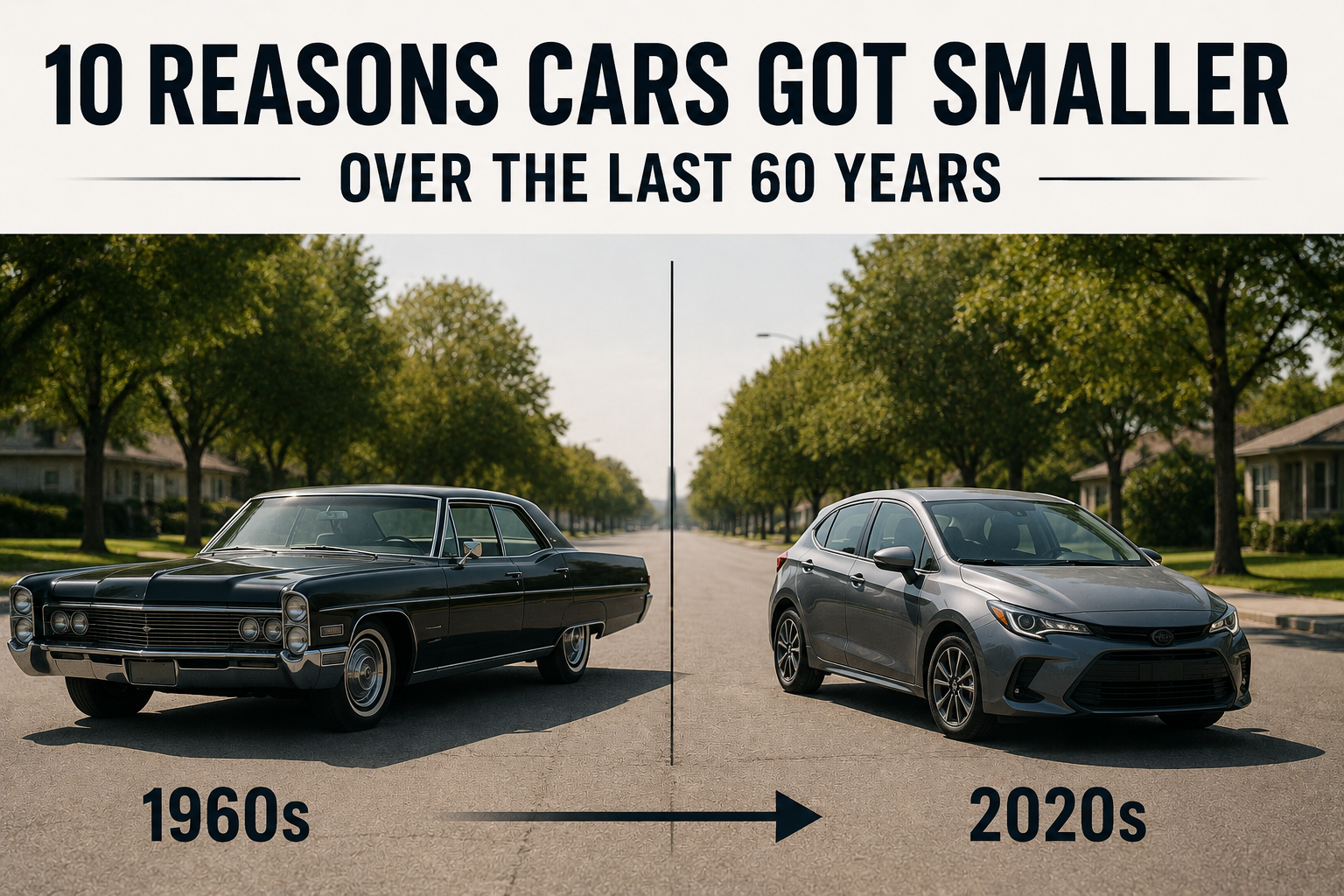
Cars from the 1950s, 1960s, and early 1970s often looked much larger than many vehicles sold today. Long hoods, wide bodies, large trunks, heavy steel bumpers, and spacious bench-seat interiors were common in markets such as the United States.
A full-size sedan could stretch well beyond 220 inches in length, while even ordinary family cars often had large engines and substantial exterior dimensions.
However, the story is more complicated than saying every car became smaller. Many modern SUVs and pickup trucks are larger than older vehicles, while some current sedans are wider, taller, and heavier than their predecessors.
What changed most noticeably was the popularity of compact and midsize cars. Buyers began choosing smaller, more efficient vehicles because fuel prices, city traffic, environmental rules, safety standards, and changing lifestyles made large cars less practical.
Over the last six decades, automakers have also become better at using interior space. Front-wheel-drive layouts, smaller engines, improved suspension design, and more efficient body structures allow modern compact cars to provide room that would once have required a much larger vehicle.
A current compact hatchback can carry four adults comfortably while taking up far less road space than a large sedan from the 1960s.
The reasons below explain why smaller cars became more common and why compact vehicles continue to play an important role in the global automotive market.
Also Read: 10 Best Jaguar Cars Ever Made & Ranked
1. Rising Fuel Prices
Fuel prices were one of the biggest reasons buyers began moving away from large cars with powerful engines. During the 1950s and 1960s, gasoline was relatively cheap in many countries, particularly in the United States.
Automakers could sell large sedans, station wagons, and coupes with V8 engines because fuel costs did not strongly discourage buyers from using them every day.
The oil crisis of the 1970s changed that situation quickly. Oil supply disruptions caused fuel prices to rise sharply, and long lines formed at gas stations in several countries.
Drivers who had once accepted poor fuel economy began looking for vehicles that used less gasoline. Smaller cars became more attractive because they weighed less, used smaller engines, and required less fuel during city driving.
Japanese and European automakers benefited from this shift because they already had experience building compact, efficient cars.
Models such as the Toyota Corolla, Honda Civic, Volkswagen Golf, and Datsun Sunny gained popularity as buyers searched for affordable transportation with lower running costs. American manufacturers also began developing smaller vehicles and reducing engine sizes to respond to changing demand.

Fuel prices still influence car buying today. Even though SUVs dominate many markets, buyers continue to consider fuel economy when choosing between different models.
Hybrid systems, turbocharged engines, electric vehicles, and smaller gasoline engines are all connected to the same concern that emerged decades ago: a vehicle that uses less energy costs less to operate.
2. Crowded Cities and Limited Parking
As cities expanded, driving large cars became less convenient. Older urban areas were often designed before modern traffic levels existed, which meant narrow streets, small parking spaces, tight garages, and limited room for large vehicles.
A long full-size sedan might be comfortable on an open highway, but it could be difficult to park in a crowded city center or maneuver through narrow residential streets.
Compact cars gave drivers a practical answer. Their shorter length made parallel parking easier, while their smaller turning circles helped in tight intersections and crowded parking lots.
A small hatchback could fit into spaces that would be difficult for a large sedan, station wagon, or pickup truck. This was especially important in European and Asian cities, where streets are often narrower, and parking is more limited than in many American suburbs.
Automakers also recognized that urban buyers had different priorities from rural drivers. They needed cars that were easy to place in traffic, simple to park near apartments, and affordable to run during short trips. Small vehicles became more useful because they reduced the stress of daily city driving.
Modern compact cars also use space more efficiently than older small cars. Front-wheel-drive layouts allow the engine and transmission to sit across the front of the vehicle, leaving more room for passengers and cargo. A current compact car may be short on the outside but still provide enough cabin space for four adults and their belongings.

Smaller cars did not replace large vehicles everywhere, but they became essential in cities where space itself became one of the most valuable parts of vehicle ownership.
3. Stricter Emissions Rules
Governments began introducing tougher emissions regulations as concerns about air pollution increased. During the 1960s and 1970s, major cities experienced serious smog problems caused partly by vehicle exhaust.
Large engines burning more fuel could produce higher levels of pollutants, especially before modern catalytic converters and electronic fuel injection became common.
Smaller cars gave automakers a useful starting point when meeting new environmental requirements. A lighter vehicle generally needs less energy to move, which means it can use a smaller engine and burn less fuel.
This did not automatically make every compact car clean, but it made emissions targets easier to achieve compared with a heavy vehicle powered by a large-displacement engine.
Automakers began adding catalytic converters, exhaust-gas recirculation systems, electronic engine controls, and more precise fuel-delivery technology.
These changes helped reduce harmful pollutants, but they also made it more difficult to keep large, inefficient engines affordable. Smaller vehicles with four-cylinder engines became increasingly common because they could meet regulations without using excessive fuel.
The effect was especially noticeable in markets where governments imposed strict fleet-average emissions standards.

Manufacturers had to consider the emissions produced by all the vehicles they sold, not just individual models. Compact cars helped balance larger trucks, performance cars, and luxury vehicles within a company’s lineup.
Modern emissions rules have become even more demanding. Hybrid systems, plug-in hybrids, electric cars, and smaller turbocharged engines are now common responses.
Although many SUVs have grown in size, the push for cleaner transportation continues to support compact cars because their lower weight and smaller powertrains can reduce energy use.
4. Better Use of Interior Space
Older cars often needed large exterior dimensions to provide comfortable seating and cargo room. Many used rear-wheel-drive layouts with a long engine bay, a driveshaft tunnel running through the cabin, and bulky mechanical components placed beneath the floor.
These designs worked well for powerful engines, but they used a lot of space that could otherwise have been available for passengers.
Front-wheel drive changed this arrangement. By placing the engine and transmission together at the front, automakers eliminated the long driveshaft running to the rear wheels. This allowed designers to create shorter vehicles with more usable cabin room.
A compact hatchback could have a relatively short hood, a long passenger compartment, and a rear cargo area that was easy to access.
Hatchback body styles also made smaller cars more versatile. Instead of a separate trunk with a narrow opening, a hatchback uses a large rear door that opens into the cargo area. Folding rear seats can create room for larger items, making a compact vehicle useful for shopping, luggage, sports equipment, or household tasks.
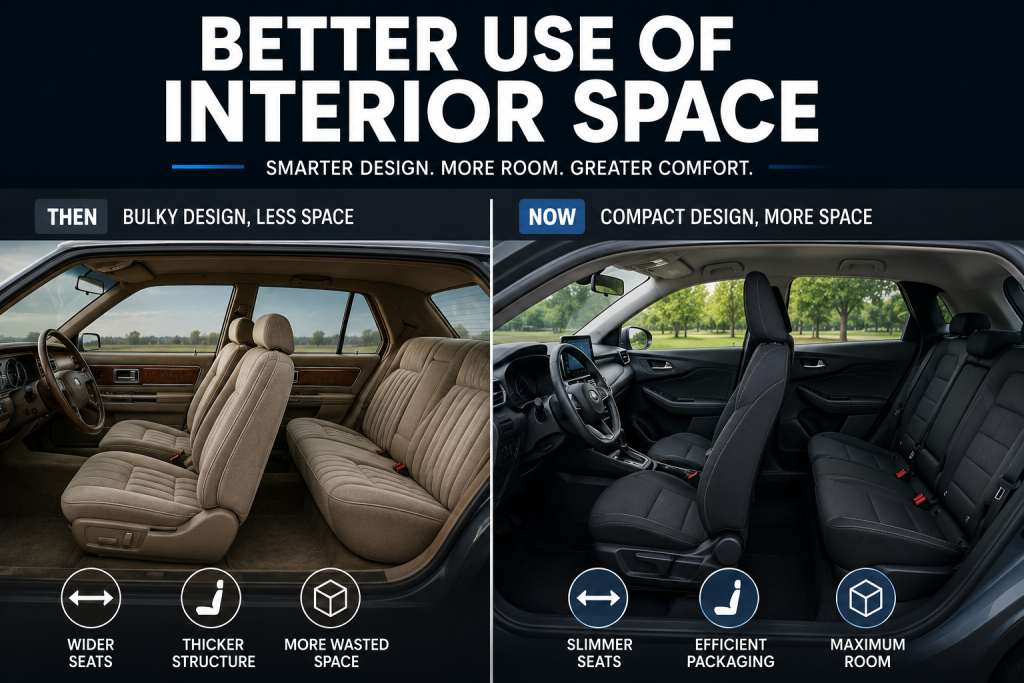
Improved seat design, thinner door panels, better suspension packaging, and more compact climate-control systems have also helped modern cars feel larger inside than their exterior dimensions suggest.
Engineers now use computer modeling to place components more efficiently, allowing vehicles to meet safety requirements without wasting cabin space.
This change helped buyers accept smaller cars because they no longer had to sacrifice as much comfort. A modern compact sedan or crossover can offer room that once required a much larger vehicle, proving that smart packaging can be as important as physical size.
5. Higher Insurance and Ownership Costs
As vehicle ownership became more expensive, many buyers started paying closer attention to the total cost of keeping a car on the road. Insurance premiums, registration fees, maintenance, tire replacement, parking charges, and fuel costs can all rise with vehicle size, weight, engine output, and purchase price.
A large sedan with a powerful engine may offer more space, but it can also bring higher operating expenses over time.
Smaller cars often appeal to budget-conscious drivers because they can reduce several of these costs at once. Compact vehicles usually use smaller tires, less engine oil, smaller brake components, and lower quantities of other fluids.
Replacement parts may also be less expensive than the components used on large SUVs or luxury sedans. This does not mean every small car is cheap to insure or maintain, but its simpler mechanical layouts can help keep routine expenses manageable.
Parking is another cost that has become more important in crowded cities. Apartment buildings, office complexes, airports, and shopping districts may charge more for parking, while some garages have tight spaces that are difficult for large vehicles.
A compact car can fit more easily into standard spaces and may reduce the risk of door damage or parking-related scrapes.

Automakers responded by offering small cars with features that were once limited to larger models. Touchscreen infotainment systems, automatic emergency braking, heated seats, advanced safety equipment, and smartphone connectivity are now available in many compact vehicles. Buyers no longer need to purchase a large sedan simply to get modern convenience features.
The shift toward smaller cars was not caused by one expense alone. It came from the combined pressure of fuel, maintenance, insurance, parking, and purchase costs. For many households, a compact vehicle became a practical way to keep transportation affordable without giving up everyday comfort.
6. Changing Family Sizes
Family structures changed significantly during the last 60 years, affecting the kinds of vehicles people needed. In earlier decades, many households had more children, and large sedans or station wagons were common because they could carry several passengers along with luggage, groceries, and other daily necessities.
A long vehicle with wide bench seats made sense for families that regularly traveled together. As average household sizes became smaller in many countries, the demand for extremely large passenger cars declined.
Couples, single drivers, and small families often found that a compact sedan, hatchback, or small crossover offered enough room for their daily needs. They did not always need three rows of seats or a large trunk, especially if most trips involved commuting, school runs, or local shopping.
Smaller cars also became more attractive to younger buyers who lived in apartments or urban areas. These drivers often valued affordability, fuel efficiency, and easy parking more than maximum passenger capacity.
A compact car could handle work, travel, and weekend trips without the cost of owning a large family vehicle.
The station wagon gradually lost popularity in several markets, while compact hatchbacks and small SUVs took its place. These newer vehicles offered flexible cargo areas and fold-flat rear seats, allowing owners to carry larger items when necessary without driving a long vehicle every day.

Large SUVs and minivans still serve families that need extra seating, but the market became more diverse as households changed. Smaller cars gained importance because they matched the needs of people who wanted practical transportation without paying for unused space.
7. Safety Engineering Became More Advanced
Modern safety standards changed the way cars are designed, and this helped smaller vehicles become more practical than they once were. In the past, many buyers believed that a large, heavy car was automatically safer because it had more metal around the passengers.
Size can still matter in certain crashes, but modern engineering has made compact cars far safer than the small vehicles sold several decades ago.
Crumple zones are one of the biggest improvements. These sections of the body are designed to absorb crash energy before it reaches the passenger compartment. Engineers use computer simulations and crash testing to shape the front and rear structures so they deform in controlled ways.
A smaller car can now direct impact forces away from occupants more effectively than older vehicles with rigid frames and limited crash protection.
Airbags, seatbelt pretensioners, side-impact beams, reinforced roof structures, anti-lock brakes, stability control, and automatic emergency braking have also improved safety. These features allow a compact car to protect occupants far better than earlier small models.
A modern hatchback may have multiple airbags, advanced sensors, and driver-assistance systems that were unavailable even in many luxury cars decades ago.
This progress reduced the need for buyers to choose a huge vehicle simply because they wanted more confidence in a collision. A compact car still has physical limits when compared with a large truck or SUV, but it can provide strong protection for its size.
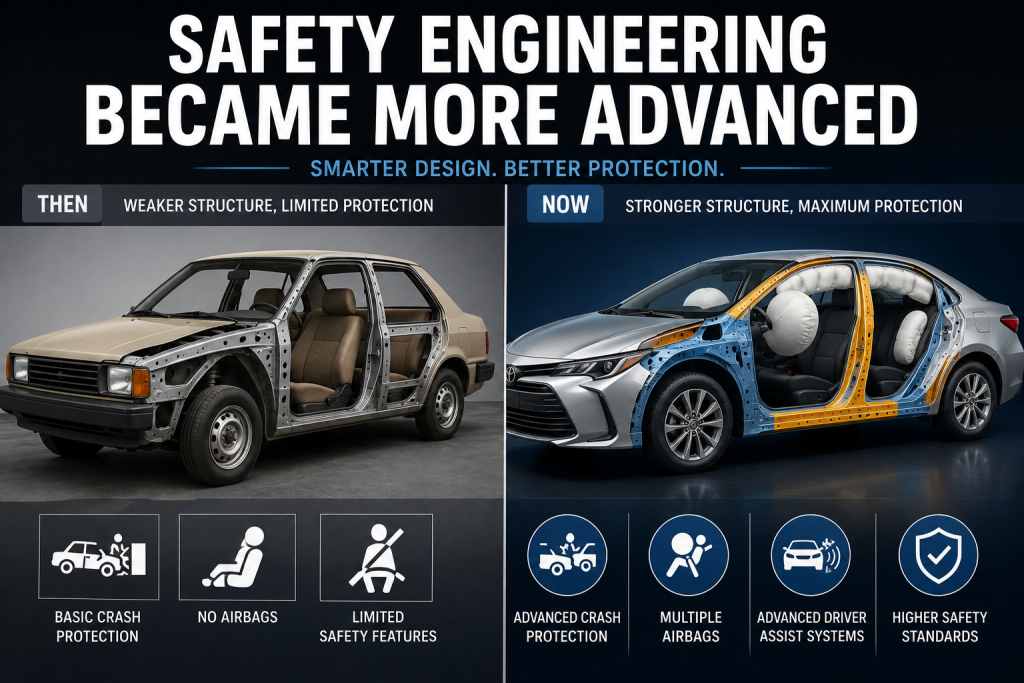
Safety improvements also allowed automakers to use lighter materials without making vehicles fragile. High-strength steel, aluminum, and carefully engineered body structures help modern cars meet crash requirements while keeping weight under control.
This balance has made smaller cars more acceptable to families, commuters, and first-time buyers.
8. Global Car Markets Grew
Automakers once designed many vehicles mainly for their home markets. American companies focused heavily on large cars because wide roads, lower fuel prices, and suburban lifestyles made them popular.
European and Japanese manufacturers, however, had long experience building smaller cars for narrower streets, higher fuel costs, and denser cities.
As the automotive industry became more global, manufacturers began designing cars that could be sold in many countries.
A compact car had a broader international appeal because it could fit into crowded cities, meet fuel-economy expectations, and remain affordable in markets with lower average incomes. This made small vehicles financially important for automakers trying to increase global sales.
The Toyota Corolla, Volkswagen Golf, Honda Civic, Ford Fiesta, and Renault Clio became successful partly because they could be adapted for different regions.
They were small enough for European and Asian cities but still practical for buyers in North America, Latin America, Africa, and the Middle East. Their size made them easier to manufacture in large numbers and sell across many markets.

Global competition also pushed companies to improve compact vehicles. Buyers expected better interiors, stronger safety features, improved fuel economy, and more technology, even in entry-level models. Automakers had to make small cars feel more refined without allowing prices to rise too much.
This international focus changed the car market. Large sedans remained important in some regions, but compact vehicles became essential products for companies that wanted worldwide success. Their smaller dimensions made them easier to adapt to different roads, parking spaces, fuel prices, and consumer budgets.
9. New Manufacturing Methods
Modern manufacturing methods made it easier for automakers to build smaller cars that were affordable, strong, and well equipped.
In earlier decades, compact vehicles were often basic because manufacturers had limited ability to include advanced safety features, efficient engines, and comfortable interiors without raising the price too much. Smaller cars could feel like compromises compared with large sedans.
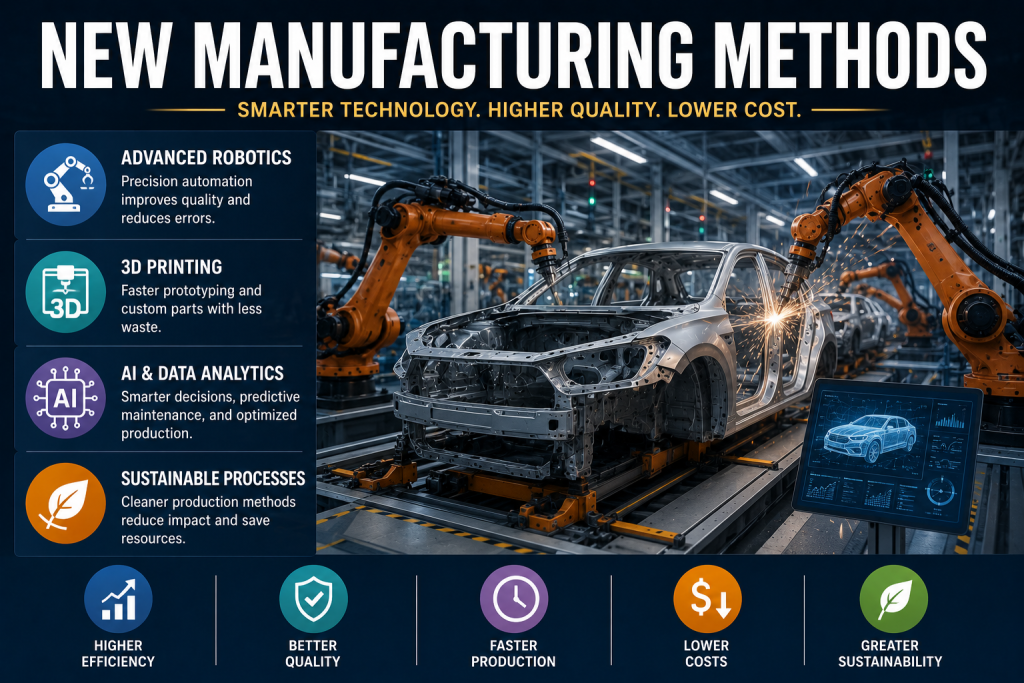
Computer-aided design changed that process. Engineers can now test body structures, suspension components, airflow, and crash performance before building physical prototypes.
This reduces development time and helps manufacturers use materials more efficiently. A compact car can be designed with strong crash protection while avoiding unnecessary weight.
Shared vehicle platforms also became important. A single platform can support a hatchback, sedan, crossover, and small SUV. This allows companies to spread development costs across several models.
Components such as engines, transmissions, infotainment systems, safety sensors, and suspension parts can be shared, helping compact cars include features that would once have been too expensive.
Robotic assembly and improved quality control have also helped. Automakers can build smaller vehicles with tighter panel gaps, more consistent welds, and better corrosion protection.
These improvements made compact cars feel more durable and refined, reducing the perception that a small vehicle had to be cheaply made.
New materials have played a role as well. High-strength steel allows body structures to be thinner and lighter while still meeting safety standards. Aluminum, composites, and improved plastics can reduce weight in selected areas. Less weight helps a smaller car accelerate, brake, and use fuel more efficiently.
Manufacturing technology did not make cars smaller by itself, but it made compact designs easier to sell. Buyers could get modern safety equipment, useful technology, and solid construction in a vehicle that took up less space and cost less to operate.
10. Different Driving Priorities
The way people use cars has changed. In the past, a large sedan often represented success, comfort, and family stability. Long hoods, wide bodies, and powerful engines were desirable because they gave cars a sense of presence. Many buyers were willing to accept higher fuel use and more difficult parking in exchange for that experience.
Today, many drivers have different priorities. They want easy parking, lower fuel costs, smartphone connectivity, safety technology, and practical cargo space.
A compact car or small crossover can meet these needs without requiring the size of an older full-size sedan. For commuters, the ability to fit into a tight parking space may matter more than having a huge trunk.
Environmental awareness has also influenced buying decisions. Some drivers choose smaller cars because they use less fuel and produce fewer emissions.
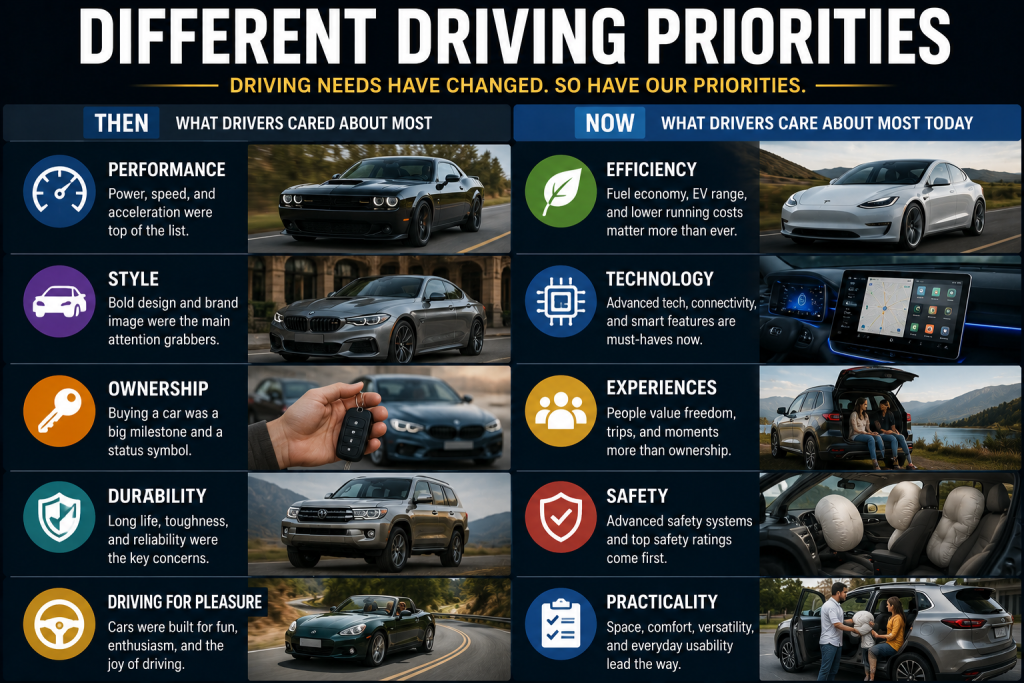
Others choose hybrid or electric vehicles, which are often designed around compact platforms to improve efficiency. Even when buyers prefer SUVs, many select smaller crossovers instead of large truck-based models.
Car-sharing services, ride-hailing, public transportation, and remote work have also changed how some people think about vehicle ownership. A person who drives fewer miles may not need a large vehicle for daily use. Compact cars can provide enough capability for occasional trips while remaining easier to own in an urban environment.
Large vehicles remain popular, especially in markets where towing, family space, and road conditions make them useful.
Yet the rise of smaller cars reflects a broader change in priorities. Many drivers now value efficiency, convenience, and smart use of space more than the sheer physical size that once defined automotive status.
Also Read: 10 Vehicles Projected to Hold Their Value Best Through 2026
