
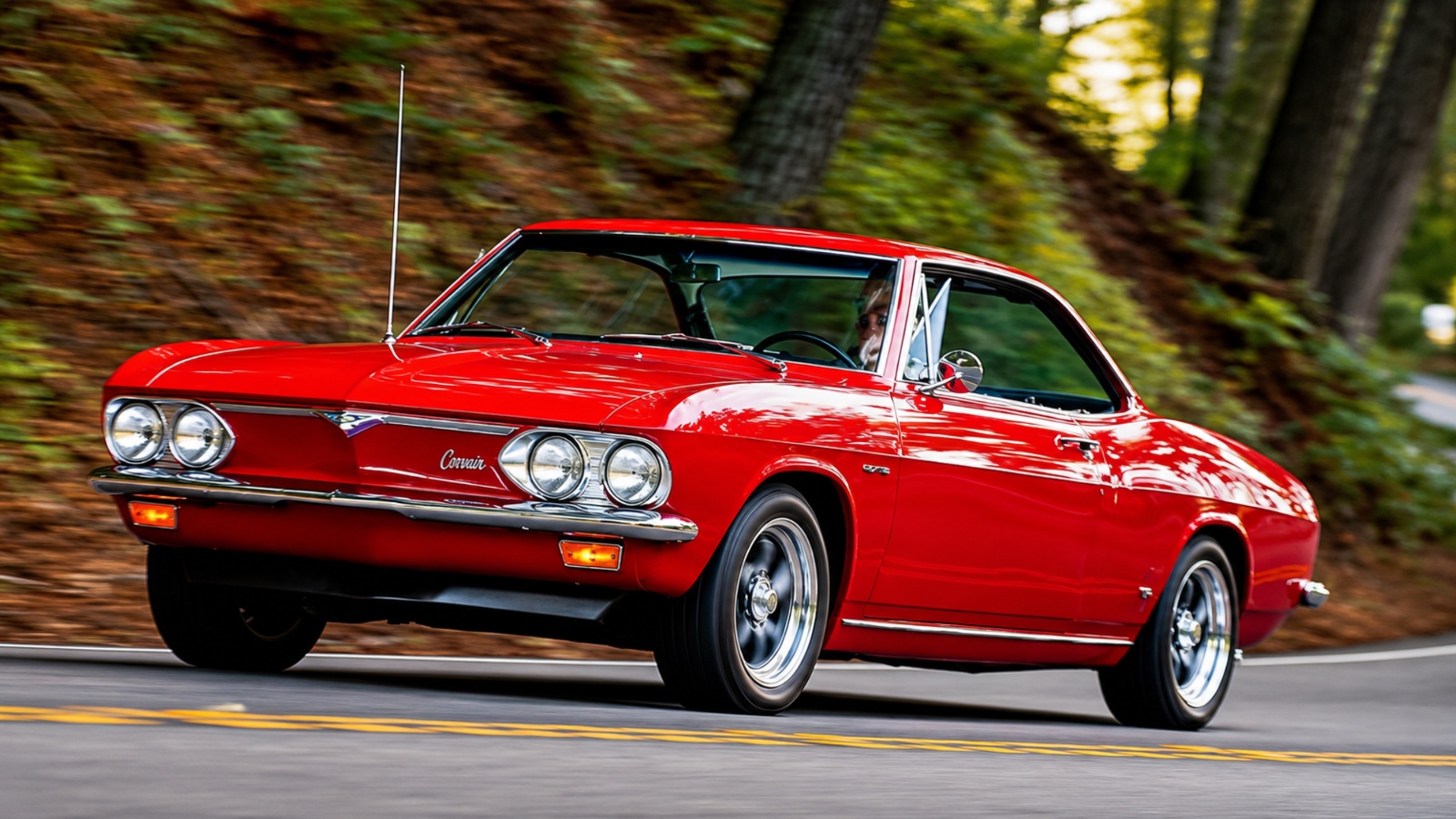
When Chevrolet introduced the Corvair for the 1960 model year, it broke nearly every rule that defined American car design.
At a time when Detroit’s compact cars typically featured front-mounted engines, water-cooled inline engines, and solid rear axles, the Corvair arrived with an engineering layout more commonly associated with European sports cars.
Its air-cooled flat-six engine sat behind the rear axle, powering the rear wheels through a transaxle instead of a conventional driveshaft.
The Corvair was unlike anything General Motors had ever built. It featured unit-body construction, fully independent suspension, aluminum engine components, and a horizontally opposed six-cylinder engine cooled entirely by air.
Chevrolet hoped these innovations would help it compete against growing imports from Volkswagen, Renault, and Fiat while offering Americans something genuinely different.
Initially, the strategy worked. The Corvair became Motor Trend’s 1960 Car of the Year and sold strongly during its first years on the market. However, the same engineering choices that made it innovative also made it controversial.
Debates over its handling characteristics eventually overshadowed many of its technical achievements, turning the Corvair into one of the most discussed automobiles in American history.
More than six decades later, automotive historians increasingly recognize that the Corvair was far more than the controversy surrounding it. It represented one of General Motors’ boldest engineering experiments and introduced technologies that were years ahead of many domestic competitors.
Also Read: Every Truck and SUV Leaving the U.S. Market for 2027
A European-Inspired Design Unlike Any Other Chevrolet
The Corvair project began in the late 1950s as American manufacturers sought answers to the growing popularity of compact imported cars. According to the GM Heritage Centre archives, Chevrolet engineers deliberately rejected traditional Detroit engineering in favor of a lightweight, space-efficient layout inspired by successful European vehicles.
The centerpiece of the design was a 2.3-liter air-cooled horizontally opposed six-cylinder engine producing 80 horsepower in its original form. Unlike conventional inline or V-shaped engines, the cylinders lay flat on either side of the crankshaft, lowering the engine’s center of gravity and reducing vibration.
A belt-driven cooling fan forced air across finned aluminum cylinders and cylinder heads, eliminating the need for a radiator, coolant, water pump, or associated plumbing.
Placing the engine behind the rear axle created additional packaging advantages. Without a driveshaft running beneath the passenger compartment, Chevrolet engineers achieved a flat cabin floor that improved interior space despite the Corvair’s compact dimensions.
The front of the car became a luggage compartment, while additional storage was available behind the rear seat, giving owners surprising practicality.
The rear-mounted engine also improved traction. With much of the vehicle’s weight over the driven wheels, the Corvair performed well on slippery roads and steep grades. Chevrolet advertisements frequently highlighted these advantages, particularly for drivers in snowy climates.
The suspension represented another major departure from American practice. Rather than using a live rear axle supported by leaf springs, the Corvair employed fully independent suspension at all four corners.
According to Chevrolet engineering publications, this design improved ride comfort while allowing each wheel to react independently to road imperfections.
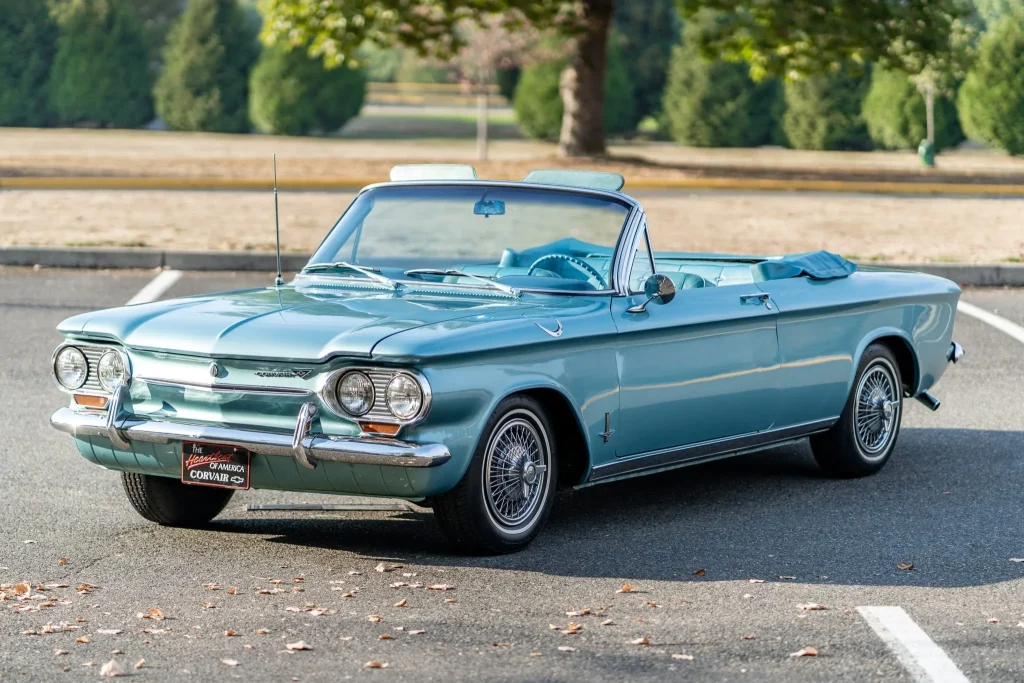
Automotive journalists initially praised the Corvair’s sophisticated engineering. Road & Track described it as one of the most technically advanced American cars of its era, while Motor Trend honored it as Car of the Year for bringing innovative design to the compact-car market.
As the model evolved, Chevrolet expanded the lineup with station wagons, vans, pickup trucks, convertibles, coupes, and the sporty Monza.
In 1962, the company introduced a turbocharged version producing 150 horsepower, making the Corvair Monza Spyder the first mass-produced American passenger car with a factory-installed turbocharger. These achievements demonstrated just how ambitious the Corvair program had become.
Why the Corvair Became So Controversial
Despite its technical innovation, the Corvair’s unconventional layout created handling characteristics unfamiliar to many American drivers.
Early 1960s through 1963 models used a swing-axle rear suspension similar to designs found in several European vehicles of the period, including the Volkswagen Beetle and Mercedes-Benz 300SL. Under aggressive cornering or improper tire inflation, the rear suspension could experience significant camber changes that affected stability.
Chevrolet recognized the importance of maintaining correct tire pressures and recommended substantially lower pressure in the front tires than in the rear. Specifically, the owner’s manual instructed drivers to use approximately 15 psi in the front and 26 psi in the rear.
These unusual specifications helped balance the car’s rear weight distribution but were often overlooked during routine service at gas stations and repair shops, where equal tire pressures were commonly applied to all four wheels.
Improper inflation could increase oversteer tendencies, making the vehicle more difficult to control during abrupt maneuvers.
The controversy reached national attention in 1965 when consumer advocate Ralph Nader published Unsafe at Any Speed. The book devoted its opening chapter to the Corvair, arguing that the early suspension design created unnecessary safety risks compared with alternative engineering solutions already available.
The publication generated widespread public concern and congressional hearings examining automobile safety standards throughout the industry.
General Motors responded by defending the Corvair’s design while introducing major engineering revisions. Beginning with the fully redesigned 1965 Corvair, Chevrolet replaced the earlier rear suspension with a significantly improved fully articulated independent system derived in part from the Corvette.
Contemporary road tests from Car and Driver and Road & Track found the updated suspension substantially improved both ride quality and handling. Years later, the debate took another important turn.
According to findings published by the National Highway Traffic Safety Administration (NHTSA) in 1972, comparative testing concluded that the 1960-1963 Corvair did not exhibit a greater potential for loss of control or rollover than several contemporary compact vehicles tested under similar conditions.
While the report did not declare the early Corvair perfect, it challenged the widespread perception that it was uniquely dangerous among cars of its era.
The study remains an important part of the Corvair’s historical legacy because it introduced a more balanced assessment after years of public controversy.
The Corvair’s Lasting Influence on Automotive Engineering
Although production ended after the 1969 model year, the Corvair left a lasting impact far beyond its sales numbers.
Its air-cooled flat-six engine proved remarkably durable when properly maintained. Many enthusiasts continue driving Corvairs today, supported by active owners’ clubs and a healthy aftermarket for replacement parts.
The engine’s simple design, free from coolant systems and associated components, remains appealing to hobbyists who appreciate mechanical simplicity.
The Corvair also demonstrated that American manufacturers were capable of producing genuinely unconventional vehicles. Its unibody construction, independent suspension, rear transaxle, lightweight aluminum engine, and rear-engine layout stood apart from virtually every other domestic passenger car of its time.
Automotive historians increasingly view the Corvair as a car that arrived before many American buyers were ready for such radical engineering. While rear-engine layouts eventually disappeared from mainstream American automobiles, they continued evolving successfully elsewhere.
Porsche refined the concept into one of the world’s most successful sports-car architectures with the 911, while Volkswagen sold millions of rear-engined Beetles worldwide.
Today, collectors often appreciate the Corvair not despite its unusual design but because of it. Early Monza models, turbocharged Spyder variants, and high-performance Corsa versions have become increasingly desirable among enthusiasts who recognize the car’s historical significance.

The Corvair remains one of the boldest engineering risks General Motors ever took. Chevrolet chose to ignore conventional American design philosophy by placing an air-cooled flat-six engine behind the rear axle, creating a compact car unlike anything else produced in Detroit.
While controversy ultimately overshadowed its commercial success, history has been kinder to the Corvair than public opinion was during the 1960s.
Rather than being remembered solely for the debates it inspired, the Corvair deserves recognition as an ambitious engineering achievement that challenged industry norms.
It proved that innovation often requires taking risks, and although not every experiment succeeds commercially, those bold ideas frequently influence automotive engineering for decades to come.
