
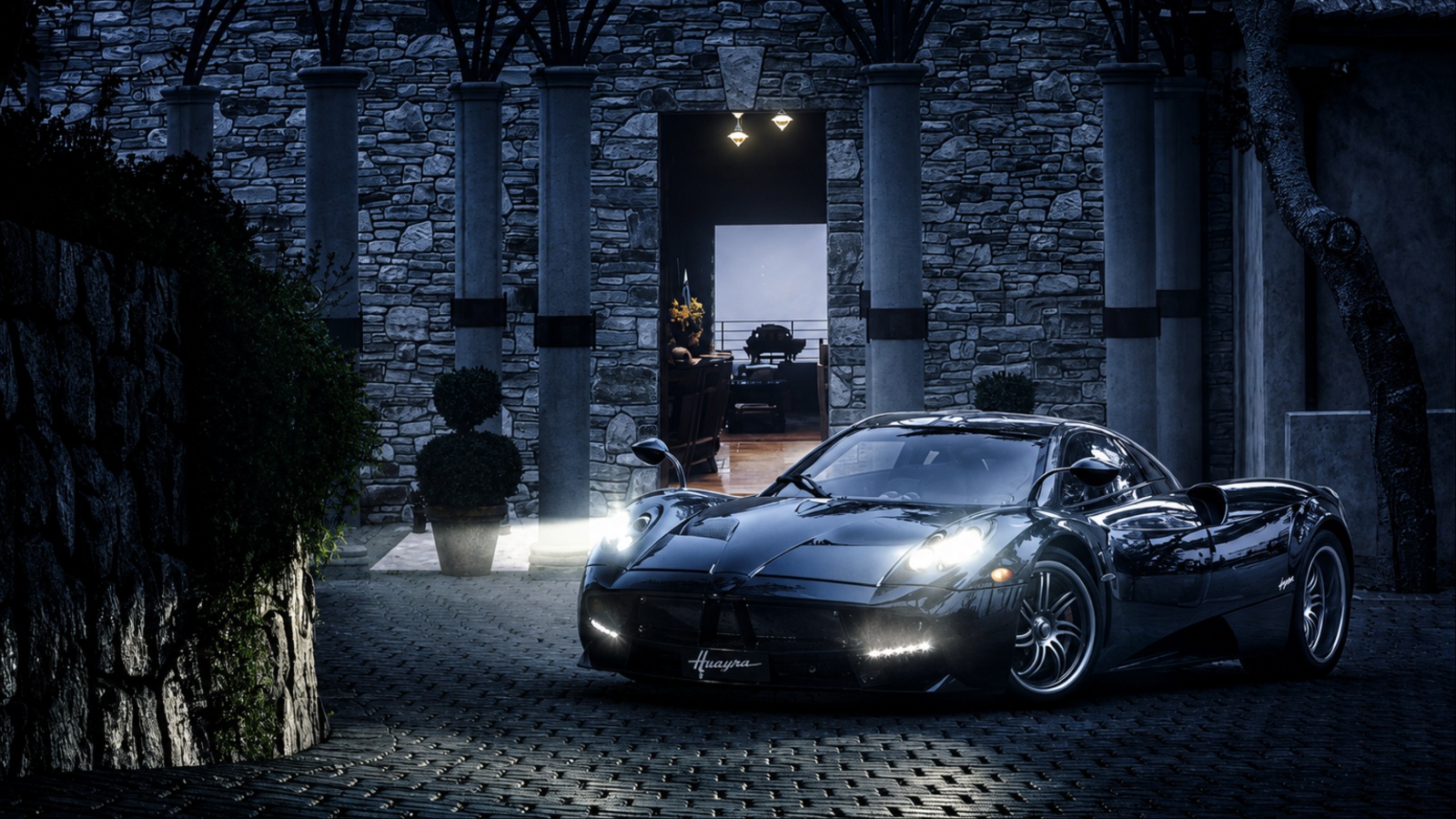
When these ten machines rolled off assembly lines, they weren’t just expensive cars. They were priced beyond what most families paid for their entire home.
In the late 1980s and through the 1990s, a median American house sold for well under $150,000. Even into the early 2000s, that figure barely cracked $180,000.
Yet a handful of automakers were charging two, five, even ten times that number for a single vehicle with two seats and barely any trunk space. Some buyers waited years on deposit lists just for the privilege of paying that much.
This list ranks ten of the most extreme examples, from the Porsche 959’s homologation-driven price tag to the Mercedes-Benz CLK GTR’s seven-figure sticker. Each entry includes its original MSRP alongside a rough inflation-adjusted figure for today’s dollars.
Two cars anchor this conversation more than any others. The McLaren F1 redefined what a road car could cost and how fast it could go, holding the outright production-car speed record for over a decade.
The Lamborghini Diablo, meanwhile, launched at a base price of $240,000 in 1991, becoming a symbol of 1990s excess in its own right. It was the first Lamborghini ever to top 200 mph.
Every top speed figure here has been checked against period road tests and manufacturer data. Every price reflects the base MSRP at launch, not later special editions or auction results.
What follows is a countdown from the least expensive of the ten to the most expensive, adjusted for roughly three decades of inflation in most cases.
10. Lamborghini Diablo
The Lamborghini Diablo entered production in 1990 as the direct successor to the aging Countach. It became the brand’s first car to break the 200 mph barrier on a public road.
Lamborghini introduced the car for sale in January 1991 at a base price of $240,000. Adjusted for inflation, that figure lands north of $580,000 in today’s money.
Power came from a 5.7-liter, 48-valve V12 producing 492 horsepower and 427 lb-ft of torque. That output was routed through a five-speed manual gearbox to the rear wheels only, with no traction aids of any kind.
Lamborghini rated the Diablo’s top speed at 202 mph, a genuine achievement for a naturally aspirated production car of that era. Independent road tests later confirmed figures close to that factory claim.
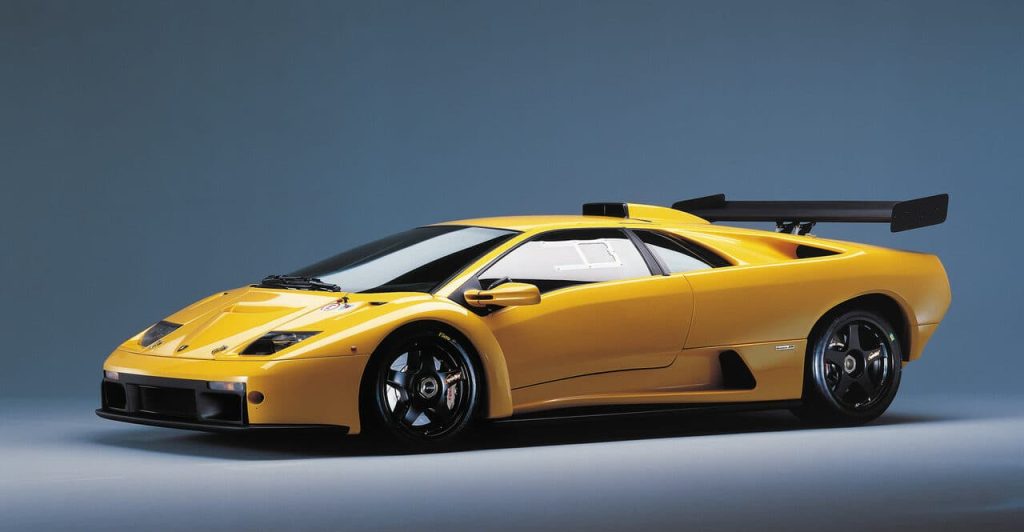
Despite the six-figure price, the interior stayed remarkably spartan. Even past $200,000, the car featured only basic radio functions, manual windows, and no anti-lock brakes at launch, largely to save weight.
Chrysler owned Lamborghini during the Diablo’s development, and its design team softened some of Marcello Gandini’s original, more angular sketches. Later variants like the SV and VT added power and all-wheel drive as the model evolved through the 1990s.
Specifications:
- Engine: 5.7L naturally aspirated V12
- Horsepower: 492 hp
- Torque: 427 lb-ft
- Length: 175.6 in
- Width: 80.3 in
9. Porsche 959
The Porsche 959 began life as a Group B rally homologation project before becoming a road-legal technological showcase. It was the world’s fastest street-legal production car at launch, hitting roughly 197 mph in period testing.
In the United States, the 959 carried a base price around $225,000, though gray-market import costs pushed real-world prices considerably higher for early American buyers. Adjusted for nearly four decades of inflation, that base figure approaches $620,000 in today’s money.
Power came from a 2.85-liter twin-turbocharged flat-six producing 450 PS, or roughly 444 horsepower, with 369 lb-ft of torque. A six-speed manual gearbox and a sophisticated computer-controlled four-wheel-drive system handled that output.
The engineering inside the 959 borrowed heavily from Porsche’s endurance-racing program. Its four-cam, 24-valve cylinder heads traced directly back to the powerplant used in the Porsche 956 and 962 Group C race cars.
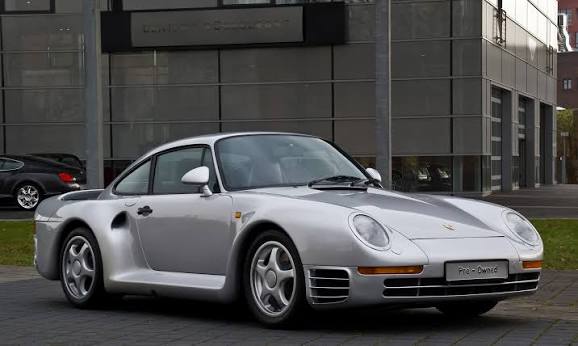
Only 337 examples were built for paying customers, plus a handful of prototypes. Strict US import regulations kept most American buyers waiting years before they could legally register one on public roads.
Bill Gates famously bought a 959 in the late 1980s and stored it for over a decade before regulations finally allowed him to drive it legally. That story alone cemented the car’s reputation as a forbidden fruit for an entire generation of enthusiasts.
Specifications:
- Engine: 2.85L twin-turbocharged flat-6
- Horsepower: 444 hp
- Torque: 369 lb-ft
- Length: 167.7 in
- Width: 72.4 in
8. Pagani Zonda C12 S
Horacio Pagani’s debut supercar arrived at the 1999 Geneva Motor Show with a Mercedes-AMG heart and an Argentine designer’s obsessive attention to detail. The C12 S variant pushed that partnership further than the standard, lower-powered car.
The Zonda C12 S carried a price tag of roughly $350,000 when new. Adjusted for inflation, that translates to approximately $665,000 in today’s dollars.
Mercedes-AMG supplied a 7.0-liter V12 tuned to 550 horsepower and 553 lb-ft of torque, mated to a six-speed manual gearbox. That same engine family shared lineage with units later used in the Mercedes CLK GTR road car.
Pagani claimed a top speed near 220 mph for the C12 S, an aggressive figure for a low-volume Italian boutique manufacturer building cars in a small factory outside Modena. Acceleration numbers backed up that aggressive billing, with 60 mph arriving in well under four seconds.
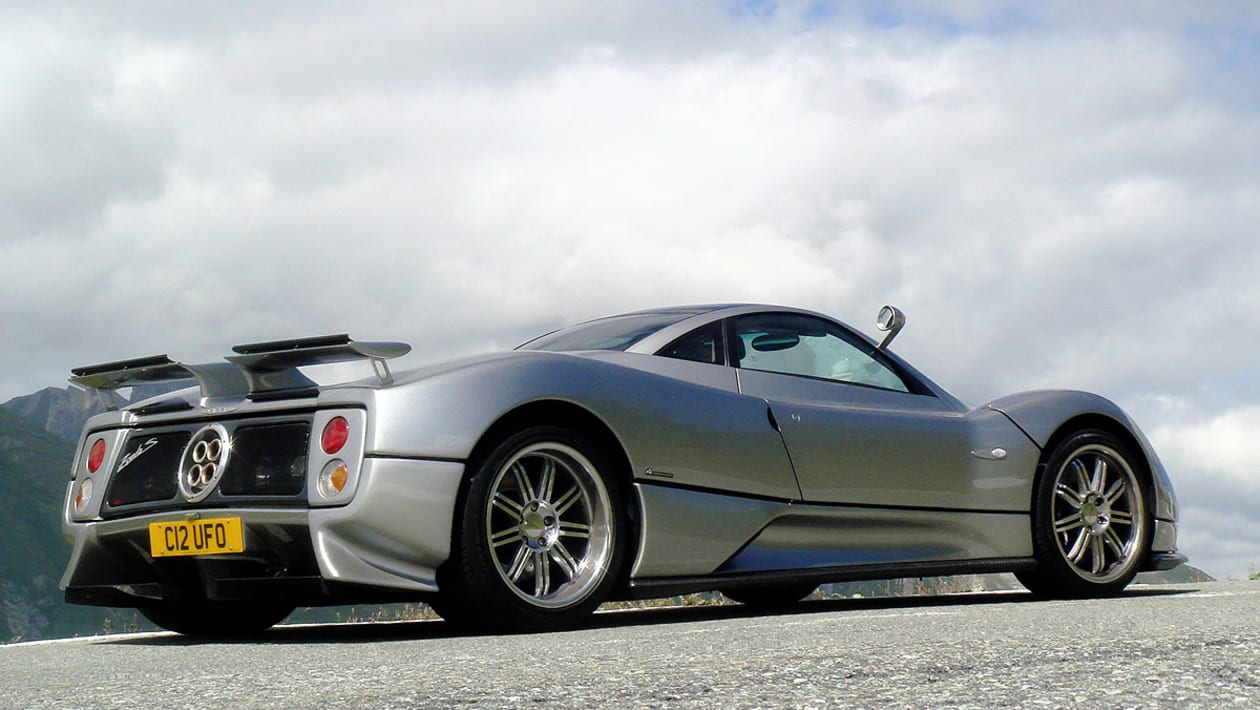
The car reportedly generated significant downforce at speed, a product of extensive wind-tunnel development that Pagani carried out with limited outside resources. Only a small handful of C12 S examples were ever built before the model evolved into later Zonda variants.
Pagani himself had previously worked at Lamborghini on the Countach Evoluzione project before striking out on his own. That background shows clearly in the Zonda’s carbon-fiber construction and exposed mechanical details.
Specifications:
- Engine: 7.0L naturally aspirated V12
- Horsepower: 550 hp
- Torque: 553 lb-ft
- Length: 173.0 in
- Width: 81.0 in
7. Ferrari F50
Ferrari built the F50 to celebrate its 50th anniversary, and the engineering reflected that milestone directly. The V12 engine traced its roots to the 3.5-liter unit used in the 1990 Ferrari 641 Formula One car.
The F50 carried a base price of approximately $487,000 at launch. Adjusted for roughly three decades of inflation, that figure now sits around $1.02 million.
Power came from a 4.7-liter naturally aspirated V12 rated at 513 horsepower and 347 lb-ft of torque. A six-speed manual gearbox sent that power exclusively to the rear wheels, with no electronic driver aids to soften the experience.
Ferrari quoted a top speed of 202 mph for the F50, matching its Sant’Agata rival from Lamborghini almost exactly. Only 349 examples were ever produced across the entire production run.
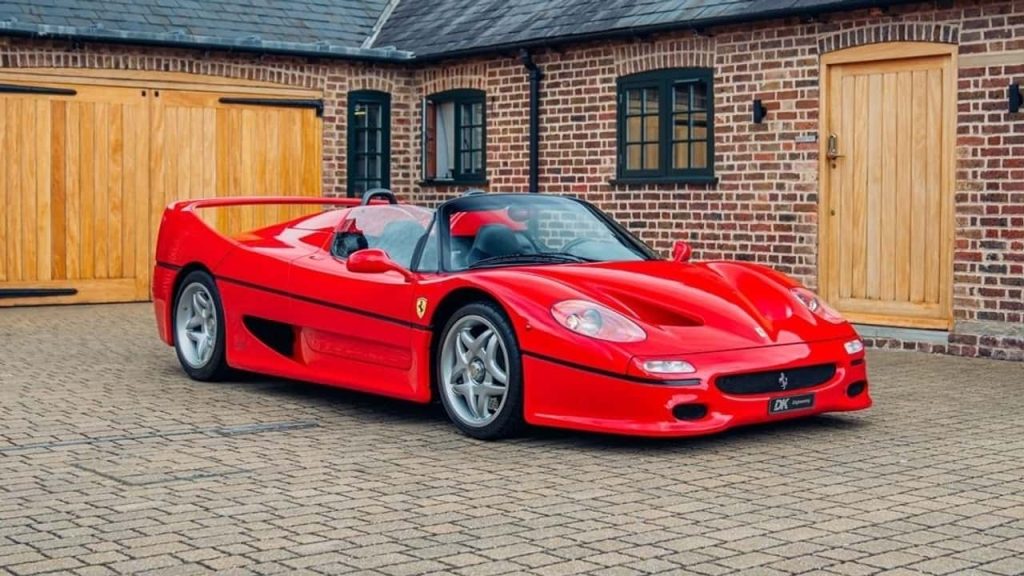
Unlike its successor, the Enzo, the F50 skipped paddle shifters and stability control entirely. That deliberately analog approach is exactly why collectors prize it so highly today, decades after computer-assisted supercars became the norm.
The engine itself was semi-structural, bolted directly to the carbon-fiber tub as a stressed chassis member, a technique borrowed straight from Formula One engineering practice.
Specifications:
- Engine: 4.7L naturally aspirated V12
- Horsepower: 513 hp
- Torque: 347 lb-ft
- Length: 176.4 in
- Width: 78.2 in
6. Bugatti EB110 Super Sport
Romano Artioli revived the Bugatti name in 1991 with a carbon-fiber chassis built by aerospace manufacturer Aerospatiale. The Super Sport variant followed roughly a year later as the lighter, more powerful hardcore version.
The EB110 GT retailed for roughly $350,000 when new, though the Super Sport commanded a higher figure closer to $500,000. Adjusted for inflation, that range now approaches $1 million or more depending on the specific configuration.
The SS motor produced around 611 horsepower at 8,250 rpm, with peak torque rated near 477 lb-ft. Four turbochargers fed a 3.5-liter quad-cam V12 unlike anything else on sale at the time, driving all four wheels through a viscous-coupling system.
Bugatti quoted a top speed approaching 220 mph for the Super Sport, making it briefly one of the fastest production cars. All-wheel drive helped put that power down more effectively than most of its rear-drive rivals.
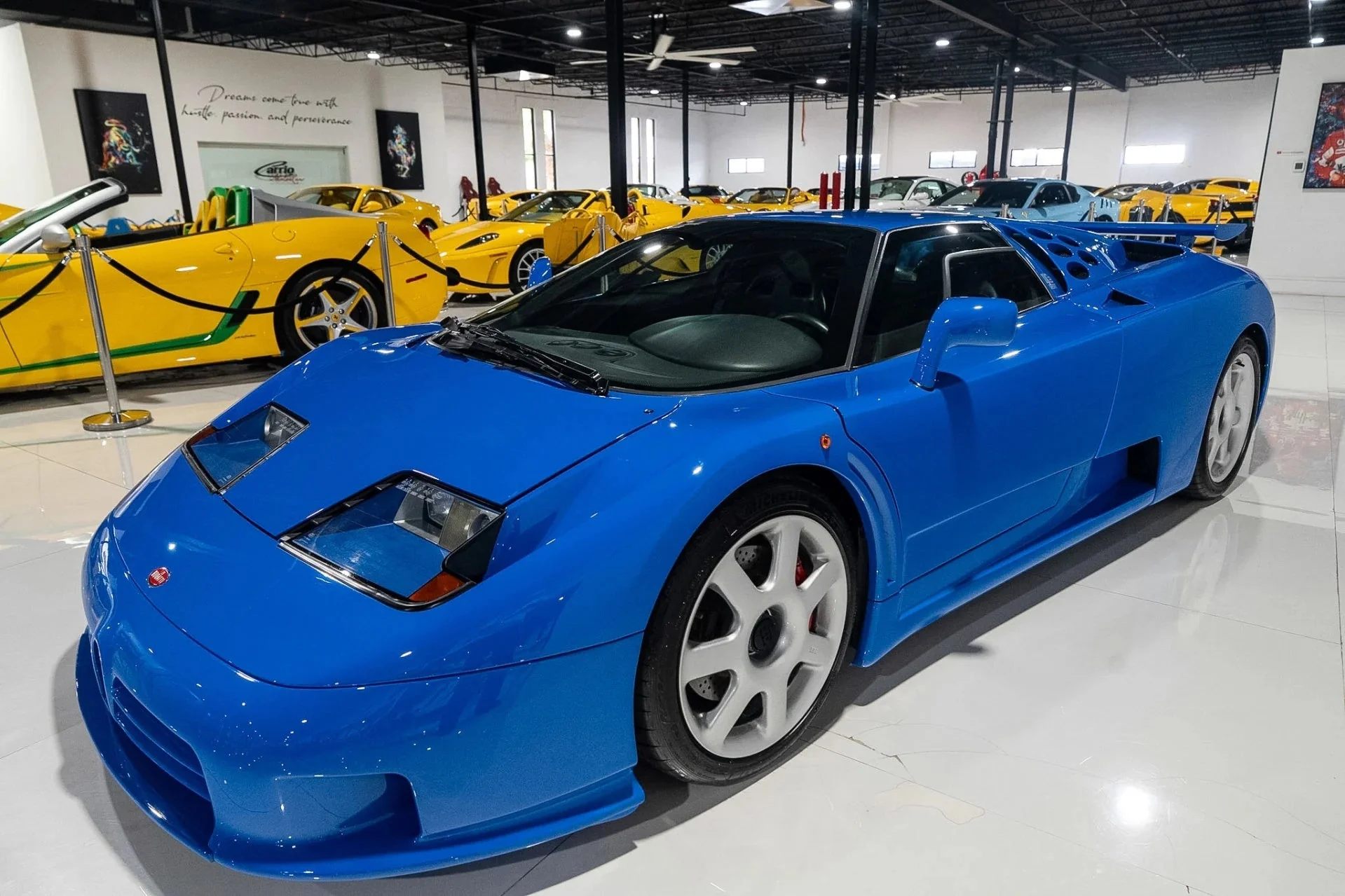
Financial trouble ended Bugatti’s Campogalliano operation in 1995, just four years after the EB110’s grand revealing at Versailles. Fewer than 150 total EB110s were built across both GT and SS specifications combined.
Formula One champion Michael Schumacher owned a yellow EB110 SS, adding to the car’s mystique among period enthusiasts. Dauer Racing later acquired remaining parts from the bankrupt company to build a small run of continuation cars.
Specifications:
- Engine: 3.5L quad-turbocharged V12
- Horsepower: 611 hp
- Torque: 477 lb-ft
- Length: 173.2 in
- Width: 76.4 in
Also Read: 7 Reasons a Factory Immobilizer Does Not Stop a Relay
5. Ferrari Enzo
Named after the company’s founder, the Enzo marked Ferrari’s shift from analog supercars toward computer-assisted performance engineering. It replaced the manual gearbox with paddle shifters for the first time in a Ferrari flagship model.
Ferrari priced the Enzo at approximately $652,000 when new, available only to invited buyers hand-selected by the factory. Adjusted for roughly two decades of inflation, that figure now sits above $1.1 million.
Power came from a 6.0-liter V12 producing 660 PS, or roughly 651 horsepower, paired with a six-speed automated manual gearbox. Torque peaked at 485 lb-ft, delivered through an engine that doubled as a load-bearing chassis component.
The Enzo reached a top speed of 217 mph, a figure that its eventual successor, the LaFerrari, never actually surpassed despite hybrid assistance. Aerodynamic downforce, rather than raw power alone, defined much of its cornering advantage over rivals.
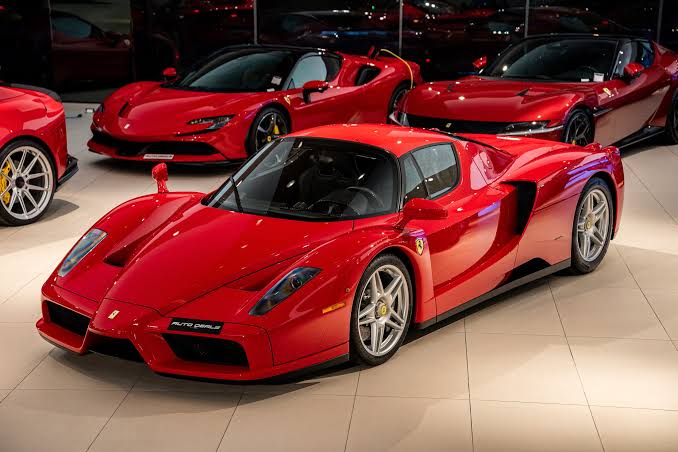
Ferrari built only 400 examples between 2002 and 2004, including a single charity car auctioned separately from the regular allocation. Every other buyer was personally vetted by the company before being offered the chance to purchase one.
Twelve later Enzo-based FXX track cars pushed output even higher, though those were never street legal. The Enzo itself remains the last Ferrari flagship built without any form of electrification.
Specifications:
- Engine: 6.0L naturally aspirated V12
- Horsepower: 651 hp
- Torque: 485 lb-ft
- Length: 185.1 in
- Width: 80.1 in
4. Jaguar XJ220
Jaguar’s supercar started as a V12, all-wheel-drive concept before production realities forced major last-minute changes. The final car swapped in a twin-turbocharged 3.5-liter V6 and dropped to rear-wheel drive only.
Jaguar priced the XJ220 at approximately $706,000 when it finally reached customers in 1992. Adjusted for over three decades of inflation, that number now exceeds $1.6 million.
The V6 produced 542 horsepower at 7,000 rpm and 475 lb-ft of torque at 4,500 rpm. A five-speed manual gearbox handled that output through the rear axle alone, without the traction control most rivals eventually adopted.
The XJ220 became the fastest production car upon release, hitting a top speed of 217 mph on a closed test track. That record stood for barely a year before the Bugatti EB110 SS arrived to claim it.
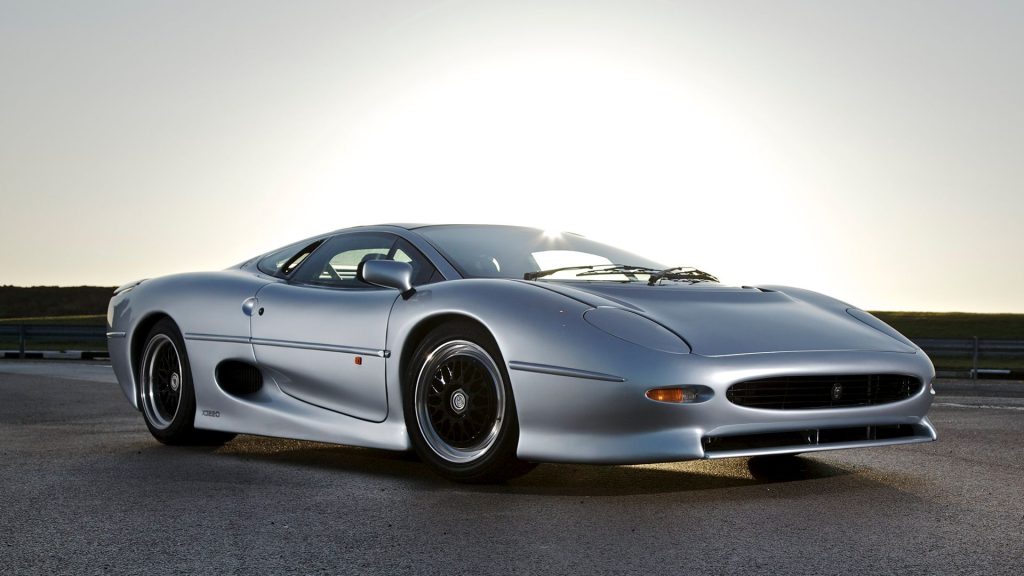
Buyers who had put down substantial deposits during the late-1980s speculative boom faced serious sticker shock when the final production specification changed so drastically. Many walked away from their orders entirely once the engine and drivetrain differences became public.
Development partner Tom Walkinshaw Racing engineered the production version at Jaguar’s Bloxham facility in Oxfordshire. Only 281 examples were ultimately built before Jaguar quietly wound the program down in 1994.
Specifications:
- Engine: 3.5L twin-turbocharged V6
- Horsepower: 542 hp
- Torque: 475 lb-ft
- Length: 194.1 in
- Width: 79.1 in
3. McLaren F1
Designed by Gordon Murray, the McLaren F1 remains one of the most significant road cars ever engineered by any manufacturer. Its carbon-fiber monocoque was the first such application in a production road car worldwide.
McLaren priced the F1 at approximately $890,000 at launch, a figure that stunned even seasoned supercar buyers at the time. Adjusted for roughly three decades of inflation, that number now approaches $1.9 million.
The BMW-sourced 6.1-liter V12 produced 627 horsepower and 479 lb-ft of torque, routed through a six-speed manual gearbox to the rear wheels only. The car weighed just 2,425 pounds at the curb, remarkably light for its power output.
The F1 reached a verified top speed of 240.1 mph, making it the fastest production car in history at the time, a record it held for over a decade. Car and Driver clocked 0 to 60 mph in 3.2 seconds and the quarter mile in roughly 11.1 seconds during period testing.
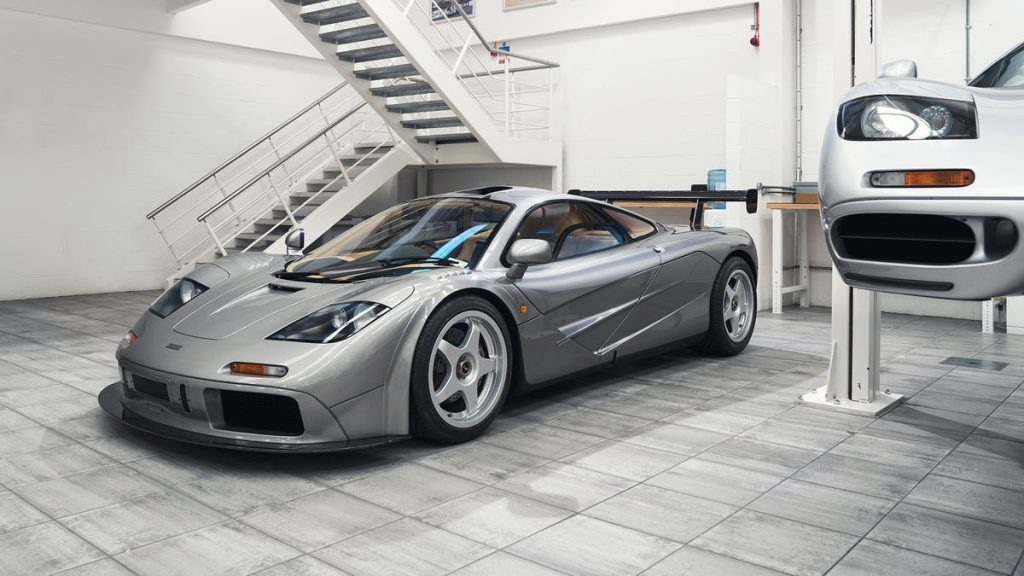
McLaren built just 106 examples across all variants, including road, race, and long-tail GT specifications. Surviving cars now regularly sell for well over $20 million at major auction houses.
The engine bay was famously lined with gold foil for heat dissipation, and the three-seat cockpit placed the driver in a central position, flanked by two passenger seats slightly behind on either side.
Specifications:
- Engine: 6.1L naturally aspirated V12
- Horsepower: 627 hp
- Torque: 479 lb-ft
- Length: 169.0 in
- Width: 72.0 in
2. Bugatti Veyron 16.4
The Veyron represented Volkswagen’s determination to build the ultimate hypercar without any real regard to production cost. The 8.0-liter W16 produced 1,001 horsepower, making it the most powerful production car engine ever built at that point in history.
Bugatti priced the Veyron at approximately $1.7 million, making it the most expensive new production car of its era. Adjusted for roughly two decades of inflation, that figure now approaches $2.8 million.
Peak torque reached 1,250 Nm, or roughly 922 lb-ft, distributed to all four wheels through a seven-speed dual-clutch gearbox developed specifically for the car. Ten separate radiators kept the quad-turbocharged engine from overheating under sustained high-speed running.
The Veyron reached a proven top speed of 253 mph, confirmed on Volkswagen’s private test track in Ehra-Lessien, Germany. That record eventually fell to the later Veyron Super Sport variant, which pushed past 267 mph.
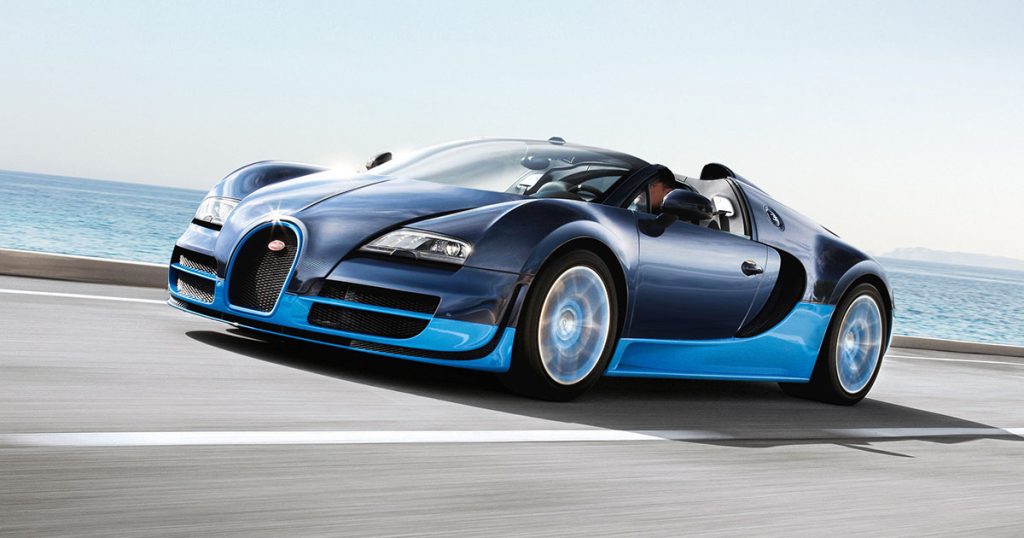
Bugatti built 450 total Veyrons across all variants between 2005 and 2015, including coupe and open-top Grand Sport versions. Company insiders have suggested each car sold at a substantial loss relative to its actual development and production cost.
The project reportedly took Volkswagen roughly five years and an enormous engineering budget to bring from concept to reality. Every major automotive publication of the era treated its arrival as a genuine watershed moment for the industry.
Specifications:
- Engine: 8.0L quad-turbocharged W16
- Horsepower: 1,001 hp
- Torque: 922 lb-ft
- Length: 175.7 in
- Width: 78.7 in
1. Mercedes-Benz CLK GTR
Built to homologate Mercedes-AMG’s FIA GT1 race car for road use, the CLK GTR shared almost nothing with the ordinary CLK coupe beyond its badge. Only the headlights, taillights, and front grille genuinely carried over from the standard production model.
Mercedes priced the road-going Straßenversion at roughly $1.55 million, certified by Guinness World Records as the most expensive production car at the time. Adjusted for inflation, that figure now sits above $3 million in today’s money.
Ilmor stroked the naturally aspirated V12 to 6,898 cc, producing roughly 622 horsepower with 539 lb-ft of torque. A six-speed sequential manual gearbox and a four-plate carbon-fiber clutch sent that power to the rear wheels only.
The road car reached a top speed of 205 mph, with 0 to 60 mph arriving in roughly 3.8 seconds. That performance came from a chassis lifted almost directly off the FIA GT1 championship-winning race car campaigned in 1997 and 1998.
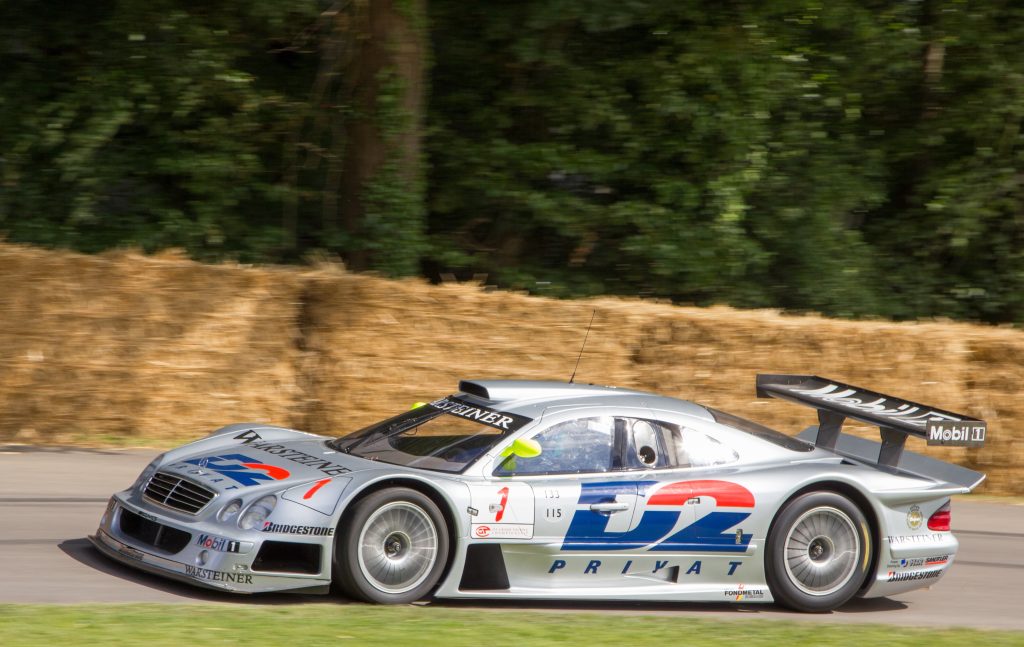
Just 28 street-legal examples were built across coupe and roadster body styles combined. Every unit reportedly sold immediately to collectors who understood exactly what they were buying: a genuine race car fitted with license plates and air conditioning.
The engine, transmission, and much of the carbon-fiber monocoque came directly from the competition program developed in just 128 days. That rushed development timeline makes the finished road car’s polish even more remarkable in hindsight.
Specifications:
- Engine: 6.9L naturally aspirated V12
- Horsepower: 622 hp
- Torque: 539 lb-ft
- Length: 191.1 in
- Width: 76.8 in
Also Read: 8 EVs With Range Held Back by Software
