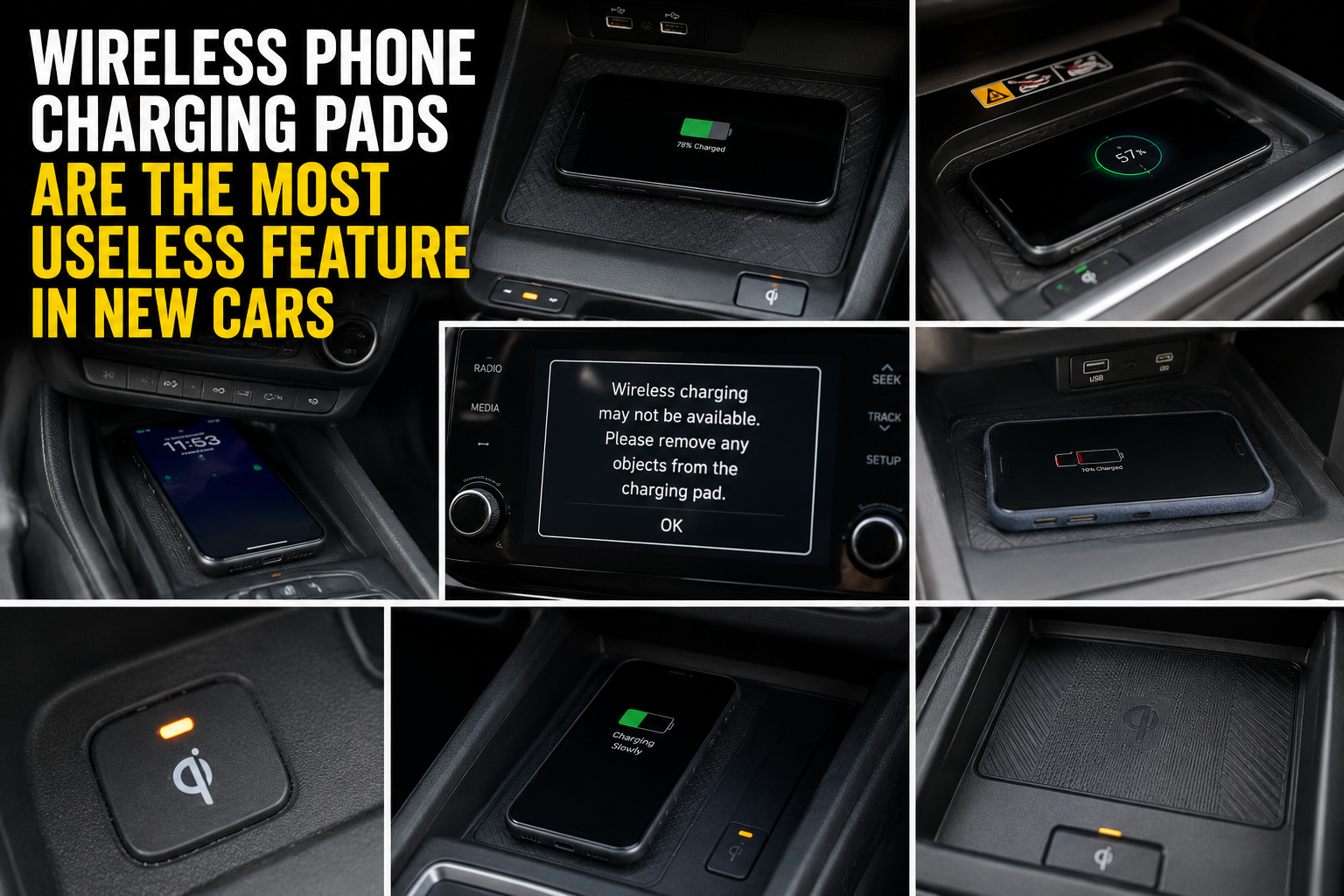
Automakers love adding new technology to vehicles. Every year brings larger touchscreens, more advanced driver-assistance systems, enhanced connectivity, and a growing list of convenience features designed to make daily driving easier.
Wireless phone charging pads are now found in vehicles across nearly every segment, from affordable economy cars to high-end luxury SUVs. Automakers have embraced the feature as a modern convenience, and on the surface, it seems like a perfect solution. Simply place your phone on the pad and let it charge without the need for cables.
Simply place your smartphone on a designated pad, and the battery begins charging without the need for cables. The feature promises a cleaner cabin, fewer wires, and greater convenience for drivers who rely heavily on their phones for navigation, music streaming, and communication.
The reality, however, rarely lives up to the marketing. Despite becoming increasingly common throughout the automotive industry, wireless charging pads remain one of the least useful features available in modern vehicles.
They often charge too slowly, generate excessive heat, struggle to keep phones positioned correctly, and frequently fail to deliver the convenience they are supposed to provide.
For many drivers, a simple charging cable continues to outperform the expensive technology built into their dashboards and center consoles.
That raises an obvious question: if wired charging is still faster, more reliable, and often more practical, why has the industry become so obsessed with wireless charging pads?
Also Read: 10 Analog-Era Super Cars
They Charge Incredibly Slowly
The biggest problem with wireless charging pads is speed. Most drivers expect charging systems to increase battery levels quickly, especially during commutes or road trips where navigation apps, music streaming, and wireless connectivity continuously drain power.
Unfortunately, wireless charging rarely delivers that experience. Even in vehicles equipped with modern charging systems, wireless charging generally remains significantly slower than a direct wired connection.
While cable-based charging can rapidly restore battery life, wireless pads often struggle to keep up with the energy demands of modern smartphones. In some situations, battery percentages barely increase at all.
Drivers may arrive at their destination expecting a fully charged phone, only to discover that the device gained minimal battery life despite spending the entire trip on the charging pad.
The difference becomes especially noticeable during long-distance travel. When speed matters most, wireless charging frequently proves inadequate.
Heat Is a Constant Problem
Wireless charging creates heat. This has been true since the technology first appeared in consumer electronics, and vehicle applications have not solved the issue.
Modern smartphones already generate heat while running navigation software, streaming audio, managing Bluetooth connections, and maintaining cellular communication. Adding wireless charging to the equation often increases temperatures even further.
Many drivers have experienced the result firsthand. A phone placed on a charging pad during a summer road trip can become surprisingly warm after only a short period. In extreme cases, devices may automatically reduce charging speeds or temporarily stop charging altogether to protect internal components.
The irony is difficult to ignore. A feature intended to charge a phone can sometimes become less effective precisely because it generates too much heat.
Meanwhile, a traditional charging cable often delivers faster charging with fewer temperature-related complications.
Phone Placement Is Surprisingly Frustrating
Wireless charging sounds effortless until the vehicle starts moving. Unlike a charging cable that remains connected regardless of road conditions, wireless charging requires the phone to stay positioned correctly on the pad. That requirement becomes surprisingly difficult in real-world driving situations.
Sharp turns, rough pavement, sudden braking, and everyday vehicle movement can cause phones to shift slightly. Sometimes that movement is enough to interrupt charging entirely.
Drivers may believe their phone is charging only to discover later that it lost alignment minutes earlier. The problem becomes even more common when the charging surface lacks sufficient grip or when larger smartphones barely fit within the designated area.
Manufacturers continue designing new solutions, but the underlying issue remains. Wireless charging depends on proper alignment. Driving often interferes with that alignment.
Phone Cases Make Everything Worse
The growing popularity of protective phone cases creates another challenge. Many consumers use cases to protect expensive devices from drops and damage. Unfortunately, those same cases can reduce wireless charging efficiency or interfere with charging altogether.
Thicker cases frequently create additional distance between the charging pad and the phone’s internal charging components. That extra separation can slow charging speeds even further.
Some drivers eventually discover that their phones charge more effectively only after removing the case, a solution that defeats much of the convenience the feature is supposed to provide.
The situation becomes particularly frustrating because not all phones and cases behave the same way. A charging pad that works perfectly for one device may perform poorly with another. Consistency remains a major weakness of the technology.
Most Drivers Still Need a Cable Anyway
Perhaps the strongest argument against wireless charging pads is that many drivers continue using charging cables regardless.
Modern vehicles increasingly support smartphone integration systems such as Apple CarPlay and Android Auto. Although wireless versions exist, many vehicles still rely on wired connections for the most reliable performance.
As a result, drivers often connect a cable anyway. Once a cable is already plugged into the phone, the wireless charging pad becomes redundant.
Even in vehicles offering wireless smartphone connectivity, many users prefer cables because they provide faster charging while maintaining stable data connections. This creates a strange situation.
Manufacturers invest in wireless charging technology, yet many owners continue relying on the same charging cables they used years ago. The expensive charging pad ends up serving little practical purpose.
Valuable Storage Space Gets Sacrificed
Center-console space is one of the most useful areas inside a vehicle. Drivers use these compartments for wallets, keys, sunglasses, snacks, parking passes, and countless other everyday items. Wireless charging pads often occupy prime real estate that could otherwise serve practical storage functions.
The tradeoff does not always make sense. Instead of gaining useful storage, owners receive a charging solution that may perform inconsistently and slowly.
Some vehicles dedicate surprisingly large sections of the center console to wireless charging surfaces. Others incorporate complicated trays and holders designed specifically to keep phones aligned during charging.
In many cases, simple storage would arguably provide greater daily utility. The emphasis on technology sometimes comes at the expense of practicality.
Manufacturers Include Them Because Buyers Expect Them
If wireless charging pads perform so poorly, why are they becoming increasingly common? The answer is largely marketing.
Consumers expect modern vehicles to include certain technology features, regardless of how frequently they are used. Wireless charging has become one of those items.
Automakers compete aggressively in showrooms and comparison tests. Features that look impressive on specification sheets help vehicles appear more technologically advanced.
Wireless charging fits perfectly into that strategy. The feature sounds futuristic and premium. Its actual usefulness often receives far less attention.
Manufacturers understand that buyers may only use the charging pad occasionally, but including it helps ensure the vehicle remains competitive against rivals offering similar technology. In many cases, perception matters more than functionality.
There Are Better Ways to Charge Phones
The simplest solution remains the best one. A quality USB-C cable delivers faster charging, greater reliability, reduced heat generation, and more consistent performance than most wireless charging pads.
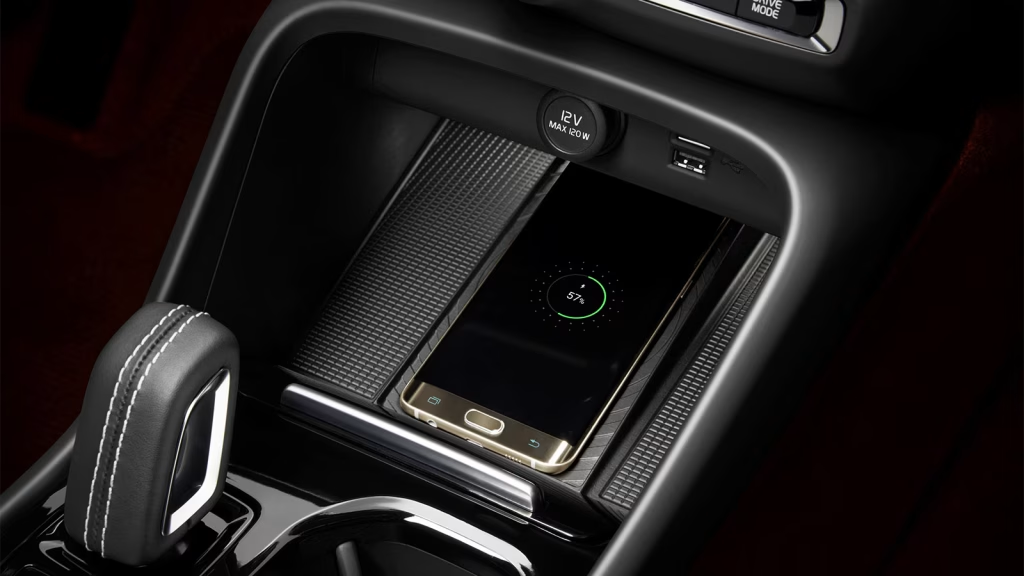
The technology is inexpensive, widely available, and proven. Drivers can charge their phones quickly regardless of road conditions, protective cases, or alignment issues. They also gain the flexibility to place devices wherever convenient rather than being restricted to a designated charging surface.
For all the advances occurring throughout the automotive industry, the humble charging cable continues to outperform one of the most heavily promoted convenience features in modern vehicles. That reality says a lot about the limitations of wireless charging technology.
A Feature That Solves a Problem Few People Had
Wireless charging pads have become common because they sound useful, not necessarily because they are useful.
The technology promises convenience but often delivers slow charging speeds, excessive heat, alignment frustrations, and inconsistent performance. Many drivers continue relying on cables despite having wireless charging available, while others abandon the feature entirely after repeated disappointments.
Meanwhile, valuable cabin space is sacrificed to accommodate technology that frequently underperforms compared with simpler alternatives.
None of this means wireless charging is completely worthless. For short trips and casual use, it can provide a convenient way to maintain battery levels without plugging in a cable.
The problem is that it rarely excels at the task it was designed to perform. In an era where automakers are investing billions in electrification, software-defined vehicles, autonomous technology, and advanced safety systems, it is somewhat remarkable that one of the most widely adopted convenience features remains one of the least effective.
For most drivers, the fastest, easiest, and most reliable charging solution is still sitting in the glove box attached to a cable. That makes wireless charging pads less of a breakthrough and more of a technological gimmick that became standard equipment before it was truly ready to replace the alternative.
Also Read: 10 Commuter Cars Ranked By Cost Per Mile