Buying a new or used vehicle is one of the largest purchases most consumers make outside of housing. Because of that, many buyers naturally worry about unexpected repair bills.
Dealership finance offices understand this concern well, which is why extended warranties, often called vehicle service contracts, have become a major part of the automotive business.
Presented as a form of financial protection, these plans promise peace of mind by covering certain repairs after the manufacturer’s warranty expires.
For many consumers, the offer sounds sensible. Modern vehicles contain sophisticated technology, replacement parts can be expensive, and horror stories about costly repairs are easy to find online.
Spending a few thousand dollars today to avoid a potentially massive repair bill tomorrow can seem like a prudent decision. Yet the numbers tell a different story.
Consumer advocates, financial experts, and automotive analysts have repeatedly pointed out that extended warranties are among the most profitable products sold by dealerships and warranty companies.
That profitability exists for a simple reason: most customers pay more into the system than they ever receive back in benefits. While some owners undoubtedly come out ahead, the average buyer typically does not.
That reality does not mean extended warranties are scams. Many are legitimate products that provide real coverage.
The issue is that they are structured much like any other insurance-related product. The company offering the coverage expects to collect more money than it pays out. If that were not true, the business model would not work.
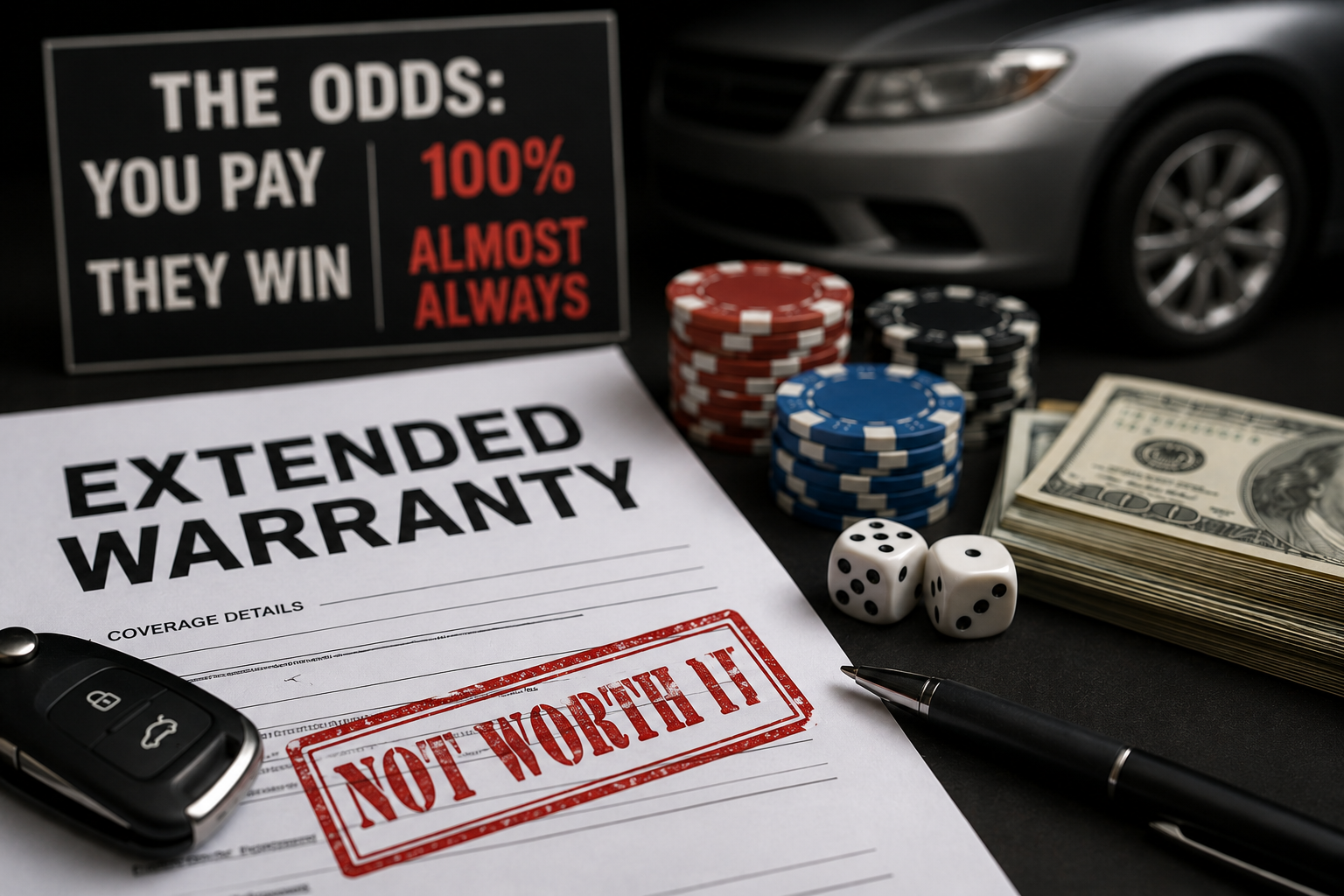
For most vehicle owners, extended warranties are less a form of protection and more a wager against future repair costs. And statistically, it is usually the buyer who loses that bet.
Also Read: BMW Reveals a Concept for M Division’s First EV
The Math Behind Extended Warranties Favors The Seller
The easiest way to understand why extended warranties are often poor financial deals is to examine how they generate profits.
Vehicle service contracts have become a major revenue source for dealerships. According to industry reports from the National Automobile Dealers Association, finance and insurance products contribute significantly to dealership profitability.
Extended warranties are among the most lucrative products sold during the financing process. The reason is straightforward.
Warranty providers use extensive reliability data, repair-cost statistics, and actuarial models to estimate future claims. They know approximately how much they expect to pay for repairs across thousands of vehicles. Pricing is then set high enough to cover those claims while generating substantial profit.
This is the same principle used by insurance companies. If a warranty costs $3,000 and the average customer receives only $1,500 worth of covered repairs, the provider comes out ahead. While individual outcomes vary, the business relies on most customers receiving less in benefits than they paid for coverage.
Consumer Reports has repeatedly advised buyers to carefully evaluate extended warranties because many owners never use them enough to justify the cost. Surveys conducted by the organization found that a large percentage of consumers who purchased coverage spent more on the warranty than they received in repair benefits.
That does mean no one benefits. It simply means the odds generally favor the company selling the contract.
Modern Vehicles Are More Reliable Than Many People Realize
One reason extended warranties remain attractive is that consumers often overestimate the likelihood of major repairs.
Stories about catastrophic engine failures or expensive transmission replacements tend to attract attention. Routine ownership experiences rarely do. This creates a distorted perception of risk.
Reliability data paints a more balanced picture. Research from J.D. Power and Consumer Reports consistently shows that many modern vehicles achieve high levels of dependability.
While no vehicle is perfect, advances in manufacturing quality, corrosion protection, engine management systems, and component durability have improved reliability compared with previous decades.
Many vehicles now reach well beyond 150,000 miles without experiencing major mechanical failures.
This matters because the most expensive repairs tend to be relatively uncommon during the years covered by many extended warranty contracts.
The majority of owners will encounter routine maintenance items, wear-and-tear components, or minor repairs rather than catastrophic failures. Warranty companies understand this.
Their pricing reflects statistical expectations based on large populations of vehicles. They are not gambling blindly. They have access to extensive historical data that helps them predict future costs with remarkable accuracy.
Consumers, on the other hand, often make decisions based on fear rather than probabilities. That imbalance helps explain why warranty providers remain profitable year after year.
Many Repairs Are Not Covered Anyway
A common misconception is that extended warranties cover everything that can go wrong with a vehicle. In reality, coverage limitations are one of the most important aspects of any service contract.
Most plans contain exclusions, deductibles, claim procedures, and restrictions that limit what will actually be paid. Wear items such as brake pads, tires, windshield wipers, batteries, and routine maintenance services are typically excluded. Cosmetic issues often fall outside coverage as well.
Even covered repairs may require specific documentation. Failure to follow maintenance schedules or provide service records can sometimes complicate claims. Certain contracts also limit where repairs can be performed or require preauthorization before work begins.
Consumer advocates frequently recommend reading warranty contracts carefully because the marketing materials often emphasize benefits while minimizing discussion of exclusions.
This does not mean providers are acting improperly. The terms are generally disclosed within the contract. The problem is that many consumers assume coverage is broader than it actually is.
When a major repair occurs, some owners discover that the issue is excluded or only partially covered. As a result, the actual value received from the contract may be lower than anticipated.
These limitations contribute significantly to the financial advantage enjoyed by warranty providers.
Dealerships Have Strong Incentives To Sell Them
Another reason buyers should approach extended warranties cautiously is the sales environment in which they are often presented.
Most warranty purchases occur in dealership finance offices after the customer has already agreed to buy a vehicle. At that point, buyers may be mentally exhausted from negotiating prices, reviewing paperwork, arranging financing, and making numerous decisions.
This environment is highly effective for selling additional products. Finance managers frequently present extended warranties alongside gap insurance, maintenance packages, wheel protection plans, and other add-ons. The cost is often framed as a small increase in the monthly payment rather than a large addition to the total purchase price.
For example, a $2,500 warranty may sound more appealing when described as an extra $35 per month.
Behavioral economists have long noted that consumers are more likely to accept additional costs when they are spread across financing terms rather than presented as lump-sum expenses.
Dealerships understand this dynamic. Extended warranties remain popular not only because buyers want protection but also because the sales process is specifically designed to maximize acceptance rates.
The fact that dealerships earn substantial profits from these products should encourage consumers to evaluate them carefully before making a decision.
Self-Insuring Often Produces Better Results
Many financial experts recommend an alternative approach known as self-insuring. Instead of purchasing an extended warranty, consumers can place the equivalent amount of money into a dedicated savings account. If repairs become necessary, the funds are available. If major repairs never occur, the owner keeps the money.
This strategy offers several advantages. First, the funds remain under the owner’s control. There are no coverage exclusions, claim procedures, or approval requirements. The money can be used for repairs, maintenance, or any other purpose.
Second, many vehicle owners simply do not experience enough covered repairs to justify the cost of a warranty. If no major failures occur, self-insuring leaves the consumer financially ahead.
AAA research consistently shows that vehicle ownership costs extend beyond repairs to include depreciation, fuel, insurance, and maintenance. Building a repair fund can help address these expenses without paying premiums to a warranty provider.
Of course, self-insuring requires discipline. The money must actually be saved rather than spent elsewhere.
For consumers capable of maintaining emergency savings, however, the approach often proves more financially advantageous over the long term.
There Are Situations Where Coverage Makes Sense
Despite the statistics, extended warranties are not always bad purchases. Certain circumstances may justify the expense.
Consumers purchasing vehicles with questionable reliability histories may benefit from additional protection. Luxury vehicles with expensive repair costs can sometimes produce claims large enough to offset warranty expenses.
Individuals who prefer predictable costs and dislike financial uncertainty may also find value in the peace of mind coverage provides.
There is also a psychological component.
Some buyers simply sleep better knowing they have protection against unexpected repairs. That peace of mind has value even if the contract never pays for itself financially. The key is understanding what is being purchased.
An extended warranty should not be viewed primarily as an investment expected to generate a positive financial return. It is better understood as risk management. Like homeowners’ insurance or travel insurance, its purpose is protection rather than profit.
Problems arise when consumers assume they are likely to come out ahead financially. Statistically, that outcome is uncommon.
Why Most Buyers Lose The Bet
Extended warranties continue to thrive because they appeal to a powerful emotion: fear of expensive repairs.
Manufacturers, dealerships, and warranty providers understand that consumers worry about unexpected costs. By offering protection, they provide reassurance at a moment when buyers are already making significant financial commitments.
Yet the economics remain difficult to ignore. Warranty providers employ teams of analysts who carefully calculate expected repair costs and price contracts accordingly.
The business works because the average customer pays more than the average customer receives. If most buyers came out ahead, the industry would not remain profitable.
For a minority of owners, extended warranties will prove worthwhile. A major repair at the right time can easily justify the cost of coverage. Those stories are real and memorable.
They are also exceptions rather than the rule. Most consumers will never experience enough covered repairs to recover what they spent on the contract.
In that sense, extended warranties resemble a wager against future repair expenses. The provider sets the odds, controls the terms, and relies on statistical advantages built from vast amounts of reliability data.
When viewed through that lens, the conclusion becomes difficult to avoid. Extended warranties are not necessarily bad products, but they are usually better deals for the companies selling them than for the people buying them.
For most vehicle owners, the safest bet is often declining the coverage and keeping the money themselves.