
When discussing the most ambitious manufacturing projects in automotive history, names like the Ford GT, Lexus LFA, and McLaren F1 often dominate the conversation. Yet one of the industry’s most extraordinary production methods belonged to an American luxury car that rarely receives the recognition it deserves.
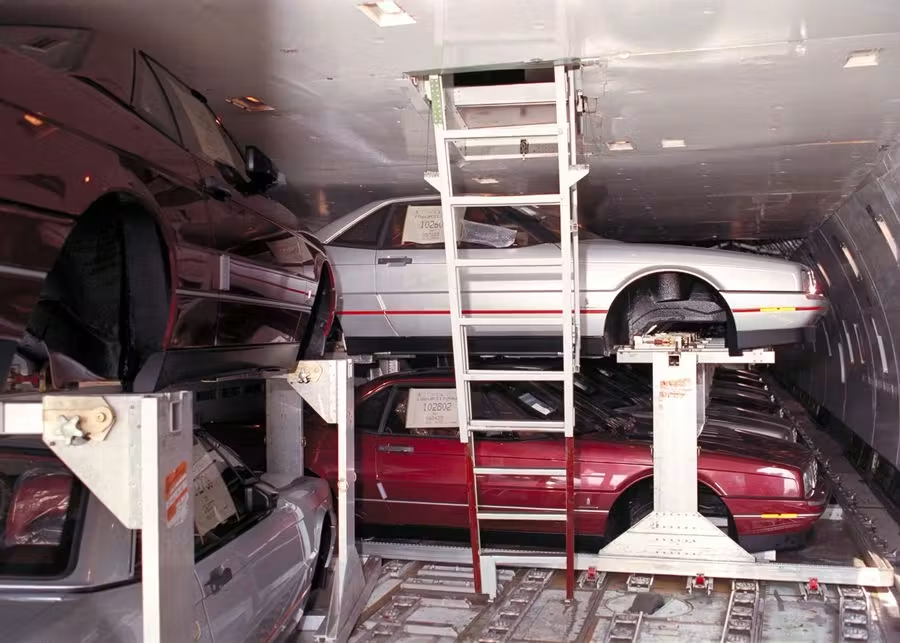
During the late 1980s, Cadillac created a global manufacturing process so unusual that completed car bodies were routinely loaded onto specially configured Boeing 747 cargo jets, flown more than 4,600 miles from Italy to the United States, and finished at a factory in Michigan.
The car was the Cadillac Allanté, General Motors’ flagship luxury roadster introduced for the 1987 model year. Designed to challenge prestigious European convertibles from Mercedes-Benz and Jaguar, the Allanté featured elegant styling by the renowned Italian design house Pininfarina.
Instead of merely borrowing an Italian design, Cadillac took the unprecedented step of having the bodies hand-built in Italy before flying them across the Atlantic for final assembly.
The operation became known inside General Motors as the “Air Bridge.” It was one of the most expensive and logistically complex production systems ever attempted by a major automaker.
Each specially configured Boeing 747-200F carried 56 unfinished Allanté bodies from Turin, Italy, to Detroit, Michigan, where they were completed with American-built drivetrains, interiors, electronics, and suspension components.
No manufacturer before or since has used such an elaborate process for a production passenger car.
Although the Allanté ultimately sold in modest numbers, its manufacturing story remains one of the boldest experiments ever undertaken in the luxury automobile industry.
Also Read: 10 Sedans With Headlights That Yellow Before 60,000 Miles
An Italian Body for an American Luxury Car
During the early 1980s, Cadillac recognized that affluent buyers were increasingly turning toward European luxury convertibles.
Mercedes-Benz, Jaguar, BMW, and Porsche had developed strong reputations for combining sophisticated engineering with timeless styling, while Cadillac’s image had become associated primarily with large American luxury sedans.
General Motors wanted a halo car that could restore Cadillac’s international prestige. Rather than assigning the styling work to one of its domestic design studios, GM partnered with Pininfarina, the legendary Italian coachbuilder responsible for some of the world’s most celebrated automotive designs.
The company had already earned global acclaim through decades of work with Ferrari, Alfa Romeo, Peugeot, Fiat, and numerous other European manufacturers.
Pininfarina did far more than sketch the exterior. It established a dedicated production facility near Turin, Italy, where highly skilled craftsmen assembled each Allanté body using techniques far more labor-intensive than those employed on conventional GM assembly lines.
Large portions of the body were welded, aligned, inspected, and finished by hand to achieve the premium fit and finish Cadillac demanded.
Unlike mass-produced vehicles that moved continuously through automated factories, the Allanté required extensive manual craftsmanship. Every panel underwent careful inspection before the body was prepared for its journey to North America. Once completed, however, the bodies faced an extraordinary challenge.
They still needed engines, transmissions, suspensions, interiors, electrical systems, wheels, and countless additional components that were produced in the United States.
Rather than duplicate production facilities overseas or ship thousands of individual American components to Italy, General Motors developed an entirely different solution.
The “Air Bridge” That Connected Two Continents
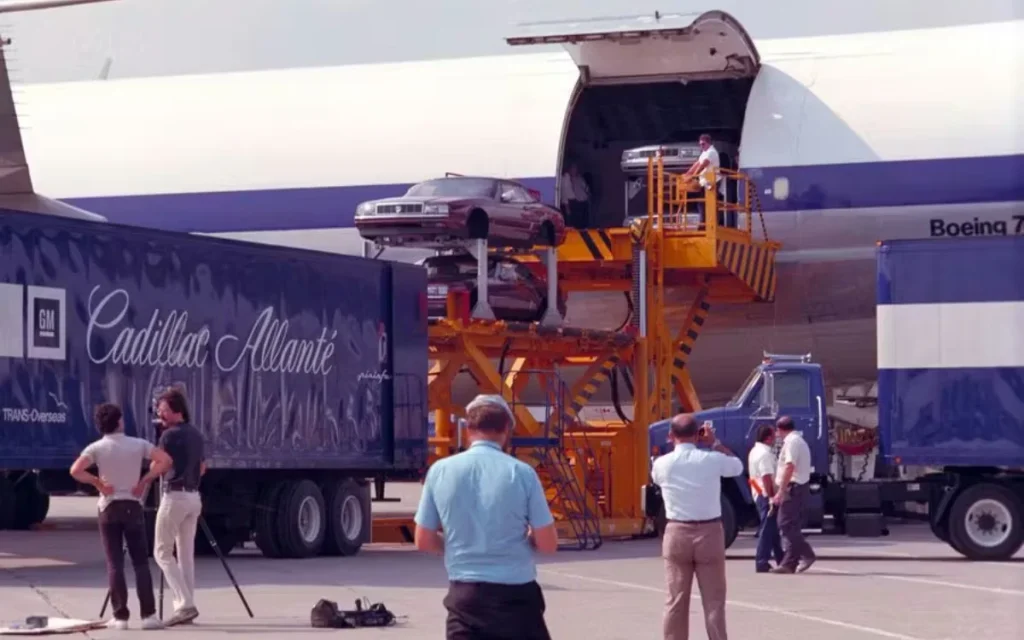
The answer became one of the most fascinating logistics operations in automotive history. General Motors contracted specially configured Boeing 747 cargo aircraft to transport unfinished Allante bodies from Italy directly to Detroit.
The aircraft were modified with custom fixtures that securely held 56 painted body shells during every flight, preventing movement and protecting the delicate finishes throughout the transatlantic journey.
After leaving the Pininfarina facility, the bodies traveled a short distance to the airport, where they were carefully loaded into the aircraft. Each body occupied a dedicated position inside the cargo hold, maximizing space while minimizing the risk of damage.
The flight itself covered roughly 4,600 miles from northern Italy to Michigan. Upon arrival in Detroit, the bodies were unloaded and transported to GM’s Hamtramck Assembly Plant, where workers installed the drivetrain, suspension, electrical systems, interior, glass, convertible top, and final trim.
The completed vehicles then underwent quality inspections before being shipped to Cadillac dealerships across North America.
This transatlantic production chain operated continuously throughout Allanté production, with aircraft making regular trips between Italy and the United States. The process was unlike anything else in the automotive industry and represented one of the largest investments GM had ever made in a specialty vehicle.
The logistics alone were staggering. Every flight required precise scheduling between two continents, careful coordination between Pininfarina and General Motors, and meticulous handling to ensure every body arrived in perfect condition.
Even minor delays caused by weather or air traffic had the potential to disrupt production schedules thousands of miles away.
Yet Cadillac believed the investment was worthwhile because the Allanté represented far more than another luxury convertible. It was intended to demonstrate that an American luxury brand could combine Italian craftsmanship with American engineering in a way no competitor had attempted before.
By the time each body reached Michigan, it had already completed one of the most unusual journeys any production automobile had ever taken before becoming a finished car.
Engineering Worthy of a Flagship
While the Allanté’s manufacturing process attracted most of the attention, Cadillac also invested heavily in the car’s engineering. The goal was to create a luxury roadster capable of competing with premium European convertibles in ride quality, comfort, and technology.
Early models were powered by Cadillac’s 4.1-liter HT-4100 V8, producing around 170 horsepower. Although smooth and refined, the engine received criticism for lacking the performance buyers expected from a premium luxury convertible.
Cadillac responded by introducing larger and more powerful V8 engines during the Allanté’s production run, including the 4.5-liter and later the 4.6-liter Northstar V8.
The biggest leap came for the 1993 model year, when the Allanté became one of the first Cadillacs to receive the new 4.6-liter DOHC Northstar V8.
Producing 295 horsepower and paired with the electronically controlled 4T80-E four-speed automatic transmission, it transformed the car’s performance. The Allanté could accelerate from 0 to 60 mph in about 6.5 seconds, making it one of the quickest Cadillacs of its era.
Beyond the powertrain, the Allanté featured four-wheel independent suspension, four-wheel disc brakes with ABS, speed-sensitive steering, electronically controlled climate systems, premium Bose audio, digital instrumentation on later models, and one of the most sophisticated onboard electronic systems available in an American luxury car during the late 1980s and early 1990s.
Every Allanté also came with a removable aluminum hardtop alongside its power-operated soft top, allowing owners to enjoy the refinement of a coupe during colder months and open-air driving in the summer.
An Engineering Marvel That Was Too Expensive
As impressive as the “Air Bridge” sounded, it created enormous manufacturing costs. Flying partially completed automobiles across the Atlantic was dramatically more expensive than building complete vehicles in a single factory.
Each Boeing 747 flight required specialized cargo handling, dedicated scheduling, fuel, customs processing, and transportation on both continents. The bodies themselves had to be carefully packaged to avoid damage during loading, unloading, and flight.
General Motors reportedly invested hundreds of millions of dollars in establishing and operating the airbridge throughout the Allanté’s production life. While the process demonstrated Cadillac’s commitment to craftsmanship, it also meant every car cost significantly more to build than a conventionally manufactured luxury convertible.
The Allanté entered a highly competitive market dominated by the Mercedes-Benz SL, the Jaguar XJS Convertible, and later the Lexus SC. Although Cadillac priced the car aggressively relative to some European rivals, the high production costs made it difficult for GM to generate strong profits.
In addition, luxury buyers often remained loyal to established European brands, limiting the Allanté’s sales potential despite its Italian styling and premium features.
Between 1987 and 1993, Cadillac produced 21,430 Allantés, making it one of the lowest-volume production models in the brand’s modern history. While respectable for a niche luxury roadster, those numbers were far below the level needed to fully justify the extraordinary manufacturing process.
When production ended after the 1993 model year, so did one of the automotive industry’s most ambitious international logistics operations.
A Collector’s Car With a Remarkable Story
Today, the Cadillac Allanté enjoys growing appreciation among collectors, not only because of its rarity but also because no other production vehicle was built quite the same way.
Enthusiasts particularly seek out 1993 Northstar-powered models, which combined the car’s best engine, improved suspension tuning, and refined electronics with the final evolution of the platform.
These models are widely regarded as the most desirable examples because they finally delivered the level of performance the Allanté had promised from the beginning.
Collectors also appreciate the craftsmanship provided by Pininfarina, whose influence can be seen in the car’s clean proportions, restrained styling, and attention to detail. The fact that each body began life in Italy before crossing the Atlantic aboard a Boeing 747 adds a level of historical significance unmatched by virtually any other American production car.
While values remain far below those of exotic European classics, well-preserved Allantés have steadily gained recognition as enthusiasts rediscover the car’s unique place in Cadillac history. Original documentation, removable factory hardtops, low-mileage examples, and well-maintained Northstar models typically command the strongest prices.
Looking back, the Allanté represented far more than a luxury convertible. It showcased General Motors’ willingness to pursue an unconventional solution in pursuit of world-class craftsmanship and international prestige.
The Air Bridge remains one of the most extraordinary manufacturing experiments ever attempted, proving that Cadillac was willing to move unfinished automobiles halfway around the world simply to achieve the design and quality it envisioned.
More than three decades after production ended, the Allanté’s legacy extends well beyond its sales numbers. It stands as a fascinating chapter in automotive history, combining Italian coachbuilding, American V8 power, and an aviation-based production system that has never been duplicated.
Flying 56 hand-built bodies at a time aboard specially configured Boeing 747 cargo aircraft may have been expensive, but it created one of the most memorable manufacturing stories the automobile industry has ever seen.
