
All Wheel Drive (AWD) has become one of the most discussed features in modern cars, especially among buyers who are trying to balance safety, performance, and cost. When shopping for a new vehicle, many people notice that models equipped with AWD tend to be more expensive than their Front Wheel Drive or Rear Wheel Drive counterparts.
That leads to an important question with no universal answer. Is AWD truly worth the additional cost, or is it simply a feature that appears more appealing in theory than it proves to be in everyday driving?
To understand this properly, it is important to look beyond marketing claims and focus on how AWD actually works, where it helps, and where it does not make a meaningful difference. AWD is designed to improve traction by distributing power to all four wheels when needed, which can be useful in slippery conditions like rain, snow, or loose gravel.
However, most driving in the real world happens on dry paved roads, where the benefits of AWD may be less noticeable. This creates a situation where the value of AWD depends heavily on geography, climate, driving habits, and even budget priorities.
AWD is not just an upfront expense added to the price of the car. It can also influence long-term ownership costs such as fuel efficiency, maintenance, tire wear, and repair complexity.
Because AWD systems involve additional mechanical components like a transfer case, differentials, and extra driveshaft elements, they can add weight and complexity to a vehicle. This often results in slightly lower fuel economy compared to similar non-AWD models.
At the same time, many drivers appreciate the added confidence AWD provides, especially in unpredictable weather or when driving on uneven terrain. For families living in regions with heavy rainfall or occasional snow, AWD can feel like an important safety upgrade. For urban drivers in warm climates, however, the advantage may be minimal compared to the extra cost.
This article explores AWD in detail, breaking down how it works, comparing it with other drivetrain systems, analyzing its real-world benefits and disadvantages, and helping you decide whether it is worth paying extra for in your specific situation.
By the end, you will have a clear, practical understanding of whether AWD is a smart investment or an optional luxury that may not be necessary for your needs.
Also Read: 10 Must-Have Tools Every Car Owner Should Keep In The Trunk

What is an AWD System and How Does It Work?
An All Wheel Drive system is a drivetrain technology that powers all four wheels of a vehicle either continuously or automatically when extra traction is needed.
Unlike simpler systems that send power only to the front or rear wheels, AWD is designed to distribute engine power across both axles. This helps the vehicle maintain better grip in conditions where one or more wheels might lose traction.
In most modern vehicles, AWD works through a central system that monitors wheel speed, throttle input, steering angle, and road conditions. When the system detects wheel slip, it instantly transfers power to the wheels with more grip.
This happens automatically without driver input, which is one of the reasons AWD is often marketed as a convenience and safety feature. Drivers do not need to switch modes or adjust settings in most everyday situations.
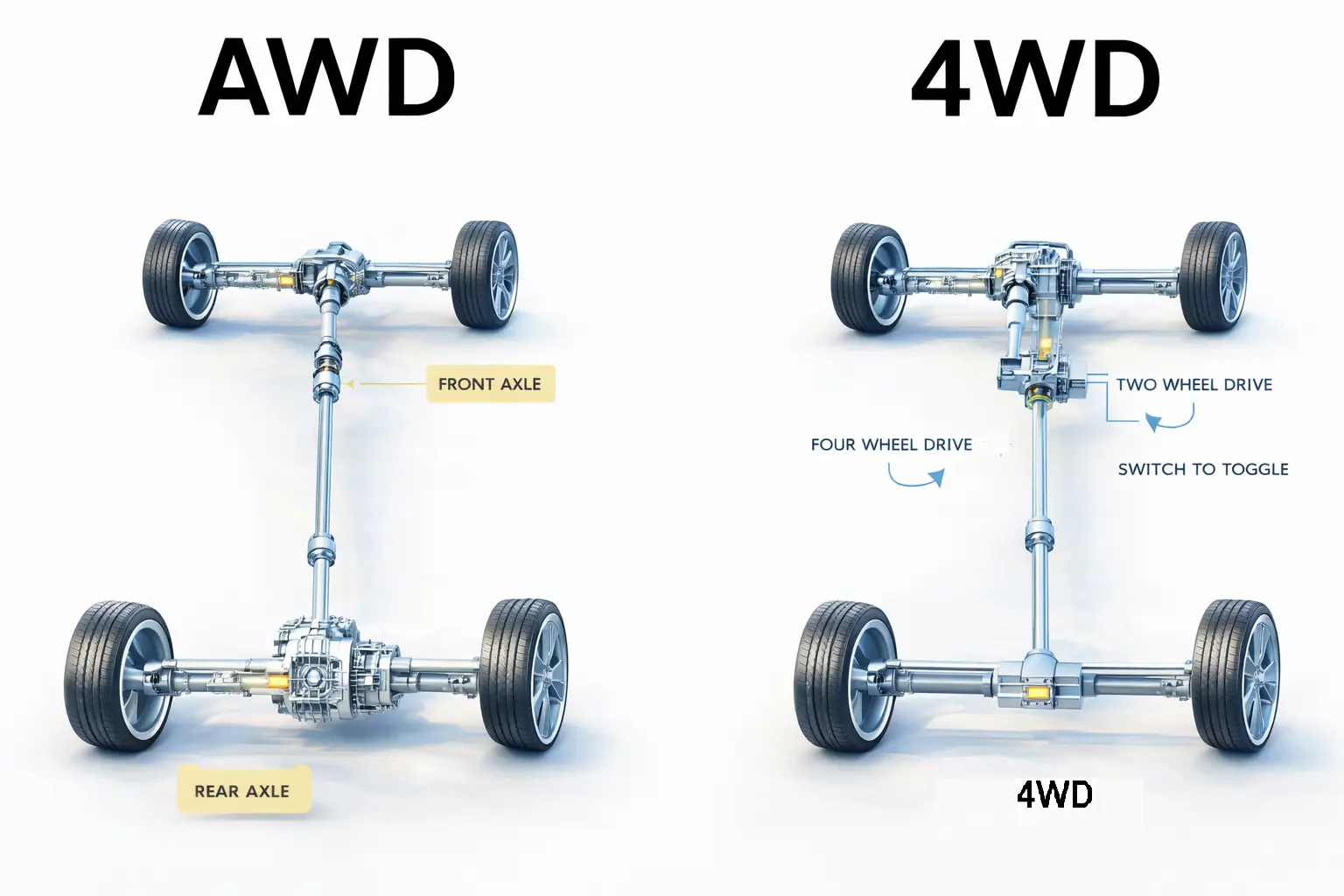
There are different types of AWD systems. Some are full-time AWD systems that constantly send power to all wheels, while others are part-time systems that operate primarily in two-wheel drive mode and activate AWD only when needed. Many modern crossovers and SUVs use on-demand AWD systems that prioritize fuel efficiency but can engage rear or front wheels when traction drops.
The mechanical setup of AWD includes several important components such as a center differential or coupling unit, additional driveshafts, and rear or front differentials, depending on the vehicle layout. These parts work together to ensure torque is distributed efficiently.
However, this added complexity also means there are more components that require maintenance over time compared to simpler drivetrains.
Another important aspect of AWD is that it does not directly improve braking performance. A common misconception is that AWD makes a car safer in all conditions.
While it does improve acceleration and stability on slippery surfaces, stopping distance is mainly determined by tires and braking systems, not drivetrain configuration. This is why AWD should be understood as a traction enhancement system, not a complete safety solution.
AWD vs FWD vs RWD Comparison
Front Wheel Drive vehicles send engine power only to the front wheels. This is the most common configuration in modern passenger cars because it is cost-effective, fuel-efficient, and provides good traction in everyday driving conditions.
Since the engine weight is over the front wheels, FWD cars often perform well in rain and light snow. However, they can struggle with oversteer under hard acceleration or when climbing steep, slippery surfaces.
Rear Wheel Drive vehicles send power to the rear wheels. This setup is often used in sports cars, trucks, and performance-oriented vehicles because it offers better weight balance and improved handling dynamics during acceleration.
RWD vehicles can feel more engaging to drive, especially on dry roads. However, they may be more challenging to control on slippery surfaces because the driven wheels are not loaded by the engine weight.
All Wheel Drive systems combine elements of both FWD and RWD by distributing power to all wheels. This gives AWD an advantage in traction and stability, particularly in low-grip conditions.
While AWD does not automatically make a car faster or safer in all situations, it provides a more balanced approach to power delivery. This makes it especially useful for drivers who encounter changing road conditions frequently.
One important difference between these systems is cost and complexity. FWD is the simplest and cheapest to manufacture, which is why it dominates the economy car segment. RWD is slightly more complex and is usually found in higher-end or performance vehicles. AWD is the most complex and, therefore, usually the most expensive option, both in terms of purchase price and long-term maintenance.
Fuel efficiency is a major distinction. FWD vehicles generally offer the best mileage because they are lighter and have fewer drivetrain losses.
RWD vehicles may consume slightly more fuel, while AWD vehicles often have the lowest efficiency due to additional mechanical drag and weight. This trade-off is one of the key reasons why AWD is not standard in all vehicles, even though it offers clear traction benefits.
Benefits of AWD in Real Driving Conditions
One of the biggest advantages of AWD is improved traction on slippery roads. In situations such as heavy rain, muddy surfaces, or light snow, AWD helps distribute power to the wheels that still have grip. This reduces wheel spin and improves forward stability. For drivers living in regions with unpredictable weather, this can make driving noticeably more confident and controlled.
One benefit is better acceleration from a standstill. AWD vehicles can transfer power to all wheels simultaneously, which allows them to launch more effectively compared to FWD or RWD cars that rely on only two wheels for initial traction. This is especially useful on uphill starts or loose surfaces like gravel roads, where single-axle drive systems may struggle.
AWD also contributes to improved handling stability in certain conditions. While it does not replace proper suspension tuning or tires, it helps maintain balance when cornering on uneven or low-grip surfaces. Some modern AWD systems can even adjust torque distribution dynamically to improve cornering performance, giving the driver a more controlled feel behind the wheel.
For families and long-distance drivers, AWD adds a psychological layer of confidence. Knowing that the vehicle can handle sudden changes in road conditions reduces stress during travel. This is particularly relevant for highway driving in regions where weather can change quickly or where roads may not always be well maintained.
AWD can improve resale value in certain markets. In areas where snow, rain, or rough terrain are common, used car buyers often prefer AWD vehicles. This can make AWD-equipped cars more desirable in the second-hand market, partially offsetting the higher initial purchase cost.
Also Read: 10 Best Dash Cams For Every Budget
Drawbacks and Hidden Costs of AWD
Despite its advantages, AWD comes with several drawbacks that are often overlooked during the buying process. One of the most immediate disadvantages is the higher purchase price. AWD is usually offered as an optional upgrade, and in many vehicles, it can significantly increase the total cost compared to the base version.
Fuel efficiency is another important concern. AWD systems add weight and mechanical resistance, which means the engine has to work harder to move the vehicle. Over time, this leads to higher fuel consumption. For drivers who travel long distances or use their vehicle daily in city traffic, this extra fuel cost can add up considerably.
Maintenance and repair costs are also higher for AWD vehicles. With additional components such as differentials, transfer cases, and extra driveshafts, there are more parts that can wear out or require servicing.
Even routine maintenance like tire replacement can be more expensive because AWD systems often require all four tires to be replaced at the same time to maintain balanced performance.
Another drawback is that AWD does not significantly improve braking performance or accident prevention in all situations. Many drivers assume AWD makes a car safer, but the reality is that braking distance depends mainly on tire quality and road conditions. This misunderstanding can sometimes lead to overconfidence in driving behavior, which is not ideal for safety.
AWD adds mechanical complexity, which can increase long-term ownership risks. More complex systems mean more potential points of failure, especially as the vehicle ages. While modern AWD systems are generally reliable, repairs can be more expensive compared to simpler FWD setups, especially outside warranty coverage.
Is AWD Worth It for Your Situation?
Whether AWD is worth the extra cost depends heavily on where and how you drive. If you live in an area with heavy rainfall, frequent snow, or rough rural roads, AWD can provide meaningful benefits in traction and stability. In such environments, the added confidence and safety margin often justify the higher price and running costs.
On the other hand, if most of your driving takes place in urban areas with well-maintained roads and mild weather conditions, AWD may offer limited practical value. In these cases, Front Wheel Drive vehicles often provide sufficient safety and performance while saving money on fuel and maintenance. For many drivers, this makes FWD a more economical choice.
Driving habits also matter. If you frequently travel long distances, drive on highways, or visit hilly or rural regions, AWD can be beneficial. However, if your driving is mostly short commutes in predictable conditions, the advantages of AWD may not be noticeable enough to justify the extra expense.
Budget is also a key factor. AWD should not be seen as an essential feature for everyone. Instead, it should be evaluated as an optional upgrade that provides added capability at a cost. Buyers who prioritize long-term savings may prefer non-AWD models, while those who prioritize versatility and confidence in varied conditions may find AWD worthwhile.
AWD is worth the extra cost only when its benefits align with your real driving environment. It is not a universal upgrade that improves every aspect of driving. Instead, it is a specialized system designed to solve specific traction problems, and its value becomes clear only when those problems actually exist in your daily driving life.
