
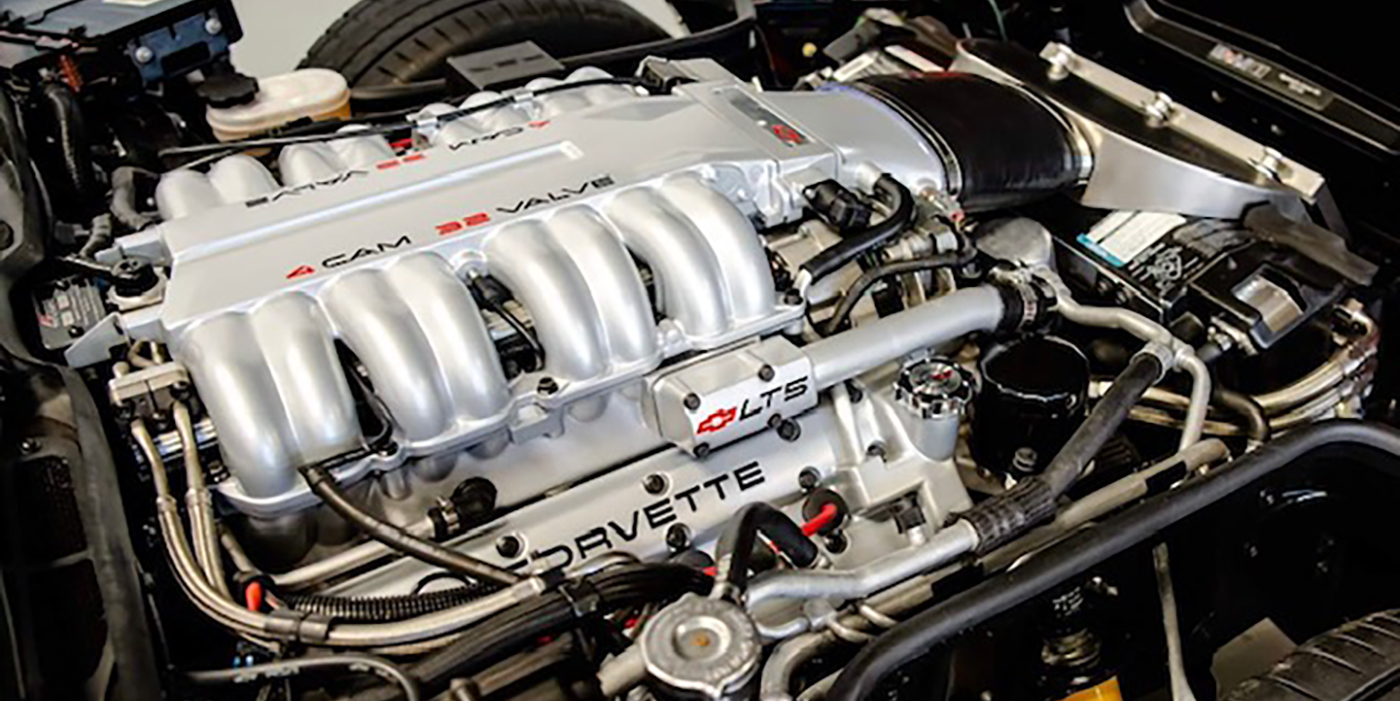
When Chevrolet introduced the Corvette ZR-1 for the 1990 model year, it was more than just a higher-performance version of America’s sports car. It represented the arrival of one of the most advanced engines ever fitted to a production Chevrolet.
At a time when most American performance cars still relied on large pushrod V8s, the ZR-1 arrived with an all-aluminum, 32-valve, dual-overhead-cam V8 that looked more at home in an Italian exotic than a Corvette.
The engine was known as the LT5, and although it carried Chevrolet branding, much of its engineering DNA came from Lotus Engineering, which General Motors owned during the late 1980s.
Lotus was tasked with transforming Chevrolet’s vision into a world-class powerplant capable of competing with Ferrari, Porsche, and Mercedes-Benz. Manufacturing was then entrusted to Mercury Marine in Stillwater, Oklahoma, whose expertise in precision aluminum engines made it uniquely qualified for the project.
Between 1990 and 1995, Chevrolet sold 6,939 Corvette ZR-1s, each powered by the remarkable LT5. According to General Motors’ heritage archives, the engine represented one of the most ambitious engineering programs in Chevrolet’s history and fundamentally changed perceptions of what an American performance car could achieve.
The LT5 represented a major evolution beyond the traditional Corvette small-block philosophy. It demonstrated that Detroit could engineer a sophisticated, high-performance V8 with world-class capability while still maintaining the durability and usability expected of a Corvette.
Also Read: 10 Cars With the Longest Single-Generation Production Runs
Lotus Created an Engine Unlike Any Chevrolet Had Ever Built
During the mid-1980s, General Motors wanted a Corvette capable of challenging Europe’s best sports cars. While the standard C4 Corvette was already an impressive performer, executives recognized that its traditional pushrod V8 architecture limited its ability to compete with increasingly sophisticated European rivals.
General Motors turned to Lotus Engineering, whose Formula One experience and expertise in lightweight engine development made it the ideal partner.
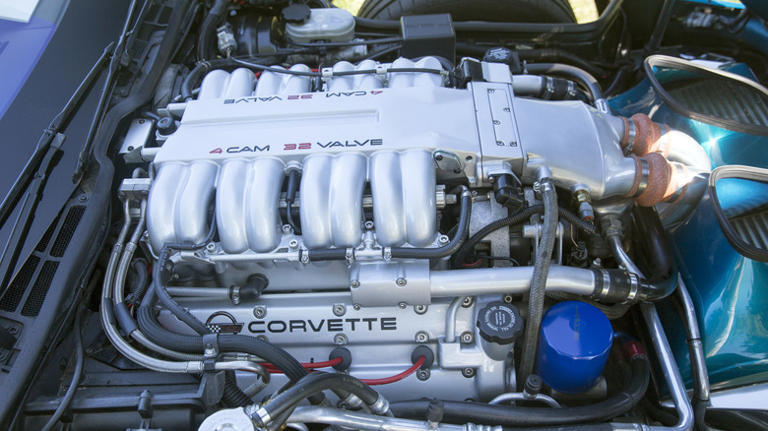
Rather than modifying Chevrolet’s existing small-block architecture, Lotus designed an entirely new cylinder head featuring dual overhead camshafts and four valves per cylinder, creating a total of 32 valves. The engine retained a 5.7-liter (350 cubic-inch) displacement but incorporated an aluminum block, forged steel crankshaft, forged connecting rods, lightweight aluminum pistons, and advanced electronic engine management.
The result was revolutionary.
The original 1990 LT5 produced 375 horsepower at 5,800 rpm and 370 lb-ft of torque at 4,800 rpm, making it the most powerful production Corvette engine ever built at the time.
For 1993, engineers introduced revised cylinder heads, improved intake airflow, upgraded camshaft timing, and enhanced fuel injectors, increasing output to 405 horsepower while maintaining 385 lb-ft of torque.
According to Chevrolet, the revised engine dramatically improved high-rpm breathing without sacrificing everyday usability.
One of the LT5’s most innovative features was its secondary intake runner system. At lower engine speeds, only one intake valve per cylinder remained active to improve throttle response and fuel efficiency.
Around 3,000 rpm, electronically controlled secondary runners opened, allowing the engine to breathe through all sixteen intake valves. Drivers experienced a dramatic surge in power that became one of the LT5’s defining characteristics.
Unlike many high-performance engines requiring constant maintenance, the LT5 demonstrated impressive durability. Lotus engineered the valvetrain for sustained high-speed operation, while Chevrolet insisted on factory reliability standards comparable to any other Corvette.
Owners regularly accumulated well over 100,000 miles without major internal engine repairs when maintenance schedules were followed.
Because Chevrolet lacked suitable manufacturing facilities for such a specialized engine, production moved to Mercury Marine. Better known for building high-performance marine engines, Mercury possessed the precision machining capabilities required for the LT5’s complex aluminum construction.
Every engine was assembled largely by hand before shipment to Chevrolet’s Bowling Green Assembly Plant for installation into the Corvette ZR-1.
The collaboration between Chevrolet, Lotus, and Mercury Marine created one of the most unusual production partnerships in American automotive history.
The Corvette That Challenged Europe’s Best
The LT5 completely transformed the Corvette’s performance credentials. According to Car and Driver, the 1990 Corvette ZR-1 accelerated from 0 to 60 mph in approximately 4.5 seconds, reached a top speed exceeding 175 mph, and completed the quarter mile in the low 13-second range. Those numbers placed it directly alongside exotic sports cars costing substantially more.
Road & Track, Motor Trend, and Automobile Magazine highlighted the LT5 not just for its impressive power output, but for its exceptional sophistication. Breaking away from the traditional American V8 formula of relying mainly on low-end torque, the LT5 delivered a willingness to rev past 7,000 rpm, offering a smooth, progressive surge of power more commonly associated with Ferrari and Porsche engines.
General Motors also demonstrated the engine’s durability publicly. In March 1990, Chevrolet took a nearly stock Corvette ZR-1 to the Firestone Test Center in Fort Stockton, Texas, where it established 11 international endurance and speed records verified by the FIA.
During a 24-hour endurance run, the car averaged 175.885 mph, proving the LT5 could sustain extraordinary performance under continuous high-speed conditions.
The achievement wasn’t merely a publicity stunt. It demonstrated that the engine’s advanced cooling system, lubrication design, forged internals, and sophisticated electronic controls could withstand stresses normally associated with endurance racing.
The ZR-1 also introduced subtle visual differences separating it from standard Corvettes. Wider rear bodywork accommodated massive tires, while a convex rear fascia, squared-off taillights, unique alloy wheels, and discreet ZR-1 badging distinguished it without excessive styling changes.
Chevrolet intentionally avoided dramatic spoilers or aggressive aerodynamic additions because the company wanted the car’s performance to speak for itself.
Why Only 6,939 Buyers Experienced the LT5
Despite its extraordinary engineering, the ZR-1 remained a relatively rare Corvette. Between 1990 and 1995, Chevrolet sold 6,939 examples, making it one of the least common Corvette performance models of its era.
Price played a major role. When introduced, the ZR-1 package added nearly $27,000 to the price of a standard Corvette, pushing the total purchase price above $58,000 in 1990. Adjusted for inflation, that equates to well over $140,000 today, placing the ZR-1 firmly in European sports car territory.
The engine’s elevated cost was largely a reflection of its advanced construction. While typical Corvette V8s were produced through streamlined mass-production methods, the LT5 demanded specialized machining procedures, significant hand assembly, and rigorous inspection at every stage. Mercury Marine’s role in manufacturing the engine further increased the resources required to bring it to production.
As the 1990s progressed, Chevrolet continued refining the Corvette’s standard LT1 pushrod V8. Although less technologically advanced, the LT1 delivered increasingly competitive performance at substantially lower cost, reducing the ZR-1’s sales appeal.
Production concluded after the 1995 model year, ending one of the most fascinating chapters in Corvette history. Today, the LT5-powered ZR-1 enjoys legendary status among collectors.
Its rarity, engineering sophistication, and historical significance have steadily increased demand. Well-preserved examples with documented maintenance histories and original components regularly command strong auction prices, while low-mileage cars remain among the most desirable C4 Corvettes ever produced. More importantly, the LT5 changed Chevrolet’s reputation.
Before its arrival, many enthusiasts viewed American V8s as powerful but technically simple. The Lotus-designed LT5 demonstrated that Chevrolet could build an engine every bit as sophisticated as Europe’s finest while maintaining the reliability expected from a production Corvette.
The project also influenced future Corvette development. Later generations would return to pushrod architecture because of packaging advantages, weight savings, and remarkable efficiency, but the LT5 proved that Chevrolet engineers were fully capable of embracing cutting-edge technology when performance demanded it.
Looking back, the collaboration remains extraordinary. A British engineering company designed the engine, an American marine engine manufacturer assembled it, and Chevrolet installed it into one of America’s most iconic sports cars. The result was an engine unlike anything else General Motors had ever offered.
Only 6,939 buyers experienced that remarkable combination between 1990 and 1995, making the LT5-powered Corvette ZR-1 one of the rarest and most technologically ambitious performance cars in Chevrolet history.
Even decades later, it stands as a reminder of an era when General Motors pursued engineering excellence without compromise, creating a Corvette capable of challenging the world’s best sports cars through innovation rather than sheer displacement alone.
Also Read: 10 Greatest Dodge Muscle Cars Ever Built
